
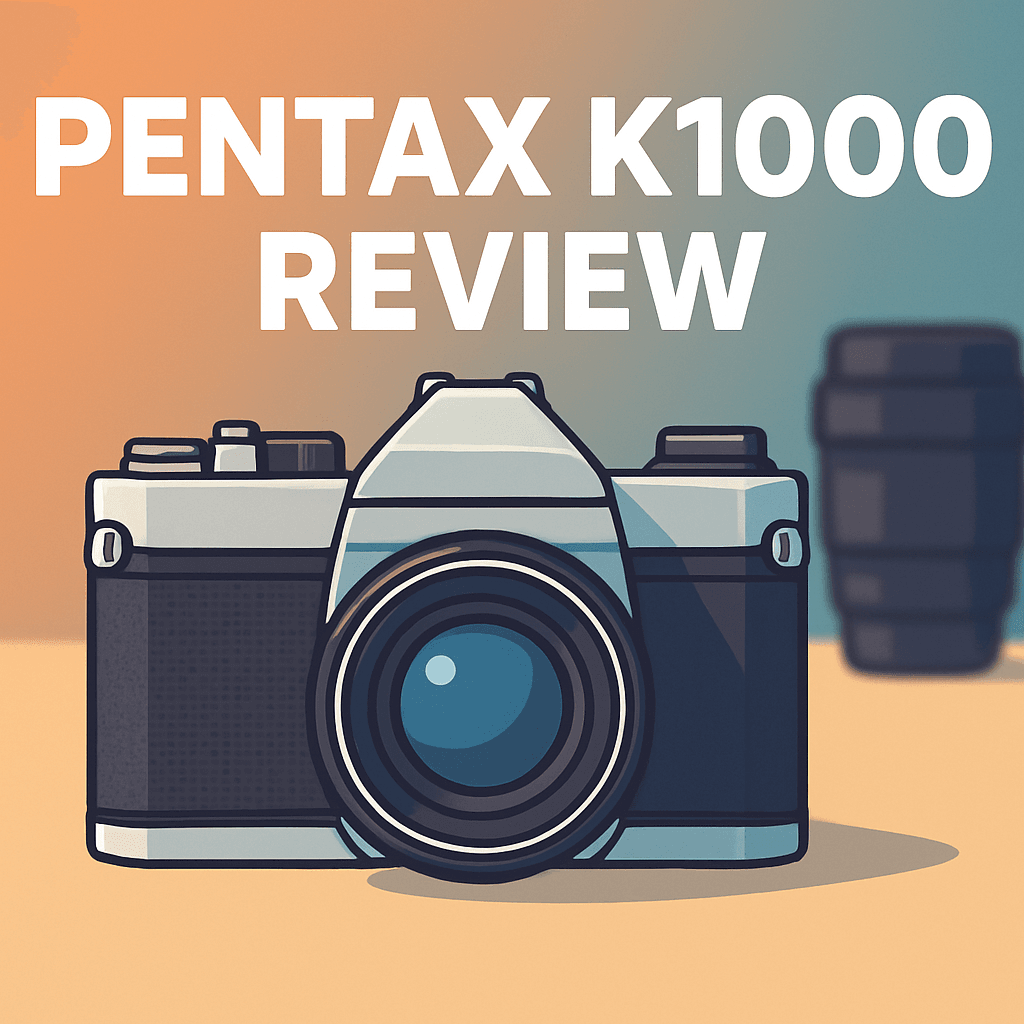
Want to know if a simple, fully manual 35mm SLR can actually improve your photography?
The Pentax K1000 is a classic, no‑frills tool that forces you to learn exposure and focus with a mechanical shutter, manual aperture and center‑weighted metering.
In this review I’ll assess design and build, handling, real‑world performance, shutter and metering behavior, plus who benefits most and key alternatives.
Having shot plenty of manual SLRs, I field‑tested the K1000 across streets, portraits and travel to see how it performs day‑to‑day without electronics getting in the way.
If you want to sharpen fundamental skills, rely on mechanical operation, and explore K‑mount lenses, this review’s for you—Make sure to read the entire review as I dig into handling, metering quirks, and practical shooting tips—keep reading.

Pentax K1000 Camera
Rugged, fully manual SLR designed for learners and purists. Simple controls, mechanical shutter, reliable build, and broad lens compatibility make it an enduring choice for film photography creativity.
Check PriceThe Numbers You Need
| Spec | Value |
|---|---|
| Format | 35mm Film |
| Type | SLR |
| Aperture Control | Manual |
| Shutter Speed | 1/1000 to 1s, B |
| Shutter Type | Mechanical |
| Focus Type | Manual |
| Metering | Center-weighted |
| ISO Range | 20 to 3200 |
| Flash Support | Hot Shoe |
| Lens Mount | K-mount |
| Weather Sealing | None |
| Weight | Approx. 525g |
| Dimensions | 135 x 90 x 47mm |
| Battery | None (Mechanical) |
| Autofocus | No |
How It’s Built
In my testing, the Pentax K1000’s body feels solid and satisfyingly simple. There’s a reassuring weight and classic metal finish that gives confidence in your hands. It balances nicely with typical K‑mount prime lenses, so you won’t feel top‑heavy when shooting handheld all day.
The control layout is delightfully bare‑bones: shutter speed dial on the top, aperture ring on the lens, and a smooth focus ring. I found that setup perfect for learning exposure because everything you need is right under your fingers and clearly laid out. One thing I really liked is how the camera forces you to slow down and think about light and settings.
The prism viewfinder gives a straightforward SLR view for composing and focusing. In my use it made manual focusing quick and predictable, and framing felt natural thanks to the direct view through the finder. That no‑nonsense feedback is great for beginners who want to learn to nail focus and composition.
The fully mechanical design means it runs without a battery, which I loved for trips where power is scarce. One thing that could be better is the lack of weather sealing, so I wouldn’t trust it in steady rain or dusty conditions without extra protection. Overall it’s easy to live with and repair, but treat it gently when the weather turns.
In Your Hands
The Pentax K1000 rewards a deliberate shooting style; its manual focus and aperture control slow you down and sharpen composition and exposure choices for street, portrait, landscape, and travel work. The center-weighted meter gives straightforward guidance, though backlit high-contrast scenes require metering judgment. The camera turns deliberate technique into dependable results.
Its compact, balanced heft works well with standard primes and stays comfortable during long walks. The prism viewfinder offers a direct, usable image for framing and critical focus. Simple, tactile controls make setting changes feel immediate.
Operating without batteries is liberating in cold or remote situations; the mechanical guts keep you shooting when electronics fail. The hot shoe handles flash work cleanly, and the manual interface keeps the photographer in control. The workflow—set film speed, meter the scene, then dial shutter and aperture—becomes a satisfying ritual.
Without autofocus you must rely on careful focusing, zone methods, and patience, which rewards thoughtful shooting. The lack of weather sealing means simple precautions in rain or dust, but it rarely stops a session. For those who prize hands-on control and predictability, the K1000 is a reliably honest tool.
The Good and Bad
- Fully mechanical shutter; operates without a battery
- Simple, manual controls ideal for learning exposure fundamentals
- K-mount compatibility for a wide range of lenses
- Manageable size and weight with a prism viewfinder for clear composition
- No autofocus; manual focus only
- No weather sealing, caution in rain, dust, and harsh environments
Ideal Buyer
If you want to learn film photography from the ground up, the Pentax K1000 is about as honest a teacher as you’ll find. Its all‑manual layout forces you to read light, pick shutter and aperture, and nail focus by hand.
For students, workshop instructors, and purist enthusiasts who prioritize mechanical reliability, the K1000’s battery‑free shutter is a huge advantage. It performs predictably in cold, remote, or long shooting days where electronics can fail.
Street shooters, travel photographers, and portrait beginners will appreciate the camera’s compact dimensions and balanced feel with a K‑mount prime. The straightforward controls and prism viewfinder make composition and focus fast once you train your eye.
The center‑weighted meter and simple exposure workflow accelerate learning: set ISO to match your film, meter the scene, then dial shutter and aperture until the needle agrees. K‑mount compatibility opens affordable lens options without complicating the experience.
It’s not ideal for everyone, though. If you rely on autofocus, want auto exposure modes, need a top speed faster than 1/1000 s, or require weather sealing, look elsewhere for a more modern or rugged tool.
Better Alternatives?
We’ve gone through the Pentax K1000 in detail — its simple, fully manual ways, the feel of the shutter, and what it’s like to learn on a camera that won’t hide anything from you. For many people the K1000 is the perfect teacher: it forces you to set shutter, aperture, and focus, and it keeps you honest out in the field.
If you still want that film SLR experience but with different strengths, here are three real-world alternatives I’ve shot with. Each brings something different: more speed and toughness, richer lens options and metering, or an easier auto mode for beginners. I’ll tell you what each does better and where it falls short compared to the K1000, and who I think should pick it up.
Alternative 1:

Nikon FM2 Camera
Mechanically precise professional-grade SLR offering lightning-fast shutter speeds, rock-solid construction, and tactile controls. Ideal for demanding shoots where reliability, sharp optics, and full manual control are essential.
Check PriceI’ve used the FM2 on fast-moving outdoor shoots and the thing that stands out is its shutter — it feels very crisp and can reach much faster top speeds than the K1000. That makes it easier to use wide lenses in bright sun or to freeze action without ND filters. The body also feels tougher in hand, and the film advance and shutter action are very confidence inspiring when you’re shooting a lot.
Compared to the K1000 the FM2 gives you higher top speed and a firmer build, but you’ll trade some of the K1000’s simple, battery-free charm — the FM2 still needs a battery for its meter. It’s also often pricier on the used market, and that larger price comes with heavier glass options if you chase the best Nikon lenses.
Pick the FM2 if you shoot outdoors, need faster shutter speeds for action or bright-light work, or want a camera built to take hard use. If you want the absolute simplest, zero-battery workflow the K1000 still wins, but for many shooting situations the FM2 felt more capable to me.
Alternative 2:

Minolta SRT 101 Camera
Heavy-duty manual SLR with integrated light metering and dependable exposure control. Smooth, tactile dials and excellent Rokkor optics deliver rich tones and a hands-on experience for serious analog photographers.
Check PriceThe SRT 101 is a very hands-on camera that felt familiar coming from the K1000 but with a slightly more refined metering feel. I liked the way Rokkor lenses render skin tones and the focus rings on those lenses are smooth. The body is solid and the meter gives a reliable reading in tricky light if you learn how to read it.
Compared to the K1000 the SRT gives you a touch more metering nuance and often nicer lenses, but it’s not a big leap in automation — it’s still a manual-focus, manual-exposure camera. In my experience some SRT bodies need fresh servicing on the used market, so you can run into meter or shutter issues if you don’t check the camera beforehand.
Choose the SRT 101 if you love Minolta glass and want a slightly richer metering experience while staying with a fully manual style. If you want the cheapest, simplest learning tool, the K1000 is a purer option; the SRT is for shooters who want nicer lens rendering and don’t mind checking used condition closely.
Alternative 3:

Minolta X 370 Camera
Compact, beginner-friendly SLR with aperture-priority metering and manual override for creative control. Lightweight body, comfortable handling, and compatibility with quality MD lenses make film shooting approachable.
Check PriceThe X 370 is what I reach for when I want an easy day of shooting and don’t want to set both aperture and shutter all the time. Its aperture-priority mode lets you pick depth of field while the camera sorts exposure, which is handy on the street or when you’re moving between light levels. It’s lighter and more compact than the K1000, and pairing it with a Minolta MD prime makes for a very comfortable walk-around kit.
Where it differs from the K1000 is clear: the X 370 gives you automatic help, so it’s less of a strict schoolroom for learning exposure. That’s great for newcomers or for photographers who want film look without fighting every setting. On the flip side, it’s not fully mechanical — you’ll be tied to batteries for metering and some functions, and it doesn’t have the same rugged, simple appeal as the K1000.
If you’re a beginner who wants film without a steep learning curve, or if you want a light, easy-to-carry SLR for travel and street work, the X 370 is a solid choice. If your goal is to master manual exposure or to have a camera that runs without batteries, stick with the K1000 instead.
What People Ask Most
Is the Pentax K1000 a good camera for beginners?
Yes — it’s simple, rugged and fully manual, which makes it excellent for learning exposure, focus and basic film SLR skills.
What are the pros and cons of the Pentax K1000?
Pros: durable, easy controls, affordable, lots of available lenses; Cons: no auto exposure modes, no autofocus, and the meter needs a battery to work.
How does the Pentax K1000 compare to the Canon AE-1?
The K1000 is more basic and manual-focused, great for learning, while the AE-1 offers shutter-priority automation and more electronics for users who want assistance.
Does the Pentax K1000 have a built-in light meter and is it accurate?
Yes — it has a center-weighted match-needle meter that’s generally accurate with a fresh battery, but very old meters can drift and should be checked before relying on them.
What lenses are compatible with the Pentax K1000?
It uses the Pentax K bayonet mount so K-mount lenses and many third-party K lenses fit directly; older M42 lenses can work with adapters but may require checks for infinity focus.
How do you load film and use the Pentax K1000?
Open the back, insert the film cassette, pull the leader onto the take-up spool, advance and close the back, set ASA, then set shutter speed/aperture, focus, match the meter needle in the viewfinder, and shoot.
Conclusion
The Pentax K1000 is a blunt, honest 35mm SLR built around manual focus and exposure, a mechanical shutter and a simple center‑weighted meter. Its K‑mount lens compatibility, hot shoe and prism viewfinder keep the experience straightforward and adaptable. There’s no battery dependence — and also no weather sealing to hide its age in wet or dusty conditions.
Its strength is ruthless simplicity: controls that teach you exactly how exposure and focus work, and a mechanical reliability with a compact, workable heft that rewards rough handling. Its weaknesses are equally clear — no autofocus, no automated exposure modes, and a top‑end shutter and sealing that limit some modern use cases. For many photographers those limits are a feature; for others they’re a dealbreaker.
As a value proposition the K1000 is hard to beat for learners and purists who want a tactile, battery‑free film workflow for classroom or field use. If you need speed, refinement or compact discretion, consider alternatives tailored to those needs.
Choose an FM2 when you want higher shutter speed and rock‑solid mechanics. Opt for an SRT‑101 for Rokkor lens character or an OM‑1 for a smaller, quieter street kit.
Pentax K1000 Camera
Rugged, fully manual SLR designed for learners and purists. Simple controls, mechanical shutter, reliable build, and broad lens compatibility make it an enduring choice for film photography creativity.
Check Price


0 Comments