
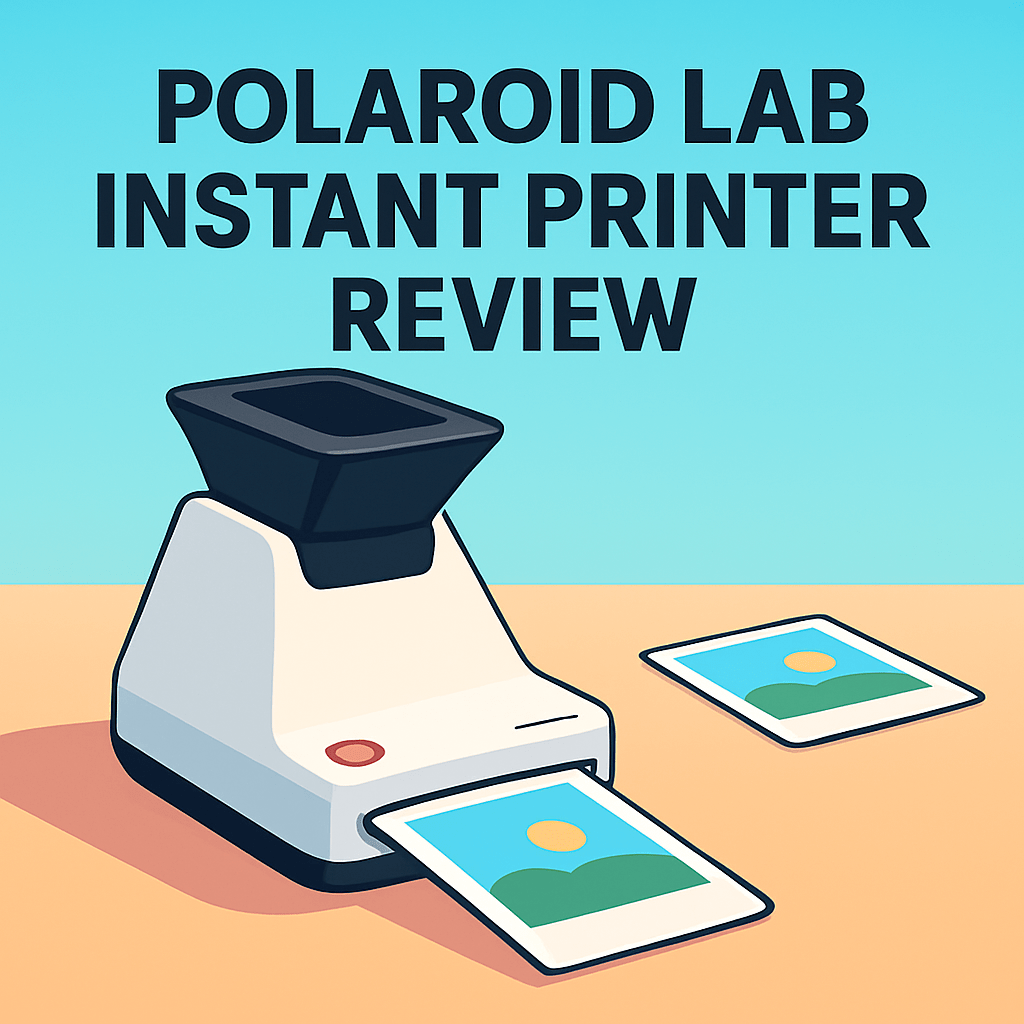
Want to turn your phone photos into real Polaroid prints?
The Polaroid Lab Instant Printer is a Bluetooth-enabled tabletop device that uses your phone screen to expose Polaroid i-Type/600 film — no ink. I took it into the field to see how it behaves in real shoots.
If you’re a smartphone photographer or creative who likes tangible keepsakes, this is aimed at you. Its main strengths are authentic film output and an easy, experimental tabletop workflow.
I’ll walk through design, ease of use, image quality and the app, plus alternatives and who should buy. Make sure to read the entire review as I unpack whether the Polaroid Lab Instant Printer is worth your time — keep reading.

Polaroid Lab Instant Printer
Transform smartphone photos into tangible vintage-style prints with authentic chemical development, adjustable exposure and framing aids. Compact tabletop unit delivers charming, high-quality tactile keepsakes perfect for gifting and home display.
Check PriceThe Numbers You Need
| Spec | Value |
|---|---|
| Printing method | Light exposure on Polaroid i‑Type/600 film |
| Compatible film | Polaroid i‑Type and 600 instant film |
| Image source | Smartphone screen image projection |
| Ink requirement | None (no ink used) |
| Print size | Polaroid square format (approx. 3.1 × 3.1 in) |
| Connectivity | Bluetooth to smartphone app |
| Power source | Rechargeable internal battery |
| Print speed | Approx. 10–15 seconds per print |
| Device type | Tabletop instant photo printer |
| Exposure control | Automatic light exposure from phone screen |
| Image editing | Smartphone app with filters and image adjustments |
| Dimensions | Approx. 130 × 135 × 69 mm |
| Weight | Approximately 430 g |
| Materials | Polycarbonate construction |
| Color options | Typically black variant |
How It’s Built
In my testing the Polaroid Lab Instant Printer feels like a small tabletop gadget that actually wants to be handled. The black polycarbonate shell is light but gives a reassuring, solid click when you touch it. That combination makes it easy to set up on a desk or counter without feeling flimsy.
I found the film loading to be delightfully simple — open the lid, drop the pack in, close it, and you’re ready. The open-close design means beginners won’t fumble with tricky trays or tiny parts. In practice it makes printing feel more like a little ritual than a chore.
The built-in rechargeable battery is a real plus for cord-free tabletop use, so you can move it around the room during a party or across the studio without hunting for an outlet. It stayed stable with my phone sitting on top, though I did notice occasional tiny shifts if I nudged the phone during exposure. That’s the one area I’d like to see improved for foolproof alignment.
The hinge action and tolerances are generally good and give a neat, precise feel when you close the lid. My only real nitpick is the plastic finish — it works fine, but a slightly more premium texture would match the classic Polaroid vibe better. Still, after using it for a while I found it friendly and very approachable for anyone new to instant printing.
In Your Hands
Pairing the Polaroid Lab Instant Printer is refreshingly straightforward: Bluetooth handshake, place your phone face-down on the cradle, and the phone’s screen becomes the light source that exposes the film. The process feels tactile and deliberate—there’s a satisfying click and a short wait before the print ejects, making each image feel like a small ritual rather than an instant, throwaway output. For anyone who enjoys the analog pause, it’s a welcome pace.
Exposure is entirely automatic on the Lab, so you won’t be fiddling with aperture or shutter settings on the device itself. That simplicity is liberating, but it also means the result leans heavily on your phone image and screen brightness; bright, contrasty photos translate into the classic Polaroid punch, while subtle, low-key scenes sometimes demand pre-print edits in the app for the best results. Expect to preview and tweak more than you would with a purely mechanical printer.
In everyday use the Lab proved reliable and repeatable, provided the phone sits squarely on the platform—minor misalignments crop up when the phone shifts or fingers nudge it during setup. Film loading and ejection are intuitive and smooth, and the chemistry development after ejection rewards careful handling rather than immediate finger-peeking. Consistency is good once you learn the little rituals.
The rechargeable, cord-free design makes the Lab an excellent tabletop companion for studio work or relaxed home sessions, where deliberate, collectible prints are the goal. It’s less suited to rapid-fire event printing where speed and uniformity matter most, but for creators who savor the hands-on, experimental nature of true Polaroid chemistry, it consistently delivers satisfying, characterful results.
The Good and Bad
- Produces true Polaroid film prints; no ink required
- Simple, approachable workflow with automatic exposure
- Compact tabletop footprint; easy film loading
- Works with both Polaroid i-Type and 600 film
- Tabletop device—not pocketable like mini mobile printers
- Exposure relies on the phone screen and automatic control; limited manual override on the device
Ideal Buyer
For smartphone shooters who crave the look and feel of true Polaroid chemistry, the Polaroid Lab Instant Printer is made for you. It turns everyday phone images into tactile, framed Polaroids without ink, so you get a keepsake rather than a glossy digital proxy.
Artists, visual storytellers, and analog enthusiasts will appreciate the Lab’s experimental character. The automatic exposure and film chemistry reward creative risk-taking, producing unpredictable but beautiful results that feel handcrafted. This is a tool for playing with tone, texture, and serendipity—not for punch-perfect replication.
Use this at home, in a studio, or at a small gathering where a tabletop setup is practical. It’s less suitable for walk‑and‑shoot portability or high-volume event printing where speed, repeatable color, and uniformity matter most.
Choose the Lab if you value authenticity, tactile prints, and an intentionally lo‑fi process. If you need pocketable convenience, faster reliable output, or different sizes, look to portable thermals or instax alternatives instead.
Avoid the Lab if your priority is speed or predictable color for event photography. The chemical development period and delicate handling make it a poor fit for high‑throughput jobs. For that crowd, a pocketable thermal or instax system will be more reliable and economical.
Better Alternatives?
We’ve gone over the Polaroid Lab Instant Printer and what makes it special: it turns phone pictures into true Polaroid i-Type/600 film prints with that analog look and chemical development process. It’s a fun, creative tabletop tool, but it’s not the fastest or most predictable way to get phone photos onto paper.
If you want something with a different size, faster results, or more pocketable options for events and travel, there are solid alternatives. Below are three I’ve used in the real world, with what each does better and worse than the Lab and who I’d recommend them to.
Alternative 1:

Fujifilm Instax Link Wide Printer
Produce wide-format, landscape-ready prints straight from your phone with vivid colors, Bluetooth pairing and intuitive app controls. Durable film, customizable layouts and high-resolution output make it ideal for events and albums.
Check PriceThe Fujifilm Instax Link Wide gives you a much larger rectangular print than the Polaroid Lab’s square. In practice that means landscapes and group shots look better composed and less cropped. I used it on a road trip and liked how a single landscape filled the frame without losing subject detail the way I sometimes had to on the Lab.
Compared to the Lab, the Link Wide is more predictable and faster — prints come out ready to hold and the colors generally match what you see on your phone. What it loses versus the Lab is the classic Polaroid chemistry and the unique, slower development feel. The Link Wide’s prints are instant and consistent, but they don’t have the same tactile, retro look of Polaroid film.
Buy the Link Wide if you want bigger, dependable prints for events, albums, or travel photos and care more about reliable color and composition than Polaroid’s analog quirks. If you want true Polaroid frames and that slower chemical charm, the Lab is still the better pick.
Alternative 2:

Fujifilm Instax Mini Link 3 Printer
Pocketable printer creates credit-card sized photo mementos instantly, pairing fast wireless connection with playful filters and collage modes. Sleek design and quick prints keep memories alive during travel and gatherings.
Check PriceThe Instax Mini Link 3 shines for being pocketable and fast. I’ve taken it to parties and weekend trips where I wanted quick, fun little prints to hand out. Compared with the Polaroid Lab, the Mini Link 3 gives you tiny glossy photos almost immediately and with very consistent colors from the app.
Where it falls short versus the Lab is obvious: the photos are small and glossy, not the larger, textured Polaroid keepsakes. You trade size and that analog skin-of-time look for speed and convenience. Also, the Mini Link 3 won’t give you the same depth or feel that Polaroid chemistry provides — it’s more about social prints than collectible art.
Choose the Mini Link 3 if you want something light, cheap per-print, and social for handing out at gatherings or slipping into scrapbooks. If you want larger, more vintage-feeling prints to archive or display, stick with the Lab or a wider-format alternative.
Alternative 3:
Fujifilm Instax Mini Link 3 Printer
Designed for social sharing, this compact companion prints vibrant mini photos from mobile devices with precise colors, AR-enhanced effects and customizable borders. Fast, fun features and party games boost creativity.
Check PriceUsing the Mini Link 3 again but focusing on its app tools, it’s great for playful edits — AR effects, borders, and in-app games add a social layer the Lab doesn’t try to match. I’ve used those features to make quick themed prints at events, and guests loved the instant, shareable vibe.
Compared to the Lab, the Mini Link 3 is more of a toy for social moments: it’s reliable and consistent but doesn’t offer the Polaroid chemistry or the archival weight of a true Polaroid print. If you want creative app tricks and speedy output, the Mini Link 3 wins; if you want authentic, textured Polaroids that age and feel special, the Lab still has the edge.
If your priority is party printing, playful customization, and portability, the Mini Link 3 is a solid pick. If you’re after the unique look and process of Polaroid film for keepsakes or fine art, you’ll prefer sticking with the Polaroid Lab.
What People Ask Most
Is the Polaroid Lab worth buying?
If you love tactile, nostalgic instant prints and the analog experience, yes—it’s a fun, well-made device; if you need accurate colors or fast, consistent prints, it may disappoint.
Can you print digital photos with the Polaroid Lab?
Yes—you place your smartphone image face down on the Lab and it optically exposes a Polaroid film to create a physical print.
What type of film does the Polaroid Lab use?
The Lab uses Polaroid instant film formats like i-Type and 600, the standard packs sold by Polaroid Originals/Polaroid.
How good is the picture quality from the Polaroid Lab?
Expect a soft, vintage look with lower sharpness and color shifts—very pleasing for creative prints but not for high-fidelity reproduction.
How long do Polaroid Lab prints last?
Kept out of direct light, heat, and humidity, Polaroid prints can last for decades, though some color fading or shifts are normal over time.
Is the Polaroid Lab compatible with Polaroid Originals/Impossible Project film?
Yes—the Lab is designed to work with Polaroid Originals (formerly Impossible Project) film lines like i-Type and 600, but always check the pack type before buying.
Conclusion
The Polaroid Lab Instant Printer is a simple, Bluetooth-connected tabletop device that turns smartphone images into real Polaroid film prints via light exposure, with no ink. It delivers the tactile, imperfect charm of chemical Polaroids. Setup and printing feel deliberately low-tech and hands-on.
Strengths are obvious: authentic Polaroid chemistry, an approachable app workflow, and a compact footprint that makes desk-side printing pleasurable. The results are more about mood and keepsake value than clinical perfection. For creators who relish analog quirks, prints feel special.
Downsides are real. The Lab is a tabletop-only experience with a fixed square format and automatic exposure control that can yield variable, lo-fi results and a chemical development period that demands careful handling. It’s not the fastest, most predictable tool for event work or high-volume needs.
My verdict is clear: if authentic Polaroid chemistry and a creative, experimental workflow matter more than speed and uniformity, the Lab is a compelling, characterful choice. If you prize pocketability, rapid consistency, or larger formats, consider faster thermal or instant alternatives. This is a love letter to analog play, not a utility printer.
Polaroid Lab Instant Printer
Transform smartphone photos into tangible vintage-style prints with authentic chemical development, adjustable exposure and framing aids. Compact tabletop unit delivers charming, high-quality tactile keepsakes perfect for gifting and home display.
Check Price

0 Comments