
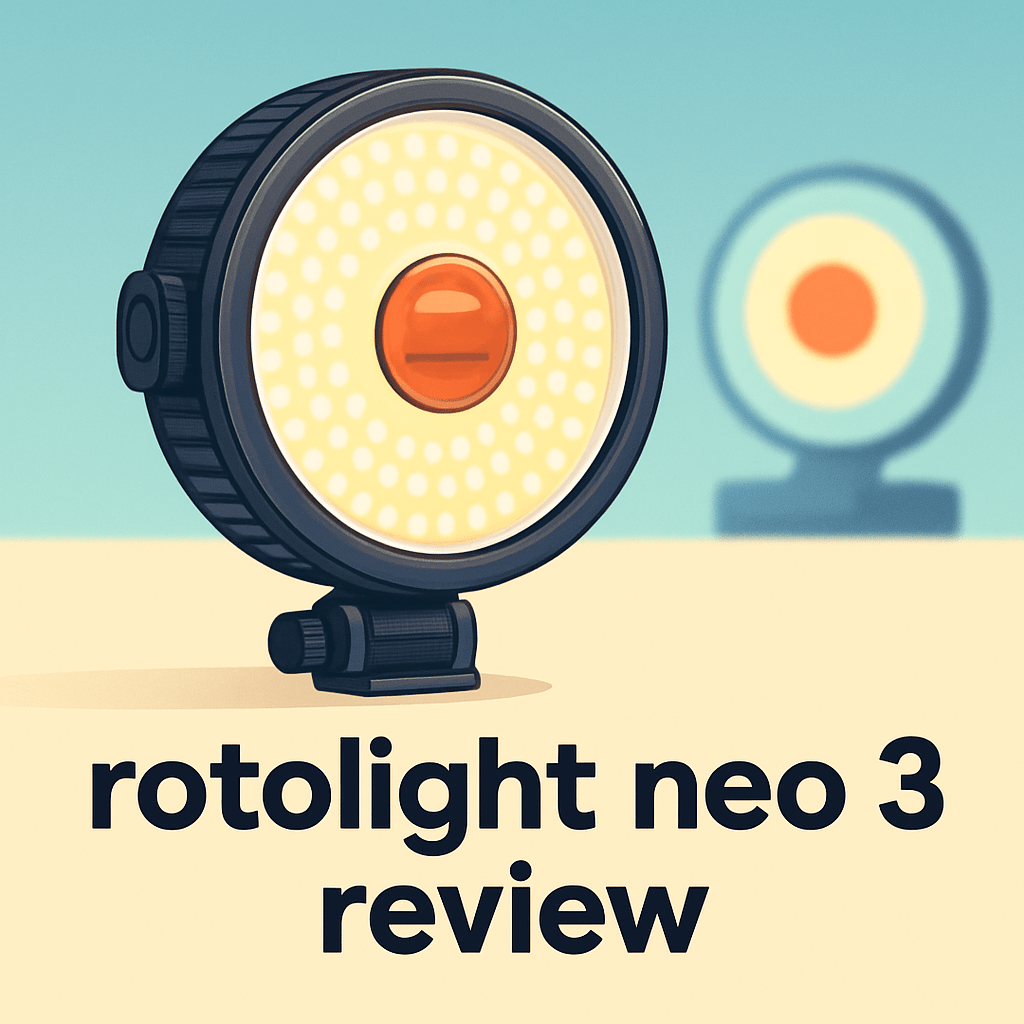
Want a single light that nails skin tones, runs on batteries, and fits in your bag?
After years of field testing lights, I spent focused time with the Rotolight NEO 3 Pro LED Light on real shoots to see how it performs in practical setups.
It’s aimed at photographers and filmmakers who want accurate, tunable bi‑color light, Bowens modifier support, and app control for solo and small-crew work. Make sure to read the entire review as I dig into color, runtime, app quirks, and whether it truly replaces bigger lights — keep reading.

Rotolight NEO 3 Pro LED Light
High-output bi-color continuous lighting engineered for pros, delivering accurate color rendition, flicker-free output and built-in creative effects. Intuitive controls, long battery runtime and silent operation make it ideal for photo and video shoots.
Check PriceThe Numbers You Need
| Spec | Value |
|---|---|
| Output | 2400 lumens |
| Colour temperature | 3000–10,000 K adjustable |
| TLCI | 98 |
| CRI | 96+ |
| Weight | 1.25 kg (body only) |
| Size | Compact rectangle |
| Power | Mains and Sony NP-F |
| Battery runtime | Up to 2 hours (2× Sony NP-F970) |
| LEDs | 1,024 bi‑colour |
| Control | Touchscreen LCD, rotary knobs, app, Bluetooth |
| Effects | Built‑in lightning, fire, TV, candlelight |
| Diffusion | Built‑in flicker‑free diffusion |
| Mounts | Bowens S‑type, 1/4‑inch tripod |
| Operation | Continuous operation only (no flash) |
| HSS/Sync | Supports up to 1/32,000 s (HSS); wireless sync |
How It’s Built
In my testing the Rotolight NEO 3 Pro LED Light has a compact rectangular body that feels solid in the hand. It’s noticeably heftier than tiny pocket panels, so you know it’s built for proper work rather than casual vlogging. For beginners that means it won’t flop around on a light cold shoe — but think about support and balance if you want it on top of a camera.
The control layout is one of my favorite parts. The touchscreen plus two rotary knobs make quick changes painless, and the app connection gives you remote control when you’re shooting solo. I found the screen clear and the knobs clicky, which makes dialing in skin tones easy without fuss.
Mounting options are very practical for real shoots. The Bowens-style front lets you fit proper softboxes and modifiers, which is great for portraits, while the small tripod thread works for arms and gimbals. In practice adding big modifiers to this compact head can shift balance, so I used a sturdier stand to keep things steady.
Power choices are flexible but come with tradeoffs. Running on battery is convenient on location, yet the packs add weight and bulk that affect on-camera balance; that could be better for true run-and-gun work. I also noticed the body gets warm on long takes, but vents handled it without shutdown, so it’s usable for most shoots.
In Your Hands
Out of the box the Rotolight NEO 3 Pro delivers consistently neutral, flattering skin tones that make portrait and interview work feel effortless. Color shifts across warm-to-cool settings were predictable and easy to match to practicals, so white balance felt more like a creative choice than a correction chore.
The forward-facing array with built-in diffusion gives a pleasing, controlled spread for headshots and talking heads, and adding a Bowens modifier immediately softens and broadens the field for full-frame or tabletop work. On-camera use as a fill is handy, but the unit’s mass and directional face make it most comfortable as a stand-mounted key for longer shoots.
Onboard effects — lightning, fire, TV and candle modes — are more than gimmicks; they translate well on camera and are superb for quick b-roll or single-operator narrative setups. They won’t replace practicals for complex scenes, but they save time and creative energy when you need instant mood.
The touchscreen plus knobs work smoothly on set, and the mobile app paired reliably with low latency in both studio and location tests. Remote camera control proved useful for solo interviews, though compatibility varies by camera and you may hit occasional hiccups with less-common bodies.
With dual Sony‑style batteries the light comfortably handled typical interview and run‑and‑gun sessions, though that battery pairing adds weight and bulk so hot‑swap planning helps. Mains power is straightforward in-studio, and importantly, the unit we tested behaved as a continuous-light source — despite some claims of high-speed sync, no flash/strobe functionality was observed, so confirm flash needs before relying on it.
The Good and Bad
- Wide CCT range for ambient matching and mood shifts
- High color accuracy with strong TLCI and CRI performance
- Respectable output for a compact form factor
- Bowens S-type compatibility expands modifier options
- Heavier body may be cumbersome for on-camera top-of-cage use
- Conflicting notes on flash and HSS versus continuous-only create uncertainty and require verification
Ideal Buyer
If you shoot portraits, interviews, product work or run-and-gun video and you want color that behaves, the Rotolight NEO 3 Pro LED Light is aimed squarely at you. Its broad 3000–10,000K range and high TLCI/CRI make skin tones reliable across locations. Compact size keeps it easy to position on stands or on-camera for tighter shots.
Solo creators and small crews will love the Bowens mount, onboard creative effects and the touchscreen plus Bluetooth app for remote tweaks. Dual power options—mains or NP-F batteries—mean you can move between studio and location without swapping ecosystems. The app-based control speeds setups and keeps a one-person shoot flowing.
That said, be realistic about trade-offs. The 1.25 kg body and the need for two NP-F970s at maximum runtime add weight and bulk, so expect to manage balance when mounting on cameras. The Neo 3 Pro shines when paired with modifiers for softer light and when you need a reliable, color-accurate single-source solution.
Skip it if you need featherweight pocket panels, a naturally huge soft source, or if you absolutely require confirmed strobe/flash performance without ambiguity. If flash capability matters, verify the NEO 3 Pro’s sync behavior before you buy. For everyone else seeking a versatile, accurate bi‑color LED, it’s a compelling tool.
Better Alternatives?
We’ve gone deep on the Rotolight NEO 3 Pro LED Light — how it handles skin tones, its build, app controls, and where it sits in a kit. It’s a strong, flexible light with lots of features, but no single light fits every shooter or every budget.
If you want something smaller, lighter, or cheaper for run-and-gun work, or just a different shape of light for specific tasks, here are a few real-world alternatives I’ve used and trusted on shoots.
Alternative 1:

Amaran Ace 25x Video Light
Pocketable variable-color on-camera illumination with punchy output and smooth dimming for run-and-gun creators. Sturdy build, rapid mount compatibility and portable power options ensure flattering, controllable light for vlogging and interviews.
Check PriceThe Amaran Ace 25x is a very handy on-camera light that I’ve used for quick interviews and street vlogging. Compared to the Rotolight NEO 3 Pro, it’s smaller and lighter on a cage or hot shoe, so your rig stays balanced and you can move fast. It gives a punchy, usable beam that looks great for head-and-shoulder shots without hauling a stand and big modifiers.
Where it lags the NEO 3 is in sheer flexibility and finesse. The Neo 3’s Bowens mount and bigger face make it easier to soften light and shape catchlights; the Amaran is more of a direct little source and needs diffusion or gels to match the Neo’s creamy look. Color fidelity and built-in effects on the Neo 3 also feel more polished on portraits and controlled shoots.
If you’re a solo creator, vlogger, or run-and-gun shooter who needs a light you can grab and go with that still looks good on camera, the Amaran Ace 25x is a great pick. If you need a workhorse light for studio portraiture or want the extra shaping and app features of the Neo 3, stick with the Rotolight.
Alternative 2:

Lume Cube Mini Panel LED Light
Tiny rechargeable panel delivering surprisingly bright, even light with adjustable intensity and color balance. Magnetic housing and multiple mounting points make it perfect for macro shooting, mobile content creation and travel kits.
Check PriceThe Lume Cube Mini Panel is one I throw in a bag whenever I travel. It’s tiny, tough, and gives a clean punch of light for product close-ups, macro, or a quick fill on location. Against the Rotolight NEO 3 Pro, it’s much easier to position in tight spaces or stick to metal surfaces with its magnetic housing.
What you lose versus the Neo 3 is scale and smoothness. The Neo 3’s larger surface and Bowens options make it a better single-source key light for flattering portraits; the Lume Cube is a small hard-ish source that can be harsh without a little diffusion. Battery life and overall output are also smaller, so it’s better as a helper light than your main studio source.
This Mini Panel suits photographers who need a tiny, durable light for travel, macro work, or mobile social posts. If your shoots need a single versatile light that can be shaped and softened for full-frame portraits, you’ll prefer the Rotolight instead.
Alternative 3:
Lume Cube Mini Panel LED Light
Ultra-compact fill light offering clean, diffused illumination for close-range subjects. USB-C charging, stepless dimming and lightweight construction let creators add professional-looking highlights to portraits, product shots and on-the-go videos.
Check PriceI often use the Lume Cube as a tiny fill or hair light when I want a subtle rim or catchlight without adding a big stand. Compared to the Rotolight NEO 3 Pro, this Lume Cube option is far simpler to hide behind a reflector or stake into a tabletop rig, and its USB-C charging makes it easy to keep running all day with a power bank.
That convenience comes at the cost of range and polish. The Neo 3 will light a subject more evenly from farther away and gives more natural skin rendering without adding more units. The Lume Cube is fantastic for close-up accents and fast setups, but it won’t replace the Neo 3 as a primary key light for larger subjects or groups.
Choose this Lume Cube if you want a tiny fill light that’s cheap to carry and quick to deploy for portraits, product highlights, or run-and-gun interviews. If your work needs a single, highly accurate, and shapeable light for main illumination, the Rotolight NEO 3 Pro remains the stronger, more flexible choice.
What People Ask Most
Is the Rotolight NEO 3 worth buying?
Yes — if you want a compact, versatile on‑camera light that doubles as a soft continuous source and a pulse flash, it’s a great buy for vloggers, portrait shooters, and run‑and‑gun videographers.
How bright is the Rotolight NEO 3?
It’s very bright for its size and punches well at close range, though it won’t replace larger studio panels for lighting big scenes.
What is the battery life of the Rotolight NEO 3?
Expect several hours on moderate settings and noticeably less at full output; you can also use it while charging for long shoots.
What are the differences between the Rotolight NEO 3 and the NEO 2?
The NEO 3 is brighter, has improved colour accuracy and features an upgraded flash/firmware set, making it a more capable all‑rounder than the NEO 2.
Can the Rotolight NEO 3 be used as a continuous light and as a flash?
Yes — it functions as a bi‑colour continuous light for video and includes a built‑in short‑duration pulse flash mode for stills.
Is the Rotolight NEO 3 good for video and portrait photography?
Yes — it gives soft, flattering light and nice catchlights for portraits and is compact and flicker‑free for video work.
Conclusion
The Rotolight NEO 3 Pro LED Light is a compact, feature-rich bi‑color unit that genuinely delivers where color fidelity and control matter most. Its responsive app, practical onboard effects, and Bowens compatibility make it unusually versatile for a single small fixture, letting you swap modifiers and dial looks quickly. In real shoots it behaved like a reliable, adaptable workhorse that I’d happily pack for portrait or narrative work, and it translated well across skin tones and mixed ambient lighting.
There are trade-offs worth calling out. It is heavier than pocket panels and performs best when you accept added battery weight and modifiers to shape the light for softer results. Also, claims about flash or high‑speed sync are inconsistent in the documentation and marketing, so confirm sync capability before you commit.
Bottom line: for hybrid photographers and filmmakers who prioritize accurate skin tones, flexible control and quick creative looks, the NEO 3 Pro represents strong value. If you need the absolute lightest on‑camera panel or a naturally huge soft source, consider alternatives tailored to those needs. Verify the sync story, plan for batteries and modifiers, and budget a small bag of accessories to get the most from this capable tool.
Rotolight NEO 3 Pro LED Light
High-output bi-color continuous lighting engineered for pros, delivering accurate color rendition, flicker-free output and built-in creative effects. Intuitive controls, long battery runtime and silent operation make it ideal for photo and video shoots.
Check Price


0 Comments