
Want a camera that gets you close to distant subjects without lugging extra lenses?
The Sony CyberShot DSC-H300 Camera promises 35x reach and steady handholding, and I took one into the field to see how that plays out in real life.
If you shoot travel, wildlife from afar, or family events in bright light, this review will focus on telephoto usability, stabilization, and low-light compromises. Make sure to read the entire review as I point out when it truly shines — keep reading.
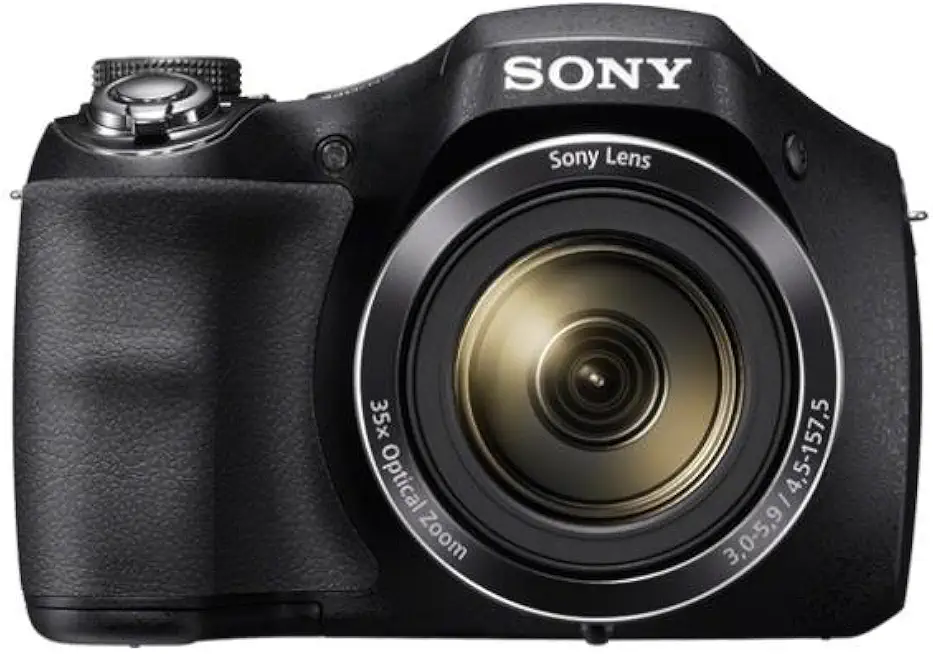
Sony CyberShot DSC-H300 Camera
Capture distant details and family moments with a 20.1MP sensor and powerful 35x zoom, ergonomic grip, and straightforward controls—ideal for beginners seeking high-resolution photos without complexity.
Check PriceThe Numbers You Need
| Spec | Value |
|---|---|
| Sensor | 20.1 MP CCD |
| Optical Zoom | 35x |
| Lens | Integrated fixed lens |
| Image Processor | BIONZ X |
| Image Stabilization | Optical SteadyShot |
| ISO Range | 80–3200 (expandable to 6400) |
| Maximum Aperture | f/3.4 (wide) to f/6.5 (telephoto) |
| Focal Length (35mm equivalent) | 25-875 mm |
| Shutter Speed Range | 1/4000 to 1 second (up to 2 seconds in manual mode) |
| Burst Mode | Up to 3 fps (frames per second) |
| LCD Screen | 3.0-inch TFT with 230,400 dots |
| Video Resolution | HD 720p at 30 fps |
| Viewfinder | Electronic, 201,000 dots |
| Weight | Approx. 610 grams (with battery and memory card) |
| Dimensions | Approx. 130.6 x 97.0 x 75.9 mm |
How It’s Built
In my testing the Sony CyberShot DSC-H300 Camera feels like a serious step up from tiny pocket cameras. It’s noticeably heavier and more substantial in your hand, which helps with steadiness but can tire you on long hikes. For day trips and family outings it’s comfortable and reassuring to hold.
Because the lens is built in, balance at long focal lengths is better than I expected. I found it steady for casual telephoto work when I used a two‑handed grip and braced against my face or a railing. What could be better is that at the longest reach you really need that careful stance or a support to avoid soft shots.
The LCD and electronic viewfinder are basic by modern standards, and in bright sun the screen can look washed out. After using it for a while I relied on the EVF more for framing and to steady the camera, even though the viewfinder won’t show every tiny detail. For beginners the EVF is a nice bonus — it makes aiming at distant subjects much easier.
I liked the simple fixed‑lens approach because you don’t have to swap glass or worry about compatibility. The camera’s layout and controls are easy to learn, which is great if you’re new to photography. One clear drawback is the basic screen/electronic finder; higher resolution would make checking focus and fine detail less hit-or-miss.
In Your Hands
The Sony CyberShot DSC-H300 delivers the kind of daylight punch you expect from a 20-megapixel CCD paired with Sony’s BIONZ X engine — crisp, well-saturated JPEGs with pleasing color rendition and usable detail for prints and web sharing. In bright, contrasty scenes it rewards careful framing and steady hands; the sensor and processor combo simply prefer good light and conservative ISO choices. Low-light caveats aside, daytime image quality is the camera’s strongest suit.
Responsiveness is practical rather than pro-caliber: the camera gets you from shot to shot at a steady clip that’s fine for family moments and travel candids but can struggle with fast, unpredictable action. The focus system and burst capability work best when you anticipate the moment rather than chasing it, so pre-focusing and timing matter. For everyday shooting this approach feels familiar and reliable.
Optical SteadyShot does meaningful work across most of the zoom range, rescuing handheld frames that would otherwise blur and making composed telephoto shots attainable without a tripod. At the longest reach you’ll still want to stabilize with a wide stance, tucking the camera to your face and favoring the EVF for bracing — those classic photographer’s tricks pay off. For critical telephoto work, a support or calm breathing rhythm helps more than aggressive ISO boosts.
Video capture is straightforward HD suited to casual clips rather than cinematic use, and the basic EVF and LCD serve their job for framing in good light. The modest-resolution finder and screen can make confirming fine focus or pixel-level detail tricky, so review images on a larger screen when precision matters. Still, for travel diaries and everyday memories the camera’s playback and framing tools are entirely serviceable.
The Good and Bad
- Thirty-five times optical zoom covers twenty-five to eight hundred seventy-five millimetre equivalent for highly flexible framing
- Optical SteadyShot aids handholding across the zoom range
- Twenty point one megapixel CCD with BIONZ X processing for detailed daylight shots
- EVF presence (two hundred one thousand dots) offers a more stable shooting stance than LCD-only framing
- Video limited to HD at thirty frames per second
- Telephoto aperture of f six point five restricts low-light performance at long focal lengths
Ideal Buyer
If you want one camera that gets you from wide landscapes to distant details without swapping glass, this is for you. The Sony CyberShot DSC-H300’s 35x zoom is the kind of reach travelers and backyard shooters will love. It’s a grab-and-go tool for daylight storytelling.
Family milestones, park wildlife, and roadside vistas benefit most from this camera’s strengths. Optical SteadyShot helps keep long-zoom shots usable when the light is good. The modest weight and bridge form factor make it easy to carry for day trips.
Buyers who prize simple operation over camera-chain complexity will appreciate the fixed-lens approach. If you prefer one body that covers a huge focal range and stabilizes in your hand, this fits. You trade pro-level video and rapid burst speed for convenience and reach.
If your work is night photography, action sports, or 4K video, look elsewhere. The H300 is happiest in well-lit conditions and is designed for casual clips rather than cinematic output. Accepting basic EVF/LCD resolution and 720p video is part of the deal.
In short, this is a practical pick for budget-conscious hobbyists, parents, and travelers who want more zoom than a smartphone. It’s an honest, all-in-one performer for daylight-focused shooters who value reach and simplicity.
Better Alternatives?
We’ve already gone through what the Sony Cyber-shot DSC-H300 does well: a simple all-in-one 35x zoom that’s easy to carry and gives you lots of reach in daylight. It’s a solid choice if you want a no-fuss camera for travel, family shots and long-distance framing without swapping lenses.
If you want more reach, better video, or modern sharing features, there are a few bridge cameras that change the trade-offs. Below are three practical alternatives I’ve used in the field, how they differ from the H300 in real shooting, and who each one suits best.
Alternative 1:

Canon PowerShot SX540 Camera
Travel-ready superzoom offers an expansive 50x optical reach, crisp 20MP imaging, built-in Wi-Fi for instant sharing, and full HD video—perfect for explorers craving dramatic telephoto shots on the go.
Check PriceThe Canon PowerShot SX540 gives you noticeably more reach than the H300 — 50x vs 35x — so in real shooting that means you can frame birds or subjects much closer without cropping. I found the image stabilization and autofocus to be steadier on the long end than the H300 when handholding, and the jump from 720p video to 1080p makes casual clips look cleaner on a TV or phone.
Where the Canon doesn’t always beat the H300 is in low-light detail — both cameras share the same small-sensor limits, so don’t expect miracles when light drops. The SX540’s menus and body feel a bit more modern and it uses a rechargeable lithium battery (handy for long trips), while the H300’s simple controls and AA-style power can be more familiar to some users.
If you want more telephoto reach and easier sharing, the SX540 is for you — travelers who shoot wildlife at a distance, sports from the stands, or anyone who wants full HD clips and built-in Wi‑Fi to post quickly. If you mostly shoot in very low light or need RAW files, neither option is ideal, but the SX540 wins for reach and everyday usability.
Alternative 2:

Panasonic Lumix DC-FZ82 Bridge Camera
Ultra-telephoto bridge model pairs a 60x zoom with 4K photo capability and fast autofocus, delivering detailed wildlife and sports frames while keeping creative controls accessible for enthusiast photographers.
Check PriceThe Panasonic FZ82 (FZ80 in some regions) is a step up in reach and speed in everyday shooting. Its 60x zoom gets you well past what the H300 can do, and the 4K photo/frame extraction feature is a real help when you want to pull a single sharp moment out of a burst — something the H300 can’t match with its 3 fps and 720p video.
On the downside, the FZ82 still has the small 1/2.3″ sensor common to superzooms, so low-light and shallow-depth-of-field results are still limited compared to larger-sensor cameras. I’ve also seen the autofocus hunt in dim light more than you’d like, so while it’s faster in good light than the H300, it’s not a magic fix for night shooting.
Pick the FZ82 if you shoot wildlife, distant sports or travel scenes where reach, speed and frame-grab options matter. It’s the better tool when you need to capture fast or tiny subjects at a distance and want the flexibility of 4K extraction — just plan your shoots in daylight or use faster shutter techniques to avoid AF hunting.
Alternative 3:

Panasonic Lumix DC-FZ80 Camera
Versatile long-zoom tool combines 60x reach with 4K video and intuitive shooting modes, stabilization for steady handheld shots, and simple menus that help travel photographers capture stunning, shareable images.
Check PriceThe FZ80 is very similar to the FZ82 in the field: long 60x reach, good stabilization for handheld telephoto work, and 4K video that gives you sharper stills when you need them. Compared to the H300, it feels more modern and confident for handheld telephoto shots — I could get usable images at longer focal lengths more often thanks to the stabilization and faster AF in daylight.
That said, the FZ80 won’t fix the core limits the H300 also has: small-sensor noise in low light and limited background blur. I also noticed Panasonic’s default sharpening and color can look punchy straight out of camera, so you may want to dial things back or do light editing for a more natural look — something the H300’s simpler JPGs sometimes avoid.
The FZ80 is great for travelers who want a single camera that can do long telephoto, steady handheld video, and quick frame grabs without a lot of fuss. If you value easy controls, lots of reach, and the ability to pull sharp stills from video, go for the FZ80. If your shoots are mostly in dark scenes or you want the simplest possible menu and battery setup, the H300 might still be the easier pick.
What People Ask Most
Is the Sony Cyber-shot DSC-H300 a good camera?
It’s a decent, budget-friendly bridge camera for daytime and long-zoom shots, but it’s not great in low light or for professional work.
Is the Sony H300 worth buying?
Yes if you want an inexpensive camera with a big zoom for casual use; skip it if you need fast autofocus, RAW files, or strong low-light performance.
How many megapixels does the Sony Cyber-shot DSC-H300 have?
It has 20.1 megapixels.
How much optical zoom does the Sony H300 offer?
It offers 35x optical zoom (roughly 26–910mm equivalent).
Does the Sony H300 have image stabilization?
Yes—it includes Sony’s SteadyShot image stabilization, but it’s basic and less effective at extreme zooms or very slow shutter speeds.
What are the pros and cons of the Sony Cyber-shot DSC-H300?
Pros: very affordable, long 35x zoom, easy to use; Cons: small sensor, noisy at high ISO, slow autofocus, and no RAW support.
Conclusion
The Sony CyberShot DSC-H300 Camera is a no-nonsense superzoom that delivers extraordinary reach in a straightforward, single-lens package. In daylight it produces pleasing detail and color, and the in-camera stabilization meaningfully improves your chances of sharp shots when you’re handholding at long focal lengths. The simplicity of one fixed lens and an easy menu makes this a very travel-friendly companion for photographers who prefer shooting over fiddling with gear.
That convenience comes with clear compromises that matter to many shooters. Video capabilities and continuous shooting feel dated, and the viewfinder and LCD are basic when you want to confirm fine focus or inspect files on the spot. Low-light telephoto work and longer creative exposures require careful technique or will show limitations, so expect to lean on good light and careful bracing for the best results.
If your priority is flexible framing, straightforward operation, and affordable telephoto reach, the H300 is a pragmatic choice that rewards steady hands and realistic expectations. If you need faster autofocus, more modern video, or wireless sharing, shop the newer superzoom class instead. For its intended buyer, the Sony CyberShot DSC-H300 Camera is honest, capable, and highly useful as a budget-minded reach-first camera.
Sony CyberShot DSC-H300 Camera
Capture distant details and family moments with a 20.1MP sensor and powerful 35x zoom, ergonomic grip, and straightforward controls—ideal for beginners seeking high-resolution photos without complexity.
Check Price

0 Comments