

Want to capture wider scenes in lower light without sacrificing portability?
The Sony FE 16mm f/1.8 G pairs a fast aperture with a compact, travel-friendly design, and it accepts screw-in filters while offering weather resistance for real shoots.
I’d put this lens through field-testing across landscapes, night skies, and run-and-gun video, and it showed clear strengths in practical use. It’s a great fit for landscape, architecture, astro, travel, and hybrid video shooters, and APS-C users will benefit too.
I’ll dig into handling, AF behavior, optical performance, and real-world astro use, and weigh when a wider or faster alternative makes sense — make sure to read the entire review as you keep reading.
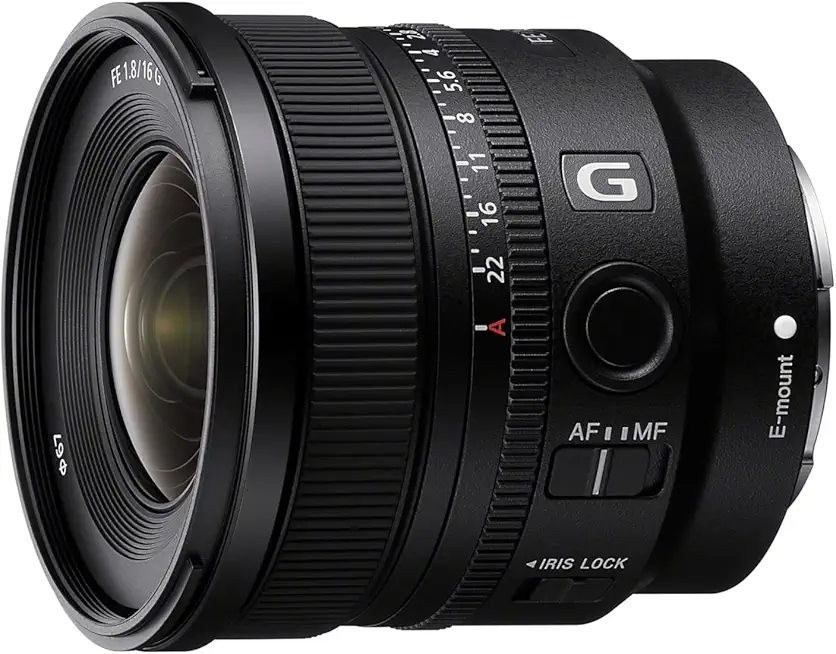
Sony FE 16mm f/1.8 G
Ultra-wide 16mm prime delivering exceptional edge-to-edge sharpness, fast f/1.8 low-light performance, and compact portability—ideal for landscapes, astrophotography, and environmental portraits with beautiful rendering and minimal distortion.
Check PriceThe Numbers You Need
| Spec | Value |
|---|---|
| Focal length | 16mm |
| Maximum aperture | f/1.8 |
| Lens mount | Sony FE (full-frame E-mount) |
| Lens type | Ultra-wide prime |
| Angle of view | Approximately 109° (full-frame) |
| Optical design | 13 elements in 11 groups |
| Aperture blades | 9, rounded |
| Minimum focus distance | 0.24 meters |
| Maximum magnification | 0.19x |
| Autofocus | Linear motor-driven, internal focus system |
| Filter size | 67mm |
| Lens dimensions (diameter x length) | Approx. 73 x 89 mm |
| Weight | Approx. 280 grams |
| Weather sealing | Dust and moisture resistant |
| Compatible sensor format | Full-frame and APS-C (crop factor applies) |
How It’s Built
In my testing the Sony FE 16mm f/1.8 G felt like a proper premium lens without the pretension. The metal-and-plastic mix gives a solid, well-made vibe in my hand. The G-series finish looks and feels refined, which is nice when you’re out shooting all day.
It’s impressively compact and light, so tossing it in a daypack or on a gimbal never felt like a chore. The internal focus means the barrel doesn’t move while focusing, which keeps your balance and makes it friendlier on stabilizers. The 67mm screw-in thread is a small detail that pays off big time for filters and long exposures.
The weather sealing gave me confidence on drizzly hikes and dusty trails, though I still avoid soaking it. The lens hood snaps on securely and the front element is easy to clean after a windy shoot. Those little things matter when you’re shooting landscapes or travel all day.
Ergonomically the focus ring is smooth with a light resistance that works well for stills. What I liked most was the portability and the handy filter thread; what could be better is a touch more tactile damping on the focus ring for video work. For beginners this means a sturdy, easy-to-carry lens that handles like a pro without getting in the way.
In Your Hands
On bodies I tested, AF felt swift and decisive, locking reliably for stills and staying on moving subjects in continuous tracking. Linear motor focusing is quiet and unobtrusive, so on-camera mics rarely pick up noise. Focus breathing is minimal enough that reframing during pulls remains predictable for run-and-gun video.
Despite its ultra-wide perspective, the lens lets you get surprisingly close to foreground subjects, making dramatic near-to-far compositions easy to create. Working distance is short, so you can emphasize textures and exaggerated perspective without awkward reach. This isn’t a macro, but the close-focus capability is creatively useful for landscapes and environmental portraits.
The internal focusing and compact footprint make the lens a great gimbal partner; balance is natural and tilts feel inertial rather than twitchy. Focus transitions are smooth with only subtle stepping when you push for long, cinematic pulls. Rolling-shutter issues are more a camera than lens story, but IBIS pairs well in handheld footage.
In street, travel, and event work the lens empowers fast framing and confident composition thanks to its wide view and light weight. On APS-C bodies it becomes a punchy wide-angle that tightens framing for tighter interiors and closer environmental shots. Weather resistance inspires trust in misty or dusty conditions, and the hood seats securely to keep stray flare at bay.
The Good and Bad
- Ultra-wide 16mm focal length with fast f/1.8 maximum aperture
- Compact and lightweight (~280 g) for travel and gimbal use
- 67mm front filter thread for easy use of common NDs and polarizers
- Dust and moisture resistant build
- Not as wide as 14mm options for maximum coverage
- Not as fast as f/1.4 primes when absolute light gathering and subject isolation are the priority
Ideal Buyer
If you’re chasing an ultra-wide perspective without hauling a big kit, the Sony FE 16mm f/1.8 G is built for you. Fast f/1.8 speed and a roughly 280 g, compact footprint make it ideal for travel days and long handheld shoots. It keeps wide creativity portable.
Landscape, architecture and interior shooters who value usable filters will appreciate the 67mm screw‑in thread for NDs and polarizers. The lens balances field coverage with manageable distortion for composed wide shots. Stopping down cleans edges while leaving the ultra-wide look intact.
Hybrid photo/video creators and gimbal users benefit from the internal focus and quiet linear motor AF. Focus transitions are smooth and the lens stays well balanced on compact stabilizers. Its size makes it easy to run and gun.
Astro‑curious photographers will like the f/1.8 brightness for shorter exposures and lower ISO. If you demand absolute corner-to-corner star perfection you might still consider a 14mm GM, but the 16mm is a far easier night‑sky companion for travel.
APS‑C shooters who accept the crop trade‑off get a fast, wide prime that doubles as a versatile walkaround lens. Documentary, environmental portrait, and street shooters who favor reach over extreme width will find the lens especially useful. In short, buy it if you want ultra‑wide speed, filter convenience, and minimal bulk.
Better Alternatives?
We’ve already gone through what the Sony FE 16mm f/1.8 G does best: a fast, compact ultra‑wide that’s easy to carry, works well on gimbals, and accepts normal screw‑in filters. It’s a great everyday choice for landscapes, interiors, travel, and dipping your toes into night sky work.
If you want something that pushes one of those areas further — wider field of view, better corner stars, or more light — there are a few clear alternatives worth considering. Below I’ll walk through three lenses I’ve used in the field and explain what each one gives you that the 16mm doesn’t, and where they lose ground.
Alternative 1:

Sony FE 14mm f/1.8 GM
Premium ultra-wide prime offering breathtaking resolution, creamy bokeh, and exceptional coma control for pinpoint stars. Designed for dramatic perspectives, precision architecture work, wide landscapes, and night-sky imaging with professional-grade clarity.
Check PriceI’ve used the Sony 14mm f/1.8 GM when I needed the absolute cleanest corners and the widest frame possible. Compared to the 16mm G, the 14mm gives you noticeably more scene and better edge sharpness at wide apertures — that matters when you’re framing sweeping landscapes or trying to get pinpoint stars in the corners for astrophotography. The star points stay tighter and the sky feels less “soft” out at the edges.
Where it loses to the 16mm is size, weight, and convenience. The 14mm is a bigger, heavier piece of glass, and it’s less friendly on a small gimbal or when you want to travel light. It’s also much more expensive. In handheld city or travel work I often reach for the 16mm simply because it’s less of a burden to carry all day.
This is the one I’d pick if you’re a pro or serious enthusiast who prioritizes corner-to-corner image quality and night‑sky work above portability. If you do lots of architecture, big landscapes, or professional astro shoots and don’t mind the extra size and cost, the 14mm GM is worth it.
Alternative 2:

Sigma 14mm f/1.8 Art Sony E
Fast ultra-wide prime engineered for immaculate sharpness, reliable build, and brilliant low-light performance. Controls coma and flare for crisp stars, making it a go-to choice for astrophotography and dramatic landscapes.
Check PriceThe Sigma 14mm f/1.8 Art is the value‑minded heavy hitter. In the field it gives you a similar ultra‑wide reach and very strong corner performance for stars and landscapes — often punching above its price. Compared to the 16mm G you get a wider view and better corner control at the expense of size and the easy filter options the Sony has.
What I noticed shooting with the Sigma is that it’s bulkier and the front element needs special handling for filters, so it’s not as grab‑and‑go as the 16mm. It also feels a bit heavier on lighter bodies and gimbals. But for nightscapes and dramatic wide scenes where you want more sky, the Sigma often gives you more for your money.
Pick the Sigma if you want top-notch wide coverage and astro performance without paying the premium for Sony’s GM glass. It’s a good fit for landscape and night photographers who prioritize image quality over compactness and who don’t mind carrying a slightly bigger setup.
Alternative 3:

Sigma 14mm f/1.4 Art Sony E
Ultra-fast f/1.4 ultra-wide prime delivering extraordinary low-light reach, creamy foreground separation, and exceptional edge-to-edge sharpness. Engineered for immersive nightscapes, creative wide-angle portraits, and demanding professional imaging with controlled coma correction and refined contrast.
Check PriceThe Sigma 14mm f/1.4 Art is the “go big or go home” option for low‑light and creative wide work. In real shoots it gives you a level of light gathering and subject separation the 16mm can’t match — f/1.4 lets you shoot with lower ISO or shorter exposures, and you can get more separation of foreground subjects against a wide background. That’s a creative tool the 16mm simply doesn’t offer.
On the downside, that extra speed comes with more bulk and weight, and the lens is less practical for travel or long handheld days. It also requires a bit more care to control distortion and composition at such an extreme wide and fast aperture. For quick run‑and‑gun work, I still prefer the 16mm for its balance of size and usefulness.
If you’re an astro pro, nightscape artist, or creative shooter who needs every bit of light and wants the option for dramatic shallow foregrounds, the 14mm f/1.4 is compelling. But if you want a compact, all‑round ultra‑wide that’s easy to carry and filter, the 16mm f/1.8 G remains the smarter daily driver.
What People Ask Most
Is the Sony FE 16mm f/1.8 G good for astrophotography?
Yes — its 16mm field and f/1.8 aperture deliver bright wide skies and it controls coma well enough to produce sharp stars across most of the frame.
Is the Sony FE 16mm f/1.8 G worth buying?
Yes — it’s a compact, very sharp ultra-wide with a fast aperture that performs great for landscapes, astro and video, making it excellent value for many shooters.
How sharp is the Sony FE 16mm f/1.8 G wide open at f/1.8?
Very sharp in the center at f/1.8, with mild corner softness that improves noticeably when stopped down to around f/2.8–f/5.6.
Is the Sony FE 16mm f/1.8 G weather-sealed and durable?
Yes — it features dust- and moisture-resistant construction and a solid mount for field use, though it’s not waterproof for submersion.
How does the Sony FE 16mm f/1.8 G compare to the Sony FE 20mm f/1.8?
The 16mm gives a noticeably wider field and is better for astro and very wide landscapes, while the 20mm is a touch smaller and lighter with similar overall sharpness, so choose based on how wide you need to go.
Is the Sony FE 16mm f/1.8 G good for vlogging and video?
Yes — the wide angle and f/1.8 make it excellent for run-and-gun vlogging, with fast, quiet AF and good low-light performance, though it can be very wide for close-up single-person shots on full-frame.
Conclusion
The Sony FE 16mm f/1.8 G is an ultra‑wide, fast prime that manages an impressive balance of expansive perspective, compact handling, and everyday usability. In real-world shooting it gives confident autofocus, smooth video-friendly behavior, and the convenience of standard screw‑in filter use that creatives actually rely on. The weather‑resistant, travel-friendly package makes this lens an easy reach for landscapes, interiors, gimbal work, and astro experimentation.
It is not without trade‑offs, and those matter to some buyers. Serious astrophotographers and landscape pros chasing absolute corner sharpness and coma control will find wider, more extreme optics that outperform it at the edges. Likewise, shooters demanding the very fastest light gathering or maximum subject isolation will prefer larger, faster alternatives despite added bulk and cost.
For the majority of hybrid shooters and traveling creatives this 16mm f/1.8 G is a pragmatic, high‑value tool that unlocks dramatic foreground‑to‑sky compositions while staying unobtrusive in your bag. It rewards spontaneity, low‑light practice, and run‑and‑gun video more than it punishes with optical compromises. Choose it as your go‑anywhere ultra‑wide, and only step up to 14mm or faster glass when your priorities are absolute corner performance or the last stop of light gathering.
Sony FE 16mm f/1.8 G
Ultra-wide 16mm prime delivering exceptional edge-to-edge sharpness, fast f/1.8 low-light performance, and compact portability—ideal for landscapes, astrophotography, and environmental portraits with beautiful rendering and minimal distortion.
Check Price

0 Comments