
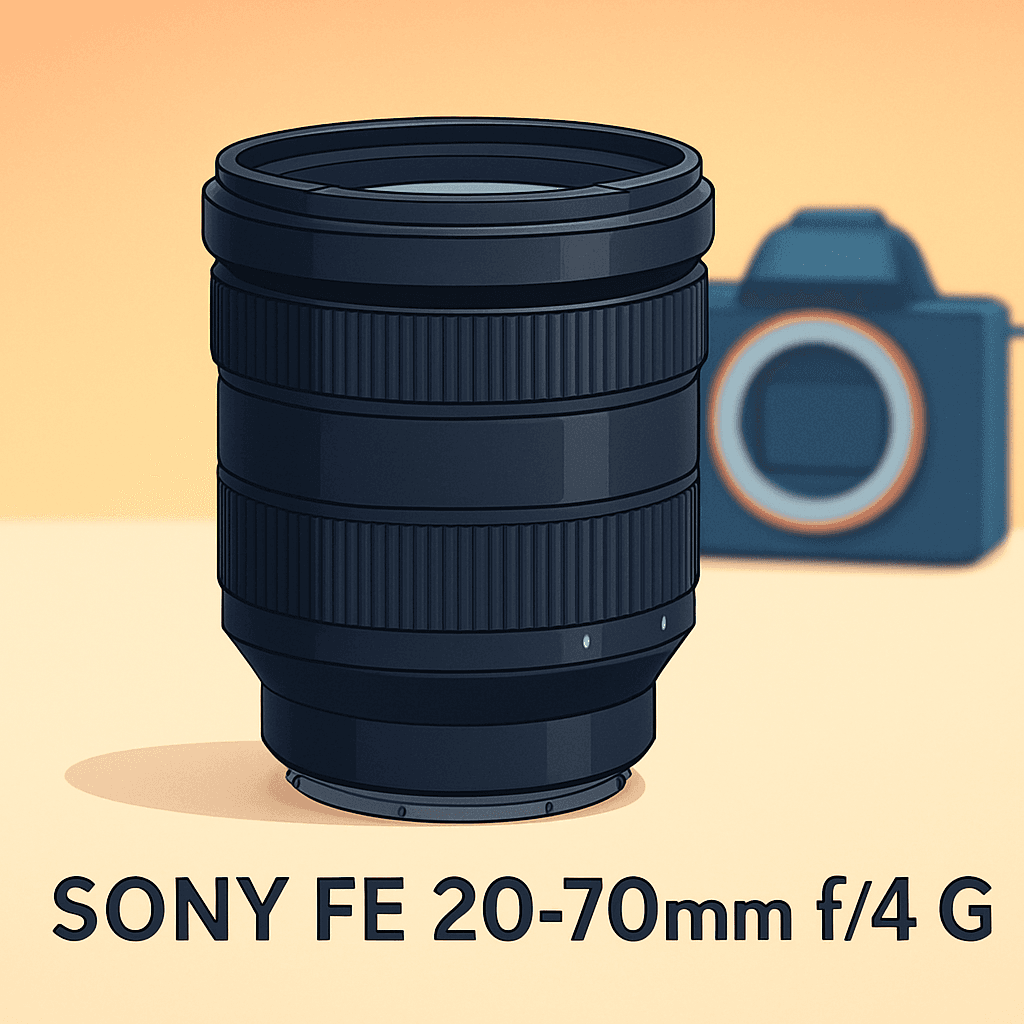
Want one lens that lets you shoot sweeping landscapes, tight interiors, and environmental portraits without changing glass? Most photographers would love that kind of do-it-all optic.
Sony’s FE 20–70mm f/4 G gives you a wider 20mm start than typical 24–70s. It stays at f/4, is compact, and relies on body stabilization rather than in-lens OSS.
That range is great for travel, landscape, architecture, everyday family photos, and hybrid photo/video creators who want flexibility and portability. I’ve been shooting with it on trips to see how it performs in real conditions.
I’ll cover handling, image quality, autofocus, and how it compares to 24–70mm alternatives. Make sure to read the entire review as I dig into the details — keep reading.

Sony FE 20-70mm f/4 G
Constant f/4 full-frame zoom optimized for travel and street photographers—compact, lightweight handling paired with high-resolution optics, quick autofocus and smooth rendering for crisp images in varied lighting conditions.
Check PriceThe Numbers You Need
| Spec | Value |
|---|---|
| Mount | Sony E-mount (Full-frame compatible) |
| Focal Length | 20-70mm |
| Maximum Aperture | Constant f/4 |
| Lens Type | Wide-to-standard zoom |
| Minimum Focus Distance | Around 0.35 meters |
| Maximum Magnification | Approx. 0.24× |
| Image Stabilization | No (relies on camera body stabilization) |
| Autofocus Motor | Linear motor (fast and quiet AF) |
| Filter Diameter | 67mm |
| Lens Construction | Includes ED and aspherical elements |
| Aperture Blades | 9, rounded for smooth bokeh |
| Angle of View | Approx. 94° to 34° (diagonal) |
| Length | Approx. 99mm |
| Weight | Approx. 545 grams |
| Weather Sealing | Dust and moisture resistant |
How It’s Built
In my testing the Sony FE 20-70mm f/4 G felt noticeably compact and solid in the hand. It’s an E-mount lens built for full-frame bodies and the finish gives you confidence in light rain or dusty conditions. For travel and day-to-day shooting that means you can carry it without feeling weighed down or worrying about a little bad weather.
Handling is friendly and intuitive. The zoom and focus rings have a smooth, slightly damped feel that let me reframe quickly or pull focus for video without fuss. On typical Sony bodies it sits balanced, so you don’t get neck strain after a long walk around a city.
The optical design uses advanced glass to keep colors and edges clean, and the rounded aperture gives a pleasing background blur when you want it. What I really liked was how portable it is for a full-frame zoom—easy to toss in a small bag and still cover most shooting situations. One thing that could be better is the lack of in-lens stabilization, which means you rely on your camera’s stabilization and sometimes have to raise ISO in low light.
For beginners this lens is forgiving and practical. It uses a common filter size so polarizers and NDs are easy to find, and the overall build balances durability with portability. After using it for a while I found it perfect for travel, landscapes, and everyday hybrid work, as long as you accept the trade-offs for size and speed.
In Your Hands
The 20–70mm reach reshapes how you frame a day of shooting: the wide end opens interiors and architecture in a way a standard short-tele zoom can’t, while the longer end tucks in tight for environmental portraits and street candids without having to change glass. That extra width gives you compositional freedom on crowded streets and sweeping landscapes alike, making fast reframing feel natural and intentional.
Being a constant-aperture zoom, it asks you to work with exposure rather than brute-force it with a faster lens. In practice that means relying on the camera’s stabilization and sensible ISO choices for dimly lit events; on bodies with good IBIS handheld shots stayed usable and clean, though you’re not chasing the extreme low-light limits of faster zooms.
Close-focus capability is genuinely useful for detail work—food, product, and environmental close-ups feel punchy without claiming macro status. For video creators the linear AF delivers quiet, smooth transitions, and combined with body stabilization the lens produces steady run-and-gun footage with relatively restrained focus breathing during normal shooting ramps.
Across travel, architecture, family gatherings and hybrid shoots the lens stays out of your way: compact enough to carry all day, quick to recompose from wide to tight, and friendly with common filters for creative control. It’s a practical one-lens solution when versatility and portability matter more than extreme shallow depth of field.
The Good and Bad
- Unique 20–70mm range for a standard zoom, giving extra width versus a typical 24–70mm
- Constant f/4 aperture throughout the zoom range
- Compact and lightweight for full-frame (approx. 99mm length, 545 g)
- Dust- and moisture-resistant weather sealing
- No optical stabilization — relies entirely on camera IBIS
- f/4 maximum aperture limits low-light performance and subject separation compared to f/2.8 alternatives
Ideal Buyer
The Sony FE 20-70mm f/4 G is for photographers who want one versatile zoom that reaches wider than a typical 24–70. Travel shooters, landscape and architecture photographers, and environmental portraitists will appreciate the extra 20mm without swapping lenses. It’s a great one-lens solution for everyday and family lifestyle work.
If you prioritize portability and balanced handling over the bulk of f/2.8 zooms, this lens earns its keep. The compact, weather-sealed body and 67mm filter compatibility make it friendly in a light travel kit. Expect constant f/4 performance that keeps size and weight down.
Hybrid creators who toggle between photo and video will like the quiet linear AF and the flexible 20–70 range for run-and-gun shoots. Relying on camera IBIS instead of in-lens OSS is fine for most modern Sony bodies. The 67mm filter thread also simplifies ND and polarizer workflows.
Avoid this lens if you need the absolute low-light reach or shallow depth of field of an f/2.8 or faster glass. Also skip it if you depend on built-in lens stabilization for handheld long exposures or video. Otherwise it’s an astute pick for anyone valuing extra width, portability, and one-lens versatility.
Better Alternatives?
We’ve already walked through what makes the Sony FE 20-70mm f/4 G a useful one-lens solution: that extra 20mm wide end, constant f/4, light weight, and quiet AF. It’s a great pick when you want a travel-ready lens that covers landscapes, interiors, and everyday shooting without swapping glass.
If you’re thinking about other options, the usual trade-offs come up: do you want more low-light punch and background blur, or do you want in-lens stabilization and a slightly smaller package? Below are three real alternatives I’ve used in the field, with how each compares to the 20–70mm in real shooting situations and who I’d recommend them to.
Alternative 1:

Sony FE 24-70mm f/4 Vario-Tessar T
Versatile, compact standard zoom featuring advanced Tessar-inspired optics and T* coating for punchy contrast and minimal flare—ideal for everyday shooting, travel, and photographers seeking consistent edge-to-edge sharpness.
Check PriceI’ve taken the 24–70mm f/4 Vario-Tessar on city trips and handheld video shoots. Compared to the 20–70 f/4 G it loses the extra 20mm of width, so you’re a bit tighter in small rooms or wide landscapes. What it gives back is built-in OSS (optical stabilization) and that classic Zeiss look—colors and contrast that please the eye straight out of camera.
In practice the OSS makes a real difference for handheld low-light shots or slow-motion walk-and-talk video, especially on bodies with weaker IBIS. The 20–70 wins on framing flexibility and is a touch newer in handling, but the Vario-Tessar feels a bit more solid for steady handheld work without doing ISO gymnastics.
Pick the 24–70 f/4 Vario-Tessar if you travel with a lightweight kit but need reliable in-lens stabilization for video or handheld stills, and you don’t miss shooting at 20mm. If your top priority is extra wide coverage and the smallest weight, stick with the 20–70. If steadier handheld shooting and that Zeiss color/contrast matter more, the Vario-Tessar is a smart swap.
Alternative 2:

Sony FE 24-70mm f/2.8 G Master
Professional-grade constant f/2.8 zoom delivering exceptional resolution, creamy bokeh, and reliable low-light performance—robust build and fast autofocus make it the go-to choice for weddings, portraits, and commercial work.
Check PriceI’ve shot weddings and portraits with the 24–70 f/2.8 GM and its biggest real-world win over the 20–70 f/4 is obvious: f/2.8 gives you more light and shallower depth of field. That means cleaner low-light results, faster shutter speeds for motion, and creamier backgrounds for portraits. The GM also feels rock-solid in the hand and locks onto subjects faster in demanding AF situations.
The trade-off is size, weight, and price. The GM is heavier to carry all day and doesn’t offer the 20mm wide end that helps with tight interiors and dramatic landscapes. If you often rely on very shallow depth of field or shoot events where low light and subject separation matter, the GM will outperform the 20–70 in real shoots. For light travel or when extra-wide framing matters, the 20–70 keeps the edge.
Choose the 24–70 f/2.8 G Master if you’re a pro or ambitious enthusiast who needs top image quality, faster aperture for low light and portraits, and the most reliable AF for events. If you want one-lens travel freedom with a wider 20mm field and a smaller package, the 20–70 f/4 is the better fit.
Alternative 3:
Sony FE 24-70mm f/2.8 G Master
High-performance f/2.8 zoom tailored for filmmakers and pro photographers seeking smooth aperture control, minimal focus breathing, and class-leading sharpness across the frame—durable weather-sealed construction for demanding shoots.
Check PriceI’ve also used the 24–70 f/2.8 GM for video work, and it shines for filmmakers compared to the 20–70 f/4. The faster aperture helps keep exposure consistent at lower ISOs and gives nicer subject separation on shallow shots. In practical shooting the GM’s focus transitions feel smoother and the overall control of bokeh and sharpness looks more filmic.
Where the 20–70 still wins for hybrid shooters is the extra wide 20mm for establishing shots and a lighter, less tiring kit for long handheld shoots. The GM is tougher and more professional, but it’s heavier and more obvious on a gimbal or long handheld day. Also, if you often switch between photo and run-and-gun video and want one ultra-light lens, the 20–70 is more convenient.
Go with the 24–70 f/2.8 G Master if you’re a filmmaker or pro photographer who values smooth aperture control, minimal focus breathing, and top-tier sharpness and bokeh, and you don’t mind the extra weight. If your shoots need a lighter lens and the ability to go wider at 20mm, stick with the 20–70 f/4 G for a better all-around travel/hybrid kit.
What People Ask Most
What is the image quality and sharpness of the Sony FE 20-70mm f/4 G?
Very good to excellent — sharp in the center even wide open and improves at the edges when stopped down, with well-controlled aberrations and contrast.
How does the Sony FE 20-70mm f/4 G compare to the Sony 24-70mm f/2.8 GM?
The 24-70mm f/2.8 GM is faster, a touch sharper and better in low light, while the 20-70mm f/4 G is lighter, cheaper and offers a wider 20mm end for more versatile framing.
Is the Sony FE 20-70mm f/4 G weather-sealed and suitable for outdoor use?
Yes — it has dust and moisture resistance and is fine for general outdoor shooting, but you should avoid prolonged exposure in heavy rain.
Does the Sony FE 20-70mm f/4 G have optical image stabilization (OSS)?
No — it does not include OSS, so you’ll rely on in-body stabilization in Sony camera bodies for handheld low-light work.
Is the Sony FE 20-70mm f/4 G compatible with Sony APS-C cameras?
Yes — it works on APS-C E-mount bodies and gives roughly a 30–105mm equivalent range, though you lose the native 20mm wide-angle field of view.
Is the Sony FE 20-70mm f/4 G a good lens for travel and landscape photography?
Yes — its compact size, wider 20mm coverage and strong image quality make it a very practical choice for travel and landscape work.
Conclusion
The Sony FE 20-70mm f/4 G is unapologetically purposeful: you get an unusually wide standard zoom in a compact, easy-to-carry package with a constant aperture and quiet, dependable autofocus. It feels built for real-world shooting—travel days, tight interiors and hybrid photo/video projects where swapping lenses slows you down. That focused identity is its strongest selling point.
In practice the lens delivers usable rendering across the range, solid close-focus capability and reliable behavior in mixed lighting when you lean on camera stabilization. Handling and weather resistance make it a confident everyday tool for photographers who want one-lens versatility without the bulk. For shooters who prize portability and framing flexibility, it makes a compelling case.
The compromises are clear and unavoidable: no in-lens stabilization and a moderate maximum aperture limit low-light headroom and creamy background separation compared with faster alternatives. Wide-end optical quirks are present and often require correction in-camera or in post. These are acceptable trade-offs if size and extra width are priorities.
If your kit needs a single, versatile workhorse for travel, landscape, architecture and hybrid shoots, this lens is a very smart, pragmatic choice. If you demand the ultimate low-light performance or the shallowest bokeh, opt for a faster, heavier zoom instead. Decide how much you value that extra-wide reach and portability, and buy accordingly.
Sony FE 20-70mm f/4 G
Constant f/4 full-frame zoom optimized for travel and street photographers—compact, lightweight handling paired with high-resolution optics, quick autofocus and smooth rendering for crisp images in varied lighting conditions.
Check Price

0 Comments