
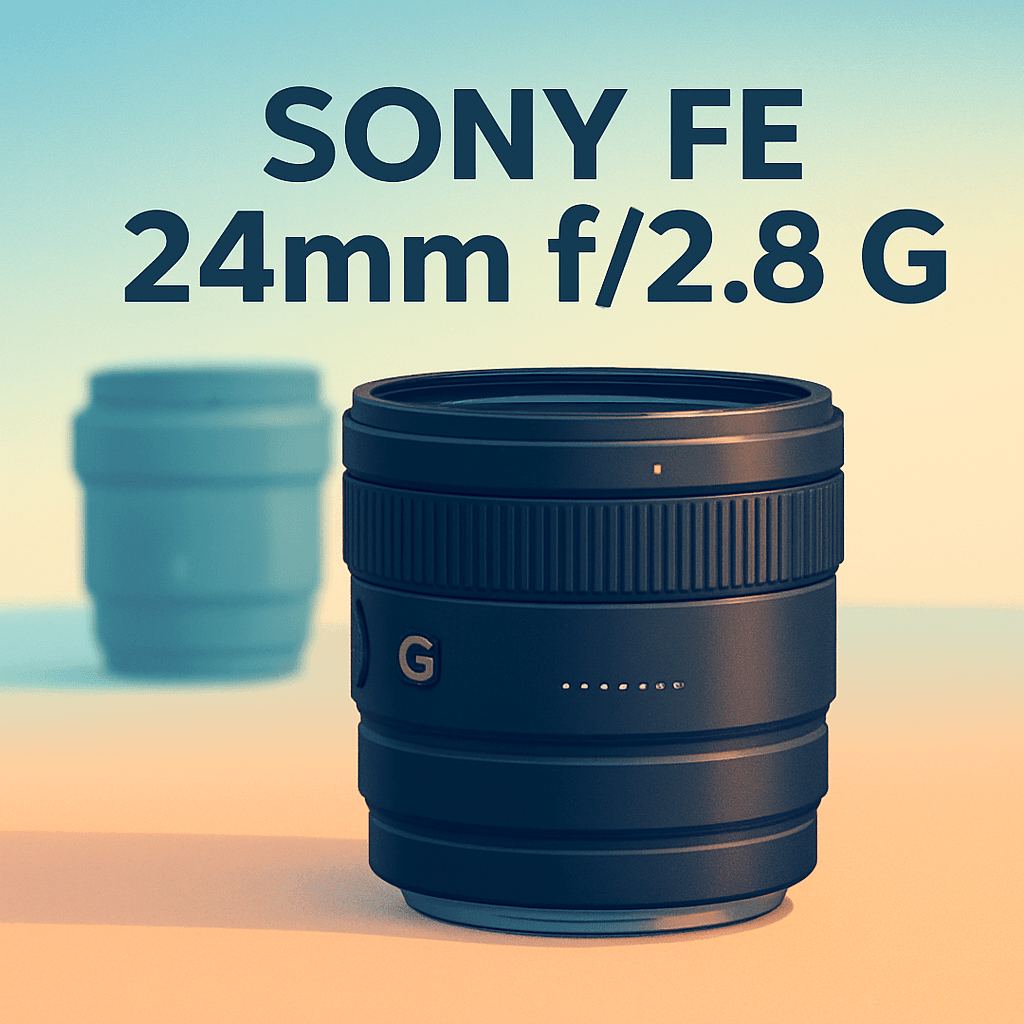
Want a 24mm prime that’s small enough to carry all day but still serious on a full‑frame Sony body?
The Sony FE 24mm f/2.8 G aims squarely at travel and street shooters with a pocketable G‑series design, weather resistance, silent linear AF and close‑focus versatility for detail shots.
It does trade a faster aperture and in‑lens stabilization for that compact size, so it leans on your camera’s IBIS. I took it into the field on city shoots and short trips to see how that balance plays out.
If you value everyday carry, discreet autofocus, and wide‑angle flexibility for landscapes, environmental portraits and closeups, this review will be worth your time—keep reading.

Sony FE 24mm f/2.8 G
Compact, lightweight wide-angle prime delivering crisp edge-to-edge detail and quick f/2.8 low-light performance. Ideal for travel, landscapes, and street photographers seeking portability without sacrificing optical quality.
Check PriceThe Numbers You Need
| Spec | Value |
|---|---|
| Lens mount | Sony E-mount (Full-frame compatible) |
| Focal length | 24mm |
| Maximum aperture | f/2.8 |
| Format compatibility | Full-frame and APS-C sensors |
| Optical design | 9 elements in 8 groups (includes aspherical elements) |
| Minimum focus distance | 0.16 m (16 cm) |
| Maximum magnification ratio | 0.18× |
| Aperture diaphragm blades | 7, rounded for smooth bokeh |
| Autofocus | Linear motor-driven, fast and silent AF |
| Image stabilization | None (relies on camera body) |
| Filter thread diameter | 40.5 mm |
| Dimensions | Approx. 44.5 mm diameter × 45.5 mm length |
| Weight | Approx. 162 g |
| Weather sealing | Dust and moisture resistant design |
| Angle of view (full-frame) | 83° |
How It’s Built
Holding the Sony FE 24mm f/2.8 G in my hand felt like a small revelation. It’s surprisingly compact and clearly built as a premium G-series optic, yet light enough to actually go wherever you go. In my testing that made it effortless to carry all day on walks and trips.
The lens seals against dust and light moisture, and I found that reassuring when shooting in windy city streets or coastal light rain. The focus ring is smooth and the little switch has firm, positive clicks that won’t move by accident. That tactile feedback matters in the real world when you’re juggling a camera and a bag.
What I really liked was how pocketable it is — it disappears into a jacket or small bag and won’t weigh you down. One thing that could be better is the filter situation; the small, uncommon thread size means you might need to buy a new filter or an adapter for your kit. For beginners that’s worth knowing so you don’t get surprised later.
After using it for a while I came away impressed by the build-quality-to-weight tradeoff. It feels solid without being bulky, and that makes it a friendly lens for people learning travel and street work. Simple, dependable, and easy to live with day to day.
In Your Hands
The wide perspective feels expansive yet natural for travel and street work, and the linear motor AF is quick and whisper‑quiet, snapping to faces and small details. In typical light it locks reliably; in very dim scenes it can hesitate briefly before confirming. For discreet street shooting the silence and speed are definite advantages.
The lens lacks optical stabilization, so you rely on the camera’s IBIS for steadiness. That pairing delivers surprisingly steady handheld keepers at modest shutter speeds, though true low‑light handheld shooting still benefits from support or higher ISO. Its compactness also makes tripod setup painless for landscapes.
Close‑focus capability is a practical strength — you can get tight on food, small subjects and environmental product shots while retaining context. These near images show pleasing separation and solid contrast, which is handy for editorial and social work. Focus feel remains responsive even up close.
Stopped down the optic tightens up for cityscapes and vistas, and in‑camera corrections handle geometry well. Flare control is generally good, but direct strong light can introduce subtle ghosts and vignetting eases when you stop down. Color and micro‑contrast renderings stay natural and lively across scenes.
For video the autofocus is smooth and unobtrusive, holding through gentle pans with minimal hunting and very little noise near on‑camera mics. That makes it a strong choice for run‑and‑gun travel clips or quiet street captures. Overall, the lens’ responsiveness and pocketable handling make it a reliable everyday tool.
The Good and Bad
- Extremely compact and lightweight (approx. 162 g; short length)
- Dust and moisture-resistant design
- Fast, silent linear motor AF
- Close focusing at 0.16 m with 0.18x magnification
- Maximum aperture limited to f/2.8
- No optical image stabilization (relies on body IBIS)
Ideal Buyer
If you prize lightness and discretion, the Sony FE 24mm f/2.8 G was made for you. It’s built to slip into a pack or jacket pocket and vanish on the street. APS‑C owners get a handy 36mm equivalent useful for tight street and everyday work.
Travel photographers and everyday shooters who want a weather‑resistant, no‑fuss wide prime will appreciate its pocketable footprint and reassuring sealing. The lens balances nicely on smaller Sony bodies and stays out of the way during long days. The modest 40.5 mm filter thread makes adding a polarizer or ND straightforward for landscapes and long exposures.
Street shooters and documentary makers who need fast, silent AF and surprising close‑focus capability will find a lot to love. The 0.16 m minimum focus lets you get intimate environmental portraits, food and texture shots without switching lenses. Its rendering favors natural contrast and satisfying mid‑distance bokeh, so environmental subjects sing.
This is also an excellent choice for Sony owners with in‑body stabilization who don’t require an f/2 or faster optic. If your priority is absolute low‑light speed or maximum subject separation, consider a faster alternative; otherwise this lens is an ideal everyday companion.
Better Alternatives?
We’ve already gone over the Sony FE 24mm f/2.8 G — a great little travel and street lens that’s light, weather‑resistant and easy to carry. It’s built for photographers who want a no‑fuss 24mm that stays out of the way but still delivers good sharpness and quiet autofocus.
If you’re wondering what else to consider, there are a few clear alternatives that trade the Sony’s pocketable size for faster glass, lower price, or slightly different handling. Below I’ll run through three real‑world options I’ve used, and point out what each one does better and worse than the Sony so you can pick the right tool for your shooting style.
Alternative 1:

Sigma 24mm f/1.4 DG DN Art Sony E
Ultra-fast wide-angle prime with an f/1.4 aperture, producing stunning bokeh, exceptional low-light capability and razor-sharp resolution across the frame—perfect for astrophotography, portraits, and creative low-light scenes.
Check PriceThe Sigma 24mm f/1.4 is the obvious pick if you need light‑gathering and shallow depth of field. Compared to the Sony f/2.8 G, the Sigma gives you roughly two stops more light, which makes a real difference for night shots, indoor scenes, and for getting subject separation on close subjects. In my shooting, it also renders very fine detail and feels a step up in sheer resolution when you pixel‑peep or crop.
The trade‑offs are obvious in the field: the Sigma is bigger, heavier and more noticeable on a small Sony body. It’s not the lens you’ll want to keep in a jacket pocket for a day of walking. It’s also pricier, and you’ll feel that weight after a few hours handheld. Autofocus is excellent on modern Sony bodies, but you give up the Sony 24/2.8 G’s absolute tiny size and the same level of discreetness for street work.
Who should buy it: photographers who shoot a lot in low light, do astro or creative shallow‑depth portraits, or want the best resolution out of a 24mm for landscape crops. If you value performance and image look over keeping your kit tiny, the Sigma is a clear step up from the Sony 24/2.8.
Alternative 2:

Tamron 24mm f/2.8 Di III OSD Sony E
Featherlight design packs versatile 24mm coverage with reliable autofocus and smooth OSD-driven focusing. Balanced for everyday shooting—travel, street, and landscape—offering clean contrast and lively color rendition.
Check PriceThe Tamron 24mm f/2.8 is the budget‑friendly alternative that keeps things small and light. In day‑to‑day shooting it feels a lot like the Sony in size and handling, but you’ll usually pay less for it. In good light it makes sharp images with pleasing color and contrast, and it’s easy to carry for travel and street work.
Where it falls short vs the Sony is mostly in fine detail and feel. Wide open the Tamron can be a touch softer at the corners and its micro‑contrast isn’t quite as punchy as the Sony G, so images can look a little flatter straight from the camera. Autofocus works well for most situations, but in really low light or when you need the most reliable, silent AF for video, the Sony’s linear motor feels a bit more refined.
Who should buy it: shooters on a tighter budget who still want a compact 24mm for travel, street and landscapes. If you don’t need the absolute best corner sharpness or the premium tactile finish, the Tamron gives you most of the practical benefits of the Sony at a lower price.
Alternative 3:
Tamron 24mm f/2.8 Di III OSD Sony E
Exceptionally compact 24mm solution delivering consistent performance in a tiny package. Fast, quiet focusing, weather-resistant build, and punchy micro-contrast make it a go-to choice for on-the-go creators.
Check PriceLooking at the Tamron again from the “on‑the‑go” angle, it’s a really comfortable lens to carry all day. I’ve used it on long walks and short trips where keeping gear light mattered, and it blends into a workflow without getting in the way. The AF is quiet and quick enough for run‑and‑gun video and general street work.
Compared to the Sony 24/2.8 G, the Tamron’s build is slightly less fancy and the sealing feels a step down — not that it’s useless in bad weather, but the Sony gives you that extra confidence if you shoot in rough conditions often. Optically the Tamron can deliver very pleasing contrast and “pop” for social and editorial work, though if you push for corner‑to‑corner perfection the Sony will usually edge it out when stopped down.
Who should buy it: creators who want the smallest, least intrusive 24mm that still shoots well for both photos and video. If your priority is staying light, moving fast, and getting good punchy images without hauling heavy glass, this Tamron is a sensible, practical choice.
What People Ask Most
Is the Sony FE 24mm f/2.8 G a good lens?
Yes — it’s a compact, lightweight and affordable wide-angle that performs very well for travel, street and everyday landscape work.
How sharp is the Sony FE 24mm f/2.8 G?
Very sharp in the center at f/2.8, with edges and corners improving further when stopped down to around f/4–f/8.
Is the Sony FE 24mm f/2.8 G weather-sealed?
Yes, it has dust and moisture resistance for light outdoor use, but it’s not fully waterproof for heavy exposure.
Does the Sony FE 24mm f/2.8 G have optical image stabilization (OSS)?
No — the lens has no OSS, so use a body with IBIS or a tripod for slower shutter speeds.
What size filter does the Sony FE 24mm f/2.8 G use?
It uses 49mm screw-in filters.
Is the Sony FE 24mm f/2.8 G good for astrophotography?
It can work for wide-field night-sky shots thanks to its sharpness and low weight, but expect some coma and it’s not as good as faster, specialized astro lenses for faint stars.
Conclusion
The Sony FE 24mm f/2.8 G is one of those rare lenses that makes you want to go out shooting just because it’s light, unobtrusive and built to take a knock. Its strength is in everyday usability: weather resistance, whisper‑quiet autofocus and close‑focus flexibility that turn a single prime into a true travel companion. The trade‑offs are clear—its maximum aperture is modest and it relies on the camera for stabilization—so it favors shooters who prioritize portability over extreme low‑light muscle.
Optically it delivers the dependable rendering and micro‑contrast I expect from Sony’s G lineup, with pleasing out‑of‑focus backgrounds for subject‑centric work. If ultimate low‑light performance or the absolute sharpest edges are mission‑critical, a faster 24mm from another maker is worth considering. For budget-minded buyers who prize compactness without premium refinements, third‑party 24mm options remain sensible alternatives.
In short: buy the Sony FE 24mm f/2.8 G if you want a tiny, tough, reliably silent 24mm that excels at travel, street and environmental portraits. It’s an especially smart pick for street shooters who value discretion. If you need more stops or razor‑edge corner acuity, look to the faster or value-priced alternatives instead.
Sony FE 24mm f/2.8 G
Compact, lightweight wide-angle prime delivering crisp edge-to-edge detail and quick f/2.8 low-light performance. Ideal for travel, landscapes, and street photographers seeking portability without sacrificing optical quality.
Check Price


0 Comments