
Want a full-frame zoom that’s tiny enough to forget you’ve packed it, yet useful for everyday shoots?
I field-tested the Sony FE 28-60mm f/4-5.6 SEL2860 on street and travel days, and I’ll steer you through what matters in real use, not just lab numbers.
This lens is clearly aimed at minimalists and travelers who value pocketable gear, quiet autofocus, and versatile framing over blazing speed or long reach.
I’ll cover handling, image payoffs, and practical tradeoffs so you can decide if it belongs in your kit — keep reading.

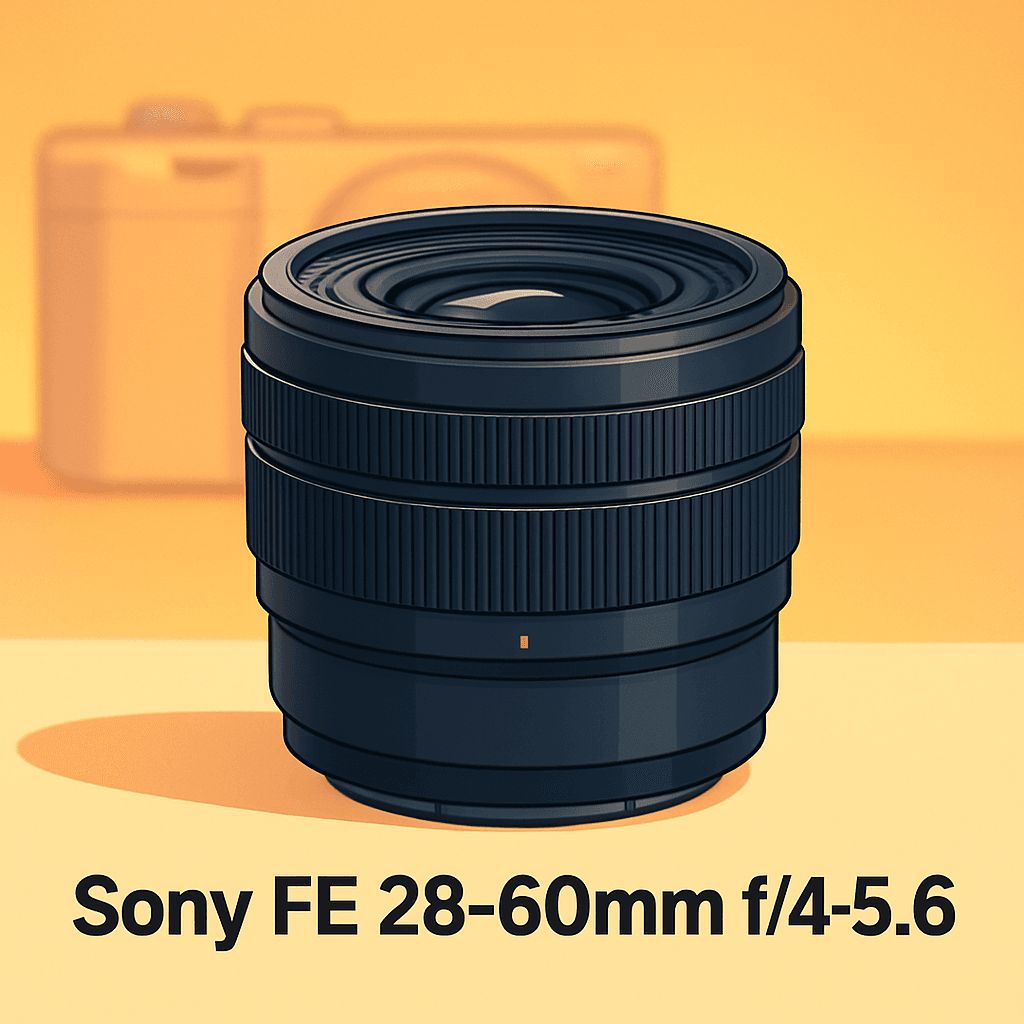
Sony FE 28-60mm f/4-5.6 SEL2860
Featherweight collapsible zoom designed for travel photographers, delivering sharp everyday images from wide-angle to short telephoto. Compact build, responsive autofocus, and dependable optical performance for landscapes, portraits, and street scenes.
Check PriceThe Numbers You Need
| Spec | Value |
|---|---|
| Focal length | 28-60 mm |
| Maximum aperture | f/4-5.6 (variable) |
| Lens mount | Sony E-mount (FE) |
| Format compatibility | Full-frame (35mm) |
| Lens type | Standard zoom |
| Minimum focusing distance | 0.3 m (approx.) |
| Maximum magnification ratio | 0.18x |
| Optical design | 9 elements in 8 groups |
| Aperture blades | 7 (rounded) |
| Filter diameter | 40.5 mm |
| Image stabilization | No (relies on in-body stabilization) |
| Autofocus motor | Linear motor (quiet and fast AF) |
| Weight | Approx. 167 g |
| Dimensions (diameter x length) | approx. 64 x 55 mm |
| Lens hood | Included (petal-shaped) |
How It’s Built
In my testing the Sony FE 28-60mm f/4-5.6 felt like a miracle of smallness — it’s ridiculously light and slips into a compact bag without weighing you down. On smaller Sony bodies it balances nicely and feels almost like an extension of the camera. On larger full-frame bodies it can look a bit toy-like, but it’s still perfectly usable for quick walks and travel days.
The build is primarily lightweight materials, yet I found the fit and finish surprisingly tight with very little play. The zoom ring moves smoothly with just the right amount of resistance and I didn’t notice any annoying wobble or creep when carrying it around. The included petal hood clicks on solidly and stays put.
Practical touches matter: the tiny 40.5mm filter thread keeps filters cheap and light, but those little filters are easy to lose in a backpack. I often use a step-up ring to match more common sizes in my kit, which makes life easier on the road.
What I really liked was the sheer portability — it makes full-frame shooting feel casual and fun. What could be better is weather protection; I didn’t find any sealing, so I’d avoid wet conditions or use a cover. That said, paired with a body that has in-body stabilization, it’s a super-handy everyday lens.
In Your Hands
The Sony FE 28-60mm lives as an everyday workhorse, covering the sweet spots for travel, street, and environmental portraits with an unobtrusive profile. Its short-to-medium zoom keeps framing flexible, but it’s not meant to replace a true wide-angle or a long reach.
Indoors and in dim light the lens’s modest, variable aperture nudges you toward higher shutter speeds and sensitivity choices, so exposure strategy matters more than usual. Mounted on a body with strong in-body stabilization it becomes surprisingly usable for handheld stills, especially in calmer scenes. On cameras without steady IBIS low-light capability is noticeably reduced.
Where it really shines is mobility: it tucks into a small bag, barely announces itself on the street, and encourages candid shooting without weighing you down. Balance is delightful on compact Sony bodies but feels front‑heavy on larger rigs, a tradeoff to consider for long handheld days.
For video the variable aperture can shift exposure when zooming unless you lock settings, and the lens relies on camera stabilization for steady pans. Close‑focus gives usable detail for lifestyle shots but won’t replace a dedicated macro. In testing it delivered consistent, predictable results across typical scenes, handled backlight modestly well, and rewarded careful composition more than optical bravado.
The Good and Bad
- Extremely compact and lightweight (approx. 167 g; approx. 64 x 55 mm)
- Quiet, fast linear-motor autofocus
- Full-frame FE coverage; practical range for everyday use
- Minimum focusing distance ~0.3 m; useful near-focus flexibility for casual close-ups
- No optical stabilization; reliant on IBIS
- Variable, relatively slow max aperture (f/4–5.6) limits low-light and subject separation
Ideal Buyer
If your priority is disappearing into a crowd with a camera that barely registers on your shoulder, the Sony FE 28-60mm f/4-5.6 SEL2860 was made for you. It’s a lens that turns a full‑frame Sony into a pocketable travel companion without sacrificing autofocus speed or full‑frame coverage.
Think travel, street, everyday carry and lightweight documentary work. It pairs best with Sony bodies that have effective in‑body image stabilization, so you can live with the lack of optical steadying. Daylight, well‑lit interiors and candid portraiture are where this lens shines.
This isn’t the lens for low‑light specialists, wedding shooters, or anyone who needs shallow depth or long reach. If you rely on ultra‑fast apertures, need beyond 60mm reach, or use a body without solid IBIS, you’ll feel the compromises quickly. Macro and critical telephoto work are also outside its comfort zone.
Buy the 28‑60 if you prize size, discretion and effortless carry over absolute speed or range. If you need stabilization, wider coverage or a faster aperture, consider stepping up to a stabilized or faster alternative instead.
Better Alternatives?
We’ve already looked closely at the Sony FE 28-60mm f/4-5.6 and what makes it special: tiny size, light weight, and a very carry‑friendly feel that suits travel and street work. That tiny footprint is the main selling point, but it also brings compromises — slower apertures, no built‑in stabilization, and a limited zoom range.
If those tradeoffs don’t fit your shooting style, there are a few common alternatives that solve different problems. Below I’ll walk through three lenses I’ve used in the field and explain where each one wins or loses compared to the 28‑60, and what kind of shooter I’d hand them to.
Alternative 1:

Sony FE 28-70mm f/3.5-5.6 OSS
Versatile standard zoom with built-in stabilization for steady handheld photos and video. Broad focal coverage, quick autofocus, and solid optics make it an ideal, budget-friendly workhorse for everyday shooting and travel.
Check PriceI’ve carried the Sony 28‑70 OSS as a walkaround lens more than once. The biggest practical difference from the tiny 28‑60 is the built‑in OSS — when you’re shooting on a body without strong IBIS or when you need steadier video at longer focal lengths, OSS makes a real, visible difference. The extra 10 mm of reach to 70mm also helps for tighter portraits without having to change lenses.
Where the 28‑60 still beats it is size and weight: the 28‑70 is noticeably bulkier in the bag and doesn’t hide on a small mirrorless body the same way. Optically they feel similar in the center for everyday shots, though the 28‑70 can hold up a touch better in the corners when stopped down. If you often find yourself handheld in low light and don’t have IBIS, the OSS and extra reach will matter more than the extra ounces.
Buy the 28‑70 OSS if you want an inexpensive, reliable standard zoom that gives you stabilization and a little more reach. It’s a good pick for hobbyists or casual travel shooters who value steadier handheld shots and slightly better flexibility over carrying the smallest possible kit.
Alternative 2:

Sony FE 24-70mm f/4 Vario-Tessar T OSS
Constant-aperture midrange zoom delivering consistent exposure and sharp edge-to-edge detail. Advanced coatings and steady-shot stabilization produce contrasty images in varied light, perfect for events, portraits, and professional travel assignments.
Check PriceThe Zeiss 24‑70 f/4 is a clear step up in image quality from the little 28‑60. I’ve used it for travel and small event work — the files look cleaner, with better edge detail and richer tonal separation, especially when you push exposure or need contrast in flat light. Starting at 24mm is helpful too: you get noticeably wider views for interiors and landscapes that the 28mm start of the 28‑60 can’t match.
Compared to the 28‑60, the Zeiss gives you constant f/4 and OSS, so exposure stays steady as you zoom and shots stay steadier handheld. That consistency is handy for video and working through changing light. The tradeoffs are obvious on the street: it’s heavier, bigger, and more expensive, so you lose the discreet, ultra‑light carry that makes the 28‑60 so appealing for long days out.
Pick the 24‑70 f/4 if you care about nicer-looking images and need 24mm for wider scenes, or if you shoot events and want predictable performance and better flare control. It’s for photographers who are willing to carry something a bit bigger for higher image quality and reliability in mixed lighting.
Alternative 3:
Sony FE 24-70mm f/4 Vario-Tessar T OSS
Reliable f/4 zoom offering precise control and smooth rendering throughout the focal range. Compact, weather-resistant construction, fast AF, and OSS-enhanced stability support demanding shooting conditions and extended handheld sessions.
Check PriceUsing the Zeiss 24‑70 for longer assignments taught me it’s a dependable workhorse — the focus is quick and steady, the coatings really help when shooting into bright sun, and the build feels more robust than the tiny 28‑60. For shoots where I need to rely on one lens for a variety of tasks, the 24‑70’s wider end and constant aperture make framing and exposure simpler and faster in the field.
That said, you pay for that sturdiness in bulk. Compared to the 28‑60, you lose discretion and the ease of slipping a lens into a jacket pocket. If you prioritize a light, invisible setup for candid street work or ultra‑compact travel kits, the 28‑60 will still be the better daily carry. The Zeiss is the choice when image consistency and handling under pressure matter more than minimalism.
Choose the Zeiss again if you’re an event, travel, or pro shooter who needs one reliable zoom that handles varied jobs without swapping lenses. If you shoot long days, in mixed weather, or want predictable results for clients, this lens is worth the extra size and cost over the 28‑60.
What People Ask Most
Is the Sony FE 28-60mm f/4-5.6 a full-frame lens?
Yes — it’s designed for full-frame E-mount cameras and also works on APS-C bodies with a crop factor.
How sharp is the Sony FE 28-60mm f/4-5.6?
Center sharpness is good in daylight, but edges and corners are softer, and it doesn’t match the resolution of higher-end zooms.
Does the Sony FE 28-60mm f/4-5.6 have optical image stabilization (OSS)?
No, it lacks OSS, so you’ll want a body with IBIS or faster shutter speeds for low-light shots.
Is the Sony FE 28-60mm f/4-5.6 good for portraits and travel?
It’s excellent for travel thanks to its tiny size and light weight, and fine for casual portraits, but it won’t give very strong background blur or excel in low light.
Is the Sony FE 28-60mm f/4-5.6 the kit lens for the Sony A7C, and is it worth buying?
Yes, it’s the A7C kit lens; it’s worth buying if you prioritize portability and price, but expect compromises in low-light performance and bokeh.
How does the Sony FE 28-60mm f/4-5.6 compare to the Sony FE 24-70mm f/4?
The 24-70mm f/4 is sturdier, sharper across the frame and has a constant aperture, while the 28-60mm is much smaller, lighter and more travel-friendly but less versatile optically.
Conclusion
The Sony FE 28-60mm f/4-5.6 SEL2860 is the kind of lens that forces a simple choice: prioritize extreme portability and near-invisibility, or accept bulk for better speed and stabilization. In practice it delivers exactly what it promises — full-frame versatility in a minimal package with autofocus that quietly gets you usable results. I find it best when it can disappear into the kit and let the photographer work without fuss.
Its strengths are obvious and honest: a tiny footprint, everyday focal range and unobtrusive handling that encourages shooting on the move. Its weaknesses are equally plain — a relatively slow variable aperture, no in‑lens stabilization, and limited reach compared with larger zooms. Those tradeoffs matter in low light and when you want more subject separation or tighter framing.
That combination gives the 28-60mm a clear value proposition for travelers, street shooters and anyone building a minimalist full-frame setup, especially on bodies with solid in‑body stabilization. If you need steadier handheld performance without IBIS, the Sony 28‑70 with OSS is a sensible alternative. If you want better overall image quality or low‑light speed and don’t mind more bulk, step up to the Zeiss 24‑70 or a faster Tamron instead.
Bottom line: buy the FE 28-60mm if ultimate lightness and discretion are your priority. Skip it if you routinely demand low‑light speed, built‑in stabilization, or more reach. Used for its intended purpose, it’s a brilliantly focused little lens.
Sony FE 28-60mm f/4-5.6 SEL2860
Featherweight collapsible zoom designed for travel photographers, delivering sharp everyday images from wide-angle to short telephoto. Compact build, responsive autofocus, and dependable optical performance for landscapes, portraits, and street scenes.
Check Price

0 Comments