
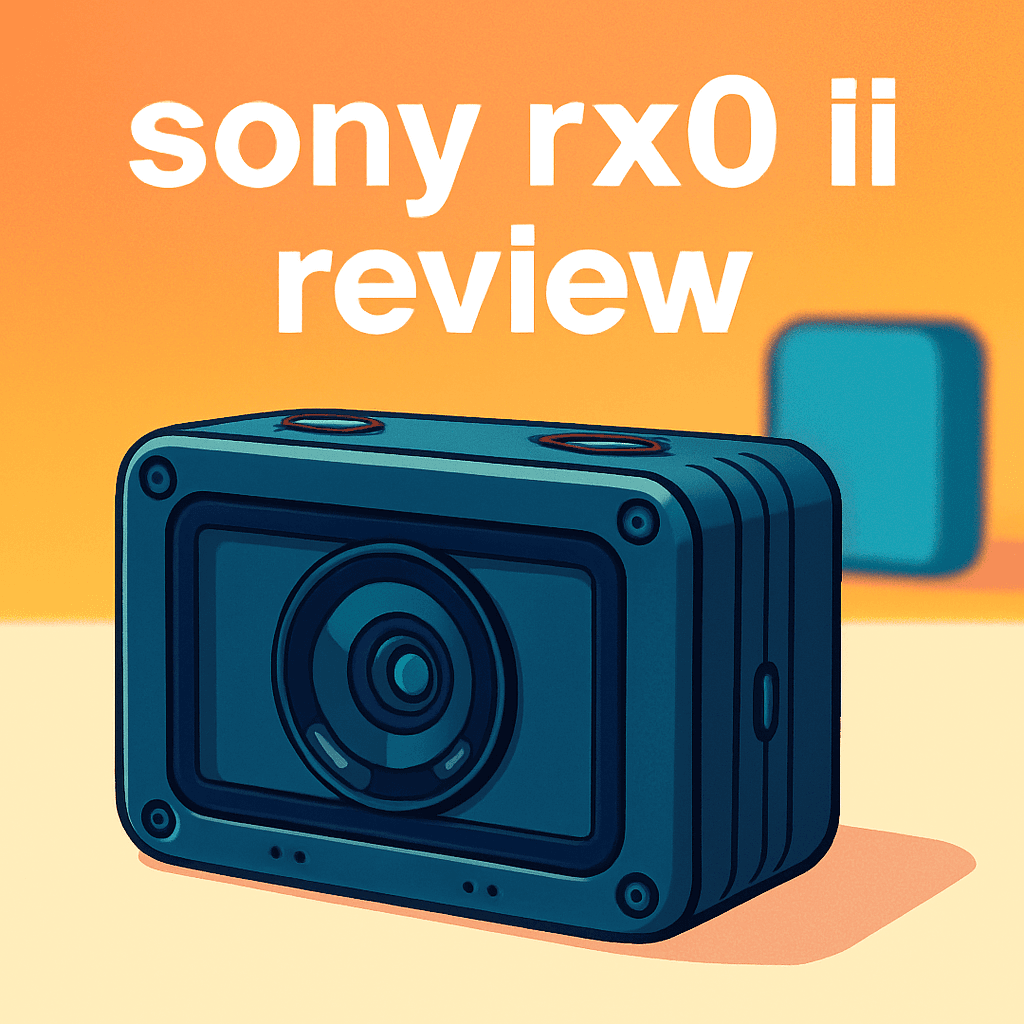
Want a tiny camera that can take a beating and still produce noticeably better footage than your typical action cam?
I’ve spent time shooting with the Sony RX0 II in real conditions to see how it performs, and it’s built around a striking core idea: ultra‑compact, ultra‑rugged body with a 1.0‑type stacked sensor and internal 4K recording.
It also offers a 180° flip‑up screen for self‑shooting, a fixed 24mm F4 lens, and electronic stabilization only — strengths that serve creators who need a mountable, indestructible shooter with better image quality than small‑sensor action cams.
There are trade‑offs — stabilization limits, a fixed wide prime, a small screen, and 4K capped at 30p — and I’ll walk you through what that means in practice, comparisons, and who should actually buy one, so keep reading.

Sony RX0 II Camera
Ultra-compact professional-grade action camera delivers outstanding image quality, 4K video, flip LCD for vlogging, rugged waterproof and crushproof design, advanced image stabilization and creative shooting modes for versatile capture.
Check PriceThe Numbers You Need
| Spec | Value |
|---|---|
| Sensor | 1.0-type stacked Exmor RS CMOS |
| Effective resolution | 15.3 megapixels |
| Video recording | Internal 4K UHD up to 30 fps |
| LCD screen | 1.5-inch flip-up, 180° tilt for vlogging |
| ISO range | 80–12800 (expandable to 40–25600) |
| Image stabilization | Electronic SteadyShot (EIS) only |
| Waterproof | Up to 10 meters (33 feet) without housing |
| Shockproof | Drop resistant from 2 meters (6.6 feet) |
| Lens | Fixed ZEISS Tessar T* 24mm F4 wide-angle lens |
| Shutter speed | 1/32000 to 30 seconds |
| Continuous shooting | Up to 16 fps |
| Connectivity | USB-C, micro HDMI, Wi-Fi, Bluetooth |
| Dimensions | Approx. 59 x 40.5 x 35 mm |
| Weight | Approx. 132 grams (body only) |
| Storage | SD/SDHC/SDXC card compatible with UHS-I support |
How It’s Built
In my testing the Sony RX0 II feels like a tiny workhorse — it’s small enough to hide anywhere and tough enough to actually survive being shoved into odd places. That means you can mount it on helmets, drones, or rigs without adding bulk, and it disappears in shots where bigger cameras scream “look at me.” For beginners that freedom is huge: you get pro-quality shots from places you couldn’t before.
The flip-up screen is a real practical win for vlogging and framing tight shots. I found it helpful for quick self-recording and low-angle setups, though in bright sun it can be hard to see clearly. In the field I still reached for a loupe or shaded my hand sometimes to get the framing right.
The fixed wide-angle F4 lens shapes what you can shoot in a simple way. I liked how natural and immersive POV and landscape shots felt, but you don’t get zoom or creamy background blur, and low-light work asks for more care with exposure and mounting.
Ports and wireless options make it easy to offload files or feed footage out, and the covers seal up solidly to keep water and dust out. One thing that could be better is those port doors — they’re tight and fiddly with gloves, so plan for that when shooting in cold or wet conditions.
In Your Hands
In handheld use the Sony RX0 II feels like a tiny workhorse — its diminutive, rock‑solid body lets you tuck it into places larger cameras simply can’t reach. The compact controls and small flip screen are intuitive after a few minutes, though they can be fiddly with gloves or in fast, messy shoots. Sealing and rugged construction meant I could shrug off rain, dust, and the occasional bump without a second thought.
Electronic stabilization steadies casual walk‑and‑talks and POV mounts impressively, cutting the need for heavier rigs on short runs. Push it into aggressive action and you’ll encounter the usual digital artifacts — slight warping or micro‑jitter — but a thoughtful mount and smooth operator inputs keep that mostly out of frame. On a tripod the camera is rock steady and static framing remains crisp, with no post‑processing surprises.
To maximize real‑world results pair the RX0 II with low‑profile clamps, chest or helmet mounts, or a lightweight gimbal rather than relying on handholding alone. For fast bursts I prefocus and use short, deliberate shooting cadences to catch decisive moments without hunting for focus, and in dim scenes I favor steady support or added light while exposing conservatively to protect highlights and minimize aggressive noise reduction. The camera is predictable and dependable in the field — a few small operational quirks are easy to work around given its go‑anywhere reliability.
The Good and Bad
- Ultra-compact, ultra-rugged body (waterproof, shockproof, crushproof)
- 1.0-type stacked sensor for a tiny form factor
- Internal 4K UHD up to 30 fps
- 180° flip-up LCD for self-shooting/vlogging
- Electronic stabilization only (no optical/IBIS)
- Fixed 24mm focal length; F4 aperture limits low-light flexibility and depth-of-field control
Ideal Buyer
If you’re a creator who needs a camera that disappears into the scene yet survives anything, the Sony RX0 II is for you. It’s tiny, bomb‑proof and can be tucked into rigs, helmets, or tight mounts where full‑size cameras won’t fit.
Photographers and filmmakers who want better image character than a typical tiny action cam will appreciate its 1.0‑type sensor and ZEISS 24mm prime. The fixed wide view encourages POV storytelling, travel vlogging, and behind‑the‑scenes coverage with minimal fuss.
Use it as a stealth B‑cam, multi‑angle rig camera, or a durable solo vlogging tool when size and survivability matter more than zoom. The flip‑up screen and internal 4K make framing and delivery simple in fast workflows.
It’s less ideal for shooters who demand class‑leading stabilization, optical zoom, or higher‑frame‑rate 4K for slow motion. If you prefer big screens and traditional ergonomics, the RX0 II’s minimal controls and tiny monitor can feel limiting.
Choose the RX0 II when stealth, mountability, and rugged reliability unlock shots other cameras can’t get. For punchy, wide‑angle captures from impossible positions, it’s a concise professional tool that simplifies setup and survives abuse.
Better Alternatives?
We’ve already dug into what makes the Sony RX0 II special: that tiny, rock‑solid body, the fixed wide ZEISS lens, and the trade‑offs that come with such a focused design. You know it’s great when you need a camera that can be shoved into odd places, take a knock, and still give surprisingly nice images for its size.
But if you find yourself wanting smoother motion, more lens options, longer shoots, or easier workflows for action and social content, there are a few cameras worth looking at. Below are three alternatives I’ve used in the field and how they stand up against the RX0 II in real shooting situations.
Alternative 1:

Insta360 ONE R 1 Inch Camera
Modular 1-inch-sensor system produces stunning low-light detail and cinematic 5K footage, Leica-tuned optics, FlowState stabilization, waterproof durability and seamless smartphone editing for effortless, immersive content creation.
Check PriceI’ve shot with the Insta360 ONE R 1‑inch module a lot when I wanted cleaner low‑light footage and smoother handheld movement than the RX0 II often gives. The FlowState stabilization is noticeably better for long, moving shots — walking or running footage is cleaner and less jittery without needing a separate gimbal. In practice that means fewer ruined POV clips when you’re on the move.
Where it loses to the RX0 II is in simplicity and size. The ONE R’s modular setup is great for swapping lenses or adding a 360 head, but once stacked it’s bulkier and harder to tuck into tiny mounts or cram into tight rigs. I also found the ONE R needs a bit more care with waterproofing and attachments if you want full durability in rough environments — the RX0 II feels more “grab and go” tough.
If you’re a creator who wants better handheld video, easy mobile edits, and the option to swap modules for different looks, the ONE R makes sense. If your priority is the smallest, most indestructible camera to mount in weird places, you’ll probably stick with the RX0 II instead.
Alternative 2:

GoPro HERO12 Black Camera
Flagship action cam delivers ultra-smooth HyperSmooth stabilization, crisp high-resolution footage, extended battery life, superior low-light performance, waterproof ruggedness and versatile mounting options for fearless outdoor and sports videography.
Check PriceFor pure action shooting, I reach for a GoPro before the RX0 II when I need rock‑steady footage straight out of the camera. HyperSmooth stabilization and horizon lock make bike, ski, and moto shots look clean and worry‑free, so you can focus on the run instead of your rig. The mount ecosystem is also unbeatable — there’s always a clever way to attach a GoPro to a helmet, bar, or board.
The trade‑off is image character and some low‑light nuance. In dim interiors or when I want the slightly richer look from a larger sensor, the RX0 II’s image tends to hold up better. I also find the GoPro’s tiny lens gives a different look than the RX0 II’s ZEISS wide — it’s more “action cam” and less like a small cinematic camera.
Pick a GoPro if you shoot lots of sports and want the easiest, most reliable stabilization and mounting options. If you need a camera that will survive extreme abuse and give you that 1‑inch sensor look in tight mounting spots, the RX0 II still has the edge.
Alternative 3:
GoPro HERO12 Black Camera
Designed for creators seeking pro-level results, it offers autofocus, 10-bit color, advanced timelapse and live-streaming capabilities, quick voice controls, intuitive app workflow and durable build to capture every adrenaline moment.
Check PriceI’ve used the HERO12 in a few creator‑level gigs where live streaming, color flexibility, and easy in‑camera timelapse were needed. The workflow from shooting to phone edit is fast, and features like better color profiles and autofocus make it easier to get good-looking clips without heavy grading. For quick turnaround content, that beats the slower, more deliberate RX0 II workflow.
Still, the HERO12 isn’t a direct swap for the RX0 II if your job needs the smallest possible camera that can take real knocks. The RX0 II’s build and the feel of its images can be preferable for controlled shoots, mount‑tight POVs, or situations where you need a tiny footprint and a more “photo‑like” readout from the sensor.
Choose the HERO12 when you want modern creator tools — live streaming, easy color control, and autofocus that just works — and when your shoots are action‑heavy. Choose the RX0 II if you need that ultra‑compact durability and the slightly different image character that comes with its fixed ZEISS lens and 1‑inch sensor in a much smaller package.
What People Ask Most
Is the Sony RX0 II worth buying?
Yes—if you need an ultra-compact, rugged camera for action, vlogging, or as a secondary rig; just be aware of its fixed wide lens, limited battery life, and modest low-light performance.
How good is the image quality on the Sony RX0 II?
Very good for a 1‑inch sensor: sharp images and clean color at low ISO, but dynamic range and high‑ISO performance fall short of larger‑sensor cameras.
Does the Sony RX0 II shoot 4K video?
Yes, it records internal 4K up to 30p and supports S‑Log2 for grading, with clean HDMI output for external recorders.
Is the Sony RX0 II waterproof and rugged?
Yes—it’s waterproof to 10 meters (33 ft), shockproof from about 2 meters, and built to handle rough use without extra housing.
Does the Sony RX0 II have a flip screen for vlogging?
Yes, it has a 180° tilting LCD that flips up for selfie framing, though the screen is small and not fully articulating.
What is the battery life of the Sony RX0 II?
Battery life is short—expect under an hour of continuous 4K recording and limited stills per charge, so carry spare batteries for extended shoots.
Conclusion
The Sony RX0 II Camera is a rare, unapologetic tool: tiny, bomb‑proof, and built to go where normal cameras can’t. It pairs a surprisingly capable 1.0‑type stacked sensor and a fixed wide prime with internal 4K recording to deliver usable stills and video from extreme positions. It’s purposefully simple, trading bells and whistles for a footprint that disappears on rigs and in covert setups.
Its real strengths are practical and straightforward. Stealthy mounting, true durability, and a nicer sensor character than run‑of‑the‑mill action cameras mean cleaner color and more usable detail in controlled shoots.
But it isn’t a do‑everything device. Electronic‑only stabilization and a single wide‑angle focal length limit handheld smoothness and low‑light flexibility. The 4K ceiling at 30p and the small monitor further tighten its practical range.
Buy the RX0 II if your priority is invisibility, indestructibility, and better-than-action-cam image character in tight or hazardous mounts. Choose something else if you need strong stabilization, zoom range, longer takes or a friendlier action ecosystem. For the right use cases it’s a niche hero; for everything else it’s a clever compromise.
Sony RX0 II Camera
Ultra-compact professional-grade action camera delivers outstanding image quality, 4K video, flip LCD for vlogging, rugged waterproof and crushproof design, advanced image stabilization and creative shooting modes for versatile capture.
Check Price


0 Comments