
You’ve wanted to capture candid, decisive moments without bulky gear getting in the way. If you’ve ever asked what camera did henri cartier bresson use, you’re not alone. You’ll see why a black, low-profile body mattered for invisibility in crowded streets, and how simple tweaks reduced glare.
This piece walks through the Leicas he favored and how his pared-down kit made framing faster and less intrusive, so you’ll get sharper shots and fewer missed moments. You’ll also find practical tips for discreet shooting, minimal lens choices, and a faster, clearer workflow you can try today. We’ll also debunk a persistent myth about focal choices that leads many newcomers astray.
If you’re a street photographer, travel shooter, photo student, or teacher, you’ll find usable lessons in the gear story. If you’re an intermediate shooter trying to simplify your kit and improve timing, this guide’s for you. You’ll see how small choices mattered—keep reading because the fix is simpler than you think.
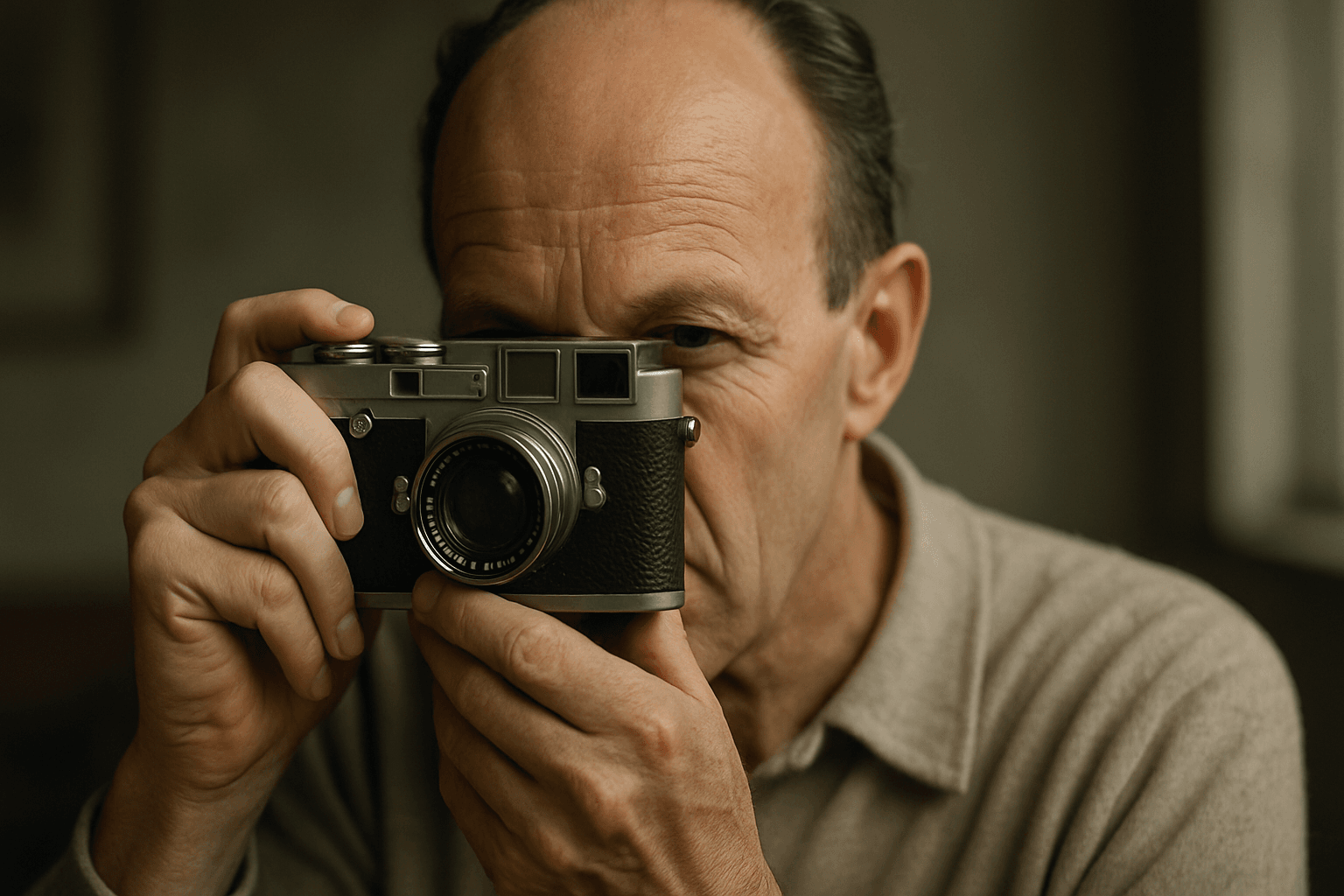
Leica Cameras Cartier-Bresson Used (chronological)
If you’ve ever wondered what camera did Henri Cartier-Bresson use, it begins with three compact Leicas that shaped his vision. Their small size and quiet shutters made invisibility possible.
- Black Leica I
- Leica II with built-in rangefinder
- Leica M3
Each step added a tool that refined his rhythm. The Leica I taught discretion, the Leica II tightened focus, and the M3 delivered bright, accurate framing without slowing him down.
For a deeper dive into his bodies and timelines, you can read more on Leica and skim a concise camera timeline. So, what camera did Henri Cartier-Bresson use evolves from stealth to precision.
Leica I
The black Leica I was his early companion in the 1930s, and that dark finish mattered. In crowded streets, chrome gleams attract attention; matte black quietly disappears.
With a viewfinder separate from the lens, he learned to anticipate. That anticipation nurtured timing, letting him compose, step, and press the shutter without breaking the social spell.
Leica II
The Leica II added a built-in rangefinder, which means a focusing window that aligns two images to confirm sharpness. It improved speed and accuracy when scenes unfolded fast.
Suddenly, he could pre-focus more confidently while walking. That extra certainty reduced hesitation, which is everything when a gesture lasts a heartbeat and never returns.
Leica M3
Later, the Leica M3 became a staple. Its bright viewfinder and framelines offered clear composition, especially for the 50mm, which matched his way of seeing.
The shutter was smooth and quiet, encouraging close work. With fewer distractions in the viewfinder, he could ride the flow of a scene like a dancer.
Why the 50mm Became His Go‑to Lens
The 50mm lens offers a field of view close to how we perceive space. That familiarity helped him build honest frames, without compression or distortion calling attention to themselves.
He used the 50mm as a discipline. Keeping one perspective, he moved his feet, refined timing, and learned how light, gesture, and geometry meet in the decisive moment.
Working with one prime also accelerates focus decisions. At f/8, he often zone focused—pre-setting a distance and aperture so most of the scene stayed sharp while he concentrated on timing.
Other Focal Lengths He Experimented With
He occasionally reached for a 35mm Summicron, which widens the scene and invites context. With wider lenses, you must move closer, making presence part of the composition.
At times he explored longer lenses, like a 90mm, to compress space and isolate a subject. Telephotos change the conversation, creating layers but also increasing the distance from life.
Changing focal lengths shifts your body and your behavior. He returned to the 50mm because it balanced intimacy and order, letting lines, moments, and people relate naturally.
Cameras Beyond Leica: Exceptions and Context
Early on, he dabbled with simple box cameras and, later, a movie camera while assisting Jean Renoir. Motion taught him to anticipate choreography inside the static frame.
There are scattered stories of borrowed medium-format cameras for specific tasks, but those are outliers. The overwhelming record shows Leica was home base, not a passing phase.
His consistency appears plainly in his Magnum profile, which emphasizes 35mm rangefinders as his signature tools. Exceptions existed, but they never defined his approach.
How Equipment Shaped the “Decisive Moment” Style
Minimal gear trims mental noise. With a small rangefinder and a fast 50mm, he could walk, watch, and wait, letting composition coalesce without fumbling settings or bags.
Quiet shutters invite proximity, and proximity invites truth. The less you disrupt a scene, the more human rhythms continue, giving that invisible fraction when everything clicks.
So when people ask, what camera did Henri Cartier-Bresson use, I answer: tools that never argued back. Simplicity cleared the path for timing, geometry, and empathy.
Discreet‑Shooting Techniques and Camera Modifications
He favored black finishes and sometimes darkened shiny parts with tape. Reduced reflections matter in street work, where a glint can break a subject’s flow or glance.
He kept straps short, cameras tight to the body, and movements economical. Pre-focusing at common distances—one, two, or three meters—made the camera feel nearly instantaneous.
Comparative Analysis with Other Photographers of His Era
Contemporaries like Dorothea Lange and Weegee often used large press cameras with flash. Those tools command authority but announce themselves, shaping subjects’ behavior immediately.
Robert Capa embraced 35mm too, chasing action with compact rangefinders. Yet Cartier-Bresson leaned harder into quiet observation, letting composition emerge without the theatrics of flash or bulk.
Compared with studio or tripod-based work, his handheld approach prioritized mobility. The result was agile geometry, where lines, frames, and people align before the mirror fogs.
Influence on Modern Photography Education and Practice
Many classes still assign a month with a single 50mm. The constraint echoes his practice, forcing students to move, negotiate distance, and feel perspective shifts in their bones.
Workshops emphasize small cameras, silent shutters, and pre-focusing. These habits boost attention to gesture and light, not menu diving or lens swapping during peak moments.
Educators cite his contact prints and consistent field of view as teaching tools. Repetition breeds mastery, and mastery frees your eye for timing and empathy.
Practical Tips for Photographers Emulating Cartier‑Bresson
Pick one prime—start with a 50mm—and commit for a season. Learn its distances, practice zone focus, and let your feet handle “zooming” until it feels natural.
Keep your kit lean: one body, one lens, spare batteries, and a pocket notebook. Quiet your presence with dark tape on chrome and a short, unfussy strap.
Walk slowly, pre-focus, and let scenes build before your eyes. When the pieces align, breathe out and press gently. In time, you’ll answer your own what camera did Henri Cartier-Bresson use.
What People Ask Most
What inspired Cartier‑Bresson to choose Leica cameras?
I’d say he favored Leicas for their compact, quiet bodies and the way they let him stay invisible on the street; the built‑in rangefinder (a simple focusing aid separate from the lens) and a fast 50mm lens made quick framing and focusing natural.
How did his use of a single lens influence his photography style?
Using primarily a 50mm forced him to move, simplify compositions, and anticipate moments, which I teach as a great way to develop a strong eye for decisive framing.
Did Cartier‑Bresson ever use autofocus cameras?
No—autofocus arrived after his formative years; he worked with manual‑focus rangefinder Leicas throughout his career rather than modern autofocus bodies.
What are some notable photographs taken with his preferred equipment?
Many of his best‑known decisive‑moment street images and reportage pictures were made with his black Leica I, the Leica II, and later the M3 using a 50mm, and you can find these widely reproduced in his books and the Magnum archive.
Was Cartier‑Bresson’s background in painting influential in his photography?
Yes—his painting training shaped his sense of geometry, line, and composition, and I often point out how that visual education translates directly into his careful framing and timing.
How did Cartier‑Bresson’s equipment choices compare to other photographers of his time?
Unlike contemporaries who used larger‑format or heavier SLR rigs, he kept gear minimal and compact with rangefinder Leicas and a single prime, which I note made him more mobile, discreet, and composition‑focused.
Wrapping Up: Cartier‑Bresson’s Gear and the Decisive Moment
If you came in wondering what camera did henri cartier bresson use, the article gives that answer and — more importantly — the why behind it, so you’re not stuck on specs alone. By tracing his choices and methods we solved the opening itch: you now see how simple gear supported a way of seeing, not the other way around.
The core insight is that restraint — a single, familiar optic and unobtrusive handling — sharpened his attention to composition and timing, which any photographer can apply. That doesn’t mean gear is irrelevant; don’t expect a camera swap to fix weak observation or timing, and be ready to adapt when light and access limit your ideal approach. Street photographers, documentary shooters, and students of composition will benefit most from this mindset because it turns technical decisions into choices that serve vision.
Think back to that opening curiosity: instead of chasing gear, try paring down and rehearsing your eye until timing becomes second nature. With practice and small, deliberate limits you’ll find the decisive moments you’ve been trying to capture.


0 Comments