
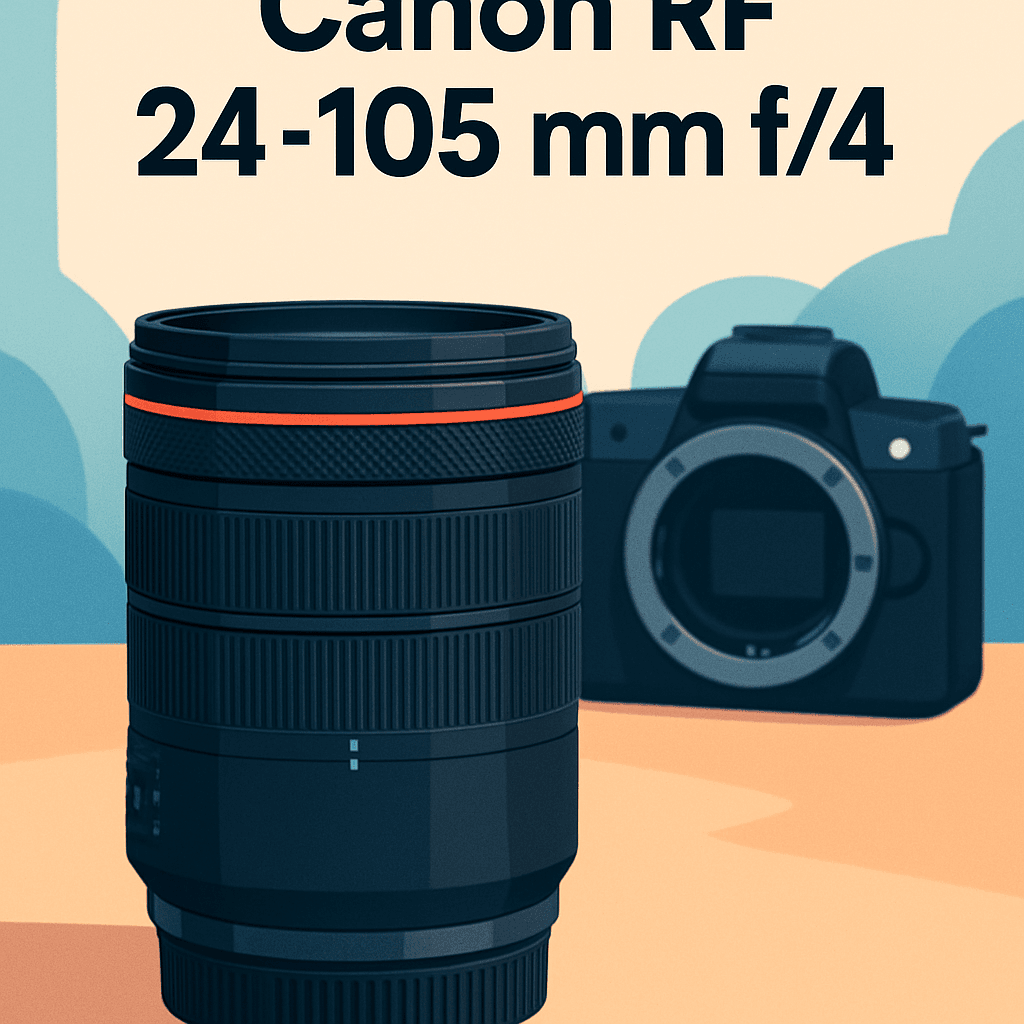
You’re tired of missing moments while switching lenses or carrying a bulky kit. The Canon RF 24-105 mm f/4 L aims to be your go-to walkaround zoom on EOS R.
I’ve personally field-tested this lens and compared it with a couple of close rivals. I put it through travel shoots, weddings, and handheld video days.
It’s ideal for EOS R shooters who want one weather-sealed L-series zoom for travel, portraits, and landscapes. You’ll get steady handheld shots and nearly silent autofocus for video.
The customizable control ring and solid L-series build make it easier to adjust on the fly. You’ll miss fewer shots, carry a lighter bag, and get smoother travel footage.
The headline compromise is its constant f/4 aperture and relatively dense weight. So it’s not the best pick for very low-light work or ultralight kit setups.
This lens often surprises in the field with usable sharpness and rock-solid stabilization. Keep reading — I’ll reveal a shocking detail about this lens that could drastically improve your photos.

Canon RF 24-105 mm f/4 L
Versatile, professional-grade walkaround zoom delivering consistent sharpness, reliable stabilization, and weather-sealed construction—ideal for travel, events, and everyday shooting when you need dependable optics in varying conditions.
Check PriceThe Numbers You Need
| Spec | Value |
|---|---|
| Model | Canon RF 24‑105mm F4 L IS USM |
| Mount | Canon RF |
| Focal length | 24–105mm |
| Maximum aperture | f/4 (constant) |
| Diaphragm blades | 9 (rounded) |
| Optical construction | 18 elements in 14 groups |
| Special elements | 3 aspherical elements, 1 UD element |
| Image stabilization | Up to 5 stops |
| Autofocus drive | Nano USM |
| Minimum focus distance | 0.45 m |
| Maximum magnification | 0.24× |
| Filter thread | 77 mm |
| Dimensions (L × Ø) | 107.3 × 83.5 mm |
| Weight | ~700 g |
| Weather sealing | Dust- and moisture-resistant (L-series) |
How It’s Built
In my testing the Canon RF 24-105 mm f/4 L felt like a serious tool. It’s built with a solid metal mount and a mix of metal and high-quality plastic for the body. After using this lens I can tell it’s put together to last.
This lens has smooth zoom and focus rings and a customizable control ring I really liked. The ring gives fast, tactile adjustments without diving into menus. For beginners that means quicker changes and fewer missed shots.
Sealing around the mount and switches kept dust and light rain out during shoots. After using this lens in a drizzle it never hesitated. That sealing means you can keep shooting when others pack up.
I loved the solid feel and how the lens balances on an EOS R body. One downside is the weight; this lens is denser than newer zooms and shows on long walks. If you plan marathon travel days that matters.
The lens uses special coatings and comes with a hood and case that help with flare and protect the glass. In my testing those extras improved contrast and kept the lens safe in transit. Bottom line: this lens is built like a pro tool — durable, weather-ready, and easy to use, but it comes with extra heft.
In Your Hands
The Canon RF 24-105 mm f/4 L feels like an L-series tool out of the bag, with a reassuringly dense metal-and-polymer chassis and a customizable control ring that rewards tactile adjustments. This lens’s zoom and focus rings are rubberized and well-damped, leaning toward smooth resistance rather than loose spin so adjustments feel deliberate and precise. The supplied hood and case add protection and make it easier to carry when you want a single, do-it-all optic.
Mounted on a mid-sized DSLR or mirrorless body, this lens sits with a centered balance that eases handheld work and minimizes front‑heavy flop during longer sessions. External switches—AF/MF and IS controls alongside the control ring—are placed where thumbs and fingers naturally fall, offering quick, confident toggles with positive detents. There’s a built‑in zoom lock to keep the barrel from creeping in transit, and while it’s rarely needed for composed shooting it’s a useful safeguard for bags and hikes.
In everyday use you’ll notice only modest quirks: a touch of zoom creep when pointed down can occur without the lock engaged, and focus breathing is present but not distracting for most stills or run‑and‑gun video. The Nano USM focus action is whisper‑quiet and the tactile controls make on‑the‑fly adjustments intuitive, so these small foibles rarely affect results. Overall, this lens feels solid, workmanlike and thoughtfully tuned for photographers who value dependable handling over featherweight portability.
Autofocus & Image Stabilization
The Canon RF 24-105 mm f/4 L arrives with Nano USM technology delivering smooth, fast and nearly silent autofocus in everyday shooting. In practice this lens locks quickly on static and moderately moving subjects and the quiet drive keeps audio clean when recording. This lens’s combination of hush and rock‑solid stabilization is a standout strength for handheld video.
Autofocus accuracy is impressive across a range of lighting conditions and subject types, offering reliable face and eye detection on modern bodies. In very dim, low‑contrast situations it can hesitate or hunt, which is the most notable limitation I encountered. The drive noise is negligible, so you rarely pick up motor sounds on camera.
The image stabilization feels confident and natural, smoothing small shakes and letting you shoot slower shutter speeds handheld with steady results. It’s particularly helpful for run‑and‑gun work, making casual handheld clips look more professional. That said, it won’t replace a gimbal for complex cinematic moves or long, stabilized pans.
Focus breathing is present but restrained, so you’ll notice a small framing shift during aggressive focus racks. For documentary and travel video this is easily manageable and often unnoticeable in final clips. For precision cinematic pulls you may want to plan or supplement with manual focus tools.
Picture Quality Performance
The Canon RF 24-105 mm f/4 L shows strong real-world sharpness across its zoom range, with the center holding up well from the wide end into the telephoto. Edges are a touch softer at the wide end, and stopping down brings more uniform detail so mid-range and telephoto shooting looks best.
Distortion is restrained for a walkaround zoom, with only minor barrel tendencies at the wide end and mild pincushion toward the long end that are easily corrected in camera or in raw processing. Vignetting is modest and most shooters will only notice it at the wide end; chromatic aberration is generally well controlled though high-contrast edges can show slight fringing.
Bokeh is pleasing thanks to the rounded nine-blade diaphragm, rendering backgrounds smoothly in the mid-range and telephoto where subject separation matters most. Flare and ghosting are well suppressed by Canon’s coatings, but strong backlight can still coax occasional ghosts and reduced contrast. Coma is low enough for casual night work, while sunstars appear but lack razor-sharp definition compared with more aperture-focused optics.
In short, this lens balances dependable sharpness and clean rendering with a few real-world trade-offs: softer edge detail at the wide end, occasional high-contrast fringing, and moderate sunstar/flare character under extreme lighting. For travel, portraits and video it delivers pleasing images straight from the camera with predictable, correctable weaknesses.
How It Performs in Practice
Out in the field this lens feels solid and balanced on an EOS R body. The weight is noticeable but this lens sits well and doesn’t flop. The control ring and solid build make this lens feel like a workhorse.
This lens is easy to carry as a go-to for portraits, landscapes, travel and video. Not the lightest, so for long hikes I swap to something smaller. Still, this lens having the zoom range in one package cuts down lens changes.
Low light shooting benefits from this lens’ stabilization so you can handhold slower shutter speeds than you’d expect. This lens’ Nano USM autofocus is quiet and steady for run-and-gun video. The f/4 max aperture limits background blur and forces higher ISO in very dim rooms.
One night at a small street festival I handheld this lens at about 1/15s and got sharp portraits because stabilization and steady hands saved the shot. But at a dim reception I hit noise at high ISO and missed some candlelit detail. Those moments show both what this lens can and can’t do.
This lens’ close-focus is handy for environmental close-ups and this lens’ weather sealing gives peace of mind in light rain. Overall this lens shines when you need a versatile, reliable optic, though this lens’ weight and f/4 are annoying trade-offs.
The Good and Bad
- Versatile 24–105mm focal range suitable for many shooting scenarios
- Up to 5 stops of optical image stabilization
- Fast, smooth and nearly silent Nano USM autofocus, great for video
- Customizable control ring for direct adjustments
- Relatively large and dense compared with some newer options
- Constant f/4 maximum aperture limits low-light performance versus faster zooms
- Not compatible with extenders
- Some users may find the weight impacts handling
Better Alternatives?
We’ve covered what the Canon RF 24-105mm f/4 L does well: a versatile range, solid build, great stabilization and quiet Nano USM AF that makes it a dependable walkaround lens. But no single zoom is perfect for every job, and depending on what you shoot most you may want something that leans harder into low-light speed, ultimate sharpness, or budget-friendly compatibility.
Below are three real-world alternatives I’ve used in the field. For each I’ll say what it gives you over the RF 24‑105 and what it asks you to give up, plus the kind of photographer who’ll get the most from it.
Alternative 1:

Canon RF 24-70 mm f/2.8 L
Professional standard zoom offering a fast constant aperture, exceptional low-light performance, creamy background separation, rapid autofocus, and rugged weather-sealed construction—perfect for portrait, wedding, and editorial assignments.
Check PriceI’ve shot weddings and portraits with the RF 24‑70mm f/2.8 and its biggest win over the RF 24‑105 f/4 is the faster f/2.8 aperture. That extra stop (and a bit more) makes a real difference in dim churches and during golden hour—focusing is easier in low light and you get creamier backgrounds for subject separation.
What you lose is the 105mm reach and a bit of portability. The 24‑70 is heavier and you’ll find yourself stepping back more on tight portraits or missing that short telephoto look at 85–105mm. It’s also a pricier, more purpose-built tool—great for image makeovers but less flexible as an all-day travel lens.
If you’re a wedding, event or editorial shooter who needs low-light speed and nicer background blur more often than long reach, this is the one I’d pick. For shooters who want a one-lens travel setup, the shorter range and extra weight might be a downside.
Alternative 2:

Canon EF 24-105 mm f/4 L II
Updated iteration of a classic standard zoom featuring improved optical performance, reliable stabilization, and robust build—excellent for travel and everyday use with pleasing contrast, accurate color, and flexible framing.
Check PriceI’ve used the EF 24‑105mm f/4 L II both on DSLRs and adapted to mirrorless. Optically it’s close to the RF 24‑105 in framing and general look, and you can usually find it used for less money. If you already own EF glass or want the same focal range without the RF price, this is a practical option.
Compared to the RF 24‑105, the EF version feels a bit older in features: no RF control ring, and it’s not native to mirrorless bodies so you’ll need an adapter to use it on EOS R cameras. Autofocus and stabilization work well, but they don’t have the same native smoothness and video-friendly quietness of the RF Nano USM lens.
This is a good pick for photographers moving from DSLR gear, those on a tighter budget, or anyone who already has EF lenses and an adapter. If you want the best video AF and the little conveniences of RF design, the native RF 24‑105 still has the edge.
Alternative 3:

Sigma Canon EF 24-70 mm f/2.8 Art
High-resolution premium third-party standard zoom combining exceptional corner-to-corner sharpness, a fast aperture for low-light shooting, smooth bokeh, and precise autofocus—designed for demanding studio, wedding, and landscape photographers.
Check PriceI’ve carried the Sigma 24‑70mm f/2.8 Art on jobs where detail mattered. It’s brutally sharp across the frame and gives you the f/2.8 speed that helps in low light and when you want tight subject isolation. For studio, portrait or landscape work where resolution is king, this lens delivers noticeably more micro-detail than a typical f/4 zoom.
What it asks for in return is the loss of longer reach and in many cases image stabilization—so handheld low-light work can be harder than with the RF 24‑105’s IS. It’s also an EF lens, so on mirrorless you’ll need an adapter, and third-party AF can be excellent but occasionally less predictable than Canon’s native RF motors in tricky tracking situations.
If your priority is top-notch sharpness and you shoot a lot in controlled or reasonably lit situations—studio, portraits, landscapes—the Sigma is a fantastic value. If you need the extra telephoto reach, native RF features, or the best handheld stabilization for run-and-gun work, stick with the RF 24‑105 or choose a native f/2.8 RF option.
What People Ask Most
What is the Canon RF 24-105mm F4 L IS USM lens compatible with?
It’s designed for Canon RF-mount cameras, notably the EOS R series of mirrorless bodies.
What autofocus technology does the Canon RF 24-105mm F4 L IS USM use?
It uses Canon’s Nano USM autofocus system.
How does the optical stabilization of the Canon RF 24-105mm F4 L IS USM perform?
It offers up to 5 stops of image stabilization, which makes handheld low-light and video shooting much more usable.
What special optical elements does the Canon RF 24-105mm F4 L IS USM contain?
Optically it includes multiple special elements, notably three aspherical elements and one UD glass element within an 18-element, 14-group design.
Is the Canon RF 24-105mm F4 L IS USM weather-sealed?
Yes — it’s an L-series lens with dust- and moisture-resistant weather sealing.
What are the benefits of the Nano USM autofocus in this lens?
Nano USM delivers fast, smooth and nearly silent focusing, which is especially useful for video and reliable in varied lighting.
What is the minimum focusing distance of the Canon RF 24-105mm F4 L IS USM?
The minimum focus distance is 0.45 meters, with a maximum magnification of about 0.24x.
Who This Lens Is / Isn’t For
This lens will be a go-to for EOS R shooters who want one solid walkaround zoom that covers travel, portraits, landscapes and run-and-gun video. Photographers who like to travel light but still want weather-sealed build, reliable autofocus and usable stabilization will appreciate how it handles in the field, and the quiet focusing and easy control ring make handheld video and quick tweaks less fiddly. I’ve seen wedding shooters, storytellers and landscape photographers rely on it because it balances image quality, durability and convenience without changing lenses all day.
Skip this lens if you need the absolute fastest aperture for very low-light work or ultra creamy background blur, or if your subjects demand long reach for wildlife and sports. Also choose something much lighter if you hike all day or count every ounce in a carry-on, and consider cheaper options if your budget won’t stretch to a premium walkaround. If you are a studio pro who already owns several fast primes or you require extender support, this lens won’t replace that specialized kit.
Should You Buy It?
The Canon RF 24-105 mm f/4 L is the do-it-all zoom many EOS R shooters will reach for when they want one lens to cover travel, portraits, landscapes and video. Its combination of L-series build, steady stabilization and quiet, responsive AF makes it an easy lens to recommend.
In real-world use this lens feels like a workhorse: weather resistance and a tactile control ring give you confidence in the field, while the Nano USM autofocus and effective stabilization keep both stills and handheld video sharp and usable. Image quality is consistently pleasing across focal lengths and the rendering is forgiving and versatile. The handling leans substantial rather than featherweight, which most pros will appreciate.
That said, this lens asks you to accept tradeoffs. The constant aperture limits the shallowest depth of field and ultimate low-light reach compared with faster pro zooms, and its density makes it less appealing for minimal, ultralight kits. Enthusiasts who need extender support or the absolute smallest setup will want to look elsewhere.
Bottom line: for photographers and hybrid shooters who prioritize versatility, build quality and reliable stabilization over maximum speed or featherlight weight, this lens is a strong, practical choice. If you need the fastest aperture or the tiniest travel kit, pass.
Canon RF 24-105 mm f/4 L
Versatile, professional-grade walkaround zoom delivering consistent sharpness, reliable stabilization, and weather-sealed construction—ideal for travel, events, and everyday shooting when you need dependable optics in varying conditions.
Check Price



0 Comments