
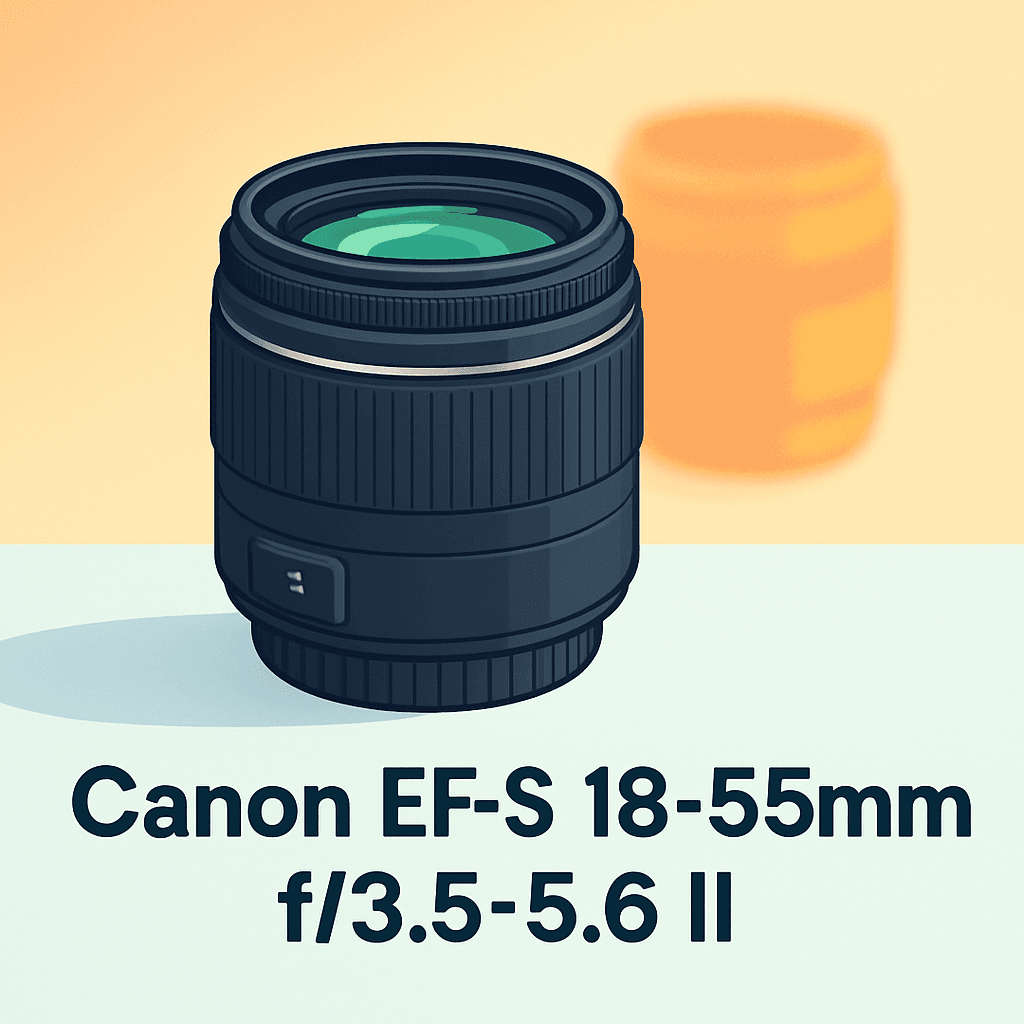
Wondering if the Canon EF-S 18-55mm f/3.5-5.6 II is the pocketable all-rounder your APS-C kit needs?
I’ve field-tested it on Canon bodies and came away with practical impressions you can use.
It’s a compact standard zoom with optical image stabilization and a variable aperture, built for everyday shots from landscapes to portraits.
Its light, unobtrusive size makes it easy to carry for travel and walkaround work.
It uses a built-in autofocus motor that isn’t STM, so you’ll notice AF feel and audibility in Live View and video.
That difference matters if you shoot hybrid stills and video and want quieter focus action.
I’ll cover build, handling, stabilization, sharpness, pros and cons, ideal buyers, and popular alternatives to help you decide.
Make sure to read the entire review as I break down the real-world trade-offs and who’ll benefit most — keep reading.

Canon EF-S 18-55mm f/3.5-5.6 II
Lightweight standard zoom ideal for newcomers; delivers sharp everyday images, easy handling, and reliable performance for landscapes, portraits, and general shooting. Budget-friendly option for learning lens fundamentals.
Check PriceThe Numbers You Need
| Spec | Value |
|---|---|
| Lens type | Standard zoom |
| Focal length | 18-55mm |
| Maximum aperture | f/3.5-5.6 |
| Lens mount | Canon EF-S |
| Optical image stabilization | Yes (IS) |
| Minimum focusing distance | approx. 0.25 m |
| Filter size | 58mm |
| Number of diaphragm blades | 6 |
| Lens construction | 11 elements in 9 groups |
| Angle of view (diagonal) | approx. 74°20′ to 27°50′ |
| Autofocus | Yes (built-in motor) |
| Dimensions (diameter x length) | approx. 69.0 x 74.0 mm |
| Weight | approx. 200 g |
| Compatible sensor format | APS-C |
| Aperture blades type | Rounded |
How It’s Built
In my testing the Canon EF-S 18-55mm f/3.5-5.6 II feels like the kind of lens you grab when you want to travel light. It’s compact and easy to balance on small Canon bodies, so I often forgot I had it on until I started shooting. I really liked how unobtrusive it is for day-to-day use.
The zoom and focus rings are straightforward and forgiving for beginners. Zooming does extend the barrel, which is normal, but I didn’t notice any annoying wobble or looseness while shooting. That extension means you’ll want to be mindful of your hood and filters, but it keeps the lens small when tucked away.
The controls are minimal by design, which makes this lens simple to learn. It uses an EF-S mount so it’s made for Canon crop bodies, and the filter thread is a common size that’s easy to find replacements for. One thing that could be better is the autofocus motor — it works fine for stills but is noticeably louder and less smooth in live view or video compared with newer STM designs.
Optically the lens uses rounded diaphragm blades, which can help out-of-focus areas look pleasant in real scenes. For beginners that means decent background separation at closer distances without fuss. Overall the build is simple and practical, made for people who want a no-drama, easy-to-carry zoom.
In Your Hands
Autofocus with the Canon EF-S 18-55mm f/3.5-5.6 II feels familiar and reliable for stills: the built-in motor nails routine focus sweeps with sensible accuracy. In Live View and handheld video the AF is noticeably more vocal and a bit less buttery than newer STM designs, so you’ll hear and see the trade-off in motion work.
The variable maximum aperture means you’ll be juggling ISO and shutter in dim interiors more than with faster glass, and subject separation at the long end is modest unless the light is generous. That said, when conditions cooperate the lens renders everyday portraits and scenes in a pleasing, unobtrusive way.
Covering the classic wide-to-short-tele span, the zoom gives roomy framing at the wide end and useful tightness at the long end for tighter compositions and candid headshots. The range makes it a true walkaround tool—versatile enough for landscapes, street work and casual portraits without constantly changing glass.
Close-focus ability is a practical strength: you can get close to food, small products and detail work and still capture texture and context without swapping lenses. Background blur is serviceable for subject isolation, but don’t expect dramatic bokeh from the tele end.
Its compact, lightweight footprint keeps it comfortable on day-long walks and travel shoots, and the built-in IS noticeably steadies handheld frames. For evaluation, try AF stills and Live View video to judge noise and smoothness, low-light interiors wide vs. tele to see aperture limits, and backlit scenes to check micro-contrast and flare control in real-world shooting.
The Good and Bad
- Compact and lightweight for easy carry
- Useful 18–55mm standard zoom range for general photography
- Optical image stabilization (IS) for improved handheld usability
- Minimum focusing distance of approximately 0.25 m for close-up opportunities
- Variable f/3.5–5.6 maximum aperture limits low-light performance and subject separation at the tele end
- Autofocus is non-STM; STM alternatives are quieter and smoother for video and Live View
Ideal Buyer
If you shoot on a Canon APS-C body and want a no-fuss, compact standard zoom, the Canon EF-S 18-55mm f/3.5-5.6 II fits the bill. Its light weight and built-in IS make it ideal for everyday shooting from wide environmental scenes to tighter portraits. It balances well on smaller bodies and won’t bleed energy on long walks or travel days.
Choose this lens when simplicity and portability matter more than extra reach or a fast aperture. It’s a tidy travel and street companion that keeps your kit small and your options flexible. The handy 58mm filter thread and close-focus ability mean you can still craft detail shots without swapping glass.
Still photographers will appreciate its straightforward autofocus and steadying IS for handheld work. Hybrid shooters should note the AF motor is not an STM design, so expect audible focus action in Live View and video. If quiet, buttery AF is a priority for vlogs or run-and-gun video, the STM variants are worth comparing.
At about 0.25 m minimum focus it’s useful for food, product or casual macro-style images without extra gear. Budget-conscious buyers, first-time DSLR owners, or anyone needing a lightweight backup lens will find this a sensible, no-nonsense choice. For everyday photography that prizes convenience over specialist performance, it’s an easy lens to recommend.
Better Alternatives?
We’ve already gone through the Canon EF-S 18-55mm f/3.5-5.6 II — what it does well and where it falls short. It’s a handy, light standard zoom that covers the everyday bases, but some shooters want quieter autofocus, more reach, or a small step up in image quality.
Below are a few real-world alternatives I’ve used in the field. I’ll point out what each one does better and where it gives up something compared to the 18-55 II, and who I think would prefer each option.
Alternative 1:

Canon EF-S 18-55mm f/3.5-5.6 IS STM
Compact kit lens with optical stabilization and smooth stepping motor for quiet, accurate autofocus; excellent for hybrid shooters doing handheld stills and video, offering improved low-light reach and steadier footage.
Check PriceI’ve shot with the 18-55 IS STM a lot, and the main real difference you feel right away is the autofocus. The STM motor is noticeably quieter and smoother in Live View and when recording video, so you don’t get the chatter and hunting you might hear from the older non-STM II. For walk-around stills the AF is also a touch more confident, so you get more keepers when shooting moving subjects.
Optically it’s very similar to the II in everyday use, but I found a little extra micro-contrast and a touch sharper images at typical apertures. The stabilization is about as good as the II, so handheld low-light shooting feels steadier. What you don’t get is a faster aperture or more reach — low-light performance and subject separation at 55mm are still limited by the f/3.5–5.6 range.
If you shoot a lot of video, use Live View, or just want a quieter, more refined AF for street and family work, the 18-55 IS STM is the better pick. If you need more tele reach or a faster lens for low light, look elsewhere.
Alternative 2:

Canon EF-S 18-135mm f/3.5-5.6 IS STM
All-in-one travel zoom combining wide-angle convenience with extended tele reach; built-in stabilization and silent autofocus deliver versatile, grab-and-go performance for vacations, events, and run-and-gun photo and video work.
Check PriceThe 18-135 IS STM is the first lens I reach for when I want one-lens travel kit. The obvious win over the 18-55 II is reach — you get about three times the tele range, so you can pull in distant subjects without changing lenses. That freedom really changes how you work on vacations, events, or when you’re trying to travel light.
On the downside it’s bigger and heavier than the 18-55 II, so it’s less discreet and shifts the balance on small bodies. Optically you gain convenience more than big jumps in image quality; at the long end you can see more softness than the 18-55 in close comparisons, and the variable f/3.5–5.6 aperture still limits low-light performance just like the II.
Buy this if you prefer one-lens simplicity and hate swapping glass — wedding guests, travel shooters, and event photographers who need flexibility will love it. If you prioritize ultimate sharpness, compactness, or low-light speed, then a different lens or a prime + 18-55 combo might be better.
Alternative 3:
Canon EF-S 18-135mm f/3.5-5.6 IS STM
Versatile single-lens solution for shooters who want to simplify gear; broad focal range covers landscapes to portraits, while image stabilization and silent autofocus ensure crisp handheld photos and whisper-quiet focus.
Check PriceI’ll say it again because it matters in real shooting: the 18-135 STM lets you cover everything from wide landscapes to tight portraits without changing lenses. In practice that means fewer missed moments and less fiddling with gear when light and subjects change fast — something the 18-55 II can’t match because it stops at 55mm.
That convenience comes with trade-offs. The 18-135 is less pocketable, and you’ll notice the corners and extreme tele frames aren’t as punchy as a smaller, more specialized lens. In low light it behaves the same as the 18-55 II — you still need to bump ISO or use a faster shutter for action — because the maximum aperture range hasn’t changed.
Choose the 18-135 if you want to simplify your kit and cover most situations with one lens — it’s great for travel bloggers, parents, and videographers who need silent AF and steady shots. If you want the lightest possible setup or the absolute best image quality from 18–55mm, stick with the smaller lens or look at higher-end alternatives.
What People Ask Most
Is the Canon EF-S 18-55mm f/3.5-5.6 II a kit lens?
Yes — this lens was commonly bundled as a basic kit lens with older Canon APS-C DSLRs and is often sold used as a starter lens.
Does the Canon EF-S 18-55mm f/3.5-5.6 II have image stabilization (IS)?
No, the “II” version does not include image stabilization, so handheld low-light shots can be more challenging.
Is the Canon EF-S 18-55mm f/3.5-5.6 II compatible with full-frame Canon cameras?
No, it’s an EF-S lens designed for APS-C bodies and will not mount or cover full-frame sensors properly.
How sharp is the Canon EF-S 18-55mm f/3.5-5.6 II?
It’s reasonably sharp in the center at mid apertures but soft at the edges and when wide open, especially compared to newer kit or aftermarket lenses.
What is the difference between the Canon EF-S 18-55mm f/3.5-5.6 II and the IS or later versions?
Later versions add IS, improved optics, and quieter/faster AF (STM or USM), so they focus faster and produce better image quality than the II.
Does the Canon EF-S 18-55mm f/3.5-5.6 II autofocus and is the AF noisy?
Yes, it does autofocus but uses an older motor that’s slower and noticeably louder than modern STM or USM lenses.
Conclusion
The Canon EF-S 18-55mm f/3.5-5.6 II is a compact, stabilized standard zoom that delivers no‑nonsense versatility for everyday shooting. Its real strengths are portability, straightforward handling and usable image stabilization that make handheld work easier and more confident. Its clear weaknesses are the slower variable aperture and an older non‑STM autofocus motor that shows up in live view and video.
That mix makes it an excellent starter or travel lens for Canon APS‑C shooters who prioritize light carry and general‑purpose flexibility over specialist performance. If you need quieter, smoother AF for video, a newer STM variant is the smarter swap. If you want one‑lens convenience or better low‑light performance, consider an all‑range zoom or a faster third‑party zoom instead.
Bottom line: as a pragmatic, value‑minded kit lens the Canon EF-S 18-55mm f/3.5-5.6 II still earns its place in many bags. It won’t satisfy those chasing premium sharpness, fast apertures, or whisper‑quiet video AF, but for daily snapshots, travel and learning the craft it’s hard to beat the simplicity and balance it offers. For many shooters that makes it an intelligent, cost‑conscious choice.
Canon EF-S 18-55mm f/3.5-5.6 II
Lightweight standard zoom ideal for newcomers; delivers sharp everyday images, easy handling, and reliable performance for landscapes, portraits, and general shooting. Budget-friendly option for learning lens fundamentals.
Check Price




0 Comments