
Want better photos without lugging a bulky, complicated camera?
The Fujifilm X-T100 Camera is a stills-first APS-C body that’s compact, approachable, and budget-minded. I took it into the field to see how it handles real shoots, not just lab tests.
It’s aimed at beginners, travelers, and Fuji color lovers who want film-like JPEGs, a useful tilting touchscreen, an EVF, and battery life that gets you through a day of shooting.
This review focuses on real-world payoffs—handling, image quality, autofocus behavior, and video practicality. Make sure to read the entire review as I break down where it shines and where it stumbles—keep reading.
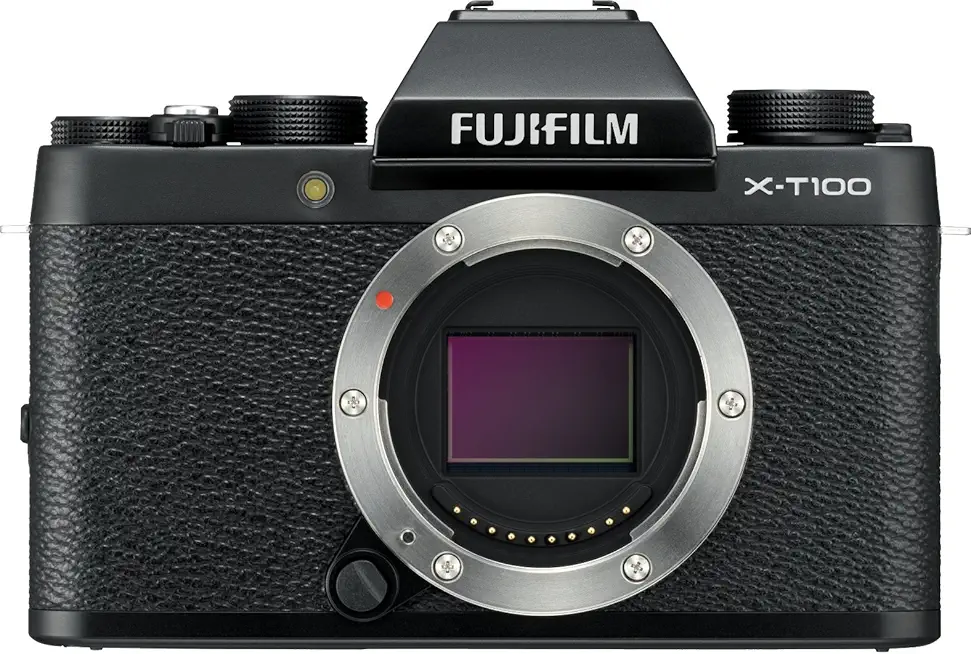
Fujifilm X-T100 Camera
Retro-styled APS-C mirrorless with intuitive controls, crisp image quality and vibrant color rendition. Lightweight and easy to handle—ideal for beginners seeking stylish, versatile photo and everyday travel performance.
Check PriceThe Numbers You Need
| Spec | Value |
|---|---|
| Sensor | 24.2 MP APS-C |
| Lens mount | Fujifilm X mount |
| Image stabilization | No in-body (lens-based only) |
| Autofocus | Contrast detect (91-point) |
| ISO range | 200–12800 (expandable to 100–51200) |
| Shutter speed | Mechanical up to 1/4000 sec |
| Burst mode | 6 fps |
| Viewfinder | EVF, 0.39”, 2.36M dots |
| LCD | 3”, tilting touchscreen, 1,040K dots |
| Video | 4K at 15 fps, Full HD at 60 fps |
| Weight | Approx. 448 g (with battery and card) |
| Dimensions | 121 x 83 x 47 mm |
| Battery life | Approx. 430 shots per charge |
| Wi-Fi | Built-in |
| Bluetooth | Built-in |
How It’s Built
In my testing the Fujifilm X-T100 feels like a friendly travel camera — small, light, and easy to carry around all day. It slips into a day bag without drama and invites you to shoot more, which is great if you’re just getting into photography.
The grip and control layout are pleasantly simple and reachable for smaller hands. I found the dials satisfyingly tactile and easy to learn, which matters when you’re learning exposure and don’t want to fumble through menus.
The electronic viewfinder is clear enough to compose in bright light, though it’s on the modest side for eyeglass wearers. The rear screen tilts, which made low and high angle shots way easier, but it doesn’t flip out for selfies or full-on vlogging — that’s one thing that could be better.
Build-wise the body felt solid in my hands without being heavy. The touchscreen was responsive for menus and touch-to-focus, and the camera survived a few rainy starts if I kept it under an umbrella, but I wouldn’t treat it like a weatherproof pro body.
I really liked how compact and intuitive it is for beginners, and the Fujifilm X mount gives you lots of lens choices as you grow. Wireless connectivity made quick transfers and remote shooting painless on the road, so sharing images was never a chore.
In Your Hands
With the Fujifilm X-T100’s choice of mechanical and electronic shutters, you get practical flexibility in the field: electronic mode is a boon for discrete, silent shooting while the mechanical option is handy when you need more traditional control, though it can constrain ultra-wide-open work in the brightest conditions. The camera feels composed for stills-first use, and switching between shutter modes is straightforward without disrupting a session.
The modest burst capability and contrast-based AF make this body a reliable companion for travel, portraits, and everyday moments rather than frantic sports sequences. For moving subjects you’ll lean on timing, anticipation, and pre-focusing techniques; the camera responds pleasantly when you work with its strengths rather than against them.
Battery life comfortably carries you through casual all-day outings, though heavy shooters will want a spare for long assignments. Without in-body stabilization you’ll rely on stabilized lenses, bracing techniques, or support systems for low-light handheld work and smoother video capture.
Built-in Wi‑Fi and Bluetooth streamline a wireless workflow for quick transfers, remote triggering, and location tagging when you’re on the move. Video-wise, the 4K mode is best reserved for static or stylized clips, while the higher-frame-rate Full HD option delivers the smoother everyday footage most creators will prefer.
The Good and Bad
- 24.2 MP APS-C sensor for detailed stills
- 11 film simulations for strong SOOC JPEG workflows
- 3-inch tilting touchscreen aids low and high-angle shooting
- Compact, lightweight body for travel and daily carry
- No in-body image stabilization; relies on lens OIS or faster shutter speeds
- Contrast-detect AF system less suited to fast action
Ideal Buyer
If you’re a beginner or enthusiast putting stills first, the Fujifilm X-T100 is a compelling entry point. Its 24.2MP APS-C sensor, compact footprint, and friendly controls make learning enjoyable without overwhelming you. It’s forgiving as you learn exposure and lens selection.
Travel shooters and everyday creators will appreciate the camera’s light weight and long battery life for full-day outings. JPEG-first photographers who love Fuji’s film simulations get immediate, publishable color straight out of camera. Budget-minded buyers who plan to grow into the X-mount system also find smart value here.
That said, the X-T100 isn’t the right tool for fast-action work or video-first creators. Contrast-detect AF and a 6fps burst rate make sports and wildlife challenging, while 4K capped at 15fps and no IBIS limit handheld, motion-heavy video. If you need high-frame-rate 4K, rock-solid tracking, or in-body stabilization, look elsewhere.
Treat the X-T100 as a color-forward, stills-oriented companion for travel, portraits, and everyday storytelling. It rewards photographers who favor simplicity, JPEG output, and the Fuji look, but it’s not a one-camera solution for every professional problem. For the right owner it’s a joyful, low-friction camera that emphasizes color and composition over chasing specs.
Better Alternatives?
We’ve gone through what the Fujifilm X-T100 does well and where it falls short in real shooting situations. It’s a great, compact stills camera with lovely Fuji colors, but if you want faster autofocus, a flip-out screen for vlogging, or stronger video options, there are a few nearby cameras that solve those pain points.
Below are three practical alternatives I’ve used in the field. I’ll explain what each one does better and worse than the Fujifilm X-T100 Camera, and what kind of shooter would prefer each option.
Alternative 1:

Fujifilm X-T200 Camera
Bright, high-resolution tilt touchscreen paired with refined autofocus delivers expressive photos and smooth video. Compact, user-friendly body with creative filters and fast response—perfect for vloggers and enthusiastic hobbyists.
Check PriceI’ve shot with the Fujifilm X-T200 a lot when I needed an easy, grab-and-go camera for trips and short videos. In real use it feels more modern than the X-T100: the screen is a full vari-angle, so framing a selfie or a vlog is quick and fuss-free. Autofocus also feels snappier than the X-T100’s contrast-detect system, so you spend less time hunting for focus on faces and casual movement.
Compared to the Fujifilm X-T100 Camera, the X-T200 is better for video and vlogging because of that flip-out screen and faster AF. It keeps Fuji’s pleasing color and good JPEGs, so image quality feels familiar. What it doesn’t fix is lack of in-body stabilization—if you need steady handheld low-light video you still need a stabilizing lens or a gimbal. Also, if you love the simple dial layout of the X-T100, the X-T200’s more modern controls might feel a bit busier.
The X-T200 fits buyers who want a friendly, modern Fujifilm camera for social video and travel photos. Pick this if you value an easier selfie/vlog workflow and quicker autofocus, but aren’t chasing pro video features or IBIS.
Alternative 2:

Canon EOS M50 Mark II Camera
Compact hybrid for content creators: sharp imagery, reliable autofocus, and seamless vertical-video capture. Built-in streaming support and intuitive controls make it a top pick for vloggers and social-media storytellers.
Check PriceI’ve used the Canon EOS M50 Mark II for quick run-and-gun shoots and live streams. Its Dual Pixel AF is noticeably better in everyday shooting than the Fujifilm X-T100 Camera’s contrast-detect system—faces lock on fast and keep tracking during casual movement. The fully articulating screen and built-in streaming features make it a go-to when I need to stream or shoot vertical video without extra gear.
Where the M50 II beats the Fujifilm X-T100 Camera is real-world autofocus and streaming friendliness. Where it falls short is in 4K: in practice that mode is cropped and the AF can be worse there, so many creators stick to 1080p for reliable results. The native EF-M lens range is smaller than Fuji’s X-mount, so you may end up adapting lenses, which can add size and cost.
This camera is for vloggers and social creators who want dependable autofocus and easy streaming tools. Choose the M50 Mark II if live video, a flip screen, and fast face tracking matter more than Fuji-style JPEGs or a broad native lens lineup.
Alternative 3:

Canon EOS R50 Camera
Advanced yet compact mirrorless offering fast autofocus, high-speed continuous shooting, and crisp image quality. Seamlessly integrates with modern lenses—great for enthusiasts seeking pro-level performance in a portable package.
Check PriceI’ve spent sessions with the Canon EOS R50 when I needed a small camera that can keep up with action. In the field its autofocus and subject tracking feel a clear step up from the Fujifilm X-T100 Camera—shots of moving kids or pets are easier to nail. Burst shooting and responsiveness also make it more reliable for sequences where timing matters.
Compared to the Fujifilm X-T100 Camera, the R50 wins on speed and modern autofocus, and its video options feel more usable for everyday clips. The trade-offs are familiar: you lose Fuji’s film-simulation look straight out of camera, and the R50 can cost more once you step into the RF lens world. It also won’t replace a stabilized rig if you need smooth, low-light handheld video without support.
The R50 is aimed at enthusiasts who want a compact body with pro-like AF and faster shooting, but who also want a clear upgrade path in lenses and video features. If you’re ready to move past the X-T100 for action, tracking, and a more modern shooting feel, this is a solid step up.
What People Ask Most
Is the Fujifilm X-T100 worth buying?
Yes — it’s a budget-friendly APS-C camera with lovely JPEGs and easy handling, but skip it if you need fast autofocus or proper 4K video.
What are the pros and cons of the Fujifilm X-T100?
Pros: great Fujifilm color/film sims, compact body and useful EVF; Cons: slowish autofocus, no in-body stabilization and 4K is limited.
How does the Fujifilm X-T100 compare to the Canon EOS M50?
The M50 generally has better autofocus and more usable video features, while the X-T100 wins on JPEG color, styling and beginner-friendly handling for photos.
Is the Fujifilm X-T100 good for beginners?
Yes — it’s very approachable with helpful auto modes and menus, though serious users may quickly notice its AF and video limitations.
Does the Fujifilm X-T100 shoot 4K video?
Technically yes, but 4K is limited to 15 fps and isn’t practical, so stick to 1080p for smooth footage.
What lenses are compatible with the Fujifilm X-T100?
It accepts all native Fujifilm X-mount lenses (XF and XC) and supports many third-party or adapted lenses with the proper adapter.
Conclusion
The Fujifilm X-T100 Camera is a compact, stills-first companion that wins on color, simplicity, and everyday usability. Its film-simulation look and straightforward handling make it a joy to carry on walks, trips, and client shoots where fast turnaround matters. For photographers who value attractive JPEGs and a light kit, it delivers real-world satisfaction.
That charm comes with clear trade-offs you’ll feel in the field. The contrast-detect autofocus and lack of in-body stabilization mean you’ll lean on lenses, technique, or support for tricky action and low light. Video capabilities are best served at standard frame rates rather than the camera’s most ambitious compressed options.
If you prioritize pure stills, travel convenience, and Fuji’s color palette, this camera is an excellent value and a smart first Fuji body. If you need faster subject tracking, a vari-angle vlogging screen, or stronger video performance, look toward newer X-series models or competitors with more advanced AF systems and video features.
In short, the Fujifilm X-T100 Camera is a confident pick for beginners and enthusiasts who shoot stills first and want beautiful straight-out-of-camera color. It isn’t the tool for high-speed action or pro-level video, but for everyday photography it’s hard to beat the combination of charm, image character, and ease of use.
Fujifilm X-T100 Camera
Retro-styled APS-C mirrorless with intuitive controls, crisp image quality and vibrant color rendition. Lightweight and easy to handle—ideal for beginners seeking stylish, versatile photo and everyday travel performance.
Check Price



0 Comments