
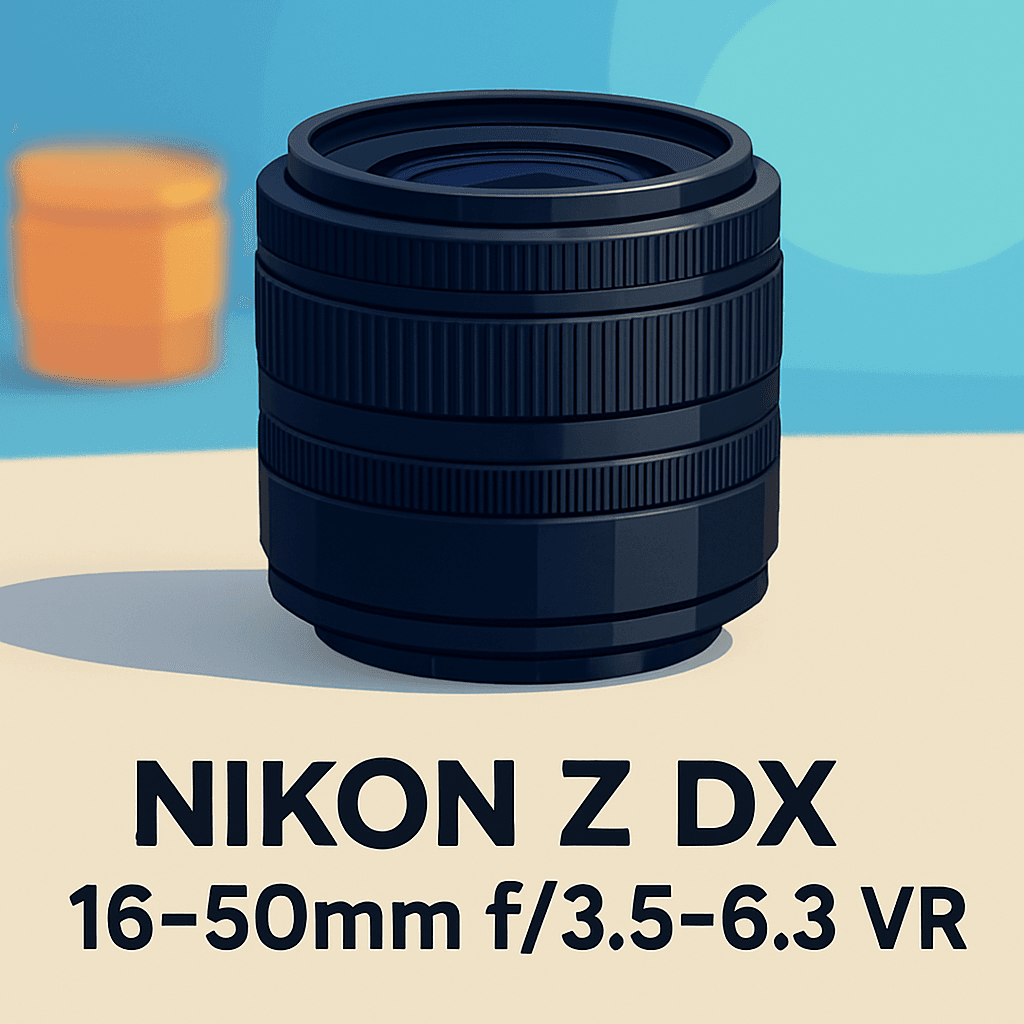
Want a travel-friendly zoom that won’t weigh down your Z DX kit?
I field-tested the Nikon NIKKOR Z DX 16-50mm f/3.5-6.3 VR on short trips and around town to see how it performs in real use.
It’s an ultra-compact, lightweight standard zoom that gives you a wide-to-short-tele range for everyday scenes.
In-lens VR and quiet AF help keep shots steady and discreet for travel, street, and family photos.
There are trade-offs — a variable, modest maximum aperture and no full weather sealing mean it’s not a low-light workhorse or pro-rugged option.
This review will cover design and handling, AF/VR behavior, centre sharpness and flare, plus who should buy it, so keep reading.

Nikon NIKKOR Z DX 16-50mm f/3.5-6.3 VR
Pocketable, lightweight zoom ideal for on-the-go creators. Optical stabilization ensures steady handheld photos and video, while versatile wide-to-normal coverage captures landscapes, street scenes, and everyday portraits with reliable sharpness.
Check PriceThe Numbers You Need
| Spec | Value |
|---|---|
| Lens type | Standard zoom |
| Mount | Nikon Z DX (APS-C) |
| Focal length | 16–50mm (24–75mm equivalent) |
| Maximum aperture | f/3.5–6.3 (variable) |
| Minimum aperture | f/22 |
| Optical image stabilization | Yes, Vibration Reduction (VR) |
| Lens construction | 10 elements in 9 groups |
| Minimum focus distance | 0.2 m (7.9 in) |
| Maximum reproduction ratio | 0.31× (macro capability) |
| Filter size | 55 mm (front) |
| Aperture blades | 7, rounded diaphragm |
| Lens weight | Approximately 135 g (4.8 oz) |
| Dimensions | Approx. 62.5 mm (diameter) × 44.5 mm (length, retracted) |
| Autofocus | Stepping motor for quiet, fast AF |
| Weather sealing | No (not fully weather resistant) |
How It’s Built
In my testing the lens is shockingly small when retracted. Extending it for use feels smooth with a firm detent and it stays put while I frame. That compact action makes it disappear on a camera and slips easily into a jacket pocket.
On a typical Z DX body it balances nicely and doesn’t make the camera front-heavy. The zoom ring is small but gives enough grip for precise framing and it’s easy to nudge for small changes, though it feels slightly plasticky at the very end of the travel. Using a filter is easy, but at the widest angle thick filters can cause mild darkening in the corners.
What I really liked was how light and unobtrusive it is for travel and street shooting — you won’t miss it in your bag, and the built-in stabilization is a welcome touch that helps casual handheld shots. What could be better is weather protection; in my testing I avoided dusty trails and rain because it isn’t sealed. For beginners that trade-off usually pays off: easy carry and decent control, but treat it gently in rough conditions.
In Your Hands
Autofocus with the Nikon NIKKOR Z DX 16-50mm f/3.5-6.3 VR feels eager and dependable for stills; the stepping motor locks quickly and rarely hunts on everyday subjects. It’s whisper-quiet in normal shooting but you’ll notice a faint mechanical whir in very quiet rooms, and focus breathing is restrained though detectable during dramatic rack-focus moves for video.
The in-lens stabilization visibly tames handshake for handheld snaps and makes walking clips smoother, allowing you to push shutter speeds lower than you’d normally trust. On bodies that lack in-body stabilization it’s an especially useful feature, turning marginal light into usable frames without a tripod.
The lens’ modest maximum aperture means you’ll trade shutter speed or ISO more often in dim conditions and won’t achieve the shallowest subject isolation that faster optics provide. In daylight and well-lit interiors it performs comfortably for travel and street work, but low-light portraits and moody interiors benefit from added light or support.
Close-focusing yields surprisingly good detail for near-macro shots, though the working distance is tight so lighting and composition need attention. At the wide end you’ll see some field curvature and edge softness that in-camera corrections can temper, so framing matters for vlogging and tight interiors.
Stopped down a bit, the lens tightens center clarity and delivers pleasing contrast and color out of the camera, while flare is manageable if you avoid direct sun angles. Chromatic fringing and distortion are mostly addressed by the camera’s corrections, but careful composition and shading remain the best ways to get the cleanest results.
The Good and Bad
- Extremely compact and lightweight for a zoom (approx. 44.5 mm retracted length; approx. 135 g)
- Useful 24–75mm equivalent range for everyday shooting
- In-lens VR for steadier handheld results
- Close focus (0.2 m) with up to 0.31× reproduction for near-macro details
- Variable, relatively slow maximum aperture (f/3.5–6.3) limits low-light flexibility and subject separation
- Not fully weather sealed
Ideal Buyer
The Nikon NIKKOR Z DX 16-50mm f/3.5-6.3 VR suits DX shooters who prioritize minimal size and weight above optical extremes. Its ultra-compact, pocketable profile, 24–75mm equivalent zoom and in-lens VR make it a go-to for travel, street and candid photography where discretion matters. On small Z DX bodies it balances well and disappears in a day bag for long outings.
Beginners and casual creators get quiet, reliable AF and effective stabilization that simplify handheld shooting and basic video. The lens’s 0.2 m close-focus and up to 0.31× reproduction let you capture table-top details and family moments without changing glass. Vloggers and interior shooters will like the 16mm wide end for tight spaces and the overall low profile for on-camera use.
It’s not ideal for frequent low-light shooters who need faster, constant apertures or for pros who require weather-sealed construction and rugged handling. If you regularly chase distant subjects or want a true one-lens-for-everything kit you’ll quickly notice the 16–50’s limited tele reach. Prioritize size and VR, not aperture speed, sealing, or long-reach versatility, and this lens is a compelling choice.
Better Alternatives?
We’ve covered what the Nikon Z DX 16-50mm f/3.5-6.3 VR does best: tiny size, useful 24–75mm equivalent range, and built-in VR that makes handheld shooting easier. It’s a great everyday lens, but it’s not perfect for everyone—some shooters need more reach, better center sharpness, or even smaller bulk depending on their workflow.
Below are a few real-world alternatives I’ve used, with what each one does better and worse than the 16‑50, and who I’d recommend each for. I’ll keep it practical—how they feel on the camera, how they behave in low light, and what kind of shoots they actually improve.
Alternative 1:

Nikon NIKKOR Z DX 18-140mm f/3.5-6.3 VR
All-in-one travel zoom offering broad reach for landscapes, portraits, and distant subjects. Vibration reduction delivers crisp handheld results, and smooth autofocus makes it a go-to for vacation photography and video.
Check PriceI’ve used the 18‑140mm on trips where I wanted one lens to cover everything, and its biggest win over the 16‑50 is obvious: reach. You get a long tele end that lets you pull distant subjects much closer without changing lenses, which is huge for casual wildlife or stage shots.
Where it loses to the 16‑50 is size and discretion. It’s heavier and sticks out more, so it’s not pocketable and it draws more attention on the street. Optical trade-offs show up too—corners can be softer at the extremes and you’ll see more distortion at long and very wide angles (the VR helps for handholding, though, and I felt steadier at 100–140mm than I ever did with the 16‑50).
If you’re a traveler or a one‑lens person who values reach and wants to avoid swapping glass, pick the 18‑140mm. If you really prize the smallest, lightest carry and your shooting is mostly wide-to-normal, the 16‑50 still wins.
Alternative 2:

Nikon NIKKOR Z 24-50mm f/4-6.3
Slim, lightweight standard zoom crafted for everyday shooting. Delivers consistent image quality, fast autofocus, and pocketable convenience—perfect for street photographers seeking minimal bulk without sacrificing sharpness.
Check PriceThe 24‑50mm is even slimmer and lighter than the 16‑50, and in real life I noticed crisper center shots and better micro‑contrast, especially stopped down a bit. On a mirrorless body it disappears on the camera and feels very natural for street work where you want to be unobtrusive.
But it gives up the 16‑50’s wide end—24mm on DX isn’t the same as 16mm, so you lose that expansive look for interiors and vlogging. Also, there’s no in‑lens VR, so on bodies without IBIS you’ll miss the steadying help you get from the 16‑50’s stabilization in low light.
This lens is for photographers who want the absolute smallest setup and value sharper center images over extreme wide angle. If you shoot mostly in daylight or use a camera with good IBIS, the 24‑50 is a great, almost invisible option. If you need VR or that 16mm wide field, stick with the 16‑50.
Alternative 3:
Nikon NIKKOR Z 24-50mm f/4-6.3
Compact, travel-friendly optic that balances portability and performance. Smooth handling and reliable optics provide pleasing bokeh and accurate color, making it an ideal companion for day trips and casual shoots.
Check PriceUsed on day trips, the 24‑50 feels like a step up in finish and color compared with the kit‑style 16‑50; skin tones look a bit cleaner and the out‑of‑focus areas are pleasant for portraits. It handles smoothly and is one of those lenses you can forget is on the camera until you look at your images.
The clear downsides versus the 16‑50 are the narrower field of view at the wide end and again the lack of VR. I found myself needing to back up more to get wider compositions, and in dim cafés or late‑day city light I had to raise ISO sooner when handheld because there’s no lens VR helping with slow shutter speeds.
Pick this version of the 24‑50 if you want a tiny, well‑behaved optic that delivers pleasing color and bokeh for casual portraits and travel snaps, and you mostly shoot in good light or on a body with IBIS. If you need that ultra‑wide 16mm look or in‑lens stabilization for low light, the 16‑50 or the 18‑140 are better choices.
What People Ask Most
Is the Nikon Z DX 16-50mm f/3.5-6.3 VR a good lens?
Yes. It’s compact, affordable, and great for travel or everyday shooting, but the slow variable aperture limits low-light performance and shallow depth-of-field control.
Is the Nikon Z DX 16-50mm f/3.5-6.3 VR weather sealed?
No, it is not weather-sealed, so avoid heavy rain and dusty conditions without extra protection.
Does the Nikon Z DX 16-50mm f/3.5-6.3 VR have image stabilization?
Yes, it has built-in VR (Vibration Reduction) to help steady handheld shots and video.
What is the 35mm equivalent of the Nikon Z DX 16-50mm f/3.5-6.3 VR?
On Nikon DX/APS-C bodies the focal length is roughly equivalent to 24–75mm on a full-frame (35mm) camera.
How sharp is the Nikon Z DX 16-50mm f/3.5-6.3 VR?
Center sharpness is good at mid apertures; edges and corners are softer wide open and at the long end, but stopping down improves overall sharpness.
Is the Nikon Z DX 16-50mm f/3.5-6.3 VR good for video?
Yes for casual video and vlogging because of VR and quiet AF, but its slow aperture and inconsistent edge sharpness make it less ideal for professional cinematic work.
Conclusion
The Nikon NIKKOR Z DX 16-50mm f/3.5-6.3 VR is the kind of lens that earns its place by being nearly invisible in your bag yet reliably useful in the field. Its stabilized, everyday range and close-focus capability cover the shots you actually take when traveling, roaming the streets, or documenting family life. Autofocus is quiet and unobtrusive, which keeps you out of the way of candid moments.
Those practical strengths come with clear compromises. The variable, relatively slow maximum aperture and the absence of weather sealing limit low-light flexibility and rugged use, so you’ll make trade-offs when subject isolation or bad weather matter. If you regularly demand shallow depth of field or work in rough conditions, look elsewhere.
For DX shooters who prioritize weight, discretion and steady handheld results, this lens is an easy, sensible recommendation. If your priorities tilt toward reach, pro-grade build or more consistent optics, consider stepping to the 18–140mm for reach, choosing the even tinier 24–50mm if ultimate compactness is king, or upgrading to the 24–70mm S for a clear professional leap.
Bottom line: buy it if pocketability and VR-driven practicality beat aperture speed and weatherproofing. Skip it if you need faster glass, heavy-duty sealing, or a one-lens professional kit. For most travel and everyday shooters this is a pragmatic, user-friendly compromise you’ll actually use.
Nikon NIKKOR Z DX 16-50mm f/3.5-6.3 VR
Pocketable, lightweight zoom ideal for on-the-go creators. Optical stabilization ensures steady handheld photos and video, while versatile wide-to-normal coverage captures landscapes, street scenes, and everyday portraits with reliable sharpness.
Check Price



0 Comments