
Want to stop distorted verticals in your architectural shots?
Isn’t the Nikon F PC NIKKOR 19mm f/4E ED the tool for that?
It’s an ultra-wide perspective-control lens for Nikon F-mount full-frame cameras, and it also works on DX bodies.
Tilt tweaks the focus plane; shift corrects converging lines, and 19mm gives serious coverage in tight spaces.
It’s a manual, specialist tool with no stabilization, so it rewards tripod work and careful setup.
I took it into the field on a few shoots to see how those real-world payoffs stack up.
Architects, real-estate and landscape shooters will want to read on.
Make sure to read the entire review as I’ll break down when and how it shines — keep reading.
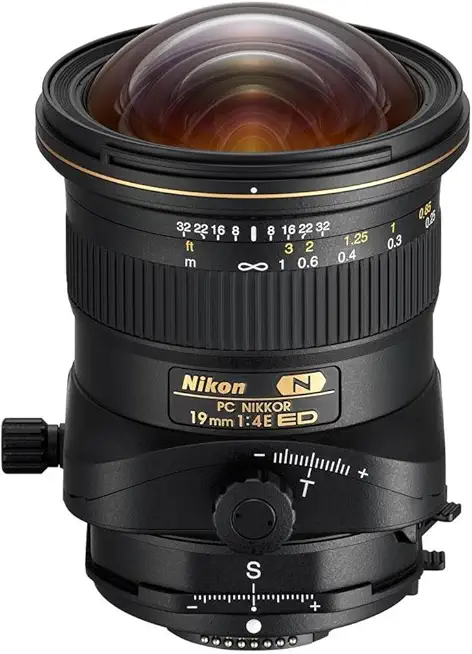
Nikon F PC NIKKOR 19mm f/4E ED
Extremely wide, rectilinear perspective-control lens built for architecture and interiors. Precise tilt and shift movements offer distortion-free compositions, while ED elements deliver superb edge-to-edge sharpness and color fidelity.
Check PriceThe Numbers You Need
| Spec | Value |
|---|---|
| Focal Length | 19 mm |
| Maximum Aperture | f/4 |
| Lens Mount | Nikon F-mount |
| Lens Type | Tilt-shift (perspective control) |
| Tilt Range | ±8.5° |
| Shift Range | ±11.5 mm |
| Optical Design | Includes ED (Extra-low Dispersion) glass elements |
| Image Stabilization | None (manual lens) |
| Aperture Blades | 9 rounded blades |
| Minimum Focus Distance | Approximately 0.25 m (25 cm) |
| Filter Size | 82 mm |
| Lens Construction | 14 elements in 11 groups |
| Weight | Approximately 955 g |
| Compatible Sensor Format | Full-frame (FX); APS-C (DX) compatible (crop factor) |
| Coating | Nano Crystal Coat for flare and ghosting reduction |
How It’s Built
In my testing the Nikon F PC NIKKOR 19mm f/4E ED feels like a serious tool from the moment you pick it up. The metal body and solid finish inspire confidence and tell you it can handle regular field use. For real-world shooting that means it won’t flex or feel toy-like when you’re cranking adjustments on a job.
I found the tilt and shift controls to be satisfyingly precise and positive. Locking knobs and detents hold settings rock steady, so once you level a building or stitch a panorama the lens doesn’t creep. One thing I really liked was how repeatable those adjustments are — you can swap compositions and come back to the same setting easily.
After using it for a while I noticed the controls could be a bit stiff at first, especially when making tiny moves. That can be annoying in cold weather or when you’re working fast, so expect to take your time and use small, deliberate turns. For beginners this simply means using live view and a tripod until the motions feel natural.
Manual focusing is straightforward, and the electronic aperture behaves predictably with modern Nikon bodies. Balance-wise it favors a tripod for long sessions, but it’s not fragile — it feels built for pro work. If you want precision and don’t mind the learning curve and heft, this lens is a rewarding tool.
In Your Hands
On buildings and interiors the Nikon F PC NIKKOR 19mm f/4E ED feels like a specialist’s tool: shifts let you correct keystoning without tipping the camera and the ultra‑wide coverage means you rarely have to step back to include a facade or an entire room. In tight spaces the lens gives you the breathing room to compose cleanly while keeping verticals true, and the freedom to tighten or expand framing with shift reduces reliance on heavy correction in post.
For real estate workflows the lens excels at single‑frame coverage and makes stitching more forgiving when you need extra width; shifting from a tripod minimizes parallax and keeps details aligned between frames. It rewards a methodical approach—level the camera, apply measured shifts, then fine‑tune—so you spend less time fighting distortions later.
Landscape shooters will appreciate the tilt capability for controlling the plane of focus, pulling near and far elements into a single sharp band without stopping down excessively. Coatings and optical design keep flare and contrast well behaved even when the sun grazes the frame, so horizons stay punchy and detail holds up across the scene.
Expect a hands‑on workflow: focusing is manual and most users rely on live view magnification or focus aids for pixel‑level checks, and the aperture is managed through the camera rather than a physical ring. Without stabilization this is primarily a tripod lens—steady support delivers the best results and lets you make fine incremental movements with confidence.
This is a full‑frame first lens, and on cropped bodies the field naturally tightens; large front filters accommodate polarizers and NDs but avoid stacking to limit vignetting. Adjustment detents feel precise and repeatable once you learn the small‑step approach—use the camera’s grid and small tilts/shifts to avoid common setup missteps and settings will hold while you recompose.
The Good and Bad
- Ultra-wide 19mm field of view for tight spaces and expansive architecture
- Dual movements: tilt ±8.5° and shift ±11.5mm for comprehensive perspective control
- ED glass and Nano Crystal Coat aimed at high optical quality and reduced flare/ghosting
- 9 rounded blades for smoother aperture rendering
- Full-frame compatibility; accepts 82mm front filters
- Manual lens operation; no image stabilization
- Relatively heavy (approx. 955g) and physically large with 82mm filters
- f/4 maximum aperture limits low-light brightness and viewfinder brightness versus faster lenses
- Learning curve for precise tilt/shift technique
- Potential for vignetting and edge performance drop at extreme movements (to be evaluated)
Ideal Buyer
The Nikon F PC NIKKOR 19mm f/4E ED is built for photographers whose work hinges on absolute control of lines and space. Architects, interior and real‑estate shooters, and landscape photographers who bend the plane of focus will get the most from its ultra‑wide 19mm coverage and precise tilt and shift range. Full‑frame Nikon shooters who regularly encounter tight rooms or towering façades will find its perspective correction indispensable.
This is a tripod‑first tool that rewards careful technique and measured adjustments. Advanced amateurs and working pros who are comfortable with manual focus, live view alignment, and an f/4 maximum aperture will appreciate the repeatability and optical quality. If you value exact framing, stitched parallax‑minimized panoramas, or Scheimpflug plane control, this lens is a specialized solution that pays dividends.
Conversely, casual shooters, event and wedding photographers, or anyone who needs bright, handheld flexibility will find the weight, size, and learning curve prohibitive. If you rarely correct keystoning or you need faster apertures and stabilization, a less extreme 24mm PC, a budget Samyang tilt‑shift, or a Laowa shift lens may be a smarter fit. Buy the Nikon PC 19mm if your assignments demand maximum ultra‑wide perspective control and you’ll use it regularly.
Better Alternatives?
We’ve already gone deep on the Nikon PC 19mm f/4E ED — that ultra‑wide tilt/shift that’s built for the tightest interiors and the most exacting architecture work. It’s a specialist tool: great coverage and full tilt + shift, but it’s big, manual, and takes practice to get the most from it.
If that level of width or those trade‑offs feel like overkill for some jobs, there are a few good alternatives that give you easier handling, lower cost, or a slightly different field of view. Below are three lenses I’ve used in the field that cover the most common reasons people look for something other than the 19mm.
Alternative 1:

Nikon F PC-E NIKKOR 24mm f/3.5D ED
Versatile wide-angle PC optic designed for critical perspective correction in architecture and landscape. Fine tilt/shift control reduces converging lines, with ED glass ensuring high resolution and minimal chromatic aberration.
Check PriceI’ve used the Nikon 24mm PC‑E when I wanted most of the perspective control of the 19mm but with an easier workflow. The 24mm is less extreme, so you don’t fight as much distortion in corners and it’s simpler to compose in small rooms. Compared to the 19mm, it needs less shift to fix verticals and the viewfinder makes framing feel less frantic.
What it does better: better everyday handling, a slightly faster f/3.5 aperture that helps a bit in low light, and tighter integration with Nikon bodies for more predictable behavior. What it does worse: you lose some of the reach and drama of the 19mm’s ultra‑wide view — you may need to stitch or move further back for very wide interiors or dramatic exteriors.
This is the lens I’d recommend to shooters who want real perspective control but don’t need the absolute widest angle. If you do a lot of architecture and want fewer headaches with composition, or you want better on‑camera feel while still getting professional shifts and tilts, the 24mm is a solid, practical pick.
Alternative 2:

Rokinon 24mm f/3.5 ED AS UMC Tilt Shift
Cost-effective manual tilt-shift lens offering creative plane-of-focus control and precision perspective correction. Aspherical and ED elements plus multi-layer coatings produce strong contrast, reliable sharpness, and reduced flare.
Check PriceI’ve used the Rokinon 24mm on budget jobs and as a teaching lens for new tilt/shift users. It gives you the same basic movements as the big Nikon at a fraction of the price. In real shooting it handles well enough, and stopped down it can deliver very pleasing sharpness for interiors and landscapes.
What it does better: price and value — you get tilt and shift control without breaking the bank, so it’s great for small studios or one-off jobs. What it does worse: build and refinement are not on the same level as Nikon. It’s fully manual with no electronic coupling, and the feel of the knobs and repeatability of settings is rougher. Optically it’s good, but you’ll often stop down more to reach the edge performance of the Nikon 19mm.
Choose the Rokinon if you’re learning tilt/shift, working to a tight budget, or don’t need perfect integration with Nikon cameras. It’s a great tool for hobbyists, small business owners, or anyone who wants the creative and corrective benefits of tilt/shift without the professional price tag.
Alternative 3:
Samyang 24mm f/3.5 ED AS UMC Tilt Shift
Professional-grade manual tilt/shift optic engineered for exacting perspective control and tilt-based selective focus. Multi-coated elements and low-dispersion glass deliver crisp detail, accurate colors, and controlled ghosting.
Check PriceThe Samyang 24mm is very close to the Rokinon in real use — same idea, slightly different badge and small manufacturing differences. On shoots I’ve used the Samyang when I wanted that 24mm field but with a lens I didn’t mind risking on rough location work. It’s simple, solid, and gets the job done when you need perspective correction without fuss.
What it does better: similar to Rokinon — excellent value and predictable results once you know how to use it. What it does worse: like the Rokinon it won’t match the 19mm for absolute edge-to-edge performance or the same smoothness in controls. It’s also fully manual, so expect to meter and set exposure yourself and to stop down for best corner sharpness.
Pick the Samyang if you want a budget tilt/shift that’s proven in the field and don’t need the ultra‑wide reach of the 19mm. It’s ideal for photographers who shoot a lot of interiors or landscapes and want the benefits of tilt/shift without the higher cost and size of Nikon’s 19mm.
What People Ask Most
What is the Nikon PC 19mm f/4 used for?
It’s a super-wide perspective-control lens used to correct converging lines and control composition in architecture, interiors, landscapes and large-format panoramas.
Is the Nikon PC 19mm f/4 a tilt-shift (perspective control) lens?
Yes — it’s a perspective-control lens that provides both shift and tilt movements to manage perspective and the plane of focus.
Does the Nikon PC 19mm f/4 have autofocus or is it manual focus only?
It is manual focus only; precise focusing and composition are done by hand, which is normal for PC lenses.
What are the tilt and shift ranges/specifications of the Nikon PC 19mm f/4?
It offers substantial shift and a useful tilt range designed for strong perspective correction and Scheimpflug adjustments; check Nikon’s official spec sheet for the exact mm/degree values for your version.
Is the Nikon PC 19mm f/4 good for architectural and interior photography?
Yes — its extreme wide angle and perspective control make it excellent for keeping verticals straight and fitting more of a room or building into the frame.
How does the Nikon PC 19mm f/4 compare to the Nikon PC-E 24mm f/3.5 and other wide-angle PC lenses?
The 19mm gives a wider field of view for tighter interiors and more dramatic architecture shots, but it can be bulkier and trickier to use; the 24mm is slightly more versatile for general work while still offering strong PC control.
Conclusion
The Nikon F PC NIKKOR 19mm f/4E ED is unmistakably a specialist’s tool for anyone who cares about true perspective control at ultra‑wide angles. It combines a very wide field of view with integrated tilt and shift movements and high‑quality glass, giving architects, interior shooters and landscape photographers precise control over lines and planes. In real-world use its optical pedigree and filter compatibility make it a go‑to when you need to get the composition right in camera.
That capability comes with trade‑offs you can’t ignore. It’s a deliberate, tripod‑oriented lens with manual focus, no stabilization, and a heavier, more physical presence than walkaround glass. Expect a learning curve for repeatable, pixel‑perfect results, and be prepared to stop down and take your time in tricky light.
If you shoot architecture, interiors or controlled landscape work regularly, this lens earns its place in a pro kit and is worth the commitment. If your needs tilt toward faster, handheld or less extreme framing, consider the milder 24mm PC options, a budget Samyang tilt‑shift, or the ultra‑wide Laowa shift for different tradeoffs. For disciplined shooters who demand the widest, integrated perspective control on Nikon F, this lens pays dividends; for everyone else, evaluate your workflow first.
Nikon F PC NIKKOR 19mm f/4E ED
Extremely wide, rectilinear perspective-control lens built for architecture and interiors. Precise tilt and shift movements offer distortion-free compositions, while ED elements deliver superb edge-to-edge sharpness and color fidelity.
Check Price




0 Comments