
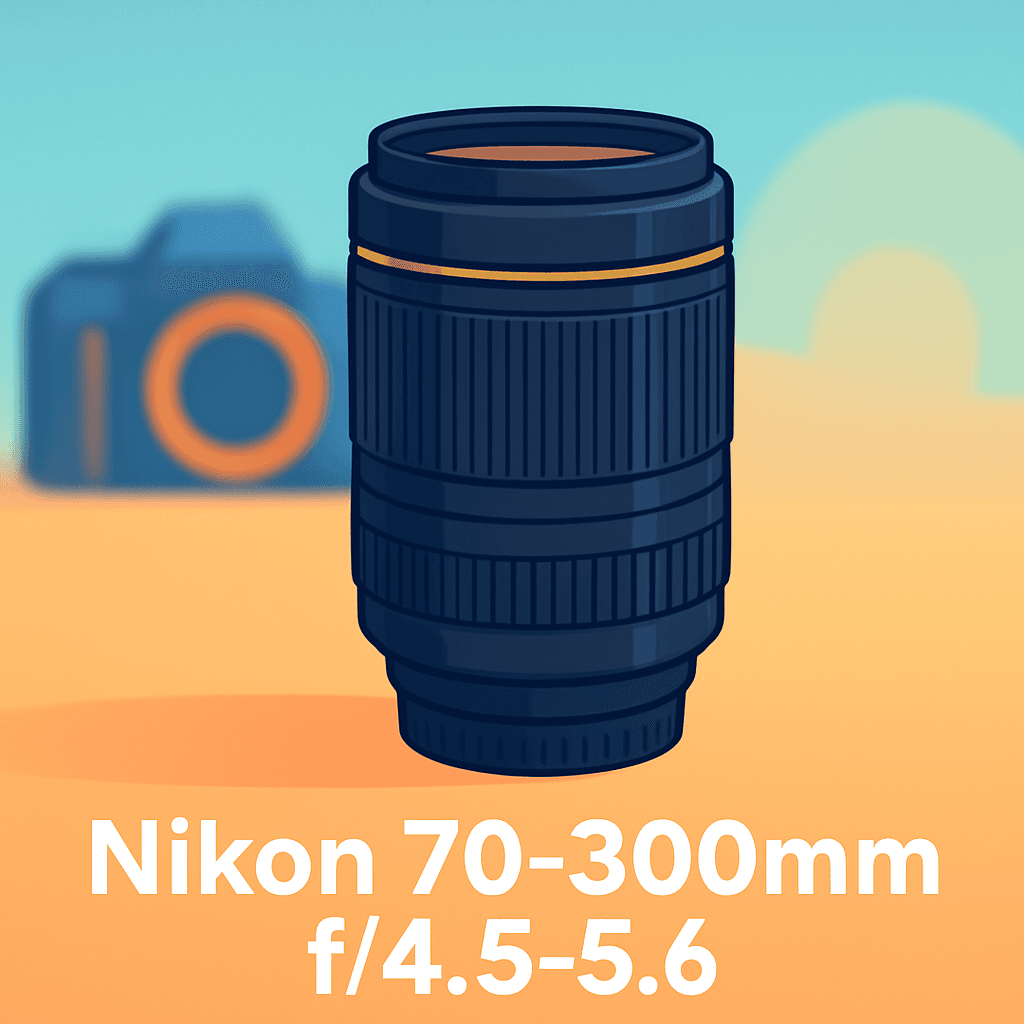
Want a single telephoto that gives you sports sidelines, wildlife reach and travel flexibility without swapping lenses?
The Nikon F mount AF-S Nikkor 70-300mm f/4.5-5.6G VR is exactly the kind of zoom many shooters consider for those jobs, and I’ve taken it into the field on real shoots to see what it delivers.
It’s built around AF-S focusing, VR stabilization, internal focusing and ED glass, promising steadier handheld reach and pleasant background separation, though you’ll trade some low-light headroom and close-focus distance.
If you’re wondering whether it’s the right telephoto workhorse for your Nikon kit, this review will walk you through practical hits and misses — make sure to read the entire review as I break it down, keep reading.

Nikon F mount AF-S Nikkor 70-300mm f/4.5-5.6G VR
Fast, silent autofocus and vibration reduction deliver crisp telephoto performance for wildlife and sports. Professional-grade optics produce sharp detail, smooth bokeh, and reliable handling for full-frame shooters.
Check PriceThe Numbers You Need
| Spec | Value |
|---|---|
| Focal length | 70–300mm |
| Aperture range | f/4.5–5.6 |
| Lens type | Telephoto zoom |
| Mount | Nikon F |
| Autofocus | Yes (AF-S) |
| Image stabilization | Vibration Reduction (VR) |
| Minimum focus distance | 1.5 m |
| Filter thread | 67 mm |
| Lens construction | 17 elements in 12 groups |
| Aperture blades | 9 |
| Maximum magnification | 0.25x |
| Focus motor | Silent Wave Motor (SWM) |
| Internal focusing | Yes |
| Edged glass | Extra-low Dispersion (ED) elements |
| Weight | Approx. 745 g |
| Length | Approx. 143.5 mm |
How It’s Built
In my testing the Nikon F mount AF-S Nikkor 70-300mm felt like a proper telephoto—you can tell it’s built to do a job without being fussy. The lens focuses internally, so it doesn’t grow or flop around when you’re tracking a bird or a kid on the move. It also uses ED glass and a rounded diaphragm, which I found helps the images look clean and the background falloff feel natural.
On a mid-size Nikon DSLR the balance is comfortable and the zoom and focus rings move with just the right amount of resistance. I liked that the lens stayed steady in my hands and didn’t have annoying zoom creep during long walks. One thing that could be better is the mostly plastic exterior; it’s fine for everyday use, but it doesn’t inspire the same confidence as a full-metal pro lens.
For beginners this is an easy lens to live with—simple to mount, easy to aim, and it plays well with common screw-on filters from the rest of your kit. After using it for a while I appreciated how practical it is in the field, and how the handling lets you concentrate on framing instead of fiddling with the gear.
In Your Hands
The 70–300 range is a workhorse: at the short end it frames outdoor portraits and sidelines, while the long end pulls distant subjects into view—birds, goal-line action, and isolated heads in crowd scenes. The lens’s variable maximum aperture means it won’t deliver the shallowest background blur or miracle low‑light exposure, so you’ll often trade ISO or shutter speed for reach. Still, in daylight it renders subject separation and compression that feel very usable for everyday assignments.
Nikon’s stabilization noticeably expands handheld possibilities; it tightens the keeper rate for daytime work and even on dull afternoons lets you handhold with confidence where an unstabilized tele would struggle. It won’t turn the lens into a low‑light prime, but the steadiness is enough to ditch a monopod for many shooting scenarios. Portraits, wandering wildlife and sideline work all benefited from the steadier viewfinder experience.
Close‑focus capability is modest—fine for detail shots and tight headshots but limiting when you want true macro or extreme close‑ups, so expect to step back or crop for composition. I noticed mild focus breathing during longer focus pulls, more evident in video than in stills but rarely distracting. Internal focusing keeps handling predictable and the front element from extending while you work the scene.
Outdoors the lens handles backlight with controlled contrast and restrained color fringing, the ED elements paying practical dividends in high‑contrast edges. It’s a comfortable companion on day hikes if you accept the weight for the extra reach, and it balances nicely on mid‑size Nikon bodies. In short, it’s a practical, everyday telephoto that delivers dependable, field‑ready results.
The Good and Bad
- Useful telephoto range (70-300mm) for sports, wildlife, and outdoor events
- Vibration Reduction (VR) for handheld shooting
- AF-S SWM with internal focusing for reliable, quiet autofocus
- ED glass in the optical design to help control chromatic aberration
- Variable maximum aperture f/4.5-5.6 limits low-light performance and subject isolation compared with faster telephotos
- Minimum focus distance of 1.5 m and 0.25x magnification restricts close-up and macro work
Ideal Buyer
If you shoot on Nikon F bodies and need a single, go-to telephoto that covers sidelines, backyard birds, outdoor portraits and travel scenes, this lens is for you. The 70–300mm reach translates to real-world versatility without a wallet-busting price. It’s a practical step up from shorter kit zooms for photographers who need extra reach more often than faster glass.
Choose this lens if you value dependable VR and AF-S Silent Wave focusing over the last stop or two of low‑light performance. The internal focusing and 67mm filter thread make it a sensible fit for shooters who swap polarizers or ND filters in the field. VR buys you usable shutter speeds handheld at long focal lengths, which matters more than f/4.5–5.6 for many outdoor users.
It’s also aimed at photographers willing to accept moderate size and weight for the gain in reach. Hikers and travel shooters who prioritize one flexible telephoto over a multi-lens kit will appreciate the balance on mid‑size DSLRs. If you need macro-level close focusing or the quietest, fastest AF-P motors for video and erratic action, look at the alternatives.
In short, buy the Nikon F mount AF-S Nikkor 70-300mm f/4.5-5.6G VR if you want stabilized, reliable telephoto reach on Nikon DSLRs and prefer practical, field-tested performance over extreme low-light speed. It’s a solid, versatile tool for everyday telephoto work.
Better Alternatives?
We’ve covered what the Nikon F mount AF-S Nikkor 70-300mm f/4.5-5.6G VR does well: solid reach, good VR, and reliable AF-S behavior for general outdoor work. It’s a great all-round tele zoom, but it isn’t the only way to get to 300mm, and different shooters want different trade-offs.
Below are a few lenses I’ve used in the field that I’d reach for instead in certain situations — lighter travel days, closer close-ups, or if you need a cheaper option. I’ll tell you what each one does better and worse than the Nikon AF-S 70-300, and the kind of buyer I think should consider it.
Alternative 1:

Nikon F DX mount AF-P Nikkor 70-300mm f/4.5-6.3G VR
Lightweight, crop-sensor-optimized tele zoom with quiet stepping motor and vibration reduction for smooth video and stills. Affordable, compact design makes it ideal for travel, wildlife, and everyday shooting.
Check PriceI use the AF-P 70-300 a lot on DX bodies when I want to carry less. Compared to the Nikon F mount AF-S 70-300mm f/4.5-5.6G VR, the AF-P is noticeably lighter and feels better on small bodies — it’s simply easier to hike with all day. The AF-P stepping motor is very quiet and feels smoother for video or for photographing skittish birds and kids.
What it gives up is light and compatibility. The long end is f/6.3 instead of f/5.6, so you lose a stop of light at 300mm; that shows up as higher ISO or slower shutter speeds in low light. Also, the AF-P design needs newer Nikon cameras for autofocus — on older DSLRs it may not AF or show limited functionality. Build-wise it feels a bit more plastic than the AF-S but still solid for travel use.
Pick this one if you have a newer DX Nikon and you want a compact, quiet tele zoom for travel, hiking, or video. If you regularly shoot low-light sports or use an older Nikon body that needs full AF support, the AF-S model will serve you better.
Alternative 2:

Tamron F mount 70-300mm f/4-5.6 Di LD Macro A17NII
Budget-friendly telephoto offering surprising close-focusing macro capability and clear optics for distant subjects. Compact construction and versatile reach make it an excellent entry-level choice for nature and portrait photography.
Check PriceThe Tamron A17NII is the one I grab when I want a simple, cheap tele with a bonus: close-focusing macro. Compared to the Nikon AF-S 70-300, the Tamron lets you get much closer to small subjects for tight detail shots — that 1:2-ish close focus is useful for flowers or insects where the Nikon’s 1.5 m limit feels restrictive.
Where it falls short is stabilization and focus speed. The Tamron has no vibration control, so at long focal lengths I either need a faster shutter or a tripod; handholding at 300mm gets tricky. Autofocus is fine on bodies with a screw-drive motor but can be slower and noisier than the Nikon AF-S, and on some modern bodies you’ll lose AF entirely if there’s no drive motor.
This lens suits budget shooters and hobbyists who want extra close-focus fun and don’t mind using a tripod or higher ISO for long shots. If you need steady hand-held performance or fast, quiet AF on modern cameras, the Nikon AF-S will be the more comfortable choice.
Alternative 3:
Tamron F mount 70-300mm f/4-5.6 Di LD Macro A17NII
Reliable, value-driven zoom combining low-dispersion elements for reduced chromatic aberration and dependable performance. Easy to carry, it delivers pleasing background separation and consistent results in varied lighting.
Check PriceAnother way to look at the same Tamron is as a value option for everyday shooting. In real use it gives good center sharpness at short to medium tele lengths and produces a pleasing background blur on portraits — in bright daylight it behaves very well compared to the Nikon AF-S 70-300, especially for casual work.
Its weaknesses again show up at the long end: corners can be softer at 300mm, and without optical stabilization it’s less forgiving for hand-held long-range work than the Nikon AF-S with VR. The build is lighter and less premium, so it won’t inspire the same confidence if you beat up gear in rough conditions.
Choose this Tamron if you want the most lens for the least money and you’re okay trading some hand-hold ease and long-end IQ for close-focus fun and light carry. If you need the steadiness of VR and more consistent long-range sharpness, stick with the Nikon AF-S 70-300mm f/4.5-5.6G VR.
What People Ask Most
Is the Nikon 70-300mm f/4.5-5.6 good for wildlife photography?
Yes for casual wildlife and distant subjects, especially on a DX body where reach is increased, but it’s limited by the moderate aperture and reach for small or fast animals.
Does the Nikon 70-300mm f/4.5-5.6 have vibration reduction (VR)?
Some versions do — look for “VR” in the model name; older non‑VR variants also exist so check the exact model before buying.
How sharp is the Nikon 70-300mm f/4.5-5.6?
It’s generally sharp in the center and improves when stopped down, but corners and the longest focal lengths can be noticeably softer than higher‑end telephotos.
Is the Nikon 70-300mm f/4.5-5.6 compatible with Nikon DX (APS-C) and FX (full-frame) cameras?
Yes — it’s an FX (full‑frame) lens so it works on both FX and DX bodies; on DX you get roughly a 1.5x crop factor (about 105–450mm equivalent).
What is the minimum focusing distance of the Nikon 70-300mm f/4.5-5.6?
It’s roughly 1.2–1.5 meters depending on the specific version, so it’s okay for tight telephoto shots but not true macro work.
Is the Nikon 70-300mm f/4.5-5.6 worth buying for the price?
If you want an affordable, lightweight long zoom with decent image quality, yes — but skip it if you need fast aperture, top AF speed, or superior low‑light performance.
Conclusion
The Nikon F mount AF-S Nikkor 70-300mm f/4.5-5.6G VR is a practical, no-nonsense telephoto that earns its keep in the field. Its VR, AF-S internal focusing and well‑tuned optics deliver reliable results across a wide range of outdoor subjects. I leaned on it for sideline sports, park wildlife and travel when reach mattered more than ultra‑fast glass.
That practicality comes with predictable trade‑offs. The variable maximum aperture and restrained close‑focus mean it won’t replace faster primes or dedicated macro optics in low light or for tight detail work. Its size and weight are reasonable for a telephoto, but noticeable if you’re trimming a travel kit.
Taken as a whole it represents strong everyday value for Nikon F shooters who need stabilized telephoto reach without breaking the bank. If you prioritize a lighter DX travel setup, a faster aperture, or real close‑up macro, newer AF‑P designs and specialty third‑party lenses are worth checking instead. Those alternatives trade some of this Nikon’s solidity for quieter AF, lower weight, or closer focusing capability.
In short, buy this lens when dependable reach, VR and classic AF‑S handling are your priorities. Pass if your shooting life demands the very lightest, fastest, or nearest‑focusing glass available.
Nikon F mount AF-S Nikkor 70-300mm f/4.5-5.6G VR
Fast, silent autofocus and vibration reduction deliver crisp telephoto performance for wildlife and sports. Professional-grade optics produce sharp detail, smooth bokeh, and reliable handling for full-frame shooters.
Check Price

0 Comments