
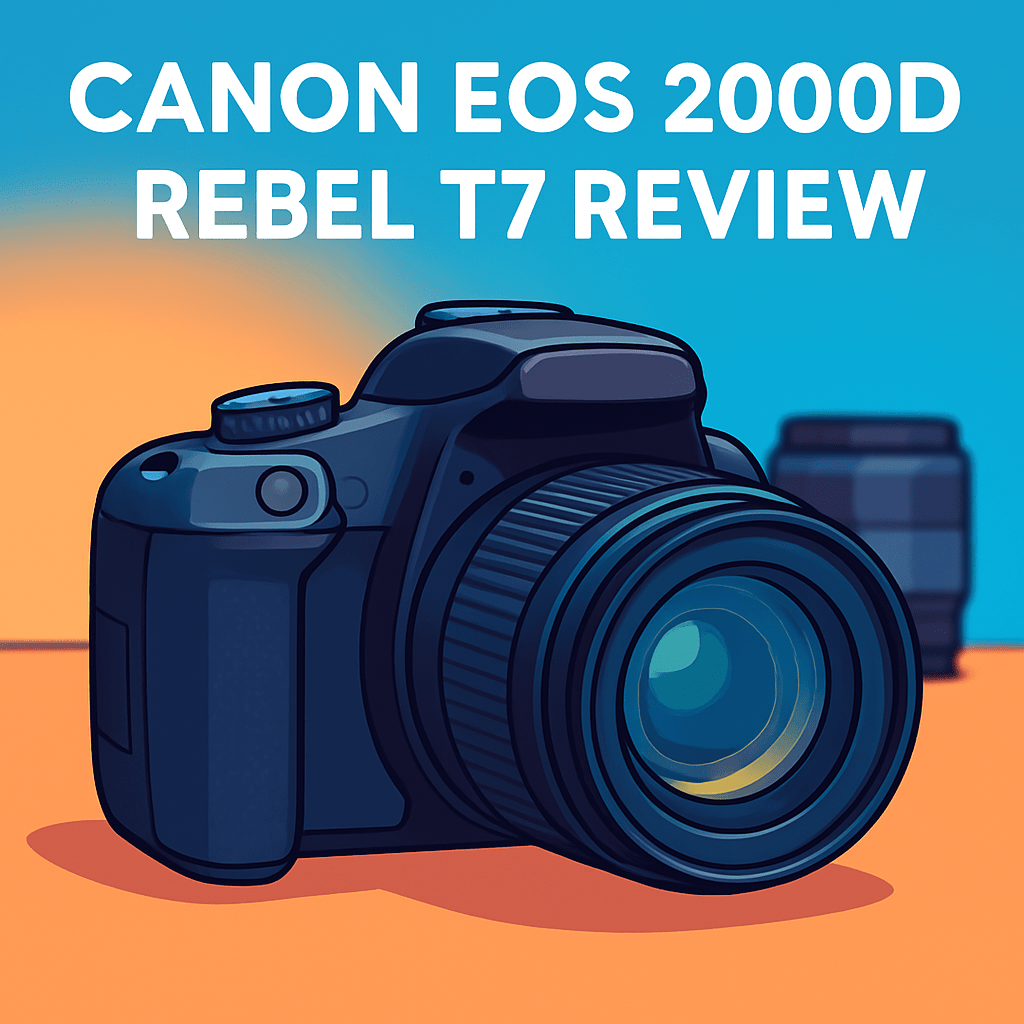
Want better photos without a steep learning curve?
The Canon EOS 2000D Camera is pitched at beginners and casual shooters who want an interchangeable-lens DSLR that’s simple to use and built for everyday stills.
After field-testing the 2000D on real shoots, I saw it favor straightforward handling, dependable image quality, and lens-growth potential over speed-first features. Make sure to read the entire review as it answers whether the 2000D is the right step for your photography — keep reading.

Canon EOS 2000D Camera
Beginner-friendly DSLR featuring a 24.1MP APS-C sensor, easy-to-use controls and Full HD video. Lightweight body with dependable autofocus and built-in Wi‑Fi for effortless shooting and quick image sharing.
Check PriceThe Numbers You Need
| Spec | Value |
|---|---|
| Sensor | 24.1 MP APS-C CMOS |
| ISO Range | 100–6400 (expandable to 12800) |
| Image Processor | DIGIC 4+ |
| Autofocus Points | 9-point AF system with center cross-type sensor |
| Continuous Shooting Speed | Up to 3 fps |
| Video Resolution | Full HD 1080p at 30 fps |
| Display | 3.0-inch LCD screen, 920,000 dots |
| Viewfinder | Optical pentamirror with 95% frame coverage |
| Built-in Flash | Yes, with hot shoe for external flash |
| Connectivity | Built-in Wi-Fi with NFC |
| Storage Media | SD/SDHC/SDXC card support |
| Battery Life | Approximately 500 shots per charge |
| Weight | Approx. 475 grams (body only) |
| Lens Mount | Canon EF/EF-S lenses compatible |
| Dimensions (W×H×D) | 129 × 101.3 × 77.6 mm |
How It’s Built
In my testing the Canon EOS 2000D feels light and compact in the hand, so it’s easy to carry all day on family trips or around town. That portability makes it less of a burden for beginners who don’t want a big, heavy camera every time they go out. It’s the kind of body you’ll actually pick up and use instead of leaving at home.
The grip is surprisingly comfortable and the main buttons sit where your fingers naturally fall. In my use the menus are simple and quick to navigate, which helps when you’re still learning settings. That means less fumbling and more time nailing the shot.
The optical viewfinder gives a clear, traditional shooting feel, but it doesn’t show absolutely everything at the edge of the frame, so I learned to leave a little breathing room when composing. The rear 3.0-inch screen is bright and detailed for reviewing photos and scrolling menus, which is handy for checking focus and exposure on the spot. For everyday reviewing and learning, it works really well.
I liked having the pop-up flash for quick fill light and a proper hot shoe when I wanted to step up to an external flash. Lenses are easy to grow into thanks to Canon’s EF/EF-S mount, so you can start simple and add primes or a tele later without changing the camera.
One thing I really liked was the comfortable grip and straightforward control layout that makes shooting enjoyable from the first day. One thing that could be better is the viewfinder coverage and slightly basic menu feel, so beginners should check framing carefully or use the screen when exact composition matters.
In Your Hands
The Canon EOS 2000D delivers the kind of stills that reassure new photographers: crisp, well-rendered images with pleasing color and enough resolution to crop and print without losing character. RAW shooting provides plenty of headroom for edits, so you can push exposure and color with confidence during post-processing.
In available light the camera performs respectably at moderate sensitivities, keeping grain under control for everyday indoor and evening scenes; very low-light work will show its limits, so a flash or faster lens helps when things get dim. This makes it a reliable companion for family moments, street shots, and casual portraits shot under ambient light.
Responsiveness is geared toward leisurely shooting rather than sport—continuous shooting and focus tracking are adequate for kids and pets but not built for sustained action. Power-up and shutter feel are satisfying for beginners, and the menu layout keeps common tasks straightforward even if the system isn’t the fastest out there.
Video is handled in a traditional Full HD style that’s ideal for school plays, home movies, and simple clips meant for social sharing. Motion-heavy scenes expose the camera’s limitations compared with higher-end bodies, so steady handling and basic stabilization techniques pay off.
Battery life easily covers a day of casual shooting, though a spare is wise for events or heavy live-view use. The SD-based workflow is simple—use cards rated for steady RAW bursts and Full HD recording to keep transfers smooth and reliable.
The Good and Bad
- 24.1 MP APS-C sensor capable of detailed stills
- Simple, beginner-friendly shooting experience
- EF/EF-S lens mount offers broad lens options for growth
- Approx. 500-shot battery life supports a day of casual shooting
- 9-point AF system is basic and limited for fast action or complex tracking
- 3 fps burst speed restricts sports and wildlife capture rates
Ideal Buyer
If you’re moving up from a smartphone or a point‑and‑shoot, the Canon EOS 2000D Camera is a gentle, dependable first DSLR. Controls are straightforward and the optical viewfinder teaches classic framing. It’s built to help you learn without overwhelming you.
Family photographers, weekend travelers, and hobbyists who prioritize still-image quality over bleeding‑edge speed will find a lot to like. The 24.1MP sensor and solid battery life let you capture detail on vacations and at gatherings. JPEG and 14‑bit RAW support mean images hold up well to editing.
Photographers who plan to grow their kit will appreciate Canon’s EF/EF‑S lens ecosystem and the pop‑up flash with a hot shoe for external lighting. Grip and button layout make the camera comfortable for new hands and longer shoots. It’s an affordable platform for learning composition, exposure, and lens choices.
This isn’t the camera for dedicated sports shooters, wildlife chasers, or vloggers chasing 4K and advanced AF tracking. If you need high frame rates, sophisticated autofocus, or cutting‑edge video features, look at higher‑end or newer mirrorless models. For everyone else who wants a simple, capable DSLR to grow with, the 2000D is a smart start.
Better Alternatives?
We covered the Canon EOS 2000D (Rebel T7) in depth — its simple handling, solid 24MP stills and where it starts to show limits for faster shooting or video. If you like the T7’s straightforward approach but want something that leans more to travel, video or a more modern live‑view experience, there are a few close alternatives worth a look.
Below I’ll walk through three cameras I’ve used in the field and tell you what each one does better and where it falls short compared to the T7. I’ll also point out the kind of buyer who will be happiest with each pick so you can match the camera to how you actually shoot.
Alternative 1:

Nikon D3500 Camera
Compact, entry-level DSLR delivering excellent image quality from a 24.2MP sensor, long battery life and responsive performance. Comfortable grip and Bluetooth connectivity simplify transfer and everyday shooting.
Check PriceThe Nikon D3500 is the one I reach for when I know I’ll be carrying a camera all day. It feels noticeably lighter in the hand than the T7, and in real use that adds up — less fatigue on long walks and easier to tuck into a day pack. The images often look a touch cleaner at higher ISOs, so when I’m shooting indoors or at dusk I get usable shots with less fuss than I did with the T7.
Where it’s not as strong is live‑view and video focus. When you need to use the screen for framing or want smooth autofocus for video, the D3500 is slower and less confident than the T7’s options in live view. Also, connectivity on Nikon’s side can be a bit hit-and-miss at times, so transferring files to a phone isn’t as seamless as some newer Canon systems.
Buyers who will like the D3500 are travellers and family shooters who value light weight, long battery life and solid stills. If you shoot mostly photos and want a camera that stays out of the way on long days, this is a great alternative. If you need quick live‑view autofocus for video or vlogging, look elsewhere.
Alternative 2:

Canon EOS 250D Camera
Versatile, ultra-light DSLR with vari-angle touchscreen and 4K time-lapse capability. Fast DIGIC processing, Dual Pixel autofocus in Live View, ideal for vloggers and hobbyist photographers.
Check PriceThe Canon EOS 250D (also sold as the SL3) is the T7’s more modern cousin. The thing I liked most when shooting with it was the vari‑angle touchscreen and the Dual Pixel autofocus in live view — focusing in screen mode is quick and confident for portraits and run‑and‑gun video, which is a clear step up from the T7’s live‑view feel.
That said, the 250D isn’t perfect. Its 4K mode comes with compromises and the camera can feel a bit more “consumer” in handling compared with the T7’s simple, no‑frills approach. Battery life under heavy live‑view or video use can drop faster than the T7, so bring a spare if you plan to vlog all day. It’s also a bit pricier, so you’re paying for the newer features.
If you vlog, shoot a lot of portraits on the flip screen, or want better autofocus when using the LCD, the 250D will make your life easier. Hobbyists who want a compact DSLR with modern live‑view performance and easier video options will prefer this over the T7. If you want the plainest, longest‑lasting stills camera for minimal fuss, the T7 or the D3500 might still be better.
Alternative 3:
Canon EOS 250D Camera
Perfect for creative beginners seeking compact SLR handling with advanced autofocus and user-friendly guides. Produces sharp images, offers Live View eye detection, built-in Wi‑Fi and straightforward social sharing.
Check PriceLooking at the same 250D from the beginner’s point of view, it’s a much friendlier camera than the T7 when you want help composing and learning. The menus and touchscreen make it easy to change settings on the fly, and the live‑view eye detection and reliable screen autofocus take a lot of guesswork out of portrait shooting. In short, it makes getting sharp, well‑framed shots easier than with the T7’s optical viewfinder workflow.
On the downside, you do give up a bit of the T7’s straightforward optical viewfinder experience and sometimes the smaller body feels less rugged in hand. Also, if your work is mostly long days of stills and you rely heavily on battery, the T7 can be a calmer companion — the 250D’s modern features encourage more screen use and that eats power.
This version of the 250D suits creative beginners and social shooters who want quick, sharp results and easy sharing. If you’re moving from smartphone photos to a proper camera and like learning through the camera’s screen and guides, you’ll appreciate the 250D more than the T7. If you prefer the simplest, long‑lasting DSLR experience focused purely on stills, stick with the T7 or consider the D3500 instead.
What People Ask Most
Is the Canon EOS 2000D (Rebel T7) a good camera?
It’s a solid entry‑level DSLR with a 24MP APS‑C sensor and reliable image quality, but it lacks advanced autofocus and fast burst speeds for demanding work.
Is the Canon Rebel T7 good for beginners?
Yes — it’s affordable, easy to use, and great for learning DSLR basics, though you may outgrow it if you need faster performance or advanced video features.
What is the difference between the Canon EOS 2000D and the Rebel T7?
There is no difference; “Rebel T7” is the North American name for the Canon EOS 2000D and they are the same camera.
How many megapixels does the Canon EOS 2000D/Rebel T7 have?
It has a 24.1‑megapixel APS‑C sensor, which is plenty for large prints and cropping.
Does the Canon EOS 2000D (Rebel T7) have Wi‑Fi and NFC?
Yes, it includes built‑in Wi‑Fi and NFC for easy image transfer and basic remote control via Canon’s app.
What lenses are compatible with the Canon EOS 2000D/Rebel T7?
It accepts Canon EF and EF‑S lenses, giving you access to a wide range of kit zooms, primes, and specialty lenses.
Conclusion
The Canon EOS 2000D Camera is a straightforward entry-level DSLR built for someone stepping up to interchangeable lenses. It hands you an optical viewfinder and a familiar, tactile shooting experience. That simplicity is its design philosophy and explains why many beginners find it so approachable.
In real-world use it delivers surprisingly satisfying stills and plenty of latitude for modest post-processing. Controls and menus are unpretentious, making learning faster than fumbling through complexity. Built-in wireless tools, a flash for casual fill and access to Canon’s lens family give it practical longevity.
The trade-offs are clear and unavoidable. Autofocus and burst performance are basic, so fast-moving subjects and complex tracking can frustrate. Video capabilities and low-light headroom are serviceable but not where you’d go for modern video work or for pushing high-ISO limits.
If your priorities are family photos, travel, and learning the craft of photography, this camera is a sensible, dependable first DSLR. If you chase sports, wildlife, or serious video, consider newer models that address those needs. Bottom line: a solid stills-first entry model that favors clarity and ease over speed and cutting-edge video, and a camera that will teach you the essentials without getting in the way.
Canon EOS 2000D Camera
Beginner-friendly DSLR featuring a 24.1MP APS-C sensor, easy-to-use controls and Full HD video. Lightweight body with dependable autofocus and built-in Wi‑Fi for effortless shooting and quick image sharing.
Check Price


0 Comments