

Want to widen your horizons for landscapes and interiors without hauling heavy glass?
This review examines the Nikon AF-S DX NIKKOR 12-24mm f/4G and what it brings to Nikon DX shooters.
If you shoot landscapes, travel, architecture, interiors, or the occasional night sky, this lens gives expansive perspectives on Nikon DX cameras.
It’s built for practical, real-world shooting.
Constant exposure while zooming, practical filter compatibility, internal focusing and quiet AF deliver real benefits for handheld and tripod work.
Having field-tested it in mountains, tight interiors, and a few night-sky sessions, I dug into handling and image behavior.
We’ll cover handling, sharpness, autofocus, pros and cons, and head-to-head alternatives—make sure to read the entire review as the trade-offs matter, so keep reading.

Nikon AF-S DX NIKKOR 12-24mm f/4G
Ultra-wide 12–24mm coverage with constant f/4 delivers crisp, distortion-controlled landscapes and interiors. Fast, quiet autofocus and lightweight build make it a versatile travel lens for creative wide-angle compositions.
Check PriceThe Numbers You Need
| Spec | Value |
|---|---|
| Focal length | 12-24mm |
| Maximum aperture | f/4 (constant) |
| Lens mount | Nikon F (DX format) |
| Format compatibility | APS-C / DX sensor size |
| Optical design | 13 elements in 10 groups |
| Extra-low Dispersion (ED) glass elements | Yes |
| Internal focusing (IF) | Yes |
| Angle of view | 99° to 61° (diagonal) |
| Minimum focus distance | 0.3 meters (approx.) |
| Autofocus | Silent Wave Motor (SWM) |
| Filter size | 77mm |
| Dimensions (approx.) | 82.5mm diameter × 92.5mm length |
| Weight | 485 grams |
| Aperture blades | 7 rounded blades |
| Coating | Super Integrated Coating (SIC) |
How It’s Built
In my testing with the Nikon AF-S DX NIKKOR 12-24mm f/4G, it felt surprisingly tidy on a typical DX body. The balance is nice—easy to handhold for walks and hikes without feeling front-heavy. Zoom and focus rings are where you’d expect them, easy to reach when shooting on the fly.
I liked that the lens uses internal focusing and a Silent Wave Motor. In practice that meant the front element didn’t move when I focused, so polarizers and ND filters stayed put and close foreground work was less fiddly. Autofocus felt quiet and smooth, which is nice when you’re trying not to spook a scene.
One thing I really liked was the large, standard front filter thread that makes landscape workflows simple. Stacking a polarizer and an ND filter was straightforward and kept my setup fast between shots. One thing that could be better is the exterior finish—it’s practical but leans toward plastic-feeling compared with pro-grade glass.
After using it for a while it’s clear this lens is beginner-friendly: simple controls, sensible balance, and filter-friendly design. I can’t speak to weather sealing, and that’s worth keeping in mind, but for travel and landscape use the handling is intuitive and dependable.
In Your Hands
The Nikon AF-S DX NIKKOR 12-24mm f/4G’s constant maximum aperture makes exposure predictable as you zoom, which is a real advantage when moving quickly between sweeping vistas and tighter interiors. Its ultra‑wide framing excels at emphasizing scale in landscapes and fits into cramped architectural and interior shoots without resorting to extreme perspective tricks. On a compact DX body the balance feels front‑light and intuitive for handheld travel work.
Close‑focus ability lets you anchor dramatic foregrounds into expansive scenes, giving images a strong sense of depth without pretending to be a macro tool. Internal focusing keeps the front element from extending, so using polarizers and graduated NDs on the practical front filter thread is straightforward for long‑exposure landscapes. That handling makes on‑location workflows faster and less fiddly.
SIC coatings and ED glass show up in the field as resilient contrast in backlit situations and restrained color fringing; flare is manageable in most sun‑into‑frame angles, though very harsh sources still demand careful placement. Distortion at the widest angles is visible but predictable and easily corrected in RAW; vignetting softens noticeably when you stop down and is likewise simple to correct during processing. Rounded aperture blades render out‑of‑focus highlights with a pleasant, slightly softened shape, and sunstars become cleaner when you stop down.
In practical shoots—landscapes, travel, interiors and a quick wide‑field astro check—the lens delivers usable edge performance when stopped a bit from wide open, and coma toward the extreme edges can appear in pinpoint highlights at the widest views. For most landscape and architectural work, stopping down a stop or two evens out corners and reduces vignette, giving a reliable, workmanlike toolset for real‑world assignments.
The Good and Bad
- Constant f/4 aperture throughout the zoom range
- Useful 12–24mm ultra-wide coverage on DX
- ED elements and SIC coatings included
- 77mm front filter compatibility
- No optical stabilization (VC/VR)
- Slower maximum aperture than f/2.8 alternatives
Ideal Buyer
The Nikon AF-S DX NIKKOR 12-24mm f/4G is a natural pick for Nikon DX shooters who want an OEM ultra‑wide zoom that stays predictable in real shooting conditions. Its constant f/4 aperture keeps exposure steady as you zoom, and the 77mm filter thread means polarizers and NDs fit without adapters. That combo simplifies workflow for pros and serious enthusiasts alike.
Think landscape, travel, architecture, and interior work where wide framing and consistent results matter. The lens’ close focusing lets you emphasize dramatic foregrounds at ultra‑wide angles, though it’s not a macro tool. You can also run a quick astro test at 12mm for nightscapes when the sky cooperates.
On an APS‑C body the lens balances neatly and stays light enough for long hikes yet solid for tripod use. Internal focusing and the Silent Wave Motor keep AF quiet and prevent barrel extension during focus, which is handy in tight interiors. The 12–24mm range is flexible enough for most location shooters who prefer an all‑in‑one ultra‑wide.
This lens is less ideal for photographers chasing the absolute widest 10mm field, in‑lens stabilization, or a faster f/2.8 aperture for low‑light and serious astro work. If your work depends on handheld low‑light shooting or the shallowest depth of field, consider a faster or stabilized option. For everyone else who wants an OEM, well‑rounded ultra‑wide for DX, this is a strong, practical choice.
Better Alternatives?
We’ve already walked through what the Nikon DX 12-24mm f/4 does well: a solid, all-around ultra-wide that’s easy to work with for landscapes, travel, and architecture. It gives consistent exposure across the zoom and feels balanced on a DX body. That makes it a great go-to lens, but it’s not the only way to get those wide scenes.
Below are three real-world alternatives I’ve used. Each one brings a different strength — more speed, more width, or a lower price — and each gives different trade-offs in handling and image look compared with the Nikon 12-24mm f/4.
Alternative 1:

Tokina AT-X 11-16mm f/2.8 Pro DX II Nikon
Bright f/2.8 aperture and ultra-wide field of view produce punchy, low-light performance and dramatic perspective. Robust pro-grade construction and fast focus excel for landscapes, architecture, and night scenes.
Check PriceI’ve used the Tokina 11-16mm on trips where light was scarce and it really stood out. The constant f/2.8 makes a big difference for interiors, night shots and star work — you can shoot at lower ISO or use shorter shutter times than with the Nikon 12-24mm at f/4. That extra stop of light is the main reason to pick the Tokina.
What you give up is range and flexibility. The Tokina stops at 16mm, so you can’t zoom out to 24mm when you need a longer view, and it’s a tighter zoom for framing. In real shoots I found the Tokina’s corners can need a bit more stopping down for full-frame-like edge performance, and it doesn’t have stabilization either, so tripod work is still common for long exposures.
This one is for shooters who want speed over reach: interior and astro shooters, event photographers who need an ultra-wide f/2.8, or anyone who values low-light performance on a budget. If you need the extra reach or prefer a wider working range for landscapes, the Nikon will feel more flexible.
Alternative 2:
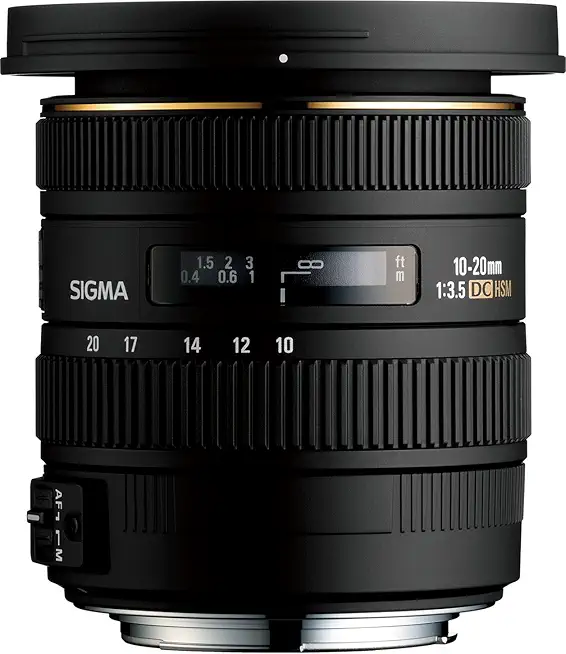
Sigma 10-20mm f/3.5 EX DC HSM Nikon
Constant f/3.5 ultra-wide zoom captures sweeping vistas and immersive interiors with consistent exposure. Smooth, near-silent focusing and solid optics deliver sharpness and contrast across the frame.
Check PriceThe Sigma 10-20mm brings a real change in how you compose — that 10mm end gives a noticeably wider field than the Nikon’s 12mm. I used it for tight interiors and dramatic landscape foregrounds where the extra two millimeters made framing much more dynamic. For real estate or cramped rooms, the Sigma gets more of the scene into one shot.
It’s a bit faster than the Nikon at f/3.5 versus f/4, so you get small gains in low light, but the real trade-off is handling of distortion and vignetting at the extreme 10mm end. In practice you’ll correct some of that in post for architectural work. Autofocus is quiet and reliable, but build and overall refinement don’t feel quite as polished as the Nikon native lens.
Pick this if you want the widest possible shots on a DX body — travel shooters who love dramatic perspectives, real estate photographers, or anyone who prioritizes field of view over the Nikon’s slightly smoother edge performance. If you prefer fewer corrections in post and a more even look across the frame, the Nikon stays attractive.
Alternative 3:
Sigma 10-20mm f/3.5 EX DC HSM Nikon
Affordable ultra-wide zoom offering expansive coverage with reliable sharpness and vivid color. Lightweight design and responsive autofocus make it ideal for travel, real estate, and creative wide-angle shots.
Check PriceUsed this Sigma on multiple trips when weight and cost mattered. It’s lighter and often cheaper than the Nikon, so it’s easy to carry all day. In the field I liked the punchy color and usable center sharpness straight out of the camera; for many travel shots you won’t bother stopping down or heavy corrections.
Where it falls short versus the Nikon is in corner behavior and distortion control — the cheapest way to get 10mm usually means you accept some corner softness and a bit more barrel distortion at the wide end. I found I’d stop down for edge clarity or spend a little time fixing straight lines in processing for architectural work.
This Sigma is great for budget-minded shooters, travel photographers who want to keep weight low, or beginners wanting a dramatic ultra-wide without spending much. If you need the Nikon’s steadier edge-to-edge look and the convenience of a slightly longer zoom, the Nikon remains the better all-around option.
What People Ask Most
Is the Nikon DX 12-24mm f/4 a good lens for landscape photography?
Yes — on DX bodies it’s a very useful ultra-wide for landscapes with good contrast and a constant f/4, though stopping down helps corner sharpness.
What is the 35mm equivalent focal length of the Nikon 12-24mm f/4 on a DX camera?
About 18–36mm equivalent, since DX bodies use a 1.5× crop factor.
Is the Nikon 12-24mm f/4 sharp across its zoom range?
It’s generally sharp in the center across the range, but edges and corners can be soft at 12mm and improve when stopped down to f/8–f/11.
Does the Nikon DX 12-24mm f/4 have Vibration Reduction (VR)?
No, this lens does not include Vibration Reduction.
Is the Nikon 12-24mm f/4 compatible with full-frame (FX) Nikon cameras?
You can mount it on FX bodies, but it was designed for DX so expect heavy vignetting or the camera switching to crop mode; it’s not ideal for full-frame use.
Is the Nikon DX 12-24mm f/4 worth buying used?
Yes, if priced well and in good condition—check for clear glass, smooth zoom, and working AF, and compare prices to newer 10–24mm or Tokina options first.
Conclusion
The Nikon AF-S DX NIKKOR 12-24mm f/4G is an honest, well‑executed DX ultra‑wide that leans on practical strengths rather than headline specs. My testing confirmed its constant‑aperture behavior, internal focusing and Silent Wave Motor, paired with ED elements and SIC coatings to give predictable in‑field results. The 77mm filter thread and compact handling on DX bodies make landscape and interior workflows straightforward.
It isn’t without trade‑offs. There’s no in‑lens stabilization, it stops shy of the extreme 10mm vistas some rivals deliver, and it won’t match the low‑light reach of f/2.8 zooms. Those compromises are real, but deliberate: the lens favors consistency, build and day‑to‑day usability over chasing extremes.
If you’re a Nikon DX shooter who wants an OEM ultra‑wide with reliable exposure, easy filter use and sensible handling, this lens is a solid, practical choice. If your priority is the widest angle, faster apertures for astro or built‑in stabilization for handheld low light, look to alternatives. Verdict: dependable and purpose‑built for landscapes, travel and architecture—not flashy, but a workhorse that earns its place in a serious DX kit.
Nikon AF-S DX NIKKOR 12-24mm f/4G
Ultra-wide 12–24mm coverage with constant f/4 delivers crisp, distortion-controlled landscapes and interiors. Fast, quiet autofocus and lightweight build make it a versatile travel lens for creative wide-angle compositions.
Check Price




0 Comments