
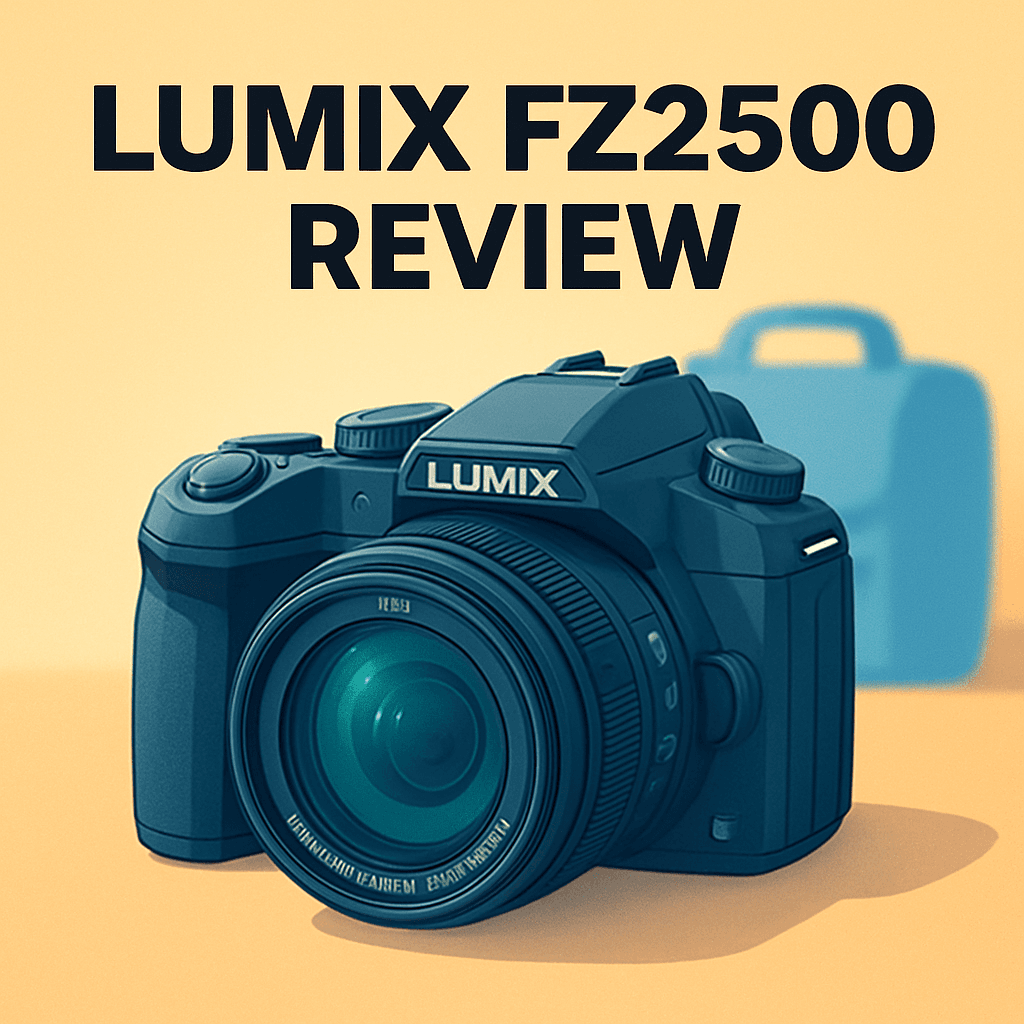
Want to up your image and video game without juggling lenses? I took the Panasonic Lumix FZ2500 Camera into the field to see what it’d do.
It’s got long reach, solid 4K, and video-first controls that translate to real-world convenience. That combo suits hybrid creators, travelers, and event shooters who want one reliable tool.
I pushed it through low light, handheld tele, and mixed stills/video runs to see how it’d cope. Those tests showed how it behaves when the stakes are real.
You’ll learn how it handles, the image/video experience, autofocus behavior, and real-world tradeoffs. Make sure to read the entire review as I uncover surprises and tradeoffs—keep reading.

Panasonic Lumix FZ2500 Camera
One-inch sensor and bright long-range zoom deliver sharp stills and cinematic 4K video; tactile controls, built-in ND filter and reliable autofocus make it ideal for travel, wildlife and event shooters.
Check PriceThe Numbers You Need
| Spec | Value |
|---|---|
| Sensor | 1-inch |
| Resolution | 20 MP |
| Lens | 20x Leica zoom |
| Zoom Range | 24–480mm equivalent |
| Video Resolution | 4K |
| Video Frame Rate | 30 fps |
| Continuous Shooting | Up to 10 fps |
| ISO Range | 125 – 12800 |
| Autofocus | Contrast AF |
| Viewfinder | 2.36M-dot EVF |
| LCD Screen | 3-inch touch LCD |
| Image Stabilization | Optical IS |
| Memory Card | SD/SDHC/SDXC |
| Connectivity | Wi-Fi, Bluetooth |
| Battery Life | Approx. 350 shots |
How It’s Built
In my testing the Panasonic Lumix FZ2500 Camera feels like a proper all-in-one tool in your hands. The fixed Leica zoom gives a huge range without swapping lenses, and the barrel stays well-behaved as you dial through the focal lengths. That translates to real-world ease when you’re traveling light or chasing a single subject without fuss.
The built-in EVF is sharp and handy in bright sun, and the touch LCD is responsive enough for quick framing and touch-AF. I found the viewfinder more useful than I expected for tight tele shots, and beginners will appreciate not having to guess exposure in harsh light. It makes composing and checking focus feel straightforward.
Optical stabilization is a real-world win. While hand-holding at long reach you get many usable frames and smooth walk-and-talk video without gimbal drama. For casual shooters and vloggers that means fewer blurry shots and steadier footage on the go.
I really liked the dedicated video-minded controls and the comfortable grip for longer shoots. The dials and buttons feel solid and intuitive, which helps when switching between stills and video quickly. One thing that could be better is the balance at full tele—the front can get a bit nose-heavy on long handheld stretches.
Battery and connectivity worked fine in the field for mixed shooting, though you’ll swap batteries on long days. Wi‑Fi and Bluetooth paired reliably for quick transfers, which is great for sharing selects on the fly. Overall it’s a friendly package for beginners who want pro-style handling without complexity.
In Your Hands
In practice the Panasonic Lumix FZ2500 punches above its class for image quality: fine detail is strong at base sensitivity, colors stay natural and pleasing for skin tones, and the files retain a forgiving dynamic range that lets you rescue highlights and shadow detail without fuss. For everyday editorial and client work the images look professional straight out of the camera with a look that’s easy to grade for video.
Low‑light performance is respectable for a compact body—noise becomes more apparent sooner than on larger‑sensor cameras, so I stay conservative for paid assignments and push it more for personal projects where grit adds character. In dim interiors the camera still produces usable results if you’re mindful of exposure and processing.
Optical stabilization is a quiet hero in real use: handheld stills and walk‑and‑talk video stay impressively steady even when framing at long reach, letting me use slower shutter speeds and capture moments I’d otherwise miss. It won’t replace a tripod for critical long exposures, but it turns marginal, handheld frames into keepers far more often than not.
The burst mode is valuable for fleeting moments, offering a reliable hit rate and a buffer that recovers quickly enough for travel, events, and family action; it’s not optimized for continuous pro‑sports sequences but handles everyday motion confidently. The zoom range is genuinely practical—sharp for landscapes and street work, and usable at distance for wildlife and events if you dial in technique and stabilization.
The EVF and responsive touch LCD make composition and touch‑AF straightforward, even when re‑framing quickly during video takes, so subject acquisition feels natural in the field. Battery life and wireless pairing fit a typical day of mixed stills and short video clips with room for a quick battery swap, and Wi‑Fi/Bluetooth simplified field delivery and social sharing when deadlines were tight.
The Good and Bad
- One-inch, twenty-megapixel imaging with extensive telephoto reach
- Ultra-high-definition video recording
- Optical image stabilization that aids handheld stills and video
- Video-friendly ergonomics and controls for dedicated video work
- Contrast AF system that trails top competitors in autofocus and subject tracking for fast action
- Ultra-high-definition video capped at thirty frames per second
Ideal Buyer
If you’re a hybrid creator who shoots both stills and video, the Panasonic Lumix FZ2500 is an easy consideration. It pairs 4K/30p capture with a 24–480mm Leica zoom, giving one-body versatility for run-and-gun assignments. Video-first ergonomics mean longer takes feel more manageable than most compacts.
Travel, documentary, and event shooters will appreciate the extended reach and dependable Optical IS. You can cover landscapes, stage moments and distant subjects without swapping lenses. Handheld shooting at moderate tele is realistic for quick turnarounds.
If your priority is controlled 4K video, physical video controls, built‑in ND and an EVF for monitoring, the FZ2500 fits. Its contrast AF is competent for run-and-gun but not bleeding-edge for fast action. For client work that prizes framing, look and steady footage over pixel-perfect tracking, this camera excels.
Action specialists and wildlife chasers should look to the Sony RX10 IV instead for superior AF tracking and faster burst behavior. If decisive-frame rates and subject tracking are mission critical, the RX10 IV is the better tool. For hybrid shooters who value video ergonomics and steady handheld reach, the FZ2500 remains a top pick.
Better Alternatives?
We’ve walked through what the FZ2500 does well — solid 1‑inch image quality, a very useful 24–480mm zoom, and video‑friendly controls that make long takes easier. In real shoots I found it reliable for travel and hybrid work, but there are clear reasons to look around: some rivals give faster autofocus, longer reach, or a different balance of size and price.
Below are three real alternatives I’ve used in the field, with honest notes on what each one does better or worse than the FZ2500 and who will get the most from them. I’ll point out the practical differences you’ll notice day to day, not just specs on a page.
Alternative 1:

Sony RX10 IV Camera
Super-telephoto reach, blazing autofocus and blackout-free burst capture fast action with stunning clarity; a 1-inch sensor and 4K video combine for versatile wildlife, sports, and documentary shooting.
Check PriceThe Sony RX10 IV is the choice when action matters. I’ve shot birds in flight and fast sports with it and the autofocus locks on and tracks subjects far better than the FZ2500. That confidence means more keepers in fast sequences, and the blackout‑free burst feels more natural when shooting decisive moments.
The RX10 IV also reaches farther at telephoto and feels a touch faster in the wide end, so distant subjects look cleaner and are easier to capture. The tradeoff is size and weight — it’s heavier than the FZ2500 and not as pleasant to carry all day, and it costs noticeably more. For long handheld hikes the FZ2500 is easier to live with.
If you need aggressive subject tracking, shot-to-shot speed, or you frequently shoot wildlife and sports, pick the RX10 IV. If you want a lighter hybrid camera that’s friendlier for long handheld video sessions, the FZ2500 still wins for ergonomic video controls and handling.
Alternative 2:

Panasonic Lumix FZ1000 II Camera
Large sensor and bright zoom produce detailed images and smooth 4K footage; improved autofocus, high-resolution electronic viewfinder, and ergonomic grip give confident control for handheld shooting.
Check PriceThe FZ1000 II is very close to the FZ2500 in image quality — I’ve gotten nearly identical stills from both in good light. Where the FZ1000 II shines is value and simplicity: it’s often lighter and cheaper, so it’s a good carry‑around camera for trips where you mainly shoot photos and want occasional 4K clips.
Compared to the FZ2500, the FZ1000 II is slightly less tuned for long video work. It doesn’t have the same video‑centric controls and ergonomics I liked on the FZ2500 during long takes, so for serious video shoots the FZ2500 still feels better in hand. Autofocus and tracking are similar or a bit behind the FZ2500 in real shooting scenarios.
Buy the FZ1000 II if you’re a stills-first shooter who wants 1‑inch image quality and a bright zoom at a lower price and weight. If you do more video or need the extra video controls and monitoring ease, stick with the FZ2500 instead.
Alternative 3:
Panasonic Lumix FZ1000 II Camera
16x optical zoom, fast continuous shooting, in-camera stabilization and customizable controls help capture decisive moments; tilting touchscreen and wireless connectivity simplify composition, review, and on-the-go sharing.
Check PriceViewed slightly differently, the FZ1000 II is also a solid all‑rounder with a good mix of features I used for everyday shooting. The stabilization and customizable buttons make it easy to pick up and nail quick handheld shots — I found it very forgiving when I was moving between scenes and didn’t want to reconfigure settings.
Where it falls short versus the FZ2500 is in video ergonomics and some pro touches. The FZ2500’s dedicated video controls, monitoring options, and handling choices make longer video sessions easier; the FZ1000 II is more of a grab-and-shoot tool. Also, if you push autofocus on moving subjects, the FZ2500 often feels a hair more consistent.
Choose the FZ1000 II if you want a simple, capable camera for travel, street, and family work, where ease of use and lighter weight matter. If you plan to do lots of video or need the extra video features and control layout I used on the FZ2500, then the FZ2500 remains the better fit.
What People Ask Most
What are the main pros and cons of the Panasonic Lumix FZ2500?
Pros: a versatile long-zoom all-in-one, very good 4K video features and solid handling; cons: the 1″ sensor limits low-light performance and background blur, and the camera is relatively bulky with average battery life.
Does the Lumix FZ2500 shoot 4K and is it good for video?
Yes — it records 4K and includes pro-style tools like a built-in ND filter and clean HDMI. It’s very capable for run-and-gun and hybrid shooters.
How is the image quality and low-light performance of the Lumix FZ2500?
The 1″ sensor gives sharp, detailed images in good light, but it struggles compared with larger-sensor cameras at high ISO and for creamy background blur.
How does the Lumix FZ2500 compare to the Panasonic FZ1000 (or FZ2000)?
It’s an evolution of the FZ1000/FZ2000 with improved video functions, ergonomics and a longer reach; overall image quality is similar since they share a 1″ sensor.
What is the zoom range and lens performance of the Lumix FZ2500?
The lens is roughly 24–480mm equivalent (about 20x zoom), excellent for travel and wildlife; it’s sharp in the center but a bit softer at the extreme wide and tele ends.
How long does the battery last on the Lumix FZ2500?
Battery life is average — expect roughly 300–400 stills per charge or a few hours of mixed shooting, with 4K video reducing runtime significantly.
Conclusion
The Panasonic Lumix FZ2500 Camera is a true hybrid tool built around video-first ergonomics and an all‑in‑one zoom that covers most shooting scenarios. It combines a capable sensor, reliable in‑body stabilization, a usable EVF and touch LCD, and modern connectivity to keep you shooting and sharing without fuss.
In the field it shines where handling and versatility matter most. Video shooters will appreciate long takes, easy monitoring and steady handheld footage, while travel and documentary shooters will love the reach and one‑camera convenience.
There are tradeoffs worth noting. The contrast‑based autofocus and burst behavior trail the fastest competitors for rapid action or birding, and those who need blistering continuous performance will be better served elsewhere.
If you’re a hybrid creator who prioritizes video ergonomics and a long zoom in a single package, this camera is a strong, practical choice. If stills speed or top-tier tracking are your priority, consider the RX10 IV or a stills-focused alternative; otherwise the FZ2500 delivers excellent value for focused hybrid work.
Panasonic Lumix FZ2500 Camera
One-inch sensor and bright long-range zoom deliver sharp stills and cinematic 4K video; tactile controls, built-in ND filter and reliable autofocus make it ideal for travel, wildlife and event shooters.
Check Price



0 Comments