
Want better photos without lugging around a heavy camera? Having shot with the Canon EOS Rebel SL3 Camera in real-world situations, I wanted to see if it really balances portability and performance.
It’s a compact DSLR that keeps the familiar handling of an optical viewfinder while adding a fully articulating touchscreen, 4K video option, and simple wireless sharing. In practice that mix can be liberating for travel, vlogging, and everyday shooting.
If you’re a beginner, upgrading from a phone, or a creator who values a small, easy-to-use DSLR, this review is written for you. There are trade-offs I noticed in the field that matter for real shoots — make sure to read the entire review as I unpack handling, autofocus, and video quirks; keep reading.

Canon EOS Rebel SL3 Camera
Lightweight DSLR with a 24MP sensor, intuitive vari-angle touchscreen, and 4K video capture—ideal for travel and vloggers seeking DSLR image quality, responsive autofocus, and easy mobile connectivity.
Check PriceThe Numbers You Need
| Spec | Value |
|---|---|
| Sensor | 24.1 MP APS-C |
| Lens System | Canon EF/EF-S mount |
| Video Resolution | 4K at 24/25p |
| Autofocus | Dual Pixel AF |
| Continuous Shooting | Up to 5 fps |
| ISO Range | 100–51,200 |
| Shutter Speed | 30s to 1/4000s |
| Touchscreen | Vari-angle LCD |
| Dimensions | 122 x 93 x 70 mm |
| Weight | Approximately 450 g |
| Viewfinder | Optical pentamirror |
| Image Stabilization | No (in-body) |
| Memory Cards | SD, SDHC, SDXC |
| Connectivity | Wi-Fi, Bluetooth |
| Internal Audio | Built-in stereo microphone |
How It’s Built
In my testing the Rebel SL3 feels whisper-light in your hands, which makes it a joy to carry all day. That small body really matters when you’re walking around shooting or traveling. For beginners this means less strain and more chances to practice without lugging a heavy kit.
The compact shape does give you easy access to most controls, but the grip is on the shallow side. After using it for a while with bigger lenses I noticed my hand wanted a bit more to hold onto. That’s fine for casual shooting, but pros or long sessions might want a grip extension.
The vari-angle touchscreen is what I really liked most; it flips and tilts for low, high, and selfie-style shots and the touch controls are responsive. In real use that makes vlogging and awkward-angle photos way less fiddly than older DSLRs. Beginners will find framing and focus much more intuitive with the screen.
Through the eyepiece you get a traditional optical view, and Live View is smooth for composing and movies. The mount gives you lots of lens choices, but note there’s no in-body stabilization—so plan on stabilized lenses for steady video and low-light stills. Built-in Wi‑Fi/Bluetooth, SD card storage, and a basic stereo mic round out a friendly package that’s easy to live with.
In Your Hands
The SL3 punches above its size when it comes to image quality, delivering pleasing detail and a broad tonal range that depends more on your lens choice than the body itself. Colors render naturally and JPEGs are ready to share with minimal fuss, making it friendly for shooters who want great results without heavy processing.
In everyday low‑light situations the camera is forgiving—you can push sensitivity to salvage dim scenes, but noise becomes noticeable if you push it hard and fine‑detail fades. Long exposures are straightforward for night and creative work, though the top shutter capability limits how you approach very fast action without brighter glass.
Continuous shooting is modest, handling family moments and casual sports without drama but not designed for pro-level bursts. Live View is where the SL3 shines: Dual Pixel AF makes composing on the flip screen simple and confidence‑inspiring, especially for run‑and‑gun stills and vlogging-style shoots.
The optical viewfinder offers a classic DSLR experience but its AF is basic compared with more advanced bodies, so expect best results with predictable subjects. Battery life has improved over the prior model, yet you’ll want a spare for full shooting days or heavy video use.
Workflow conveniences like Wi‑Fi and Bluetooth make instant transfers and remote control genuinely useful in the field, and SD cards behave reliably when managed properly. Overall, the SL3 balances portability and capable everyday performance, trading outright speed and deep action tracking for a lighter, more versatile shooting experience.
The Good and Bad
- 24.1MP APS‑C sensor
- Compact and lightweight body (122 x 93 x 70 mm; ~450 g)
- Vari‑angle touchscreen for flexible shooting angles
- Dual Pixel AF in Live View/1080p for smooth, reliable focus
- No in-body stabilization
- 4K autofocus limitations compared to 1080p AF
Ideal Buyer
If you prize portability without giving up DSLR ergonomics, the Canon EOS Rebel SL3 is an obvious pick. Its small, light body and fully articulating touchscreen make it easy to carry and frame shots from odd angles. It balances size with a proper optical viewfinder for classic DSLR shooting.
Beginners and casual shooters will appreciate the straightforward controls and the confidence of Dual Pixel Live View autofocus for stills and 1080p video. It’s forgiving for learning, and quick to get out of the bag for family moments or travel. The camera is great for learning exposure and composition without being overwhelming.
Content creators who want 4K as an option will like the SL3’s cinematic resolution—so long as they accept the 4K autofocus caveats. For run‑and‑gun vlogging, choose 1080p for the best AF behavior and rely on the vari‑angle screen and built‑in Wi‑Fi/Bluetooth for easy framing and sharing. Just be deliberate about shooting modes when you want the sharpest results.
And if you already own Canon EF/EF‑S glass, the SL3 feels instantly familiar and keeps your lens investment useful. Upgraders from older Rebels or smartphone shooters gain modern processing, better battery life than the SL2, and a compact DSLR that won’t intimidate new users. It’s the sweet spot for people who want Canon familiarity in a pocketable body.
Better Alternatives?
We’ve looked closely at the Canon Rebel SL3 — its small size, flip screen, Dual Pixel Live View AF and the trade-offs around 4K and viewfinder AF. That gives you a good sense of where it shines and where it leaves room for other choices.
If you want something with a different balance — longer battery life, stronger viewfinder AF, or a different feel in the hand — the cameras below are the most practical alternatives I’ve used in real shooting situations. I’ll point out what each one does better and worse than the SL3 and who will like each option.
Alternative 1:

Nikon D5600 Camera
Versatile DX-format camera delivering crisp 24MP images, vibrant color, and a responsive touchscreen for creative framing. Bluetooth connectivity and long battery life make it a dependable companion for enthusiasts.
Check PriceHaving shot weddings and long days of travel with the Nikon D5600, the first thing you notice is the battery life and comfort. It lasts noticeably longer than the SL3 between charges, so for long shoots or trips where you can’t swap batteries often, it’s a real advantage. The grip and balance also let you hold it steady for longer stretches without fatigue.
Where it beats the SL3 is in the optical viewfinder experience and steady stills shooting: the D5600’s AF in the viewfinder feels more confident for tracking through the OVF, so it’s easier to follow kids, pets, or sports when you’re not in Live View. What it gives up is the SL3’s Live View Dual Pixel AF speed and the 4K option — the D5600’s video AF is slower and it doesn’t offer 4K, so for vloggers or run‑and‑gun video the SL3 often feels more capable.
This camera suits stills-focused shooters who do long sessions or want a relaxed shooting day with fewer battery swaps. If you prioritize viewfinder action shooting, comfort, and longer runtime over small-body portability and 4K video, the D5600 is a solid pick.
Alternative 2:
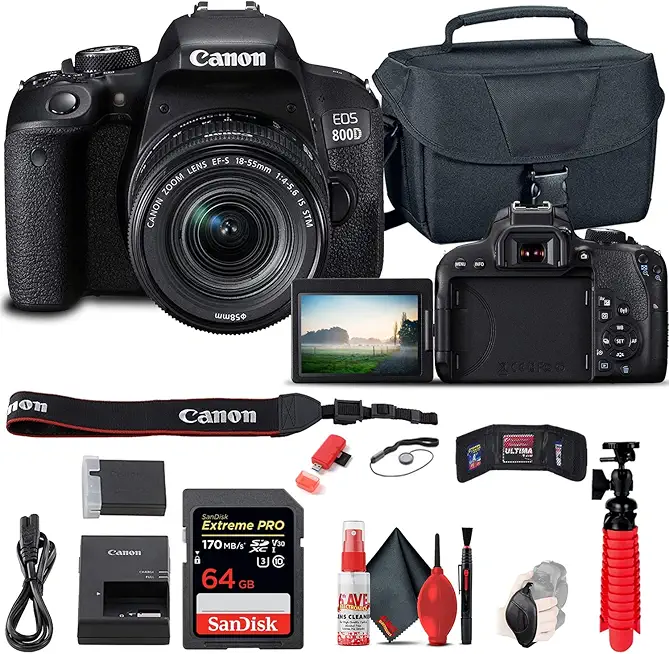
Canon EOS Rebel T7i Camera
User-friendly APS-C DSLR offering smooth autofocus, detailed 24MP stills, and a tactile touchscreen for quick menu access. Built-in creative modes and fast performance help elevate everyday photography.
Check PriceI’ve used the T7i on family shoots and short sports sessions and it feels like a more confident workhorse in the hand than the SL3. The T7i’s viewfinder AF system tracks moving subjects better when you’re shooting through the OVF, so keeping focus on erratic kids or quick subjects is easier than on the SL3’s entry-level viewfinder AF.
Compared to the SL3, the T7i’s Live View and video AF are on par — both feel smooth — but the T7i doesn’t have 4K. That means if 4K is an important feature for you, the SL3 has the edge despite its 4K AF quirks. The T7i also feels a touch bulkier, so the SL3 still wins if you want the smallest, lightest DSLR to carry all day.
This one is for photographers who want a reliable all‑around DSLR with strong viewfinder tracking and easy handling for action and everyday shooting. Pick the T7i if you value OVF AF performance and a comfortable grip more than having 4K video in a tiny body.
Alternative 3:
Canon EOS Rebel T7i Camera
Balanced camera designed for learning and growth, featuring reliable subject tracking, expansive AF coverage, high ISO capability for low-light shots, and seamless Wi-Fi for sharing and creative expansion with interchangeable lenses.
Check PriceSeen as a learning-and-growth camera, the T7i is forgiving and helpful when you’re still improving technique. In low light it often pulls usable images at higher ISOs and the AF points give you room to experiment with moving subjects without constant missed shots — a nice safety net compared with the SL3’s smaller OVF AF area.
Where it falls short versus the SL3 is in size and video flexibility: the SL3’s tiny body and 4K option are attractive if you want a compact kit for travel or occasional vlogging. The T7i trades that compactness and 4K video for a broader viewfinder AF system and more comfortable handling for longer learning sessions.
If you’re a newer photographer who wants room to grow, someone who shoots in mixed light and wants reliable AF for practice, the T7i is a great alternative. It’s especially good for buyers who prefer learning with a traditional DSLR viewfinder and who don’t need 4K video.
What People Ask Most
Is the Canon Rebel SL3 worth buying?
Yes — it’s a compact, easy-to-use DSLR with good image quality and a flip touchscreen, making it a solid buy for beginners or vloggers who value an optical viewfinder and battery life.
Is the Canon Rebel SL3 good for beginners and vlogging?
Yes — the vari-angle screen, light body, mic input and user-friendly controls make it great for beginners and vlogging, though 4K has limits to be aware of.
How does the Canon Rebel SL3 compare to the Canon EOS M50?
The SL3 offers an optical viewfinder and better battery life, while the M50 is smaller and more modern as a mirrorless camera; choose SL3 for DSLR handling and M50 for compactness and EVF advantages.
Does the Canon Rebel SL3 shoot 4K video and how good is its video quality?
Yes, it records 4K but with a significant crop and limited autofocus in 4K, so 1080p often gives better autofocus and more usable framing for most users.
Which lenses are compatible with the Canon Rebel SL3?
The SL3 accepts Canon EF-S and EF lenses natively, so you have a wide range of APS-C and full-frame EF glass to choose from.
How good is the autofocus and battery life on the Canon Rebel SL3?
Autofocus is very good in Live View and 1080p video thanks to Dual Pixel AF, while the optical viewfinder AF is basic; battery life is strong for a small DSLR but bring a spare for long shoots.
Conclusion
The Canon EOS Rebel SL3 feels like a deliberate blend of DSLR ergonomics and modern mirrorless conveniences. It delivers APS‑C image quality, a fully articulating touchscreen and class‑leading Live View autofocus, while offering 4K as a useful—but imperfect—option. It’s not perfect, but it nails a particular sweet spot.
Its biggest asset is portability; this is a camera you can comfortably carry all day without sacrificing intuitive controls. For stills shooters and vloggers who rely on Live View AF and easy wireless sharing, the SL3 simply makes picture‑taking less fussy. That simplicity is its competitive edge.
The trade‑offs are real and clear. There’s no in‑body stabilization, viewfinder autofocus is modest for fast action, and the 4K mode comes with focus limitations that push many users back to 1080p for dependable results. That makes lens choice and shooting technique more important.
In short, the SL3 is the right call for beginners and creators who want the smallest Canon DSLR with a sensible mix of modern features and comfortable handling. Buy it for easy‑to‑use Live View performance; skip it if your work demands relentless action tracking or rock‑solid battery endurance. If viewfinder AF or long shooting sessions top your list, consider the T7i, Nikon alternatives, or an older Canon that better suits those priorities.
Canon EOS Rebel SL3 Camera
Lightweight DSLR with a 24MP sensor, intuitive vari-angle touchscreen, and 4K video capture—ideal for travel and vloggers seeking DSLR image quality, responsive autofocus, and easy mobile connectivity.
Check Price

0 Comments