
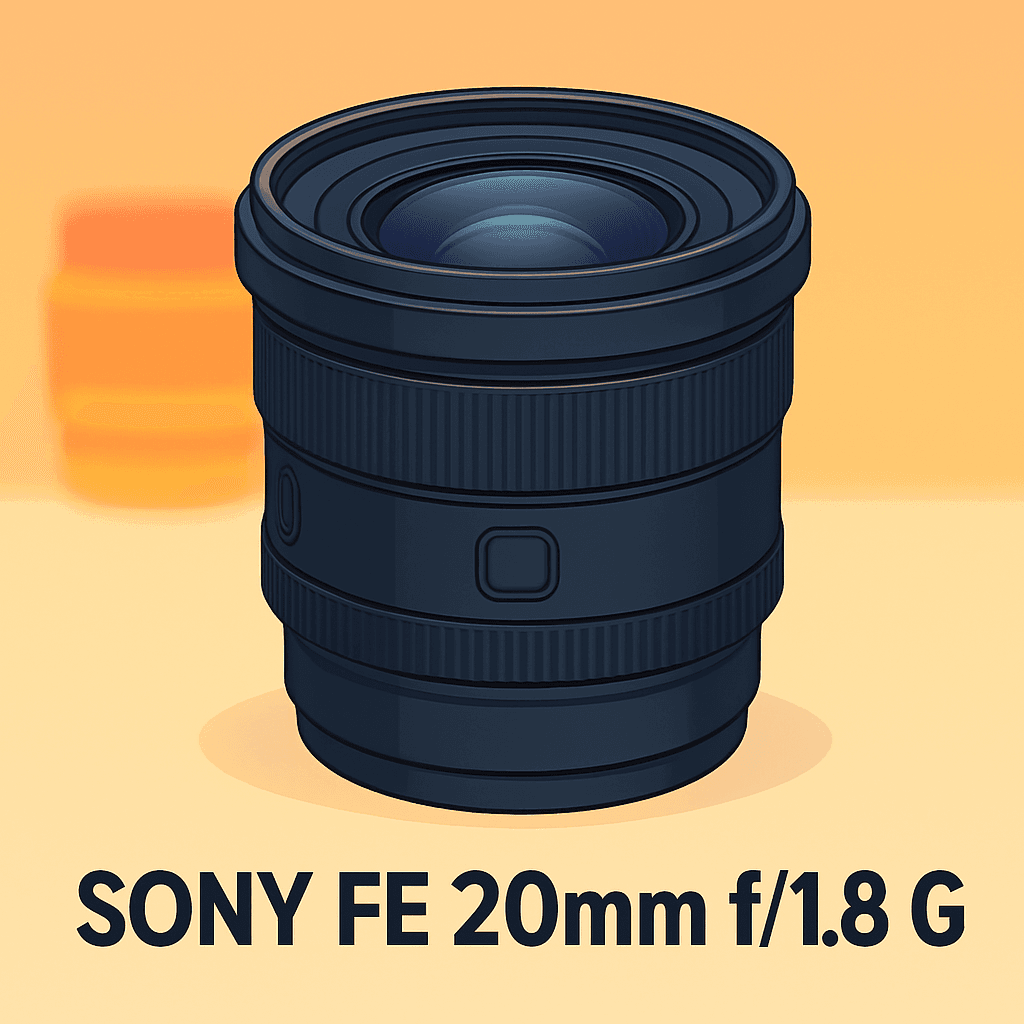
Want wider, sharper images that still work in low light — without hauling heavy glass?
The Sony FE 20mm f/1.8 G promises an ultra-wide view, bright aperture and compact handling ideal for landscapes, astro, interiors and handheld video, and I’ve field-tested it across travel and night shoots.
I’ll dig into sharpness, autofocus, flare control, coma and handling, plus how it stacks up against popular rivals — Make sure to read the entire review as you’ll discover when this lens is your perfect travel companion, so keep reading.

Sony FE 20mm f/1.8 G
Ultra-sharp full-frame wide-angle lens with a bright f/1.8 aperture for stunning edge-to-edge clarity, smooth bokeh, and lightweight handling—perfect for landscapes, astrophotography, and immersive environmental portraits.
Check PriceThe Numbers You Need
| Spec | Value |
|---|---|
| Focal length | 20mm |
| Maximum aperture | f/1.8 |
| Lens type | Ultra-wide prime |
| Lens mount | Sony E-mount (full-frame) |
| Image format compatibility | Full-frame; APS-C (30mm equivalent) |
| Minimum focus distance | ≈ 0.19 m (19 cm) |
| Maximum magnification | ≈ 0.2× |
| Autofocus | Linear motor |
| Number of aperture blades | 9 (rounded diaphragm) |
| Filter thread size | 67 mm |
| Lens elements/groups | ≈ 13 elements in 11 groups |
| Dimensions (approx.) | Diameter ≈ 78 mm × Length ≈ 84 mm |
| Weight (approx.) | ≈ 373 g |
| Weather sealing | Yes (dust and moisture resistant) |
| Special coatings | Nano AR coating (reduces flare and ghosting) |
How It’s Built
In my testing the Sony FE 20mm f/1.8 G feels like a lens built for real use, not just showroom shelves. It has a solid, confident weight and a snug mount that never felt loose on my camera. That gives you peace of mind when you’re out shooting in busy places or on a quick trip.
The focus ring and controls are simple and easy to work with. Manual focus is responsive, though the ring’s travel is on the short side, so very fine adjustments can take a little practice. For beginners that means you’ll get usable results fast, but pros chasing pixel-perfect focus might want a bit more feel.
Where this lens really wins is in how it balances on smaller Sony bodies and on gimbals. It sits close to the camera and doesn’t pull you forward, which makes handheld shooting and long walks way less tiring. Packing it into a travel kit is painless — it barely takes space but adds a lot of capability.
What I liked most was the mix of compact size and weather protection; it handled damp, breezy conditions without worry. One thing that could be better is the focus ring damping—smoother, longer travel would help for critical manual work. Overall it’s friendly for newcomers and dependable in the field.
In Your Hands
In the field the lens’s linear-motor AF proved reliably quick for stills, locking accurately with minimal hunting in mixed light, and continuous tracking handled moderate subject motion without drama. For video the focus transitions are smooth and essentially silent, so pulls feel natural and motor noise doesn’t get picked up on camera mics.
The bright aperture is a real advantage for interiors and night scenes, letting you work handheld with more flexibility and lower ISOs than slower wide-angle lenses. While an ultra-wide won’t isolate subjects like a telephoto, close-up framing delivers pleasing separation and a natural falloff thanks to the rounded diaphragm.
Close-focusing behavior is genuinely useful for creative wide-angle compositions: foreground detail is rendered with good clarity while the background rolls off gracefully. Bokeh at near distances is clean and organic, though extreme frame edges show softer rendering, which can be used creatively to emphasize scale.
Optically the center is sharp straight out of the camera and stopping down tightens contrast and brings the edges into line for landscape work. Nano coatings do a solid job against flare, but shooting toward strong light still benefits from careful shading; stopped-down sunstars are attractive and well-defined.
For astro work star shapes remain well-controlled across much of the field with only mild edge stretching at the extremes, and architecture/interiors benefit from restrained distortion that’s easy to correct. Its light, balanced handling makes it a pleasure on gimbals and compact bodies, and on crop sensors it becomes a versatile, everyday fast prime.
The Good and Bad
- Compact and lightweight for an ultra-wide prime (~373 g; ~78 × ~84 mm)
- Bright f/1.8 aperture at 20mm
- Linear motor AF that is quiet and fast for stills and video
- Close focus distance (~0.19 m) with ~0.2x magnification for near-subject emphasis
- f/1.8 is not as fast as f/1.4 alternatives
- Ultra-wide field can challenge edge performance—corners, coma, and distortion may need correction
Ideal Buyer
The Sony FE 20mm f/1.8 G is made for photographers who prize a superwide that won’t slow them down. Think landscape nomads, astrophotographers chasing Milky Way arcs, interior shooters fitting rooms into a single frame, and travel storytellers who carry lenses all day. Its bright f/1.8 and compact footprint make handheld low‑light work practical without lugging a big rig.
Full‑frame Sony shooters who want native AF, weather sealing, and front‑filter convenience (67mm) will find this lens a sweet spot. APS‑C users benefit too, getting a ~30mm equivalent fast prime that’s ideal for street and documentary rhythms.
Videographers and gimbal operators who need quiet, responsive linear‑motor autofocus and minimal weight will appreciate the balance. Close‑focus ability and pleasing out‑of‑focus transition at near distances add creative options for B‑roll and environmental portraits.
If your priority is the absolute shallowest background blur or the maximum corner resolution for pixel‑peeping, consider an f/1.4 alternative. But if you value portability, reliable AF, and a pro‑grade feature set for landscapes, astro, interiors, and travel, this Sony is hard to beat.
Better Alternatives?
We’ve taken a good look at the Sony FE 20mm f/1.8 G and what it brings to the table: a very useful ultra-wide view, a bright aperture, and a compact, well-built package. That lens is a strong all-rounder, but depending on what you shoot most—night sky, street, travel video, or run-and-gun content—there are other lenses that might fit your needs better.
Below I’ll run through three real-world alternatives I’ve used in the field, and point out what each one does better and worse than the 20mm f/1.8 G, and which kind of buyer will likely prefer each option.
Alternative 1:
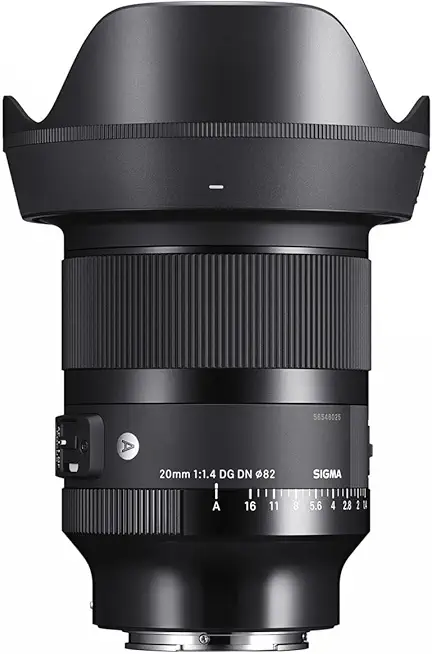
Sony E 20mm f/1.4 Art
Ultra-fast wide-angle prime delivering exceptional low-light performance, creamy background separation, and precision optics tailored for APS-C shooters who demand crisp detail, cinematic rendering, and reliable performance in challenging conditions.
Check PriceThe 20mm f/1.4 feels like a different tool in low light. I’ve used it for night cityscapes and astro work and the extra stop of light makes a noticeable difference: you can shoot faster shutter speeds or much lower ISO, and you get more subject separation when you’re close to something. Images look a bit more “three dimensional” compared with the Sony 20mm f/1.8 G, especially for single-subject shots where background blur helps the subject stand out.
What you give up is mainly size and handling. The f/1.4 version is bulkier and heavier on a camera or gimbal, and that matters on long walks or video rigs. In mixed-action autofocus work I found Sony’s native 20mm f/1.8 felt a touch snappier and more predictable—on the f/1.4 you sometimes have to be more careful with focus in very low contrast scenes. It’s also usually pricier.
Pick the 20mm f/1.4 if you shoot a lot in very low light, want the shallowest depth possible at this focal length, or do astro and night scans where every bit of light and subject isolation counts. If you prioritize small size, faster AF feel, or tight travel kits, the 20mm f/1.8 G still wins.
Alternative 2:

Sony E 24mm f/1.8 AF
Compact autofocus-friendly wide prime offering sharp corners, natural color rendition, and a bright aperture for low-light shooting; ideal for travel, street photography, vlogging, and creators who need lightweight versatility.
Check PriceThe 24mm f/1.8 is one of those lenses I reach for when I’m traveling light. It’s smaller and lighter in hand than the 20mm f/1.8 G, and that makes it easier to carry all day and to use on gimbals or selfie rigs. On full-frame it’s a touch tighter, which I liked for street work and vlogging where I wanted less distortion and a slightly more natural perspective for faces.
Compared to the 20mm f/1.8 G, the trade-off is simply field of view: you lose a bit of the dramatic wide-angle feel. In tight interiors or when you want expansive skies, the 20mm wins. Optically I found the 24mm very pleasant for everyday shooting—sharp where you need it and with nice color—so for many people the smaller size is the real winner.
This is a good pick for travel shooters, vloggers, and street photographers who value light weight and a versatile, natural look over the extra width of a 20mm. If your work needs the widest possible framing (landscape vistas, tight interiors, or big astro fields), stick with the 20mm f/1.8 G.
Alternative 3:
Sony E 24mm f/1.8 AF
Fast 24mm option with whisper-quiet autofocus, responsive handling, and pleasing bokeh; designed for run-and-gun documentary work, social content creation, and everyday photography where portability and image quality matter.
Check PriceUsed for weddings and quick documentary runs, the 24mm f/1.8 impressed me with its quiet AF and smooth handling. For video where you want soft focus transitions and low motor noise it’s a very practical choice. The bokeh at f/1.8 is pleasing for environmental portraits or capture-the-moment shooting without stealing focus from the scene.
Where it loses to the Sony 20mm f/1.8 G is in width and that close-up ultra-wide look. If you’re trying to exaggerate a foreground subject against a wide backdrop, the 20mm gives more drama. Also, the 24mm’s shallower wide framing means you sometimes have to step back or stitch for the same scene, which isn’t always possible indoors.
If you’re a run-and-gun shooter—documentary, social content, or everyday coverage—the 24mm f/1.8 is worth strong consideration for its size, quiet AF, and overall handling. If your work needs the widest angle possible or slightly better corner control for landscapes and astro, the Sony FE 20mm f/1.8 G remains the more flexible choice.
What People Ask Most
Is the Sony FE 20mm f/1.8 G worth buying?
Yes—it’s a compact, sharp, and fast wide-angle that’s great for landscapes, travel, and astro, offering excellent value if you want a lightweight f/1.8 full-frame prime.
How sharp is the Sony FE 20mm f/1.8 G?
Very sharp in the center at f/1.8 and outstanding across the frame when stopped down to f/2.8–f/5.6, with only mild edge softness wide open.
Is the Sony FE 20mm f/1.8 G weather-sealed?
Yes, it has a dust- and moisture-resistant design around the mount, but it’s not fully waterproof so use care in heavy rain.
Is the Sony FE 20mm f/1.8 G good for astrophotography?
Yes—its wide field, fast f/1.8 aperture and good coma control make it an excellent choice for night sky work.
Does the Sony FE 20mm f/1.8 G have image stabilization?
No, the lens has no built-in stabilization; rely on your camera’s IBIS or a tripod for steady shots.
How does the Sony FE 20mm f/1.8 G compare to other 20mm lenses (e.g., Sigma 20mm f/1.4)?
The Sony is smaller, lighter, and offers excellent AF and edge-to-edge performance, while the Sigma gives a brighter f/1.4 for shallower depth and lower-light reach at the cost of size and weight.
Conclusion
The Sony FE 20mm f/1.8 G nails the sweet spot between portability and professional image quality. It feels solid and weather resistant, small enough to travel with and unobtrusive on a gimbal or compact body. Optically it punches above its size with crisp center rendering, controlled contrast and a useful close‑focus range that adds creative options.
Autofocus is quietly fast and dependable for stills and run‑and‑gun video, making it a go‑to for hybrid shooters. Wide open you get strong performance but visible wide‑angle trade‑offs—corners and star shapes improve as you stop down, and flare is well managed in most backlit situations. Distortion and vignetting are predictable and easily corrected in editing, so composition and workflow remain straightforward.
In short, this is the lens I reach for when I want true ultra‑wide perspective without hauling heavy glass. Choose it for landscapes, interiors, travel, astro‑adjacent night work and handheld video; opt for a faster aperture or different focal length only if maximum shallow depth or ultimate edge resolution is your top priority. For most shooters the Sony FE 20mm f/1.8 G is the best practical compromise of speed, size and real‑world performance.
Sony FE 20mm f/1.8 G
Ultra-sharp full-frame wide-angle lens with a bright f/1.8 aperture for stunning edge-to-edge clarity, smooth bokeh, and lightweight handling—perfect for landscapes, astrophotography, and immersive environmental portraits.
Check Price

0 Comments