
Want to simplify your kit without sacrificing image quality?
Is the Sony FE 24-105mm f/4 G the one-lens solution for travel, events, and everyday work?
I field-tested the Sony FE 24-105mm f/4 G on travel, documentary, and event shoots, and it proved reassuringly versatile.
It’s a G-series zoom with a constant aperture, built-in stabilization, and weather resistance that matter in real shoots.
This review will show who benefits most — photographers who need reach, consistent exposure, and steady handheld performance.
I’ll break down handling, image behavior, and trade-offs from my field experience — keep reading.
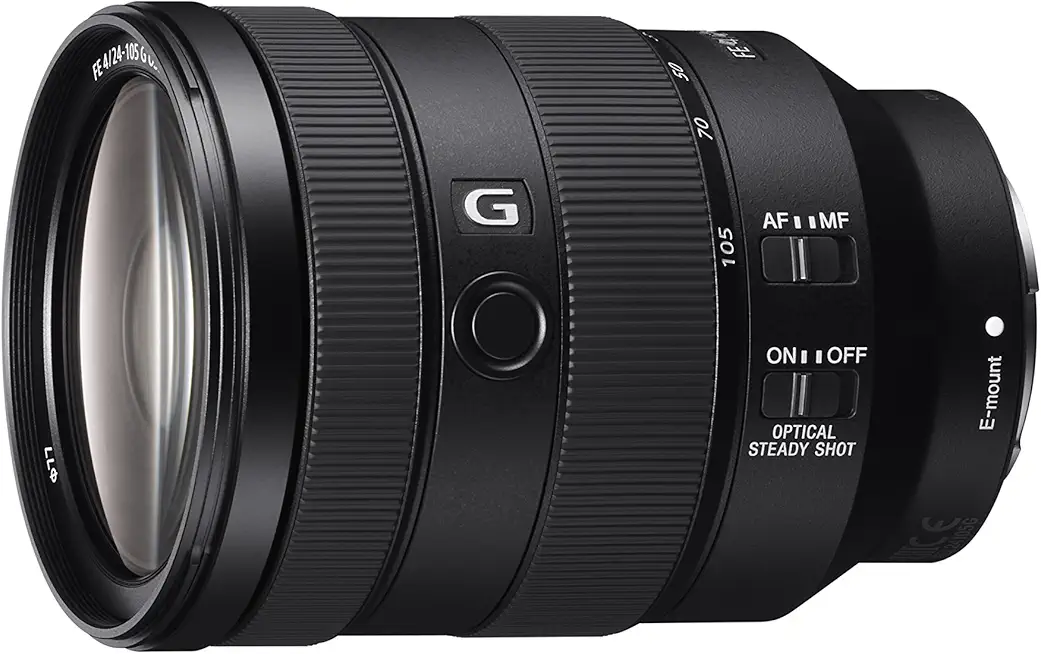
Sony FE 24-105mm f/4 G
Versatile all-in-one zoom for travel and events, delivering consistent sharpness, smooth bokeh, reliable image stabilization, and quick focusing—ideal for photographers who need flexibility without swapping lenses.
Check PriceThe Numbers You Need
| Spec | Value |
|---|---|
| Focal Length | 24–105mm |
| Aperture | Constant f/4 |
| Format | Full-frame |
| Lens Mount | Sony E (FE) |
| Lens Type | G series |
| Optical Stabilization | OSS (Sony’s image stabilization) |
| Minimum Focus Distance | 0.38 m (1.25 ft) |
| Filter Diameter | 77 mm |
| Elements/Groups | 17 elements in 14 groups |
| Special Elements | 4 aspherical, 3 ED (extra-low dispersion) |
| Aperture Blades | 9 (circular aperture) |
| Weather Resistance | Dust and moisture resistant |
| Weight | Approx. 663 g (1.46 lb) |
| Dimensions | 83.4 mm diameter × 113.3 mm length |
| Autofocus | Direct Drive SSM (Super Sonic Wave Motor) |
How It’s Built
In my testing the Sony FE 24-105mm f/4 G feels like a proper workhorse. The body is solid without being bulky, and the zoom and focus rings have a nice, confident feel that makes changing focal length smooth and predictable. That simple, reassuring feedback matters when you’re moving fast on a job or traveling light.
I liked how the lens balances on Sony full‑frame bodies I used—it doesn’t pull the camera forward or feel awkward on a handheld rig. The switches are easy to reach and make toggling AF and stabilization quick without fumbling. The included hood snaps on securely and actually blocks flare in bright, messy light.
The in‑lens stabilization and coatings are real-world helpful, especially when you don’t want to raise ISO. After using it for a while I appreciated that stabilization for handheld work and casual video. For beginners that means fewer blurry shots and more keepers, even in dimmer conditions.
One thing that could be better is the aperture speed; the constant mid‑range aperture is practical, but it’s not ideal if you crave shallow depth of field or low‑light performance. I found myself reaching for faster primes in those situations.
Overall the build feels premium and weather resistant, so you can keep shooting in less‑than‑perfect conditions. It’s a comfortable, dependable lens to carry every day, and the common filter size makes adding a polarizer or ND filter painless for most kits.
In Your Hands
The 24–105mm reach feels like a single-lens Swiss Army knife — wide enough for landscapes and interiors, long enough for flattering portrait compression and short-tele utility. The constant f/4 aperture keeps exposure predictable as you zoom, so metering and exposure compensation stay straightforward during fast-moving shoots. In practice it’s the kind of lens you toss on a body and forget until you need it to solve a framing problem quickly.
In-lens stabilization is a practical advantage in everyday shooting, especially when combined with body stabilization on modern Sony bodies. Handheld framing for dim interiors and evening events felt noticeably steadier, giving me latitude to keep shutter speeds reasonable without chasing every last ISO stop. That steadiness also translates to calmer playback clips when shooting run-and-gun video.
Remember that f/4 doesn’t give the extreme subject isolation of faster glass, but it’s more than capable of separating subjects in portrait and event work when you compose carefully. Indoors you’ll make different trade-offs with ISO and shutter speed than you would with a brighter lens, but the result is a pleasing balance of depth and context rather than razor-thin slices of focus.
The handling is one of the lens’s strengths: smooth, well-damped zoom and focus rings with sensible ergonomics that suit smaller full-frame bodies. Autofocus is confident and quiet for both stills and video, and focus breathing is minimal enough that close-up storytelling remains convincing without distracting shifts.
Optical coatings pay dividends when shooting into light, with controlled flare and good contrast retention in high-contrast scenes. I also trusted the lens on dusty, damp shoots where its sealing gave real peace of mind, and its combined stabilisation and AF behavior make it an excellent do-everything option for handheld photo and video days.
The Good and Bad
- 24–105mm zoom range covers wide to short tele in one lens
- Constant f/4 aperture for consistent exposure throughout the range
- Optical SteadyShot (OSS) for in-lens stabilization
- Dust and moisture resistant build
- f/4 is slower than f/2.8 alternatives for low light and subject isolation
- Weight and dimensions (approx. 663g; 83.4 × 113.3mm) may affect carry comfort
Ideal Buyer
If you shoot full‑frame Sony E, the Sony FE 24‑105mm f/4 G is aimed at people who want one lens to do almost everything. It gives wide‑to‑short‑tele coverage so you can travel light and stay flexible. It’s a G‑series optic with solid build and handling on A7/A9/A1 bodies.
It suits photographers who value in‑lens stabilization for steady handheld shots and smooth video. The constant f/4 keeps exposure consistent throughout the zoom and meshes well with common 77mm filters. Great on bodies with and without IBIS because of its OSS.
Think travel, documentary, events, street and landscape work where range and reliability beat the last stop of aperture. The weather‑resistant build means you can keep shooting when conditions turn messy. Its 0.38m close‑focus is surprisingly useful for near‑macro detail shots.
If you need razor‑thin depth of field or top‑tier low‑light performance, a faster f/2.8 zoom or primes will be better. But for shooters prioritizing versatility, ergonomics and one‑lens practicality, the 24‑105mm f/4 G is hard to beat. For travel photographers who prefer fewer lens swaps, the weight and reach are a fair trade.
Better Alternatives?
We’ve already run the Sony FE 24–105mm f/4 G through travel, event, and everyday shooting and know it’s a great all‑rounder: steady, weather‑resistant, and useful when you want one lens to do most jobs. But no single lens is perfect for every shooter, so it helps to look at other options that trade reach, speed, or character for things the 24–105 doesn’t offer.
Below are three lenses I’ve used in real shoots that make different trade-offs. I’ll point out what each one does better and worse in practical shooting terms, and who I think should pick them instead of the 24–105.
Alternative 1:

Sony FE 24-70mm f/2.8 GM
Professional standard zoom offering exceptional low-light capability, stunning edge-to-edge resolution, and creamy background separation; engineered for demanding wedding, portrait, and editorial shooters who require top optical performance.
Check PriceThe 24–70mm f/2.8 GM is the pick when you need more light and shallower depth of field than the 24–105 can give. I’ve shot indoor receptions and editorial work with it and the extra stop and a half of speed makes a real difference — faster shutter speeds, cleaner files at lower ISO, and a creamier background when you want subject separation.
Where it loses out is reach and convenience. You give up the 105mm tele end, so you’ll find yourself changing lenses or stepping back more often for tighter headshots. It’s also heavier and pricier, and it doesn’t have in‑lens stabilization like the 24–105, so on older bodies without good IBIS you’ll rely more on higher shutter speeds or tripods.
Pick the 24–70 f/2.8 GM if you’re a pro or enthusiast who shoots weddings, portraits, or editorial work where low‑light performance and the look of the image matter more than having a long zoom. If you need the extra reach of 105mm or want lighter kit for travel, stick with the 24–105 instead.
Alternative 2:

Sony FE 24-70mm f/4 Vario-Tessar T
Lightweight, compact standard zoom emphasizing high contrast, faithful color rendition, and quiet autofocus with effective anti-reflective coatings—perfect for photographers prioritizing portability and reliable everyday performance.
Check PriceThe 24–70 f/4 Vario‑Tessar (Zeiss) gives you a different image feel — punchy contrast, pleasing color, and a look that tends to pop straight out of the camera. I’ve used it on city walks and landscape days when I wanted a compact setup with nice color and contrast; the look is distinct compared to the more neutral rendering of the 24–105.
Compared with the 24–105 it trades away reach and a bit of flexibility: the longest stop is 70mm, so no 105mm tele, and it’s the same f/4 speed so low‑light performance is similar. The Zeiss has its own character and anti‑flare coatings that helped me in backlit scenes, but it’s an older design so autofocus feels a touch less snappy than newer Sony G lenses in some fast‑action situations.
If you care about color, micro‑contrast, and a compact, pleasing look for everyday shooting — and you don’t need the extra 105mm reach — this Zeiss 24–70 is a great choice. It suits travelers, landscape shooters, and anyone who values in‑camera color and contrast over the extended zoom range of the 24–105.
Alternative 3:
Sony FE 24-70mm f/4 Vario-Tessar T
Pocketable walkaround zoom combining consistent sharpness, pleasing rendering, and durable mechanics in a small, travel-friendly package; a smart choice for street shooters, vloggers, and content creators seeking simplicity.
Check PriceSeen as a walkaround lens, the 24–70 f/4 Zeiss is easy to carry and balances well on smaller Sony bodies. I’ve used it for street days and quick video runs; it feels less front‑heavy than the 24–105 and that makes handheld shooting and long walkabouts less tiring. Its build feels solid and predictable for everyday use.
That said, compared to the 24–105 you lose the extra tele reach and the in‑lens stabilization benefit. For video where you need that extra tight framing or smoother stabilized shots on non‑IBIS bodies, the 24–105 can be more forgiving. The Zeiss wins on handling and look, but the 24–105 wins on sheer versatility.
Choose this version of the 24–70 if you’re a street shooter, vlogger, or content creator who values a small, reliable lens with a nice rendering and easy balance. If you often need longer reach or in‑lens stabilization for run‑and‑gun video, the 24–105 remains the more flexible single‑lens option.
What People Ask Most
Is the Sony FE 24-105mm f/4 G a good lens?
Yes — it’s a versatile, well-built all-purpose zoom that works great for travel, events, and everyday shooting.
Is the Sony FE 24-105mm f/4 G sharp?
Yes, it’s sharp in the center across the range and gets noticeably better when stopped down, though corners soften slightly at the extremes.
Does the Sony FE 24-105mm f/4 G have image stabilization (OSS)?
Yes — it features Optical SteadyShot (OSS) which helps handheld shots, especially at longer focal lengths.
How does the Sony FE 24-105mm f/4 G compare to the Sony 24-70mm f/2.8 GM?
The 24-70 f/2.8 GM is faster and generally sharper with better low-light performance, while the 24-105 f/4 gives more reach, lighter weight, and better value for everyday use.
Is the Sony FE 24-105mm f/4 G good for travel and everyday use?
Yes — the wide 24–105mm range, constant f/4 aperture, OSS, and reasonable size make it a go-to travel and walkaround lens.
Is the Sony FE 24-105mm f/4 G worth the price?
For most shooters it is — you get strong versatility and solid performance for the money, though pros who need top image quality or f/2.8 speed may prefer pricier options.
Conclusion
The Sony FE 24–105mm f/4 G is a consummate do‑it‑all zoom that pairs a useful focal range with a constant aperture and in‑lens stabilization. Its strengths show up in travel, documentary, and event work where reach, consistent exposure, and confident handling matter more than chasing the last stop of light. Build quality and flare control deliver dependable results in mixed conditions, though shooters seeking the shallowest depth of field will notice the f/4 ceiling.
Autofocus is reliable for most practical situations, and the stabilization lets you handhold longer than you might expect when shooting run‑and‑gun. Close‑focus and bokeh are perfectly serviceable for environmental portraits and detail work, even if they don’t rival faster primes. If your priorities are outright subject separation or maximum low‑light speed, choose a faster zoom or a selection of primes instead.
For photographers who want one lens to cover landscapes, portraits, and on‑the‑move assignments, this is an easy recommendation. It balances range, consistency, and weather resistance in a package that genuinely simplifies a kit without crippling capability. In short, the Sony FE 24–105mm f/4 G is the pragmatic choice for generalists and travelers; opt for alternatives only if your craft absolutely demands faster glass.
Sony FE 24-105mm f/4 G
Versatile all-in-one zoom for travel and events, delivering consistent sharpness, smooth bokeh, reliable image stabilization, and quick focusing—ideal for photographers who need flexibility without swapping lenses.
Check Price



0 Comments