
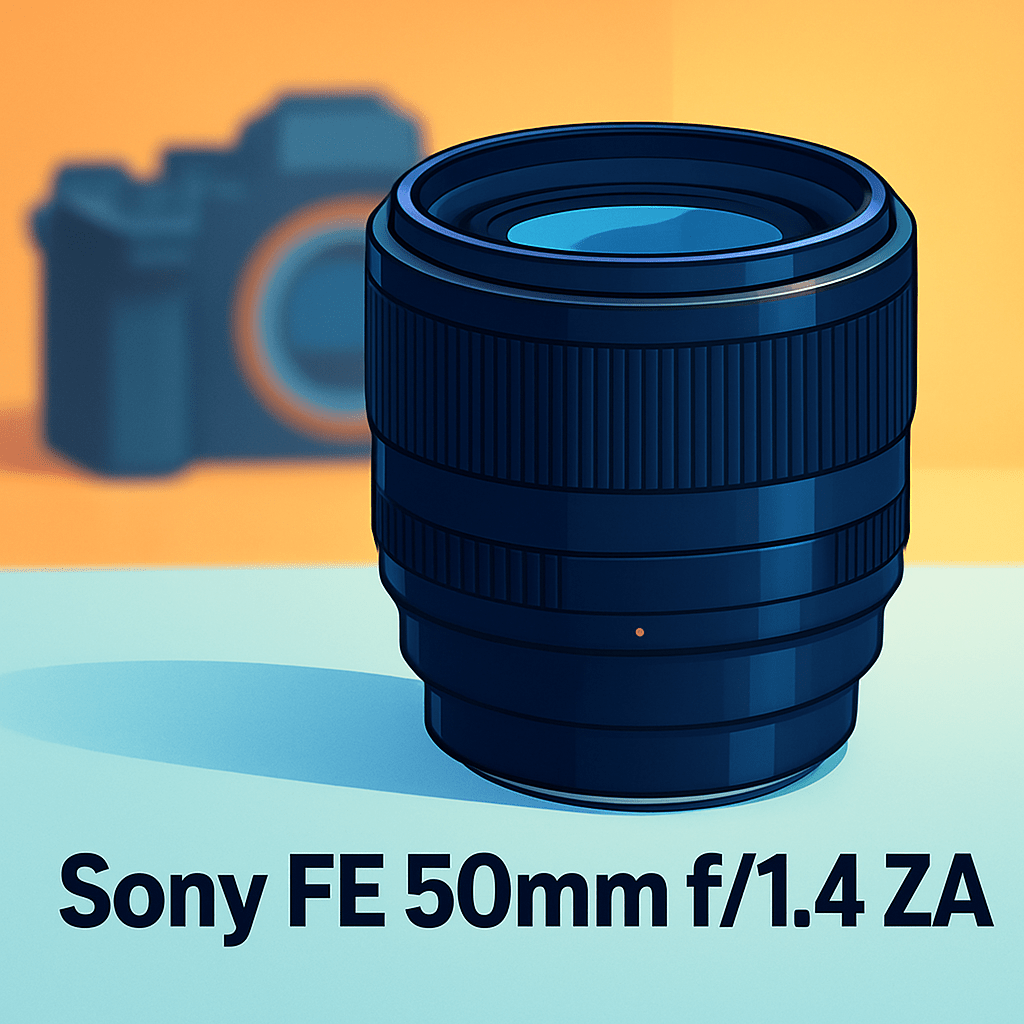
Want a fast 50mm that’ll really improve your images?
Could the Sony FE 50mm f/1.4 ZA be the one for your shooting style?
I’ve field-tested this Planar T* Zeiss 50mm across portraits, street work, and low‑light events, so you’ll get practical impressions, not marketing copy.
If you shoot portraits, environmental work, events, or everyday Sony full‑frame and APS‑C shooting, you’ll see real-world payoffs: subject isolation, bokeh, and low‑light reliability.
I’ll cover handling, build feel, rendering character, sharpness across apertures, and autofocus in real shooting situations so you can decide if it fits your kit—make sure to read the entire review as I unpack where this lens excels and where you’d prefer a different 50mm. Keep reading.

Sony FE 50mm f/1.4 ZA
Classic 50mm prime delivering crisp center-to-edge resolution, rich contrast, and cinematic bokeh. Precision coatings minimize flare, making it ideal for portraits, low-light scenes and polished commercial work.
Check PriceThe Numbers You Need
| Spec | Value |
|---|---|
| Focal Length | 50mm |
| Maximum Aperture | f/1.4 |
| Lens Mount | Sony E-mount (Full-frame) |
| Optical Design | Planar T* Zeiss optics |
| Minimum Focus Distance | 0.45 m (1.48 ft) |
| Filter Diameter | 72 mm |
| Weight | Approximately 778 g (27.4 oz) |
| Aperture Blades | 11 rounded blades |
| Autofocus | Yes, fast and silent AF motor |
| Lens Elements | 12 elements in 8 groups |
| Zeiss T* Coating | Yes, to reduce reflections and flare |
| Maximum Magnification Ratio | 0.17x |
| Compatible Format | Full-frame and APS-C (crop factor applies) |
| Dimensions (Diameter x Length) | Approx. 78 x 92 mm |
| Build Quality | Metal lens barrel with weather-resistant design |
How It’s Built
In my testing the Sony FE 50mm f/1.4 ZA simply feels like a premium tool. The metal barrel and tight seams give it a long‑lasting vibe, and the Zeiss Planar optics with T* coating hold contrast well even when shooting into bright light.
I found the focus ring has just the right amount of damping and the hood snaps on snugly, which makes it effortless to work with. It balances nicely on full‑frame Sony bodies, though you’ll notice the heft if you’re used to lightweight primes.
After using it for a while I trusted it outdoors; seals at key joints give real confidence in drizzle or dusty conditions. One thing I really liked was that solid, refined feel and smooth controls; one thing that could be better is the weight — it can tire your arm over a long day, so plan for a grip or tripod.
The rounded aperture blades help backgrounds melt into a pleasing blur, so portraits look more professional with little effort. A larger filter size means filters cost a bit more and aren’t shared with every lens, but the handling and finish make it easy to live with.
For beginners, that means a lens that behaves predictably and feels reassuring in your hands. Try it on a camera with a grip or carry a small tripod to offset the weight, and you’ll appreciate the Zeiss character without fuss.
In Your Hands
The Sony FE 50mm f/1.4 ZA feels like a classic “normal” lens with a decidedly modern temperament: a fast maximum aperture that gives you reliable low‑light reach and the kind of subject separation portrait and street shooters crave. On the street it frames naturally, and in tighter event situations it lets you pull eyes and faces away from busy backgrounds without shouting for attention.
Thanks to the Zeiss optics and coatings, contrast holds up well even when the light is against you; flares are controlled and highlights maintain shape instead of blooming into loss of detail. Color rendition leans toward faithful, slightly restrained tones with solid micro‑contrast that keeps textures looking real rather than overprocessed.
Bokeh is a strong suit — rounded aperture geometry produces creamy out‑of‑focus areas and pleasing specular highlights, which translate to attractive subject isolation in portraits. Up close the transitions remain gentle, though very tight foregrounds can show a touch more edge definition than at mid distances.
It’s not a macro tool, so close‑up detail has practical limits, but for headshots and environmental portraits it delivers the expected separation and detail. The lens feels substantial on the camera, balanced on larger bodies for long shoots, while on smaller bodies its heft can be felt but often helps steadiness; on cropped bodies the tighter field of view can be an asset for tighter framing.
Autofocus is fast and discreet for both stills and video, cooperating well with subject‑ and eye‑detection systems and producing minimal operational noise. For run‑and‑gun video the breathing is modest and the focus transitions are usable straight from the camera with only occasional hunting in extremely dim conditions.
The Good and Bad
- f/1.4 maximum aperture for low light and shallow depth of field
- Zeiss Planar T* optical design and Zeiss T* coating to control reflections/flare
- 11 rounded aperture blades for pleasing out-of-focus rendering
- Fast and silent autofocus motor
- Not lightweight at approx. 778 g; larger 72 mm filters
- Minimum focus distance 0.45 m; max magnification 0.17x limits close-up capability
Ideal Buyer
The Sony FE 50mm f/1.4 ZA is for photographers who prize character over chart-topping numbers. If you want the classic Zeiss Planar T* look — rich micro‑contrast, controlled flare and a color signature that stands out — this lens will be immediately appealing.
Its f/1.4 speed and 11‑rounded‑blade aperture make it an obvious pick for portrait and low‑light shooters who want buttery separation and elegant specular highlights. Environmental portraits, runway and event work, street scenes and everyday full‑frame shooting all play to the lens’ strengths.
Expect premium metal build and weather resistance that holds up on professional shoots, but also expect a bit of heft and the 72mm filter ecosystem to manage. Photographers who mind a larger, sturdier lens and value tactile refinement will appreciate the balance and long‑term reliability.
Choose this lens if you prefer Zeiss rendering and robust construction to the absolute fastest AF or the very last stop of resolving power. If you need the smoothest bokeh, dependable low‑light performance, and a distinctive look on Sony full‑frame bodies — with the option to use on APS‑C for a tighter field of view — this is a great match.
Better Alternatives?
We’ve gone through the Sony FE 50mm f/1.4 ZA and what makes it special — that Zeiss look, solid build, and the shallow depth you get at f/1.4. If you like the Planar’s rendering but are wondering whether another 50mm might fit your needs better, there are a few real choices to consider.
Below are three alternatives I’ve used in the field. I’ll point out what each one does better or worse than the Zeiss, and who I’d recommend it to based on real shooting experience.
Alternative 1:

Sony FE 50mm f/1.2 GM
Ultra-fast 50mm lens produces dreamy, velvety bokeh and outstanding subject separation. Exceptional sharpness wide-open, robust build and responsive AF make it perfect for pro portraits, weddings, and editorial imagery.
Check PriceI’ve used the 50/1.2 GM on a bunch of portrait and wedding days. Compared to the Planar f/1.4, it gives a noticeably shallower plane of focus and creamier bokeh when you shoot wide open. That makes subject separation more dramatic and gives a very “pro” look with backgrounds melting away at 1.2 in a way the Planar doesn’t quite match.
Where it’s worse than the Zeiss is in size, weight, and price. It’s heavier in the hand and much more expensive, so you’re trading everyday usability for top-tier image impact. Also, if you loved the Zeiss mid-range character — a touch more contrast and punch — some will find the GM’s extreme smoothness a little too soft in personality.
Who should pick it: pro portrait and wedding shooters who want the absolute creamy look and the fastest wide-open performance, and who don’t mind the extra bulk and cost. If you prioritize compactness or the Zeiss signature look, stick with the Planar; if you want maximum wide-open wow, the GM is the upgrade.
Alternative 2:

Sigma 50mm f/1.4 DG DN Sony E
High-performance f/1.4 prime balances impressive sharpness with creamy bokeh while remaining compact and affordable. Ideal for portraits, street photography and low-light work with reliable autofocus.
Check PriceI’ve carried the Sigma 50/1.4 on long shoots and in street work. In many real-world shots it matches or even beats the Planar in center sharpness, especially when stopped a bit. Images look very clean and detailed, and it’s a hair more compact and lighter to carry around day after day.
Where it falls short of the Zeiss is the optical character and some behaviour in tough backlight. The Sigma’s bokeh is pleasant but more neutral and less “Zeiss-y,” so if you’re after that classic Planar glow you may miss it. In strong backlight I’ve seen a little more flare and chromatic fringing than with the Zeiss, though it’s manageable with careful positioning or corrections in post.
Who should pick it: photographers who want top image quality without the Zeiss price — think enthusiast pros, wedding second shooters, or anyone who wants high resolution and a lighter kit. It’s a great all-around choice if you want a nearly pro-level 50mm without the premium cost and weight of the GM or the Planar’s distinct color and contrast.
Alternative 3:
Sigma 50mm f/1.4 DG DN Sony E
Studio-grade optics deliver smooth background separation and precise rendering across the frame. Thoughtful build quality and fast aperture support creative control for filmmakers, wedding photographers, and enthusiasts alike.
Check PriceUsed in controlled shoots and video, the Sigma shows how consistent it can be across a day. In studio or wedding reception work it gives very even rendering across the frame, so you get reliable results frame after frame. The build feels solid enough for regular professional use, and the fast aperture gives flexibility in low light.
Compared to the Planar, the Sigma is a bit more neutral — it won’t give you the Zeiss film-like contrast and color out of camera, and its bokeh is less characterful. On the plus side, that neutrality can be easier to grade for video or batch edit for weddings. The Sigma’s autofocus is very usable for most situations, but in fast-paced tracking scenarios I still prefer Sony’s GM AF responsiveness.
Who should pick it: filmmakers, studio portrait shooters, and wedding photographers who need a dependable, high-quality 50mm that’s easier on the wallet and consistent under varied lighting. If you need the Zeiss look specifically, the Planar still holds its own; if you want a workhorse 50 that’s sharp, even, and versatile, the Sigma will serve you very well.
What People Ask Most
Is the Sony FE 50mm f/1.4 ZA worth buying?
Yes—if you want premium Zeiss build, beautiful bokeh and color rendering; it’s pricier and heavier than alternatives, so choose it for image quality and finish rather than value.
How sharp is the Sony FE 50mm f/1.4 ZA wide open?
Very sharp in the center wide open with mild corner softness that improves noticeably when stopped down.
How does the Sony FE 50mm f/1.4 ZA compare to the Sigma 50mm f/1.4 Art?
The Sigma often matches or slightly out-resolves it and is better value, while the Sony/Zeiss offers different contrast, T* coatings and a more premium build and color rendering.
Does the Sony FE 50mm f/1.4 ZA have optical image stabilization (OSS)?
No, this lens does not include optical image stabilization.
Is the Sony FE 50mm f/1.4 ZA compatible with Sony APS-C bodies?
Yes—it mounts and works on APS-C Sony bodies, where it gives about a 75mm equivalent field of view.
How fast and accurate is the autofocus on the Sony FE 50mm f/1.4 ZA?
Autofocus is fast and accurate on modern Sony bodies and excellent for portraits and events, though it can hunt a bit in very low light.
Conclusion
The Sony FE 50mm f/1.4 ZA is a classic, feel‑good 50mm that delivers the Zeiss Planar T* look with a premium metal, weather‑resistant build. Its fast aperture, Zeiss T* coating and 11‑blade diaphragm produce a distinctive rendering and smooth out‑of‑focus character that photographers will recognize immediately. Autofocus is quiet and dependable for portraits and everyday work.
That personality comes with tradeoffs. The lens is noticeably substantial in hand and its close‑focus limits mean it won’t replace a short‑macro or longer portrait optic for tight detail work. If you need absolute top‑end tracking or the ultimate wide‑open resolving power, there are newer designs that outpace it in raw performance.
Buy this if you prioritize Zeiss character, tactile refinement and reliable all‑around performance over chasing headline resolution or lightest weight. If you want maximum sharpness and AF speed, consider the flagship 50/1.2 route; if value and near‑top optics matter more, look at the Sigma; for tight budgets the Samyang is a practical option. Try one on your body or rent a day — balance and rendering matter as much as numbers.
Sony FE 50mm f/1.4 ZA
Classic 50mm prime delivering crisp center-to-edge resolution, rich contrast, and cinematic bokeh. Precision coatings minimize flare, making it ideal for portraits, low-light scenes and polished commercial work.
Check Price


0 Comments