
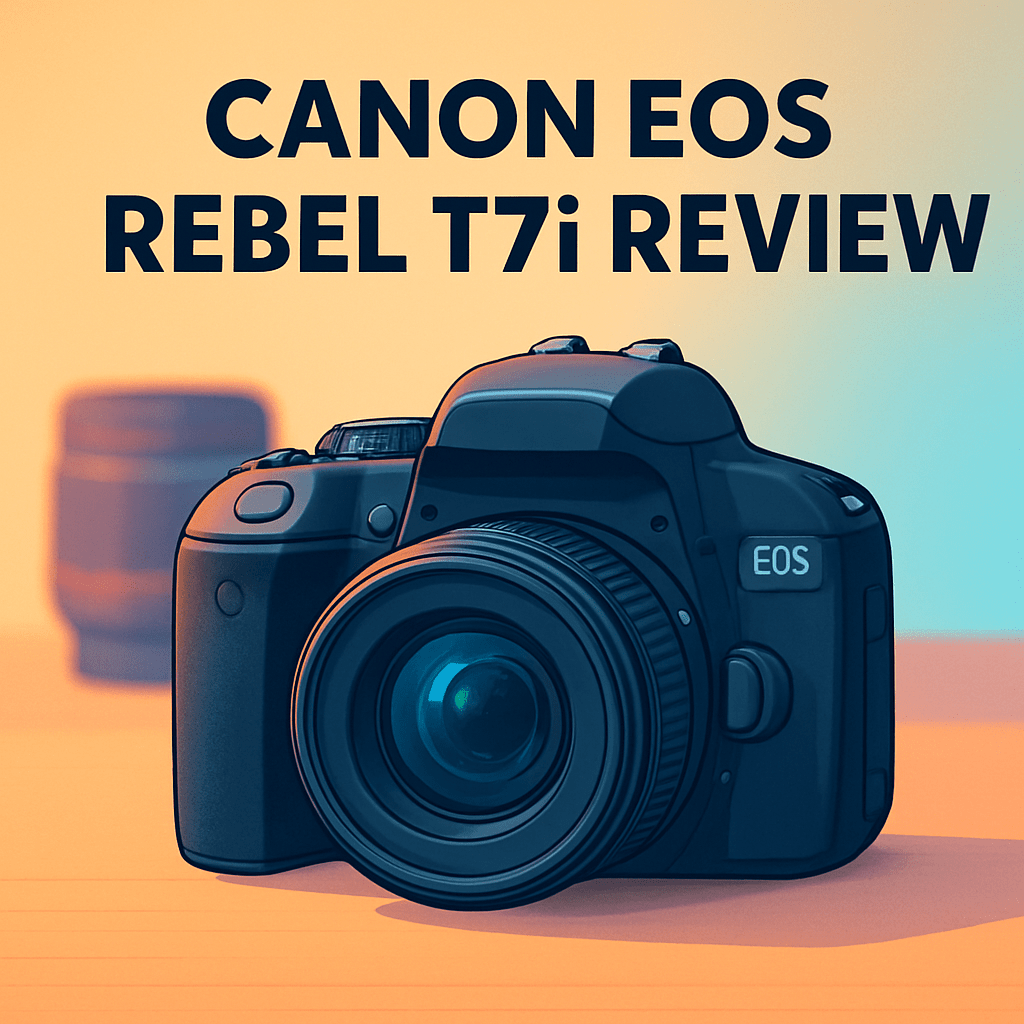
Want to step up your photos and video without giving up a simple DSLR feel?
I spent time in the field with the Canon EOS Rebel T7i Camera, so this review focuses on handling, live‑view autofocus, battery endurance, and real‑world image quality.
If you want a user‑friendly DSLR with reliable live‑view AF, long battery life, and a vari‑angle touchscreen for tricky angles, this is aimed at you.
There are headline trade‑offs: no 4K, a pentamirror viewfinder with limited coverage, no Bluetooth, and UHS‑I card support only, so you’ll want to weigh priorities.
Make sure to read the entire review as I break down autofocus, handling, image quality, and whether the T7i fits your kit — keep reading.

Canon EOS Rebel T7i Camera
A responsive DSLR with a 24.2MP sensor, fast Dual Pixel autofocus, intuitive vari-angle touchscreen and built-in Wi‑Fi; delivers sharp images and smooth live-view shooting for passionate photographers.
Check PriceThe Numbers You Need
| Spec | Value |
|---|---|
| Sensor | 24.2 MP APS-C |
| Autofocus | Dual Pixel CMOS AF |
| ISO Range | 100–25600 (expandable to 100–51200) |
| Shutter Speed | 1/4000 to 30 sec, Bulb |
| Continuous Shooting | 6 fps |
| Video | Full HD 1080p, 60 fps |
| LCD | 3.0-inch vari-angle touchscreen |
| Optical Viewfinder | Pentamirror, approx. 95% coverage |
| Wi‑Fi/NFC | Yes |
| Bluetooth | Not available |
| Storage | SD/SDHC/SDXC (UHS-I) |
| Weight (body only) | 532 g |
| Battery Life | Approx. 600 shots per charge |
| Lens Mount | Canon EF/EF-S |
| Built-in Flash | Yes |
How It’s Built
In my testing the T7i feels like a camera you can hold all day without hand cramps. The grip is shaped well and the buttons fall under your fingers in a way that makes one-handed shooting easy. That matters when you’re chasing kids or trying to steady a long session.
The vari-angle touchscreen is where this body really shines for everyday use. I used it for low- and high-angle shots and for self-recording, and the touch controls made framing and focus quick and intuitive. The optical viewfinder is fine for traditional shooting, but it doesn’t show every last bit of the scene, so I learned to check my edges in live view.
Ports and card handling are straightforward, but the camera uses a slower card standard than the newest models. In practice that means buffers take a bit longer to clear and large offloads feel less instant. Wi‑Fi and NFC transfers worked well for me, but without Bluetooth you won’t get seamless background syncing.
What I liked most was the comfortable, confidence-inspiring ergonomics paired with the flip-out screen. What could be better is the viewfinder precision and faster card support for bursty shoots. For beginners: it’s forgiving to hold and use, just bring a spare card and battery for long days.
In Your Hands
The Canon EOS Rebel T7i feels peppy, with a responsive shutter and continuous mode that’s well suited to kids, pets and light action. Long bursts are useful but you’ll hit a pause while the buffer clears—standard SD speeds dictate how quickly it recovers.
Shutter and exposure controls behave predictably, letting fast primes sing in daylight with little fuss; in very bright conditions you’ll need to stop down or reach for a filter to tame extremes. For night and creative long exposures the camera’s Bulb handling is straightforward and reliable.
Battery endurance is a standout in everyday use, easily getting most shooters through a full day when favoring the optical viewfinder. Heavy live‑view or video sessions shorten that runtime, so carry a spare for long workshops or full‑day shoots.
Video is where the T7i shows its strengths — smooth Full HD motion and usable detail for web and social. Fast pans can reveal some rolling‑shutter wobble and there’s no in‑body stabilization, so lens IS or a gimbal helps; the vari‑angle touchscreen and touch AF simplify framing and focus, and external mic support improves on‑camera audio.
Wi‑Fi and NFC provide a solid wireless workflow for offloading images and triggering the camera remotely, though pairing takes a few deliberate steps rather than an always‑on handoff. Once connected the app is reliable for transfers and basic remote control during shoots.
The Good and Bad
- Dual Pixel CMOS AF for live view/video
- 3.0-inch vari-angle touchscreen
- Full HD 1080p up to 60 fps
- Approx. 600-shot battery life
- No 4K video
- Pentamirror OVF with approx. 95% coverage
Ideal Buyer
If you crave the reassuring heft and button layout of a traditional DSLR but also want modern live‑view performance, the Canon EOS Rebel T7i is for you. Its vari‑angle touchscreen and Dual Pixel CMOS AF make framing and recording easy from odd angles. The 24.2MP sensor delivers images that satisfy most enthusiast needs without fuss.
Parents, travel shooters, and weekend event photographers will appreciate the long battery life and dependable 6 fps burst for kids and pets. Creators who are content with crisp 1080p60 video and straightforward Wi‑Fi/NFC workflows will find it a reliable companion. The built‑in flash and broad EF/EF‑S lens support keep the kit flexible on the fly.
It’s not the right tool if you demand 4K, Bluetooth‑style always‑on connectivity, or the fastest buffer and card speeds for pro sports. Studio shooters who need absolute viewfinder precision or ridiculously fast shutter ceilings may also look elsewhere. Videographers chasing state‑of‑the‑art codecs and features will be better served by newer mirrorless models.
Overall, choose the T7i if you value ergonomics, battery endurance, and a fuss‑free live‑view experience. It’s a practical, well‑rounded DSLR for shooters who prioritize comfort and reliable results over the latest spec sheet tick marks.
Better Alternatives?
We’ve already walked through what the Canon EOS Rebel T7i does well — great live-view AF, a friendly vari-angle screen, solid battery life and dependable 1080p video. If those strengths fit your shooting, you’re good; but no single camera fits every need, so it helps to look at a few real-world alternatives I’ve used in the field.
Below I’ll run through three cameras I’ve actually shot with and explain how each one stacks up against the T7i in everyday shooting — what they do better, where they fall short, and the kind of photographer who’d prefer each choice.
Alternative 1:

Canon EOS 250D Camera
Ultra-light DSLR offering 24.1MP stills, 4K video capture, DIGIC 8 processing and a rotating touchscreen; combines portability and power for travel photographers and everyday creators.
Check PriceThe Canon EOS 250D (SL3) is noticeably smaller and lighter than the T7i — I’ve carried it on long walks and barely noticed the weight difference. It also gives you 4K video as a checkbox, and the DIGIC 8 processor makes menus and touch response feel snappier. For travel shooters or vloggers who want a lighter DSLR and the option of 4K, that compactness is a real plus.
Where it loses to the T7i is in pure video AF and handling. In my tests the 4K mode is cropped and doesn’t use the same smooth Dual Pixel AF you get on the T7i in 1080p, so focus hunting is more common when you switch to 4K. The smaller body also means a less substantial grip and fewer external controls — for long shoots I preferred the T7i’s hand feel and button layout.
Buy the 250D if you travel light, want a fully articulating screen and the 4K option for occasional clips. If you prioritize long-handling comfort or the most reliable live-view/video AF, stick with the T7i instead.
Alternative 2:

Nikon D5600 Camera
Mid-range DSLR boasting a 24.2MP sensor, versatile articulated touchscreen, 39-point autofocus system and seamless smartphone pairing; crafted to expand creative possibilities for serious hobbyists.
Check PriceThe Nikon D5600 shines for stills — colors and JPEGs out of the camera look great and its battery life held up for long days in the field when I used it. The body is comfortable and the touchscreen is easy to use, so for pure photography work I found it very satisfying and reliable for family, travel, and outdoor shoots.
But compared to the T7i, the D5600 shows its age in live view and video. The live-view AF is contrast-based and slower, so I had more trouble keeping moving subjects sharp in video or when composing on the screen. It also lacks a dedicated mic input on many kits, so for serious video work the T7i’s live-view Dual Pixel AF and audio options are more helpful.
If you shoot mostly stills and care about color and battery life, the D5600 is a solid choice. If you make a lot of videos, use live view often, or need very snappy AF in video, the T7i will serve you better.
Alternative 3:
Nikon D5600 Camera
Compact yet capable DSLR with excellent image quality, reliable continuous shooting, long battery life and intuitive controls; perfect for everyday use, travel, and learning advanced photographic techniques.
Check PriceThinking of the D5600 again from a slightly different angle: it’s a very approachable camera for learning and daily shooting. In real shoots I liked how predictable its autofocus is through the optical viewfinder for stills, and its continuous shooting felt perfectly adequate for kids, pets and casual action when you want reliable frames rather than blistering speed.
That said, the T7i edges it out if you spend a lot of time in live view or recording video. The T7i’s Dual Pixel AF gives smoother, stickier focus in live view and video, and its mic jack and video-friendly features make it more flexible for hybrid shooters. I found the D5600 better for long stills sessions, but the T7i better for mixed photo-and-video days.
Choose this D5600 variant if you’re an everyday shooter, student, or traveler who values easy controls, long battery life and pleasing out-of-camera images. If you want the best live-view AF and stronger video tools in the same budget area, the Rebel T7i keeps the advantage.
What People Ask Most
Is the Canon EOS Rebel T7i worth buying?
Yes—it’s a solid, affordable APS-C DSLR with good image quality, useful features, and a friendly interface that makes it a great value for hobbyists and learners.
What is the difference between the Canon Rebel T7i and the Canon Rebel T7?
The T7i has a higher-resolution sensor, DIGIC 7 processor, 45-point all cross-type AF, touchscreen and better performance, while the T7 is a cheaper, more basic model with fewer autofocus points and features.
Is the Canon EOS Rebel T7i good for beginners?
Yes—its guide modes, touchscreen controls, and straightforward menus make it easy to learn photography with room to grow.
Does the Canon EOS Rebel T7i shoot 4K video?
No, it records up to 1080p (Full HD) at up to 60fps but does not support 4K video.
What lenses should I buy for the Canon EOS Rebel T7i?
Start with the 18-55mm IS STM kit lens, add a 50mm f/1.8 for portraits and low light, and consider a 55-250mm tele or a 10-18mm wide-angle depending on your needs.
How good is the autofocus on the Canon EOS Rebel T7i?
Autofocus is very good for its class thanks to a 45-point all cross-type AF system for viewfinder shooting, while Live View AF and continuous tracking are decent but not as fast as modern mirrorless systems.
Conclusion
The Canon EOS Rebel T7i Camera is a reliable, easy-to-use DSLR that shines where it matters: smooth live‑view and video autofocus, a flexible vari‑angle touchscreen, and a practical 1080p60 video mode. It combines responsive handling, forgiving battery life, and simple wireless sharing with a broad EF/EF‑S lens ecosystem. For everyday shooters and creators who value a traditional DSLR experience, it’s a very compelling package.
It isn’t a cutting‑edge video tool—there’s no 4K and the optical viewfinder is conservative in coverage and brightness. Missing conveniences like Bluetooth and faster UHS‑II card support mean some workflows are slower, and the shutter ceiling limits extreme fast‑action shooting. Those trade‑offs keep it out of contention for video‑first creators and high‑end action work.
Bottom line: buy the T7i if you want dependable stills, excellent live‑view AF, and a tactile DSLR with a flip screen and honest battery life. If you need lighter carry and basic 4K, look at Canon’s smaller option; if stills endurance is paramount consider Nikon’s D5600; for best‑in‑class AF and 4K video consider Sony’s a6400. Each choice is a deliberate compromise, and the T7i earns its place for photographers who prioritize feel and predictable performance.
Canon EOS Rebel T7i Camera
A responsive DSLR with a 24.2MP sensor, fast Dual Pixel autofocus, intuitive vari-angle touchscreen and built-in Wi‑Fi; delivers sharp images and smooth live-view shooting for passionate photographers.
Check Price


0 Comments