
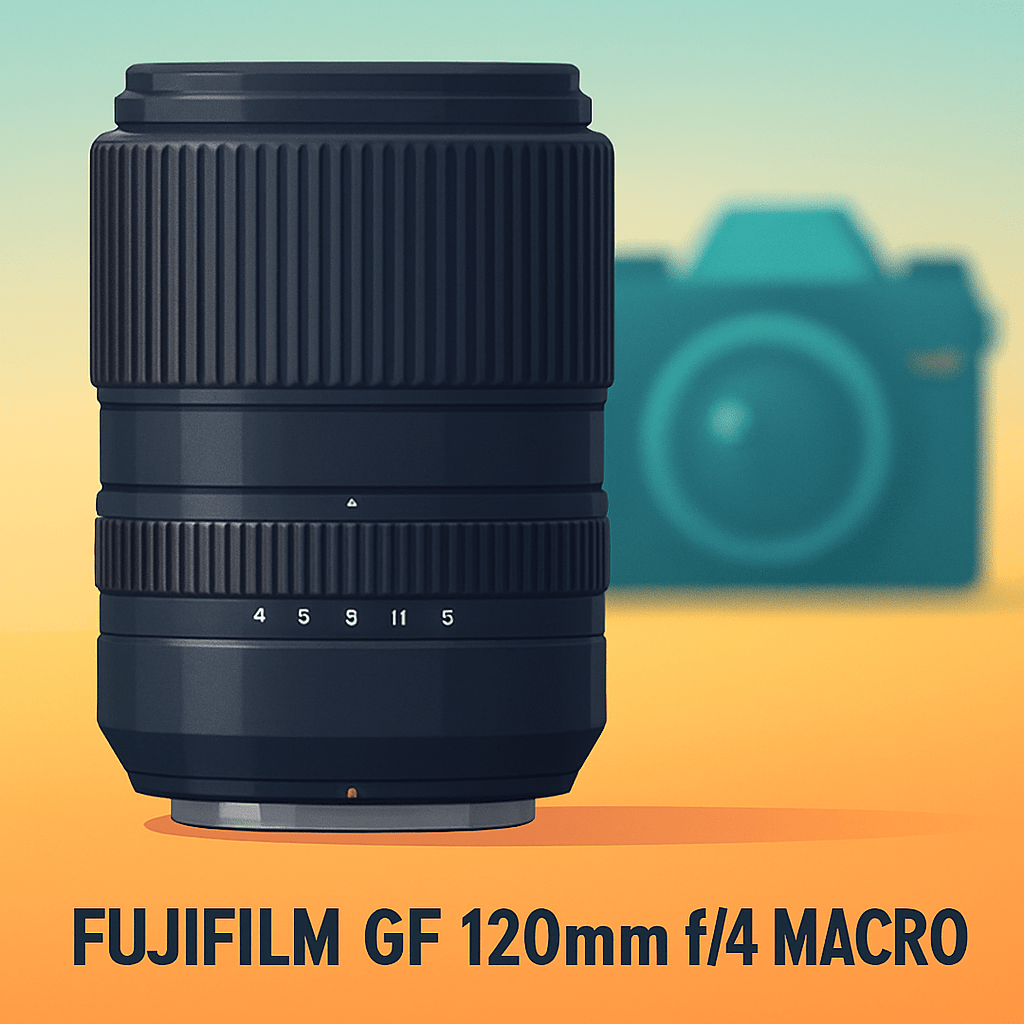
Want to make tiny subjects look monumental in your images?
The Fujifilm GF 120mm f/4 R Macro is a dedicated telephoto macro for GFX users, promising life-size 1:1 magnification, built‑in stabilization, weather resistance, and a snappy linear autofocus drive. I’ve spent time with it in both studio and field shoots, so I know where it shines.
This lens will appeal to product, still‑life, and nature macro shooters who need a comfortable working distance, steady handheld performance, and clinical, high‑detail results that reproduce texture and micro‑contrast. It’s built for repeatable, real‑world outcomes when fine detail matters most.
There are trade‑offs — a slower f/4 aperture and a more clinical look versus faster, characterful primes or zooms — and we’ll dig into how those affect real shoots. Make sure to read the entire review as I break down when this lens is the right choice for your work.

Fujifilm GF 120mm f/4 R Macro
Compact telephoto macro offering exceptional close-up performance, razor-sharp detail, smooth bokeh, and precise focusing for product, nature, and portrait work on high-resolution medium-format cameras.
Check PriceThe Numbers You Need
| Spec | Value |
|---|---|
| Focal Length | 120mm |
| Aperture | f/4 |
| Macro Capability | 1:1 |
| Mount | Fujifilm G-mount |
| Lens Type | Telephoto Macro |
| Image Stabilization | OIS |
| Weather Sealing | WR |
| Motor Type | Linear Motor (LM) |
| Optimum Format | Medium Format |
| Optics | High-resolution optics |
| Magnification | Life-size |
| Working Distance | Comfortable |
| Lens Elements | Designed for sharp macro imaging |
| Usage | Studio and Nature Photography |
| Focus Type | Autofocus |
How It’s Built
Out of the box the Fujifilm GF 120mm f/4 R Macro feels like a lens built for purpose. It’s a medium-format G-mount optic with a solid, weather-resistant shell that gave me confidence shooting in drizzly field sessions and dusty studio corners. That kind of build means you can keep working when conditions are less than perfect.
Handling is straightforward and friendly for beginners. The focus ring is smooth and precise in my testing, and the autofocus driven by a linear motor is quiet and reliable when switching between subjects. Controls are simple and sit where your hand expects them, so you spend less time fumbling and more time shooting.
The tele-macro shape is a real practical win. I liked how the working distance let me place lights and props without crowding the subject, and the built-in stabilization made handheld close-ups noticeably steadier in real-world use. For nature work you’ll thank that extra bit of reach when dealing with skittish critters.
What could be better is the trade-off in aperture and size — it isn’t designed for dreamy background blur and it feels a touch hefty on long walks. If you want pure blur or a lightweight carry, look elsewhere, but for sharp, controlled macro work this lens is built to deliver.
In Your Hands
The Fujifilm GF 120mm f/4 R Macro focuses with a calm, purposeful feel—linear-motor drive delivers quiet, accurate locks and predictable micro-adjustments at close range. In practice that means you can nail focus on tiny textures and edges without the jitter or surprise that ruins a critical shot, and manual fine-tuning remains intuitive when you need it.
Built-in stabilization transforms handheld macro work from a compromise into a practical option; it steadies framing and lets you use slower shutter choices for cleaner exposures without a tripod. Outdoors this translates to more keepers of skittish subjects, and in the studio it reduces reliance on heavy rigs for tight product detail shoots.
The 1:1 capability paired with a telephoto working distance makes lighting and composition straightforward—there’s room for diffusers, small strobes, or natural light control and less risk of disturbing living subjects. That comfortable reach also helps isolate tiny subjects against soft, unobtrusive backgrounds, so repeatable framing and consistent results are easier to achieve across a session.
Overall, this lens earns its place when clinical, detail-forward rendering is the goal; product photographers, still-life artists, and serious field macro shooters will appreciate the repeatability and discipline it brings. Transitioning between studio and field is seamless—the handling, stabilization, and focus behavior stay reliable whether you’re on a table or in the wild.
The Good and Bad
- True 1:1 life-size magnification for authentic macro work
- Optical image stabilization (OIS) supports handheld shooting and slower shutter speeds
- Weather resistance (WR) for field reliability
- High-resolution optics optimized for sharp macro results
- f/4 maximum aperture is slower than faster primes, reducing subject isolation and low-light flexibility
- Prime-only framing (no zoom versatility)
Ideal Buyer
The Fujifilm GF 120mm f/4 R Macro is for photographers who make detail their subject — product, still life and nature close‑ups that demand true 1:1 life‑size capture. Its clinical, high‑resolution rendering and telephoto working distance let you isolate tiny textures and repeat compositions with confidence. If your priority is measurable fidelity rather than painterly bokeh, this lens was made for you.
Studio shooters will appreciate how the lens’s working distance and weather‑sealed build simplify lighting, reflections and subject handling during controlled shoots. Field macro photographers also benefit from the built‑in OIS and WR, which translate to steadier handheld frames and fewer lost moments on skittish subjects. The GF120 shines when stability, repeatability and fine detail are non‑negotiable.
This is less ideal for portraitists chasing creamy background blur or for photographers who need faster apertures or a zoom’s framing flexibility. If you value expressive bokeh or low‑light speed over life‑size magnification, faster GF primes or a versatile zoom will be more satisfying. Choose the GF120 when macro capability and clinical sharpness outweigh stylistic softness or framing convenience.
Prospective buyers who switch between studio product work and field macro will find the GF120 a rare hybrid that prioritizes reproducibility over glamour. It rewards photographers who put detail fidelity and handheld reliability at the top of their kit list.
Better Alternatives?
We’ve gone deep on the Fujifilm GF 120mm f/4 Macro—how it delivers 1:1 life-size shots, steady handheld work with OIS, and a very clinical, detail-first look that’s great for product and nature macro. That lens is a specialist: if your priority is true macro detail and a comfortable working distance, it’s hard to beat.
But not every shoot needs 1:1 magnification or a clinical look. Below are a few lenses I’ve used that trade the GF 120mm’s macro tools for different strengths—faster apertures, more character in the image, or a different focal length that suits portraits and low-light work better. I’ll spell out what each one does better and where it gives ground compared with the GF 120mm.
Alternative 1:

Fujifilm GF 110mm f/2 R
Fast-aperture short telephoto delivering creamy bokeh, stunning subject separation and exceptional sharpness—ideal for low-light portraits, editorial assignments, and studio work on medium-format systems.
Check PriceI use the GF 110mm f/2 when I want portraits that pop. Compared with the GF 120mm macro, the 110mm gives a much faster aperture and creamier background blur. In low light it lets me hold shutter speeds I wouldn’t with the f/4 macro, and subjects separate from the background in a way that just looks more “portrait” than “clinical.”
What you lose versus the GF 120mm is the macro capability and the built-in stabilization. The 110mm won’t focus anywhere near 1:1, so it can’t replace the 120mm for tight product shots, tiny insects, or life-size macro work. Also, without OIS, handheld close work needs faster shutter speeds or support to avoid blur.
If you shoot mostly portraits, editorial work, or weddings and want a more characterful look and better low-light performance, the 110mm is the better pick. If you need true macro detail or rely on OIS for handheld studio/nature work, stick with the 120mm.
Alternative 2:

Fujifilm GF 80mm f/1.7 R
Ultra-fast standard prime with cinematic shallow depth-of-field, velvety bokeh, and excellent low-light performance—perfect for environmental portraits, weddings, and creative storytelling with rich tonal rendering.
Check PriceThe GF 80mm f/1.7 is my go-to when I want the shallowest depth of field and a very film-like look. Against the GF 120mm macro, the 80mm gives a much more dramatic separation between subject and background and handles dim venues with ease because of that big f/1.7 aperture. It’s great for environmental portraits where you still want subject isolation but a bit more context.
On the downside, it’s not a macro lens and it has no image stabilization, so it won’t help you capture tiny details like the 120mm does. Also, on medium format I often stop it down a bit if I need edge-to-edge sharpness for certain types of commercial work—so while it’s gorgeous wide open, it’s a different tool than the clinical, 1:1-capable 120mm.
Choose the 80mm f/1.7 if your work is creative portraits, weddings, or low-light storytelling and you want painterly bokeh. If your shoots demand life-size macro, extreme detail, or stabilized handheld close-ups, the GF 120mm remains the better choice.
Alternative 3:
Fujifilm GF 80mm f/1.7 R
Premium standard optic combining striking subject isolation, crisp center sharpness, natural color rendition, and a refined tactile design—built for photographers seeking expressive portraits and artistic shallow-focus imagery.
Check PriceLooking at the 80mm again from a slightly different angle: this lens gives beautiful skin tones and a very pleasing center sharpness that works well for headshots and editorial portraits. Compared with the GF 120mm macro, it feels more immediate and tactile in hand and gives images with a warmer, more expressive character rather than the ultra-detailed look of the macro.
It still doesn’t match the 120mm for macro work or for the stability OIS provides. If you need consistent, repeatable close-focus framing for product shots or tiny subjects, the 120mm wins every time. The 80mm is simply not built for that kind of precision close work.
If you’re a portrait or commercial shooter who values color rendering, handling, and a lyrical shallow-focus look, the 80mm is a fine choice. If your job is detailed product photography, insect or plant macro, or any situation where 1:1 magnification and OIS are critical, go with the GF 120mm.
What People Ask Most
What is the magnification and minimum focusing distance of the Fujifilm GF 120mm f/4 Macro?
It offers 1:1 magnification and focuses down to about 0.38 meters (38 cm) for life‑size macro shots.
Is the Fujifilm GF 120mm f/4 Macro a true 1:1 macro lens?
Yes — it delivers a true 1:1 life‑size reproduction ratio for genuine macro work.
Does the Fujifilm GF 120mm f/4 Macro have autofocus and how fast/accurate is it?
Yes, it uses linear motors and AF is generally fast and accurate on GFX bodies, though focus can be slower in low light or on very small subjects.
Is the Fujifilm GF 120mm f/4 Macro weather-sealed and suitable for outdoor use?
Yes, it has Fujifilm’s WR weather sealing so it’s fine for shooting in rain, dust, and typical outdoor conditions but not for underwater use.
How sharp is the Fujifilm GF 120mm f/4 Macro compared to other GF-mount lenses?
It’s among the sharpest GF lenses, delivering exceptional edge‑to‑edge detail especially at close focus distances and wide apertures.
Is the Fujifilm GF 120mm f/4 Macro worth the price for portrait and macro photography?
If you need true 1:1 macro and top image quality for portraits and studio work, it’s worth it; if you’re on a tight budget, consider less expensive or used alternatives.
Conclusion
The Fujifilm GF 120mm f/4 R Macro is a purpose-built telephoto macro for GFX shooters that delivers life-size capture with stabilized, weather‑resistant reliability. Its optical design and linear-motor AF aim squarely at clinical, high‑resolution detail rather than painterly character. In short, it does what a specialist macro should: render tiny subjects with uncompromising clarity.
In the studio and in the field it rewards careful work with repeatable results, a comfortable working distance for lighting, and OIS that makes handheld close-ups practical. The trade-offs are obvious: an f/4 maximum aperture and a clinical rendering that won’t satisfy shooters chasing creamy, portrait-style bokeh or rapid low‑light performance. If you need framing flexibility, the prime-only approach is also a limitation compared with zoom alternatives.
Value comes from purpose, and the GF 120mm f/4 R Macro is unabashedly purposeful — the right tool when 1:1 magnification and image fidelity matter most. Choose it when macro capability and detail fidelity outweigh the desire for faster apertures or zoom versatility. For product, still‑life, and serious nature macro work it’s one of the clearest, most dependable choices in the GFX lineup.
Fujifilm GF 120mm f/4 R Macro
Compact telephoto macro offering exceptional close-up performance, razor-sharp detail, smooth bokeh, and precise focusing for product, nature, and portrait work on high-resolution medium-format cameras.
Check Price


0 Comments