
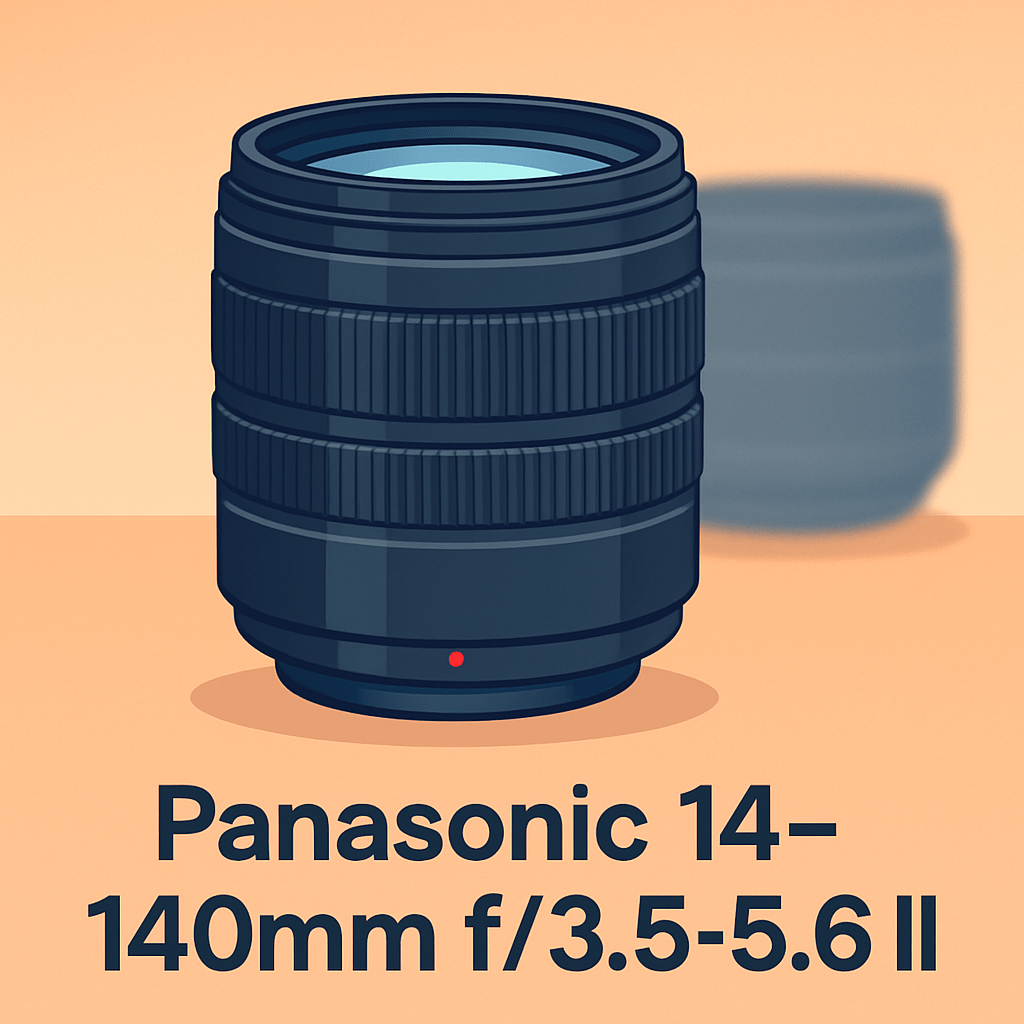
Want a single lens that covers wide travel scenes and distant details without lugging a bag? You’re not alone.
The Panasonic Lumix G Vario 14-140mm F3.5-5.6 II ASPH Micro Four Thirds is Panasonic’s all-in-one zoom for MFT bodies. It aims to be a travel-friendly, do-it-all optic.
Its real-world appeal is simple: broad focal reach in a compact, lightweight package with POWER O.I.S. for steadier handheld shots. Ideal for everyday carry, travel, and hybrid stills/video shooters.
Having spent time shooting the II in the field, I focused on practical strengths and trade-offs rather than lab numbers. You’ll find hands-on notes about handling, stabilization, autofocus, and rendering.
Want to know if it can replace a small kit or where it compromises? Make sure to read the entire review as we unpack the verdict—keep reading.
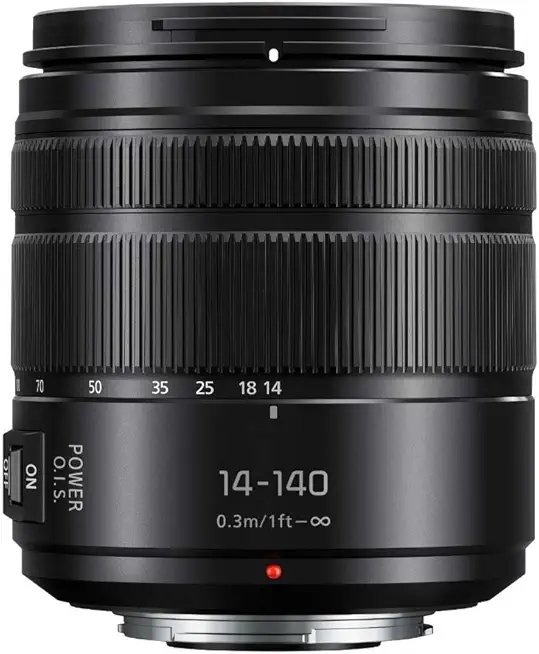
Panasonic Lumix G Vario 14-140mm F3.5-5.6 II ASPH Micro Four Thirds
All-in-one travel zoom delivering broad focal coverage and reliable performance. Compact, lightweight design with crisp optics and smooth autofocus makes it perfect for everyday shooting, landscapes, portraits and distant subjects.
Check PriceThe Numbers You Need
| Spec | Value |
|---|---|
| Focal length | 14-140mm |
| Maximum aperture | f/3.5-5.6 |
| Lens Mount | Micro Four Thirds |
| Optical Image Stabilization | POWER O.I.S. |
| Lens construction | 12 elements in 10 groups |
| Minimum focusing distance | 0.3 m (wide), 0.45 m (telephoto) |
| Maximum magnification | 0.24x (wide), 0.17x (telephoto) |
| Filter size | 58 mm |
| Diaphragm blades | 7 rounded blades |
| Angle of view | 75° (wide) to 8° (telephoto) |
| Autofocus | Contrast-detection AF system compatible |
| Dimensions (Diameter × Length) | approx. 65.6 × 99 mm |
| Weight | approx. 265 g |
| Zoom type | Rotary zoom |
| Compatible Formats | Micro Four Thirds sensor cameras |
How It’s Built
In my testing the Panasonic Lumix G Vario 14-140mm F3.5-5.6 II felt like a true do-it-all lens for Micro Four Thirds bodies. It’s compact and light enough to throw in a bag and forget, which makes it great for travel and everyday shooting. That compactness really changes how often you’ll reach for your camera.
The controls are simple and friendly — a rotary zoom ring that moves smoothly with predictable resistance. I found the focus action quiet and unobtrusive, which helps for both stills and video. The rounded aperture blades give highlights a pleasant, soft shape that’s forgiving for beginners learning about background blur.
One thing I really liked was how well it balances on smaller MFT bodies; it almost disappears on a small camera and stays comfortable for long walks. A drawback is the way the barrel extends as you zoom, so the lens changes length and feels a bit less solid than pricier glass. Build feels well-toleranced overall, but don’t expect pro-level weather protection.
For a beginner this means easy handling and few surprises in the field — you can concentrate on composition, not wrestling with gear. If you want something indestructible or with a constant bright aperture, look elsewhere; for everyday versatility, this is a very practical choice.
In Your Hands
In everyday shooting the lens’ autofocus is quietly confident — quick and unobtrusive for single-shot work and reasonably dependable in continuous modes. In good light it pins focus with minimal fuss; in dimmer situations and when pushed toward the long end you can feel it become a touch more deliberate and less aggressive at tracking fast subjects.
Optical stabilization is the feature that makes this a genuinely usable walk‑around tool, letting me handhold much longer shutter times with steady results and smooth panning for casual video. When paired with a camera that offers body stabilization the system becomes forgiving, though for very long handheld reaches I still prefer a tripod for absolute steadiness.
Close-up ability surprised me — it’s practical for tabletop, food, and small‑product work without pretending to be a macro lens. Working distance is reasonable at short focal settings, but you’ll need to step back as you zoom in; the magnification is handy for detail shots and careful composition, not for true macro subjects.
On the road the broad zoom coverage translates to fewer lens swaps and an easier bag, and the compact balance is comfortable on smaller bodies. Barrel extension is predictable, focus breathing is minimal enough for run‑and‑gun video, and flare is generally controlled with a hood or slight angle adjustments in backlit scenes.
The Good and Bad
- Broad 14–140 mm focal range in a compact, 265 g body
- POWER O.I.S. for handheld stability
- Close-focus capability: 0.3 m (wide) / 0.45 m (tele), up to 0.24x/0.17x
- 58 mm filter thread for affordable, common filters
- Variable maximum aperture f/3.5–5.6 limits light at the long end
- Maximum magnification below macro levels
Ideal Buyer
Micro Four Thirds shooters who want a single, do-it-all lens will appreciate the Panasonic Lumix G Vario 14-140mm F3.5-5.6 II ASPH Micro Four Thirds. Its 14–140mm range and compact 265 g footprint replace bulky kits and simplify travel and everyday shooting. The lens balances reach with portability for walk-around landscapes, family snaps, and street work, truly freeing you from a bag full of glass.
Travelers and hybrid shooters who also shoot video get real-world benefit from POWER O.I.S., especially on bodies without IBIS. Close-focus capability and common 58 mm filter thread make it handy for food, product shots, and affordable filters or polarizers. Autofocus that is competent in daylight and stabilization that steadies longer handheld shots make this a versatile everyday tool.
Serious low‑light shooters, portrait photographers chasing shallow depth, and those who need true macro reach may find the variable f/3.5–5.6 and max magnification limiting. Likewise, pixel-peepers seeking the absolute sharpest corners at 140mm should consider faster primes or specialty tele zooms instead. For most travelers and one‑lens photographers though, this Panasonic 14-140 II represents a smart, compact compromise between capability and convenience.
Better Alternatives?
We’ve already gone through what the Panasonic 14-140mm II does well: a compact, stabilized one-lens solution that covers most shooting needs for travel, walk-around and hybrid stills/video. It’s a solid all-rounder, but no single lens is perfect for every shooter or every situation.
If you want a little more reach, a different balance, or to replace the on-board stabilization with a body that has IBIS, there are sensible alternatives. Below are three lenses I’ve used in the field and how they really compare to the Panasonic in daily shooting.
Alternative 1:

Olympus M.Zuiko Digital ED 14-150mm F4.0-5.6 II Micro Four Thirds
Versatile telephoto zoom built for adventurous shooters seeking reach without bulky gear. Balanced handling and consistent sharpness across the range make it ideal for trips, events and wildlife snapshots.
Check PriceI’ve shot with the Olympus 14-150mm II on weekend trips and found it to be a very tidy travel lens. Compared to the Panasonic 14-140 II it gives an extra 10mm of reach at the long end, which matters when you need just a little more compression on wildlife or distant subjects. Images feel balanced and usable across the range, and the handling on smaller bodies is comfortable for long days.
Where it falls short versus the Panasonic is low-light and shallow depth control. The Olympus starts at f/4 on the wide end, so you lose a bit of light and subject separation compared with the Panasonic’s f/3.5. Also, the Olympus lacks in-lens stabilization, so if your camera body doesn’t have good IBIS you’ll notice more shake at slow shutter speeds.
This lens will suit the traveler who values slightly more reach and a compact kit and who shoots on a camera with good in-body stabilization. If you often shoot in dim light without IBIS, you’ll prefer the Panasonic’s onboard O.I.S. But if you want a simple, light travel setup and you already have IBIS, the Olympus is a very practical choice.
Alternative 2:

OM SYSTEM M.Zuiko Digital 12-200mm F3.5-6.3 Micro Four Thirds
Massive-range zoom offering dramatic wide-to-tele reach in a single lens. Excellent for travel and documentary work, it simplifies kit-building while preserving detail and compositional flexibility from wide scenes to distant subjects.
Check PriceThe OM System 12-200mm is the “take-everything” lens I pack when I want to skip lens changes. In real use it covers wider angles than the Panasonic and goes much longer on the tele end, so you can shoot sweeping interiors and distant subjects without swapping lenses. That extra range is a big win for travel and documentary days when you can’t predict what you’ll need.
On the flip side, that huge zoom range means compromises. The 12-200mm is noticeably larger and heavier than the 14-140 II, and at the very long end it’s slower (f/6.3) and a touch softer than the Panasonic in tricky light. Like the Olympus alternative, it also relies on your camera’s IBIS rather than having built-in optical stabilization, so handheld low-light tele work is tougher unless your body handles it.
This lens is for the photographer who wants to travel light in terms of bag space but still cover everything from wide landscapes to tight tele shots. If you want the best corner-to-corner sharpness, the lightest carry, or the Panasonic’s on-lens stabilization, then the 14-140 II might be better. But if replacing several lenses with one is your goal, the 12-200mm is hard to beat.
Alternative 3:
OM SYSTEM M.Zuiko Digital 12-200mm F3.5-6.3 Micro Four Thirds
A do-it-all optic that replaces multiple lenses, enabling spontaneous creativity from sweeping landscapes to tight close-ups. Lightweight construction and dependable performance keep you shooting longer with minimal gear changes.
Check PriceHaving used the 12-200mm on both street and landscape shoots, I can say it really frees you up. Compared to the Panasonic 14-140 II, the 12mm wide end makes it easier to capture tight interiors and dramatic vistas without stepping back. For fast-paced shoots where you can’t change lenses, that flexibility is a major practical advantage.
That said, the real-world trade-offs are obvious after a few hours: the lens is bulkier on your shoulder, and in low light the long end needs higher ISO or slower shutter speeds. Autofocus is solid for stills, but for fast action at long distances you’ll notice the Panasonic’s stabilization and slightly quicker feel can be better, especially on bodies without strong IBIS.
Choose the 12-200mm if you want a single-lens kit and shoot a lot of varied scenes in one session—travel, events, or run-and-gun documentary work. If your priority is the lightest possible carry with in-lens stabilization for steady handheld tele shots, stick with the Panasonic 14-140 II. The 12-200 is about coverage and convenience; the Panasonic is about balance and steadier handheld tele performance.
What People Ask Most
Is the Panasonic 14-140mm f/3.5-5.6 II a good lens?
Yes — it’s a very useful all-in-one zoom for travel and everyday use, offering a wide zoom range with sensible compromises on sharpness and aperture compared with primes.
Does the Panasonic 14-140mm II have image stabilization (O.I.S.)?
Yes, it includes Panasonic’s POWER O.I.S., which helps handheld shots and video at longer focal lengths.
Is the Panasonic 14-140mm f/3.5-5.6 II compatible with Micro Four Thirds cameras?
Yes, it’s designed for Micro Four Thirds mounts and works on all MFT bodies with full functionality.
What is the 35mm equivalent focal length of the Panasonic 14-140mm II?
On Micro Four Thirds the equivalent range is about 28–280mm in 35mm terms.
How sharp is the Panasonic 14-140mm f/3.5-5.6 II?
Center sharpness is good stopped down, but corners and the long end are softer than primes; stopping down improves usable detail.
What’s the difference between the Panasonic 14-140mm and the 14-140mm II?
The Mark II improves optics, coatings and handling for better contrast and flare control, while keeping the same versatile focal range and stabilization.
Conclusion
The Panasonic Lumix G Vario 14-140mm F3.5-5.6 II ASPH Micro Four Thirds is the jack‑of‑all‑trades zoom I reach for on travel days and city shoots alike. Its sweep from wide to long, compact carrying footprint, and dependable POWER O.I.S. make it the easy choice when versatility and steadiness beat specialized speed. In practical terms it turns a single MFT body into a complete kit that stays nimble and ready for anything the day throws at you.
That convenience does come with clear trade‑offs and compromises you should accept before buying. The variable, modest aperture curbs low‑light performance and background separation, and the lens never pretends to be a dedicated macro or a fast portrait optic. Toward the long end you trade some fine‑detail performance and AF snappiness for reach and portability, which is fine if those are fair compromises for your shooting style.
The bottom line is simple: for travel, street, family and generalist shooters the 14‑140 II delivers more usefulness per ounce than most single‑lens solutions. If you demand faster glass, the absolute sharpest corners, or extra reach, then look at alternatives or a two‑lens kit; otherwise this lens is a high‑value, low‑hassle everyday partner. I recommend it without hesitation to photographers who prize flexibility, stabilization, and a light bag over headline optics and studio precision.
Panasonic Lumix G Vario 14-140mm F3.5-5.6 II ASPH Micro Four Thirds
All-in-one travel zoom delivering broad focal coverage and reliable performance. Compact, lightweight design with crisp optics and smooth autofocus makes it perfect for everyday shooting, landscapes, portraits and distant subjects.
Check Price




0 Comments