
Want one lens that covers your everyday shoots and won’t bail when the weather turns?
The Pentax DA 18-135mm f/3.5-5.6 WR promises wide-to-tele convenience with weather resistance, perfect for travel, family days, and outdoor work.
It’s aimed at Pentax APS-C shooters who want a compact, do-it-all lens, and after a few field days I learned how it handles real conditions.
I’ll walk you through handling, autofocus, image quality, pros and cons, and practical alternatives to help you decide—make sure to read the entire review as you’ll want the full picture, keep reading.

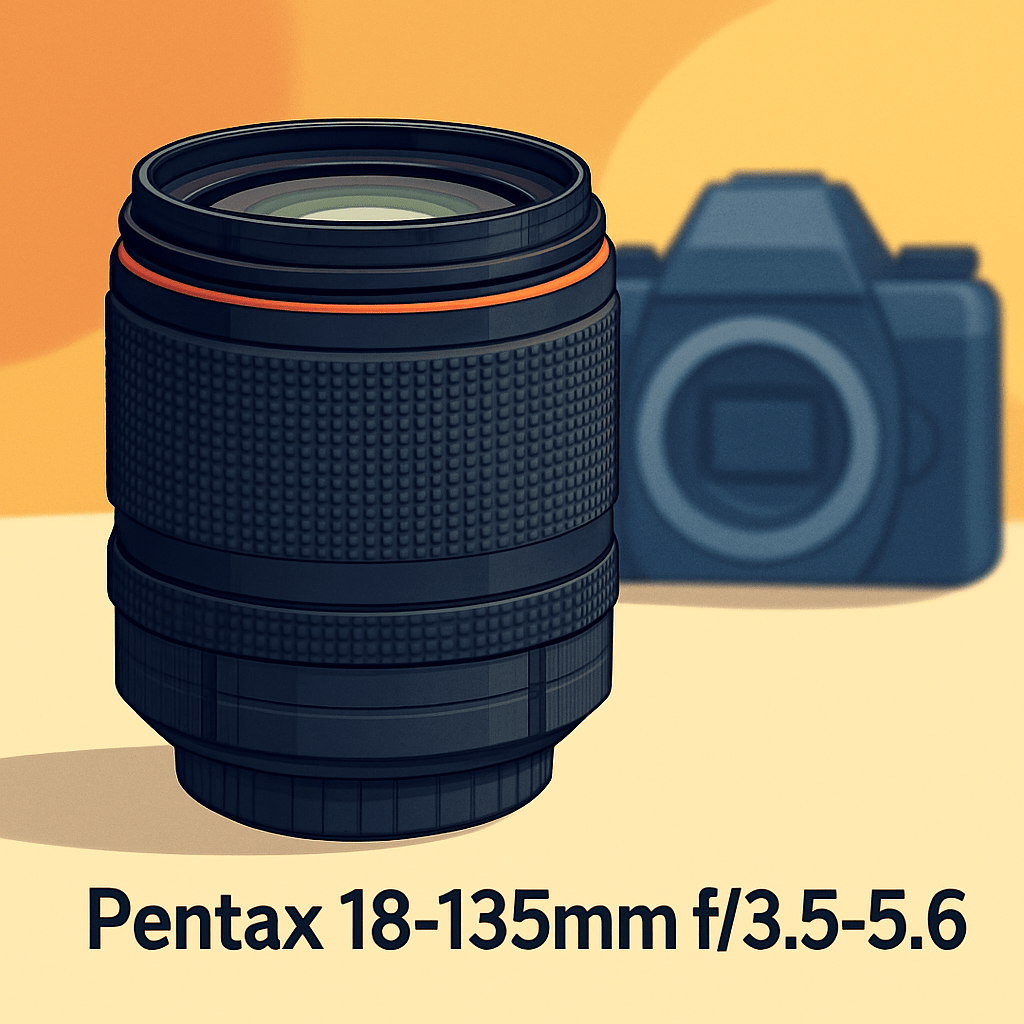
Pentax DA 18-135mm f/3.5-5.6 WR
Weather-sealed, versatile all-in-one zoom designed for APS-C shooters, delivering broad framing from wide to tele. Compact, lightweight handling with smooth autofocus makes it ideal for travel, street, and landscape photography.
Check PriceThe Numbers You Need
| Spec | Value |
|---|---|
| Focal length | 18–135 mm |
| Aperture range | f/3.5–5.6 |
| Format | APS-C (Pentax K-mount) |
| Weather resistance | Yes (WR) |
| Autofocus | Yes (DC motor) |
| Lens construction | 13 elements in 11 groups |
| Special elements | ED glass; AL element |
| Internal focusing | Yes (IF) |
| Minimum focus distance | ≈0.4 m |
| Filter size | 67 mm |
| Zoom type | One-touch zoom |
| Diaphragm blades | 7 (rounded) |
| Coating | HD coating |
| Weight | ≈405 g |
| Length | ≈76 mm (retracted) |
How It’s Built
In my testing the Pentax DA 18-135mm f/3.5-5.6 WR feels solid and properly sealed. Shooting in light rain and on dusty trails gave me real confidence to keep working. That weather resistance translates to fewer missed shots when the sky turns ugly.
It’s compact and light on a Pentax APS-C body, so it balances well and doesn’t wear you out. I carried it all day without shoulder strain, which matters on long walks or travel days. For beginners that means less gear and more shooting.
The one-touch zoom is practical and quick to use, with a firm feel that avoids accidental zoom creep. I found the throw a bit short and a touch stiffer than I’d like, so smoother action would be welcome. Internal focusing keeps the front element still, so filters and polarizers behave predictably.
Seven rounded blades help produce pleasant, soft backgrounds at longer reaches, and the HD coating stood up nicely against backlight. What I really liked was the weather sealing and handling; what could be better is the modest light-gathering in dim conditions, which pushes you to raise ISO or slow the shutter. Overall, it’s a user-friendly lens for everyday outdoor work.
In Your Hands
The lens’s wide-to-moderate-tele sweep makes it a genuine single-lens solution for travel and everyday work, easily handling sweeping cityscapes, tight street frames, and pulled-in portraits without a bag of glass. That versatility translates to less lens swapping and more decisive shooting on walks, family outings, and long day trips. Framing alternatives come fast, so you spend time composing instead of fiddling with gear.
Its modest maximum aperture means you plan exposure around available light — boosting ISO or stopping down as the scene dictates — but depth-of-field control is perfectly serviceable for environmental portraits and separating subjects in open shade. A comfortable close-focus capability lets you capture texture and detail without crawling over your subject, and the internal-focus design keeps a polarizer or ND filter behaving predictably. In bright or backlit situations the lens feels reliable and forgiving for everyday use.
Outdoors the weather-resistant build gives real confidence in light rain and dusty trails, so you can keep shooting when conditions turn on you. The zoom and focus rings are smooth and well-damped, offering predictable throw and balance that make handheld shooting pleasant for hours. At the long end it’s responsive enough for casual wildlife and event moments, making it a go-to generalist for Pentax APS‑C users who favor practicality and wash-and-wear reliability.
The Good and Bad
- Versatile 18–135 mm range in a single lens
- Weather-resistant (WR) build
- Compact and lightweight for its coverage
- DC autofocus with internal focusing (IF)
- Variable maximum aperture (f/3.5–5.6) limits light-gathering
- APS-C format only (not designed for full-frame coverage)
Ideal Buyer
This lens is ideal for Pentax APS‑C shooters who want one‑lens convenience without babying their kit. If you travel, hike, or chase family moments you’ll appreciate the 18–135mm reach and WR confidence. Its compact weight and internal focusing make it a true daypack staple for long outings.
Choose the Pentax DA 18‑135mm f/3.5‑5.6 WR if convenience beats a fast prime in your bag. It handles city walks, road trips, family parties, and landscapes with minimal lens swaps and easy 67mm filter use. Photographers who value weather resistance and reliable autofocus on Pentax bodies will find it a sensible, versatile tool.
Skip it if you need wide‑aperture low‑light performance, macro‑level closeups, or the absolute best corner‑to‑corner optics. If you want wider angles or crisper glass consider the DA 16‑85mm, and if you crave extra reach the 18‑200mm options trade IQ for tele distance. For most Pentax shooters seeking a do‑everything, weather‑sealed travel lens, this one balances size, reach, and ruggedness very well.
Better Alternatives?
We’ve gone through what the Pentax 18-135mm f/3.5-5.6 WR offers: a handy, weather‑resistant all‑rounder that keeps weight down and lets you cover wide to moderate tele without swapping lenses. It’s a great everyday and travel lens, but no single lens is perfect for every photographer or every job.
Below are a few real alternatives I’ve used in the field. Each one trades some things the 18‑135 does well for other strengths—sharper images, a wider wide, or a much longer tele range. I’ll point out what each one does better and worse than the 18‑135 and who I’d recommend it to.
Alternative 1:

Pentax DA 16-85mm f/3.5-5.6
Premium walkaround zoom with refined optics and consistent contrast across the frame. Durable construction and fluid handling suit landscape, portrait, and everyday shooting when you want high image quality without constant lens changes.
Check PriceI’ve used the Pentax DA 16-85 on hikes and city shoots and the first thing you notice is the wider 16mm end and cleaner images. Compared to the 18-135, the 16-85 gives slightly crisper detail and more even look across the frame, especially for landscapes and architecture. It also keeps the weather‑resistance that makes the 18-135 useful outdoors.
What it trades away is reach and size. The 16-85 stops at 85mm, so you lose the 135mm tele advantage of the 18-135. It’s also a touch heavier and usually costs more. In short: you get better-looking files for wide and mid ranges, but you sacrifice that handy extra reach.
This is the lens I’d pick if I mostly shoot landscapes, street, and portraits and I want better image quality without carrying a two‑lens kit. If you rarely need long tele and care more about cleaner files and a slightly wider angle, the 16-85 is a solid step up from the 18-135.
Alternative 2:

Sigma 18-200mm f/3.5-6.3 Contemporary Sony A mount
Compact superzoom offering extensive reach in a single package, perfect for travelers who need flexibility. Balanced sharpness, quick focusing, and straightforward handling let you capture distant subjects without swapping lenses.
Check PriceI’ve carried the Sigma 18-200 on day trips and vacations where swapping lenses wasn’t an option. The obvious win over the 18-135 is reach: 200mm lets you pull distant subjects much closer without changing lenses. The built‑in stabilization on Sigma models also helps when shooting handheld at the long end.
Where it loses to the 18-135 is image consistency and weather protection. The Sigma’s image quality is fine for many uses, but corners and long‑end frames are softer and you’ll see more distortion and color fringing without correcting in post. It’s usually not weather‑sealed, so I’m less confident using it in rain or dusty conditions than the 18-135 WR.
If you’re a traveler or family shooter who needs one lens to cover almost everything and you value reach over the absolute best image quality, this Sigma makes a lot of sense. It’s great when you want convenience and extra tele power and can accept some trade-offs in sharpness and build.
Alternative 3:
Sigma 18-200mm f/3.5-6.3 Contemporary Sony A mount
Cost-effective, do-it-all zoom built for convenience and versatility, excellent as a primary travel lens or backup. Covers long reach and everyday scenes with dependable autofocus and compact, lightweight design.
Check PriceUsed as a backup or the only lens on a trip, the Sigma 18-200 is a true do‑it‑all. Compared to the 18-135 WR it gives you that extra 65mm of reach and often a bit more flexibility when shooting wildlife or sports from a distance. For quick family snaps and travel shots it’s hard to beat the convenience.
The cost for that convenience is image trade-offs and handling. The Sigma can be heavier and a bit slower in low light because of the smaller maximum apertures at the long end. I also noticed you’ll do more correction in post for distortion and softness at extremes compared with the more balanced 18-135.
Pick the Sigma as your primary travel lens if you want one lens to cover everything and you won’t be shooting in bad weather or making very large prints from corner-heavy shots. It’s also a good budget choice or a sensible backup when you need reach without packing extra glass.
What People Ask Most
Is the Pentax 18-135mm f/3.5-5.6 a good lens?
Yes — it’s a versatile, well-built walkaround zoom that offers great value for APS-C Pentax shooters, though it’s not a specialist, pro-level optic.
Is the Pentax 18-135mm f/3.5-5.6 weather-sealed (WR)?
Yes, the WR version is weather- and dust-sealed, so it holds up well in light rain and dusty conditions.
Does the Pentax 18-135mm f/3.5-5.6 have image stabilization?
The lens itself has no optical stabilization, but Pentax cameras use in-body sensor-shift stabilization (SR) that works with this lens.
Is the Pentax 18-135mm f/3.5-5.6 sharp across the zoom range?
Center sharpness is good through most of the range, but corners and the long end are a bit softer wide open; stopping down improves overall sharpness.
Is the Pentax 18-135mm f/3.5-5.6 a full-frame lens or only for APS-C?
It’s a DA-design lens made for APS-C (crop-sensor) Pentax cameras and will vignette on full-frame bodies.
How does the Pentax 18-135mm f/3.5-5.6 compare to the 18-55mm kit lens?
The 18-135mm gives much more reach, better build quality and weather sealing, and is generally more useful for travel and everyday shooting than the 18-55 kit lens.
Conclusion
The Pentax DA 18-135mm f/3.5-5.6 WR is the kind of do‑everything zoom I reach for when a light, weather‑sealed one‑lens solution matters more than pixel‑peeping. It marries practical weather resistance, internal focusing and dependable autofocus behavior with a genuinely useful zoom range for day‑to‑day shooting.
Its chief compromise is the modest variable maximum aperture, which forces higher ISO or slower shutter choices in dim light and limits dramatic background separation. Close‑up performance is useful but not macro‑grade, and full‑frame shooters will want to look elsewhere.
For Pentax APS‑C users who prize convenience, ruggedness and a compact carry, this lens represents strong value and very few daily regrets. If you prioritize a wider wide angle and crisper optics, consider the PENTAX DA 16‑85mm. If you need longer reach in a single package and accept some image‑quality trade‑offs, look at the 18‑200mm options from Sigma or Tamron.
In short, this is the sensible travel and everyday zoom for Pentax owners who shoot in the rain, on trails, or with family and want to change lenses less. It won’t satisfy every specialist need, but its balance of reliability, handling and coverage makes it a go‑to workhorse.
Pentax DA 18-135mm f/3.5-5.6 WR
Weather-sealed, versatile all-in-one zoom designed for APS-C shooters, delivering broad framing from wide to tele. Compact, lightweight handling with smooth autofocus makes it ideal for travel, street, and landscape photography.
Check Price



0 Comments