
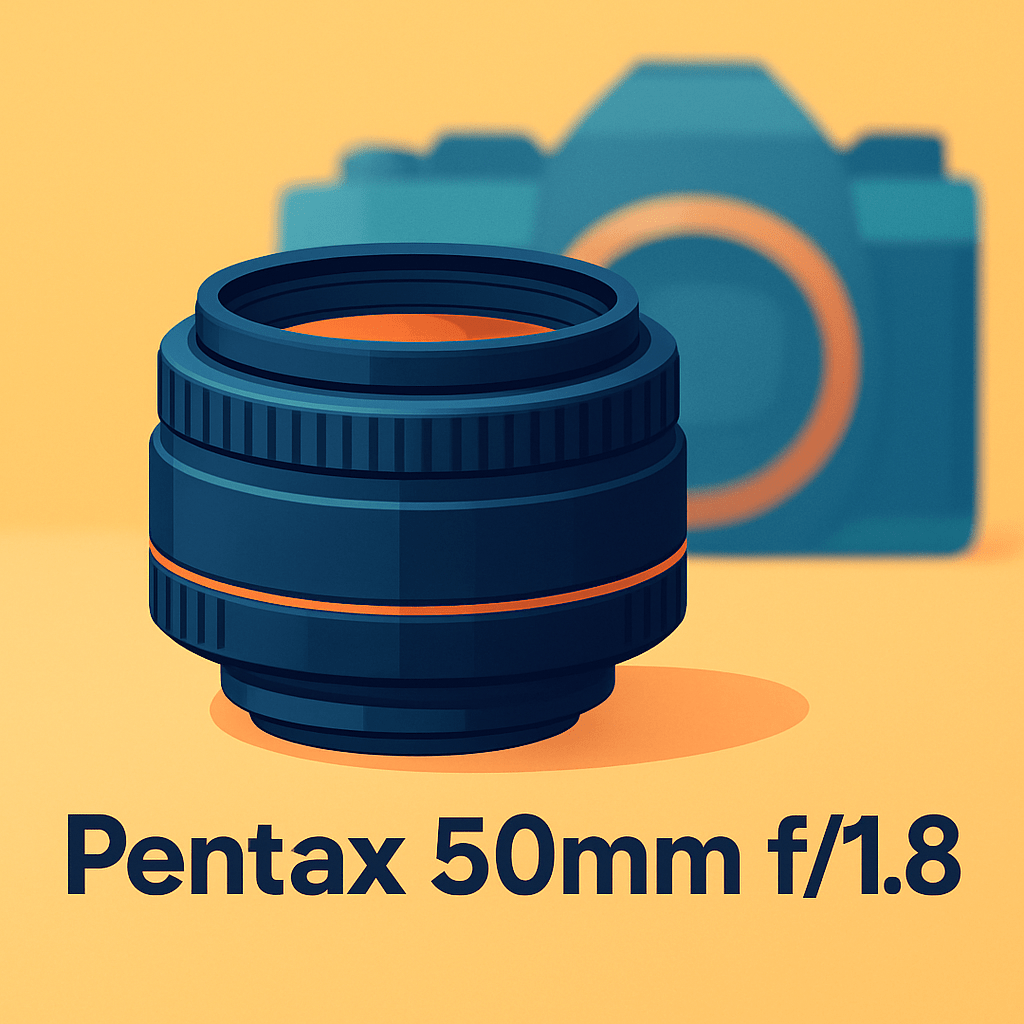
Want a small, no-nonsense 50mm that lifts your Pentax APS-C images without weighing you down?
The Pentax DA 50mm f/1.8 is a compact, walkaround prime with a bright aperture and a tactile aperture ring, and I field-tested it on real shoots to see how it behaves in practice.
It’s aimed at Pentax APS-C shooters who want effortless portraits, low-light capability, and easy carry — though there are practical tradeoffs to consider for autofocus and close focusing.
In this review we’ll unpack handling, AF quirks, rendering and everyday usability so you can decide if it’s the right lens for your kit — make sure to read the entire review as you’ll want the full picture.

Pentax DA 50mm f/1.8
Compact, lightweight normal prime delivering sharp images, smooth bokeh and reliable low-light performance. Ideal for everyday portraits and street photography on crop-sensor bodies, offering excellent value and quick, accurate focusing.
Check PriceThe Numbers You Need
| Spec | Value |
|---|---|
| Focal length | 50mm |
| Maximum aperture | f/1.8 |
| Lens mount | Pentax K-mount |
| Lens type | Prime lens |
| Format compatibility | APS-C sensor |
| Optical construction | 6 elements in 5 groups |
| Angle of view | approx. 31° |
| Minimum focusing distance | 0.45 m |
| Maximum magnification ratio | 0.15x |
| Diaphragm blades | 7 (rounded) |
| Filter size | 49mm |
| Dimensions (diameter x length) | approx. 65 x 39 mm |
| Weight | approx. 160 g |
| Autofocus | Screwdrive autofocus mechanism (requires camera body with screwdrive AF) |
| Aperture control | Manual aperture ring present |
How It’s Built
In my testing the Pentax DA 50mm f/1.8 feels like a classic small prime — light in the bag and barely there on the camera. I found it easy to forget I had it until a moment begged for a quick portrait or street frame. That kind of grab-and-go feeling makes it great for beginners who want one lens to carry daily.
The build is simple and honest, with an aperture ring that clicks into place and a focus ring that turns with predictable resistance. I liked how the aperture ring gives you direct control without diving into menus, which is nice when you’re learning exposure. One thing that could be better is the focus throw; it’s on the short side, so precise manual focusing takes a little practice.
Fit and finish are tidy rather than fancy, and the lens mates well with most Pentax APS-C bodies I used. Balance felt neutral on smaller camera grips and only a hair front-heavy on chunkier bodies, which matters when you shoot handheld for a long time. A common filter size at the front makes adding a polarizer or ND easy for beginners.
After using it for a while I appreciated how compactness encourages spontaneous shooting and keeps you discreet on the street. The simple controls teach you camera basics without extra fuss. If you want a tiny, straightforward prime that won’t slow you down, this one hits that mark.
In Your Hands
On a Pentax APS-C body the Pentax DA 50mm f/1.8 settles into a familiar short-telephoto role that frames head-and-shoulders portraits and cropped environmental shots with an intimate, focused feel. It doesn’t feel wide or distant — instead it nudges subjects forward in the frame, helping you isolate faces and small scenes without obvious distortion.
The bright f/1.8 aperture is liberating in real rooms and twilight streets, letting you keep shutters brisk and fingertip-steadiness manageable while achieving pleasing subject separation. Depth of field is generous enough for smooth background falloff yet forgiving for handheld shooting, so eyes stay sharp while backgrounds melt away.
Close-up performance is practical rather than heroic: you can get in close enough for food, detail work and storytelling vignettes, but it won’t replace a macro for tiny subjects. That moderate focusing range encourages stepping back and composing environments rather than hunting for extreme magnification.
Rendering is charmingly straightforward — out-of-focus highlights round out nicely and transitions feel smooth at wider apertures, giving portraits and street scenes a gentle, natural bokeh. The lens’ compact footprint makes it unobtrusive for wandering photographers, encouraging spontaneous captures and long days of comfortable carry.
The Good and Bad
- Compact and lightweight (approx. 65 x 39 mm, 160 g)
- f/1.8 maximum aperture
- 7 rounded diaphragm blades
- Manual aperture ring present
- Screwdrive AF requires a compatible camera body
- Minimum focus distance 0.45 m and max magnification 0.15x limit close-up potential
Ideal Buyer
This is the lens for Pentax APS‑C shooters who want a true everyday 50mm with an f/1.8 personality. It gives a natural field of view for portraits, street work, and low‑light snapshots without weighing you down. Expect familiar, no‑fuss rendering that stays out of the way.
Travelers and discreet shooters will love the compact 65 × 39 mm footprint and featherlight 160 g weight. The 49 mm filter thread makes adding ND or polarizers painless on the go. It’s the sort of lens you can leave mounted and forget about until the moment matters.
Make sure your camera supports screwdrive AF, because that’s how this lens focuses. On compatible bodies it’s perfectly usable for single‑point and casual street work. If you need fast, silent tracking on moving subjects you’ll want to test it on your body first.
If you prize tactile control, the aperture ring is a real plus for manual stops and quick exposure tweaks. Videographers and hands‑on shooters will appreciate that physical interface. It adds a satisfying, old‑school feel to modern shooting.
This isn’t a macro lens — the 0.45 m minimum focus and 0.15× magnification limit close‑up ambitions. Instead, think environmental portraits, table‑top details, and candid scenes where subject separation matters more than extreme magnification. For food or product close‑ups you’ll likely reach for a dedicated macro instead.
Overall, buy this if you want a tiny, affordable, characterful 50mm that covers most everyday needs. Opt for a heavier, faster lens only if you demand f/1.4 separation or premium optical refinements. For most Pentax APS‑C shooters, it’s a smart, practical pick.
Better Alternatives?
We’ve looked closely at the Pentax 50mm f/1.8: small, light, good for everyday shooting on Pentax APS-C bodies. It’s a very easy lens to carry and it gives a nice mix of sharpness and usable background blur without costing much or weighing you down.
If you want more speed, a different character, or higher-level sharpness, there are a few clear alternatives worth considering. Below I’ll walk through three lenses I’ve used in the field and tell you what each one does better and where it gives up compared to the Pentax DA 50mm f/1.8.
Alternative 1:

Pentax SMC FA 50mm f/1.4
Classic full-frame standard prime with a bright aperture delivering exceptional low-light performance and creamy background separation. Robust metal construction offers tactile control and characterful rendering prized by portrait and studio photographers.
Check PriceI’ve used the FA 50mm f/1.4 for portraits and low-light work and the first thing you notice is the extra stop of light. Wide open it gives a shallower depth of field than the DA f/1.8, so faces really stand out from the background and you get creamier bokeh for headshots. In dim rooms I could shoot slower shutter speeds or lower ISO compared to the DA 50/1.8 and still keep natural skin tones.
That extra speed and the heavier metal build come at a cost in size and handling. The FA is bigger and feels more solid in the hand, so it’s less of a grab-and-go lens than the DA. Also, on modern digital bodies the FA can show a bit more softness and flair at f/1.4 on the edges — stopping down a stop or two cleans it up. If you need the sharpest corners wide open, the DA can sometimes look a bit more controlled simply because it’s a newer, simpler optic on APS-C.
Who should pick it? Choose the FA 50/1.4 if you want that classic, slightly warmer portrait look and more working room in low light. It’s great for portrait shooters and studio work where image character matters more than pocketability. If you want a tiny walkaround lens or you need every ounce of edge-to-edge sharpness wide open, stick with the DA 50/1.8 instead.
Alternative 2:

Sigma 50mm f/1.4 Art DG HSM Canon EF
Flagship premium optic delivering stunning edge-to-edge sharpness, silky bokeh and exceptional micro-contrast. Fast, accurate autofocus and premium construction make it a top choice for professional portraits and demanding low-light work.
Check PriceThe Sigma 50mm Art is a different beast compared to the DA 50/1.8. In real shooting the Art gives noticeably higher resolution and contrast, even wide open. Textures like hair, fabric and fine skin detail resolve much better, so for client work where you need clean, punchy files the Sigma is tough to beat. Its bokeh is also very smooth and the subject separation is more refined at f/1.4.
But the Sigma is much larger and heavier, and that matters when you’re shooting on lighter Pentax bodies. It can make a small camera feel front-heavy and it’s not as discreet for street or travel shooting. It’s also pricier, so you’re paying for a big jump in optical quality and build. In fast-moving scenarios the DA’s compactness and simple handling can actually be more practical.
Who should pick it? The Sigma is for photographers who prioritize image quality above everything else — wedding pros, studio portrait shooters, or anyone shooting with high-megapixel bodies who wants maximum detail. If you want something tiny, cheap, and light for everyday use, the DA 50/1.8 remains the more sensible choice.
Alternative 3:
Sigma 50mm f/1.4 Art DG HSM Canon EF
Large-aperture professional prime engineered for outstanding subject isolation and exceptional clarity on high-resolution cameras. Eight-blade diaphragm and advanced coatings reduce flare while fast focusing ensures dependable performance in demanding shoots.
Check PriceLooking again at the Sigma from a slightly different angle, the thing I appreciated most on long shoots was its consistency. Focus was reliable and the images stayed sharp across a range of distances — it doesn’t rely on stopping down to look good. The coatings also help when I was working backlit; highlights behaved better than on the DA 50/1.8 and flare was more controlled.
The trade-offs are the same: size, weight, and price. For casual use the Sigma can feel like overkill, and you’ll notice battery-life and handling differences if you’re moving a lot. The DA 50/1.8 wins on simplicity — it’s light, unobtrusive, and quick to work with when you don’t need every bit of resolution.
Who should pick this version of the Sigma? Go for it if you’re shooting commercial work, portraits for clients, or high-res landscapes where fine detail matters and you don’t mind carrying a bigger lens. If you want a no-fuss, small, affordable 50mm on a Pentax body for day-to-day shooting, the DA 50mm f/1.8 is still a very smart choice.
What People Ask Most
Is the Pentax 50mm f/1.8 a good lens?
Yes — it’s a compact, affordable normal lens that delivers very good image quality for portraits and everyday shooting.
Is the Pentax 50mm f/1.8 compatible with modern K-mount Pentax DSLRs?
Yes — K‑mount versions fit modern Pentax DSLRs directly, though some older manual variants may lose electronic aperture or metering features on certain bodies.
Does the Pentax 50mm f/1.8 have autofocus?
It depends — many versions use the camera’s screw‑drive AF so they autofocus on bodies with an in‑body motor, while some older copies are manual focus only.
How sharp is the Pentax 50mm f/1.8 wide open at f/1.8?
Center sharpness is generally good at f/1.8, but edges can be soft and the lens sharpens up noticeably by f/2.8–f/4.
How does the Pentax 50mm f/1.8 compare to the Pentax 50mm f/1.4?
The f/1.4 gives a shallower depth of field and a bit better low‑light performance, while the f/1.8 is smaller, lighter, cheaper and nearly as sharp when stopped down.
What is the filter thread size and weight of the Pentax 50mm f/1.8?
Most Pentax 50mm f/1.8 versions use a 49mm filter thread and weigh roughly 130–160 grams depending on the variant.
Conclusion
The Pentax DA 50mm f/1.8 is a compact, no-nonsense standard prime that delivers exactly what most Pentax APS-C shooters want: a fast, easy-to-use optic with classic handling and a pleasing out-of-focus character. In everyday use it feels purposeful rather than flashy, pairing sensible ergonomics with an aperture ring that keeps control in your hands. For street, portrait and low-light snapshots it’s quietly effective and unobtrusive.
The tradeoffs are clear and unapologetic. Its autofocus depends on body compatibility, and it won’t substitute for a macro or the shallower rendering of much faster 50mm designs. If you demand the last bit of microcontrast, close-focus reach, or the absolute smoothest bokeh money can buy, this isn’t the final word.
Put simply, this is the right lens for the photographer who wants a small, capable 50mm with AF and tactile controls without fuss. If you’re chasing more speed and refinement you’ll look to the FA 50/1.4 or a modern Sigma Art and accept added bulk. If tiny size and vintage character matter more than autofocus, a manual Pentax-M will scratch that itch. For its price and purpose, the DA 50mm f/1.8 earns a clear recommendation.
Pentax DA 50mm f/1.8
Compact, lightweight normal prime delivering sharp images, smooth bokeh and reliable low-light performance. Ideal for everyday portraits and street photography on crop-sensor bodies, offering excellent value and quick, accurate focusing.
Check Price

0 Comments