
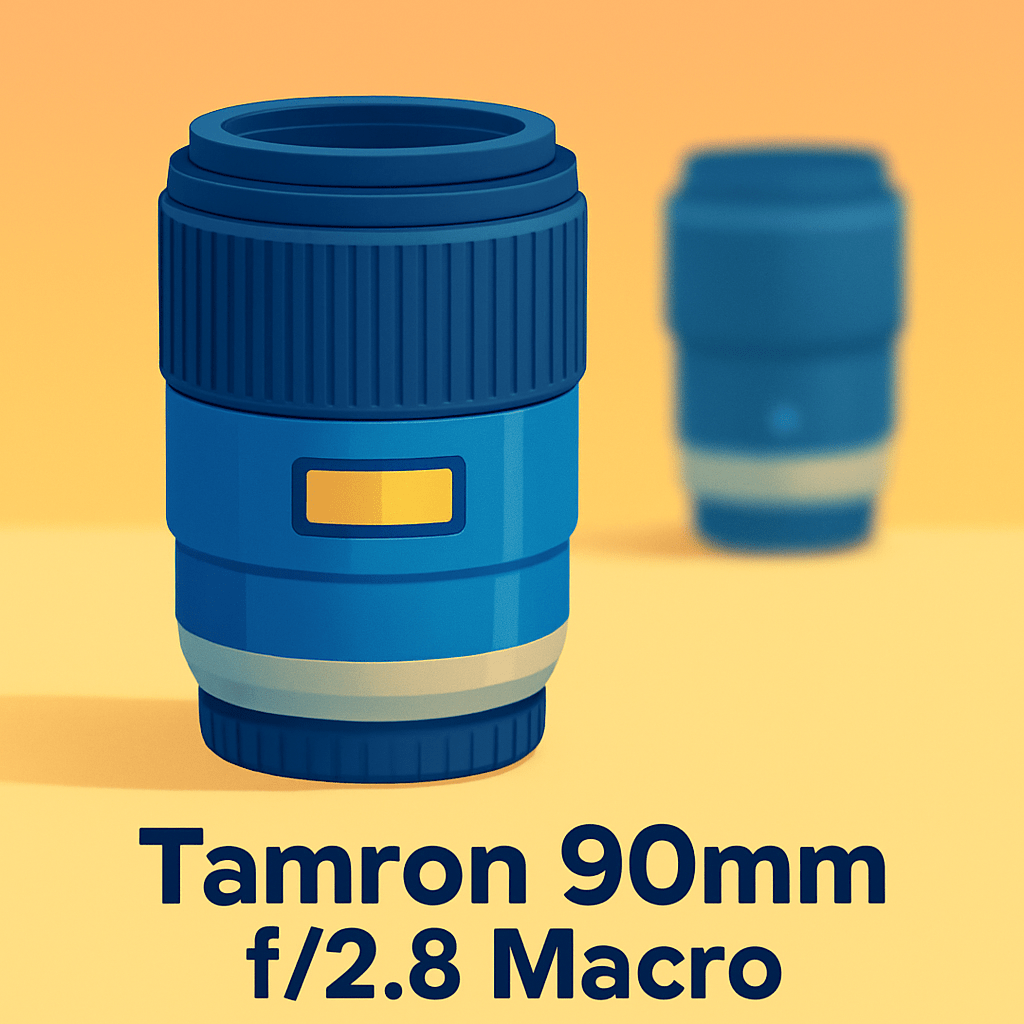
Want to make your close-ups and short-telephoto shots look noticeably better without buying a lot of extra gear?
The Tamron 90mm f/2.8 Di III VXD Macro Sony E is a native Sony E-mount, full-frame 1:1 macro with an f/2.8 max aperture, VXD linear-motor AF, no in‑lens stabilization, and moisture-resistant construction.
After taking it into the field, I dug into build and handling, real-world macro and portrait use, autofocus behavior, true 1:1 performance, pros and cons, and how it stacks up against rivals.
If you shoot Sony and want a compact, native macro that also doubles as a short telephoto with precise AF, this review’s for you—Make sure to read the entire review as I lay out when this lens makes sense and when to consider alternatives, so keep reading.

Tamron 90mm f/2.8 Di III VXD Macro Sony E
Compact tele-macro built for mirrorless E-mount cameras delivers true 1:1 magnification, razor-sharp edge-to-edge detail, silent fast linear autofocus, and creamy bokeh—ideal for close-up, portrait, and product photography.
Check PriceThe Numbers You Need
| Spec | Value |
|---|---|
| Focal Length | 90mm |
| Maximum Aperture | f/2.8 |
| Lens Mount | Sony E-mount (Di III) |
| Format Compatibility | Full-frame |
| Macro Magnification Ratio | 1:1 (life-size) |
| Minimum Focus Distance | Approximately 0.3 meters (11.8 inches) |
| Autofocus | VXD linear motor autofocus system |
| Optical Construction | 15 elements in 10 groups |
| Coating | eBAND and BBAR coatings for flare and ghosting reduction |
| Image Stabilization | No in-lens stabilization (rely on camera body) |
| Filter Size | 55 mm diameter |
| Length | Approx. 110 mm |
| Weight | Approx. 602 grams |
| Aperture Blades | 9 rounded blades for smooth bokeh |
| Weather Sealing | Moisture-resistant construction |
How It’s Built
In my testing the Tamron 90mm f/2.8 Di III VXD Macro Sony E felt compact and solid in the hand. Being a native E-mount lens it balances nicely on Sony bodies and doesn’t pull the camera forward. That makes handheld shooting and walking shoots much less tiring than many macro lenses.
The barrel is well made and the special eBAND and BBAR coatings actually cut down on flare when I worked into bright light. It also has moisture-resistant sealing, so light drizzle or dusty trails won’t instantly ruin a shoot.
The focus ring has the right amount of resistance for tiny, precise moves, and I really liked how repeatable those adjustments were for focus stacking. One thing that could be better is the lack of in-lens stabilization — you’ll want good in-body stabilization or a tripod for the shakiest close-ups. Handling is otherwise straightforward, even for beginners.
It’s compact enough to slip into a small bag and feels more like a travel prime than a heavy macro tool, though it isn’t the lightest lens you’ll carry all day. In short, solid build and great control are its strengths, with stabilization being the main trade-off to consider.
In Your Hands
The Tamron 90mm f/2.8 Di III VXD Macro Sony E delivers image quality that reads as purposeful and refined in real-world shooting. Wide open it locks onto central detail with impressive contrast, while the outer field tightens noticeably when you stop down for close-focus work; the lens yields a crisp, tactile feel to textures without looking clinical. Stopping down tames the final bits of field curvature and brings micro-detail forward, with the usual trade off of softer diffraction at very small apertures that you’ll only notice on pixel-peeping crops.
Coatings do a solid job outdoors—backlit petals and specular highlights retain color and avoid ugly veiling, and metering remains predictable in mixed light. The nine rounded blades create a buttery out-of-focus transition that flatters skin tones and separates subjects from background without distracting onion-ring artifacts, making it easy to coax pleasing portraits from a macro optic.
For handheld macro work the lens plays nicely on Sony bodies with in-body stabilization; you can get away with shutter speeds that would be impractical on unstabilized systems, though a tripod and diffused lighting still shine for meticulous stacking. Working angles are intimate at life-size reproduction, so small flashes, reflectors, or directional continuous lights become part of your routine to sculpt shadows and preserve catchlights.
As a short telephoto the rendering remains consistent—subject isolation at wide aperture is strong and color rendition stays true across distances. AF tends to be confident enough for headshots and product work, and the lens’s focus precision makes it straightforward to nail critical focus beyond pure macro duties.
The Good and Bad
- Native Sony E-mount, full-frame coverage
- True 1:1 macro capability
- VXD linear motor autofocus
- Compact dimensions and manageable weight for a macro lens (approx. 74 x 110 mm; 602 g)
- No optical stabilization in-lens (relies on camera IBIS)
- 90mm focal length offers less working distance than 100–105mm alternatives when approaching skittish subjects
Ideal Buyer
The Tamron 90mm f/2.8 Di III VXD Macro Sony E is aimed at Sony E‑mount shooters who want native, full‑frame 1:1 macro performance without adapters. You get VXD linear‑motor responsiveness and precise close‑focus control tuned for mirrorless bodies. It’s a straightforward way to add true life‑size macro to your kit without hunting for compatibility workarounds.
This lens best suits photographers comfortable relying on in‑body stabilization rather than in‑lens OSS. Accepting that tradeoff rewards you with a more compact, lighter optic that balances handling and image quality. If your Sony body has IBIS, handheld macro work becomes very practical.
Product shooters, watchmakers, tabletop creatives, and naturalists who need repeatable focus and stacking capability will love the Tamron’s tactile focus ring and reliable AF. Its moisture‑resistant build and manageable weight make it a solid field companion. The smooth 9‑blade aperture also helps deliver pleasing out‑of‑focus rendering for small subjects.
Portrait and short‑telephoto shooters looking for a dual‑purpose lens gain a fast f/2.8 option that doubles as a tight headshot and product lens. Hybrid shooters who move between detail work and tight portraits will find the balance hard to beat. If you need extra working distance for skittish subjects or built‑in stabilization, consider longer macros or OSS‑equipped alternatives instead.
Better Alternatives?
We’ve already looked closely at the Tamron 90mm f/2.8 Di III VXD Macro for Sony E — its native mount, fast VXD focus, compact feel, and true 1:1 close-up power. That lens is great for Sony shooters who want a small, sharp macro that doubles as a short telephoto.
If you’re thinking about other options, the questions usually come down to a few real-world things: do you need in-lens stabilization, a bit more working distance, native brand handling, or a tougher build for fieldwork? Below are three lenses people commonly consider instead of the Tamron, and how they stack up out in the real world.
Alternative 1:

Canon EF 100mm f/2.8L IS USM Macro
Professional L-series optic combines life-size 1:1 reproduction with powerful image stabilization and speedy ring-type autofocus, offering weather sealing, exceptional contrast and a comfortable working distance for handheld macro and portraits.
Check PriceI’ve used the Canon 100mm L macro a lot on Canon bodies, and its big advantage over the Tamron on Sony is the in-lens Hybrid IS. That makes handheld close-ups much easier when you don’t have a camera with good IBIS, and it lets you shoot at slower shutter speeds without blurry results. The build is solid and weather-sealed, so it feels tougher in wet or dusty conditions compared with the Tamron’s lighter travel-friendly feel.
What it doesn’t do as well as the Tamron for Sony users is play nicely as a native option. To use the Canon on a Sony body you need an adapter, and that usually means slower autofocus and a less reliable focus experience for tiny macro subjects. The Canon is also heavier and a bit bulkier, so it isn’t as easy to carry around for long field sessions.
If you shoot on Canon DSLRs, or you do a lot of handheld macro and need that in-lens stabilization, the Canon 100mm L is a smart choice. If you’re a Sony shooter who values native focus speed, compact size, and seamless handling, you’ll likely stick with the Tamron instead.
Alternative 2:

Nikon AF-S VR Micro-NIKKOR 105mm f/2.8G IF-ED F
Longer tele-macro featuring vibration reduction and silent-wave autofocus produces finely detailed 1:1 close-ups, outstanding edge-to-edge sharpness, and flattering compression for portraits, even in low-light handheld situations.
Check PriceThe Nikon 105mm VR gives you a bit more reach and working distance than the Tamron’s 90mm, which helps when you’re shooting skittish insects or need more space for lighting. On Nikon bodies its VR feels trustworthy for handheld macro, and the lens has a very pleasing color and contrast that makes portraits and close-ups look natural and clean.
Like the Canon, the Nikon’s weak spot for Sony shooters is the need to adapt it. With an adapter you lose the smooth native feel and the AF/continuous tracking isn’t as snappy as the Tamron on Sony bodies. It’s also an older, slightly bulkier design, so while optically excellent, it doesn’t sit as neatly on small Sony mirrorless bodies as the Tamron does.
This lens is a great pick for Nikon shooters who want a proven 105mm macro with VR and don’t mind the extra size. If you’re on Sony and want the best out-of-the-box AF and compact handling, the Tamron will probably suit you better.
Alternative 3:
Nikon AF-S VR Micro-NIKKOR 105mm f/2.8G IF-ED F
Versatile short-tele prime delivers true macro performance with internal focusing, advanced optics and ED elements for minimal aberration, smooth bokeh, reliable VR stabilization and quick autofocus for studio or field.
Check PriceTo add a slightly different take on the same Nikon 105mm: in studio work I appreciated the internal focus and very steady VR when handholding for product shots. The extra millimeter of focal length gives a nicer compression for tight headshots, and the bokeh tends to be smooth and flattering at close distances compared with the Tamron’s slightly punchier rendering.
On the downside, that studio comfort doesn’t translate to Sony without compromise. Adapting the Nikon can work for static subjects, but if you need quick autofocus, focus stacking speed, or reliable AF-C on moving insects, the Tamron’s native VXD on Sony will usually be faster and more consistent in the field.
Choose this Nikon if you already own Nikon bodies and want a reliable 105mm macro that covers studio and field work with VR. If you’re mainly on Sony and want a compact, fast-focusing macro that feels native on your camera, the Tamron generally makes more sense.
What People Ask Most
Is the Tamron 90mm f/2.8 Macro a true 1:1 macro lens?
Yes — it offers true 1:1 life-size magnification for shooting subjects at actual size on the sensor.
Does the Tamron 90mm f/2.8 Macro have image stabilization (VC)?
Some versions include Tamron’s VC (vibration compensation) while older models do not, so check the specific version before buying.
How close can the Tamron 90mm f/2.8 Macro focus?
It focuses very close — about 0.3 meters (roughly 11–12 inches) at 1:1 magnification.
Is the Tamron 90mm f/2.8 Macro compatible with full-frame cameras?
Yes — it’s designed for full-frame bodies and also works on APS-C cameras with a crop factor.
Is the Tamron 90mm f/2.8 Macro good for portrait photography?
Yes — its focal length and sharpness make it excellent for headshots and tight portraits, though f/2.8 gives less background blur than longer telephoto primes.
Is the Tamron 90mm f/2.8 Macro worth buying?
For macro shooters and portraitists looking for sharp optics and solid build at a reasonable price, yes — opt for the VC version if you need stabilization.
Conclusion
The Tamron 90mm f/2.8 Di III VXD Macro Sony E is a confidence-inspiring, native Sony E-mount 1:1 macro that feels purpose-built for modern mirrorless shooters. Its VXD linear-motor AF is decisive and the lens’ compact, weather-resistant design makes it easy to carry into the field. Coatings and rounded aperture blades keep highlights controlled and out-of-focus areas pleasing.
There are trade-offs worth calling out. The lens lacks in‑lens stabilization, so handheld low-light macro work depends on your camera’s IBIS. The 90mm reach also means a shorter working distance than longer macros, and the weight is noticeable on smaller bodies.
Put simply, this Tamron balances portability, precision, and image rendering in a way few third‑party macros do. It excels for product work, portraits, and meticulous close-ups where fast, repeatable focus and attractive bokeh matter. In practice that translates to reliable color, strong contrast, and predictable behavior when stacking or framing tight subjects.
If you want native integration, snappy AF, and a travel-friendly macro that doubles as a short telephoto, buy this one with confidence. If your priorities are in-lens stabilization or extra working distance for skittish insects and video, consider OSS-equipped or longer 100–105mm alternatives instead.
Tamron 90mm f/2.8 Di III VXD Macro Sony E
Compact tele-macro built for mirrorless E-mount cameras delivers true 1:1 magnification, razor-sharp edge-to-edge detail, silent fast linear autofocus, and creamy bokeh—ideal for close-up, portrait, and product photography.
Check Price




0 Comments