

Which camera will finally turn your footage into cinematic storytelling rather than technically competent clips—without forcing you into a maze of trade-offs?
As we enter 2026, the market offers unprecedented choices that blur the lines between cinema cameras, hybrid mirrorless bodies, and compact cinema tools, so picking the right one matters more than ever.
This concise guide distills five top options for filming in 2026, selected after weighing expert reviews, lab tests and on-set reports from working cinematographers, documentarians and creators.
We focus on the practical, everyday factors that determine whether a camera earns its keep: dependable image quality, autofocus reliability, and ergonomics that speed your workflow.
Real-world usability—how a body behaves during long takes and how quickly it integrates into a production workflow—shapes our recommendations more than spec-sheet showdowns.
Whether you’re an indie filmmaker chasing cinematic color, a hybrid shooter juggling stills and motion, or a pro cinematographer running multi-day shoots, this guide gives a clear shortlist so you can choose with confidence.
Read on to find the best camera for filming in 2026 and the right tool for your creative process—without wading through jargon or hyperbole.
1. Nikon Z9 Overview

Nikon Z 9
Flagship professional mirrorless delivering lightning-fast autofocus, unmatched resolution, and robust build for demanding photo and video productions.
Check PriceThe Nikon Z9 is a workhorse for serious filmmakers who want uncompromising video quality. It records internal 8K/60p and 4K/120p without crop or recording time limits, thanks to its stacked 45.7MP sensor and powerful processing.
Autofocus is a standout — advanced subject-detection AF performs reliably even in complex scenes. In real shoots it tracks moving subjects with confidence and keeps critical focus during long takes.
The body is fanless and weather-sealed, designed for prolonged and tough shoots, so you don’t have to worry about overheating during extended 8K sessions. Users consistently report it handles long 8K recording without heat issues, making it dependable for all-day production.
Ergonomically it’s built like a pro hybrid camera, with strong handling for both video and stills. The Z-mount ecosystem is expanding, giving you growing native lens options as your kit evolves.
Bottom line: if you’re a professional or an ambitious hybrid shooter who prioritizes top-tier video, reliable AF, and long-session stability, the Z9 is an excellent pick. If you need a compact, lightweight run-and-gun rig or you’re new to pro-level menus, be aware it’s large and feature-dense.
- Exceptional 8K/60p and 4K/120p with no crop or time limit
- Highly reliable, advanced autofocus
- Durable, fanless weather-sealed body
- Growing Z-mount lens ecosystem
- Large and somewhat heavy for handheld shooting
- Steep learning curve for beginners
2. Canon EOS R1 Overview

Canon EOS R1 Body
Ultimate pro-grade body offering blistering speed, advanced AF, and cinematic imaging tools for sports and wildlife shooters.
Check PriceThe Canon EOS R1 is Canon’s flagship 45MP full-frame mirrorless, built around serious stills and cinema ambitions. It shoots 8K/60p and 6K video, and its color science and dynamic range are repeatedly called out by professionals.
On set the R1 feels solid and responsive — a robust, pro-ergonomic body that sits well in the hand for long studio days. It’s clearly designed for hybrid shooters who need top-tier stills and video without compromise.
What stands out in real-world use is the color rendition and image quality; filmmakers and photographers both praise its pleasing tones and retained detail across highlights and shadows. The autofocus is reliable for tracking and focus accuracy, which makes complex shots less stressful to pull off.
That said, this is a very high-end tool and not particularly beginner-friendly. Menus and settings are deep and can be complex, so it rewards operators who already understand exposure, color profiles, and professional video workflows.
- 45MP full-frame stills and 8K/60p + 6K video
- Industry-leading autofocus system
- Excellent Canon color science
- Robust pro-grade build and handling
- Very high-end; steep for beginners
- Complex menus and settings
3. Blackmagic Pocket Cinema Camera 6K Pro Overview

Blackmagic Pocket Cinema Camera 6K Pro
Portable cinema-grade camera capturing ultra-high-resolution raw footage with built-in ND filters and professional audio inputs.
Check PriceThe Blackmagic Pocket Cinema Camera 6K Pro is a filmmaker’s tool built around a Super 35 sensor and true 6K recording, giving you cinematic resolution and lots of room to reframe in post. With 13 stops of dynamic range it captures highlights and shadows beautifully, which means you can push grades hard without destroying detail.
It records Blackmagic RAW and ProRes, so you get both high-quality acquisition and flexible workflows for editing and color work. The 5-inch HDR touchscreen makes monitoring and focus checks straightforward on set, and the built-in ND filters are a real time-saver when you’re moving between lighting conditions.
For indie filmmakers who prioritize image quality and grading flexibility, this camera is a compelling, relatively affordable way to achieve a cinematic look. The body is compact and lightweight, making it easy to rig or carry between locations, and users consistently praise the image and color-grading latitude.
Do be realistic about practical shooting limits: battery life is short, so plan on frequent battery swaps or external power for long days. Also, while the design is compact, ergonomics aren’t optimized for extended handheld shooting—so you’ll want a cage or shoulder rig for marathon takes.
- 6K video with professional Blackmagic RAW/ProRes codecs
- 13 stops of dynamic range for grading flexibility
- Compact, lightweight body for portability
- Built-in ND filters and 5″ HDR touchscreen
- Short battery life
- Ergonomics not ideal for long handheld shoots
4. Panasonic Lumix S5 IIX Overview
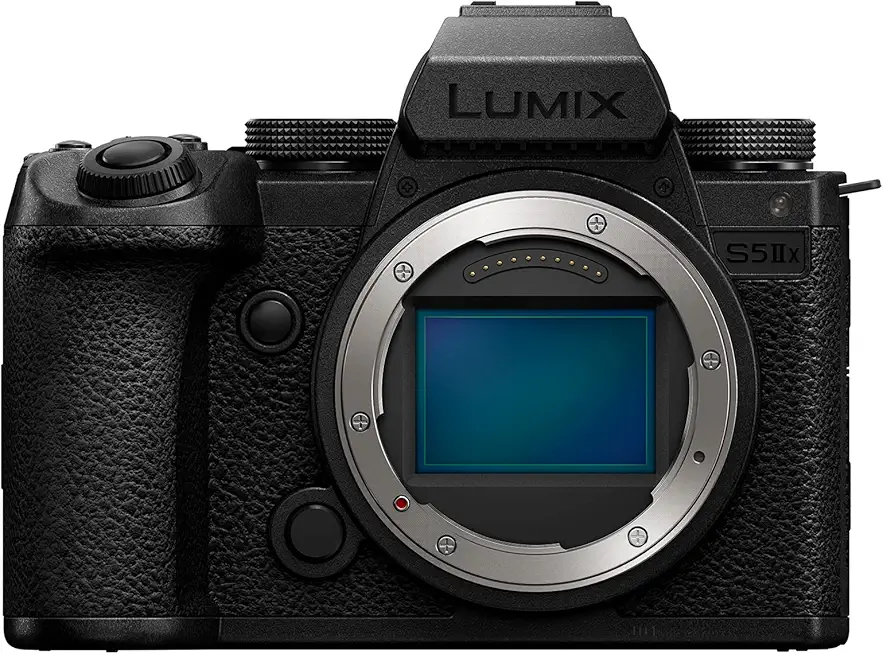
Panasonic LUMIX S5IIX Body
Compact hybrid body balancing exceptional low-light performance, advanced stabilization, and versatile video features for creators.
Check PriceThe Panasonic Lumix S5 IIX is a compact, rugged full-frame option that balances strong video features with stills capability, thanks to its 24.2MP sensor and internal 6K recording. If you’re a hybrid shooter who travels or works run-and-gun, that sensor resolution gives you flexibility for both high-quality photos and oversampled video.
Video shooters will appreciate the 10-bit 4:2:2 internal recording and V-Log support, which make grading and delivering cinematic images much easier straight out of camera. Those codecs and log profile mean you can push color and dynamic range in post without immediately hitting banding or posterization.
One of the S5 IIX’s standout real-world benefits is the 5-axis in-body image stabilization; reviewers and users note it substantially improves handheld stability in dynamic situations. That IBIS, combined with solid low-light sensitivity and good dynamic range, makes this a strong travel and documentary tool when you can’t always bring a gimbal or controlled lighting.
Autofocus is described as advanced, but some users report it can be less consistent than competing systems, especially in challenging lighting or very fast action. Also be aware Panasonic introduces a crop at higher frame-rate modes — for example, 4K 60p — which can change your field of view and lens choices on the fly.
Overall, the S5 IIX is mostly a very good, versatile camera for filmmakers who need a lightweight, durable body with professional video features and excellent handheld performance. If you rely on ultra-fast continuous AF or need uncropped high-frame-rate 4K, you should weigh those trade-offs.
- 24.2MP full-frame + internal 6K recording
- 10-bit 4:2:2 internal recording and V-Log
- 5-axis IBIS greatly improves handheld stability
- Good dynamic range and low-light sensitivity; travel-friendly body
- Autofocus can lag in challenging light or fast action
- Crop introduced at higher frame-rate modes (e.g., 4K 60p)
5. Sony FX6 (ILME-FX6) Overview

Sony ILME-FX6
Lightweight cinematic camera delivering expressive color science, fast autofocus, and high dynamic range for documentary and narrative filmmaking.
Check PriceThe Sony FX6 is a full-frame cinema camera in a camcorder-style body that feels built for professional cinematographers who need cinematic depth without lugging a large rig. Its interchangeable-lens design gives you full-frame rendering and the handling is tailored for production workflows, so it’s immediately familiar on set.
Image quality is a standout — exceptional 4K and very strong low-light sensitivity up to high ISOs give you usable footage in dim environments. Internally it records 10-bit 4:2:2 for solid color grading, while external recording unlocks 16-bit RAW for heavy post work when you need maximum latitude.
Autofocus is fast and reliable, with face and subject tracking that holds well in fast-paced shoots, which makes run-and-gun documentary and event work much less stressful. The built-in variable ND is a genuine time-saver for exposure control on the fly, removing the need to change filters between shots.
For creative choices the FX6 also supports high-frame-rate shooting up to 240fps in Full HD, so silky slow-motion is in the bag without external recorders. Reviewers and users call it one of the best-value full-frame cinema cameras — great for cinematographers who want cinematic depth, excellent low-light performance, and production-ready features in a compact package.
- Outstanding low-light / high-ISO performance
- Reliable continuous autofocus with face/subject tracking
- Built-in variable ND filter for quick exposure control
- Up to 240fps Full HD for internal slow motion
- Higher learning curve for users new to cinema cameras
- More limited internal 8K recording compared to rivals (primarily 4K-focused)
Audio Quality Essentials
Audio is as important as the image; poor sound is the fastest way to make your footage feel amateur. Built‑in camera microphones are convenient but tend to pick up room tone, camera noise, and wind; treat them as reference tracks, not final audio for dialogue or interviews.
Choose your microphone to match the job. A shotgun on a boom or on‑camera mount gives clean, directional pickup for run‑and‑gun situations, while lavalier mics nailed to the talent are unbeatable for consistent, isolated dialogue. Always use a proper windscreen—deadcat or blimp—when filming outside to avoid ruined takes from gusts.
For the best fidelity, record to an external field recorder. Dedicated recorders have cleaner preamps, proper gain staging, and options like 48V phantom power for condenser mics. The tradeoff is extra sync work, so bring a slate, use a camera-recorded scratch track, or lock both devices to the same timecode when possible.
If you’re a one‑person crew, an on‑camera shotgun or a wireless lav tied straight into the camera can save your life by avoiding post sync. Even then, monitor on headphones and watch your levels; aim for nominal peaks around ‑12dB to ‑6dB so you have headroom without excessive noise. Check cables and connectors before the take—most audio problems come from dumb physical issues.
Finally, control the environment. Move interview subjects away from reflective surfaces, close windows and turn off noisy appliances, and use blankets or portable acoustic panels for quick dampening. Good location sound plus a simple lav or boom will elevate footage more than switching to a “better” camera ever will.
Autofocus Performance Explained
Autofocus has moved from a convenience to a creative tool. Modern mirrorless systems use phase-detection and machine‑learning subject recognition to lock onto faces, eyes, animals, and even vehicles. That makes continuous AF (AF‑C) indispensable for run‑and‑gun work, documentary shoots, and any scene with movement—you get fewer missed frames and more usable takes without constantly pulling focus by hand.
In practice, don’t let the camera do all the thinking. Use eye‑AF or face‑priority when you want the subject’s gaze sharp, and switch to zone or tracking modes when you need the camera to follow motion across the frame. Back‑button focus is my go‑to: it decouples focus from the shutter so you can recompose without the system resetting, and it’s especially helpful when switching between static interviews and unpredictable action.
Remember the limits. Autofocus struggles in low contrast, through glass, or with repetitive patterns. Fast glass and good light always help—wider apertures give the AF system more to work with and faster lenses reduce hunting. If you know a scene will be cinematic and deliberate, consider pulling focus manually or using a follow focus for predictable, repeatable results; AF is brilliant for reliability, but it can breathe or hunt in ways that break a carefully framed shot.
Camera choice matters for AF confidence. Flagship bodies offer advanced subject detection and reliable tracking, while some cinema‑oriented cameras favor manual control and external solutions. Whatever body you use, test your lens+body combo before the shoot. Run through typical moves, check how the camera handles occlusions, and adjust AF area and sensitivity so the camera behaves like a helpful assistant, not a surprise-maker.
What People Ask Most
What is the best camera for filming videos?
There is no single best camera for every use; the right choice depends on your shooting style, budget, and workflow. Focus on features like image quality, autofocus reliability, lens options, and how the camera fits into your production process.
What camera do professional filmmakers use?
Professional filmmakers select tools that match the demands of their projects, favoring cameras with reliable image quality, robust ergonomics, and a broad lens ecosystem. Many professionals also consider support for advanced codecs and flexible audio and power workflows.
What is the best camera for filming low light?
For low-light work, look for cameras with larger sensors and good performance at higher sensitivities, paired with fast lenses to gather more light. Good stabilization and careful exposure technique also help produce cleaner footage in challenging lighting.
What is the best mirrorless camera for filmmaking?
The best mirrorless choice depends on the features you need, such as autofocus performance, codec and recording options, and available lenses. Consider how the camera’s ergonomics and connectivity fit your shooting style and postproduction needs.
What camera is best for vlogging and filming on YouTube?
Vlogging-friendly cameras are typically compact, easy to operate, and offer reliable autofocus, good audio inputs, and a front-facing screen for framing. Portability and battery life are important for mobile creators who shoot alone or on the move.
What camera is best for shooting cinematic footage?
Cinematic results often come from cameras that deliver wide dynamic range, flexible color profiles, and compatibility with cinema lenses and grading workflows. Consistent exposure control, good low-light behavior, and workflow-friendly codec options also contribute to a cinematic look.
Should I use a DSLR or mirrorless camera for filming?
Mirrorless cameras generally offer advantages for video, such as live view benefits and modern autofocus systems, while DSLRs can still be useful depending on existing lenses and familiarity. Choose the system that suits your workflow, lens needs, and long-term plans.
Conclusion For Best Cameras For Filming
These five cameras illustrate how different tools suit different filmmaking needs, from high-end studio and 8K work to indie cinema, hybrid run-and-gun shooting, and camcorder-style low-light production.
Use the real-world feedback and the pros and cons above to match a camera to your workflow, weighing video formats, autofocus, audio choices, stabilization, ergonomics, battery life, and lens ecosystem.
If you want to sharpen your shooting and post-production skills, explore more guides and reviews on our site to help refine your choices and techniques.
Have questions or want advice on a specific setup? Leave a comment below and we usually reply within a few hours.




0 Comments