
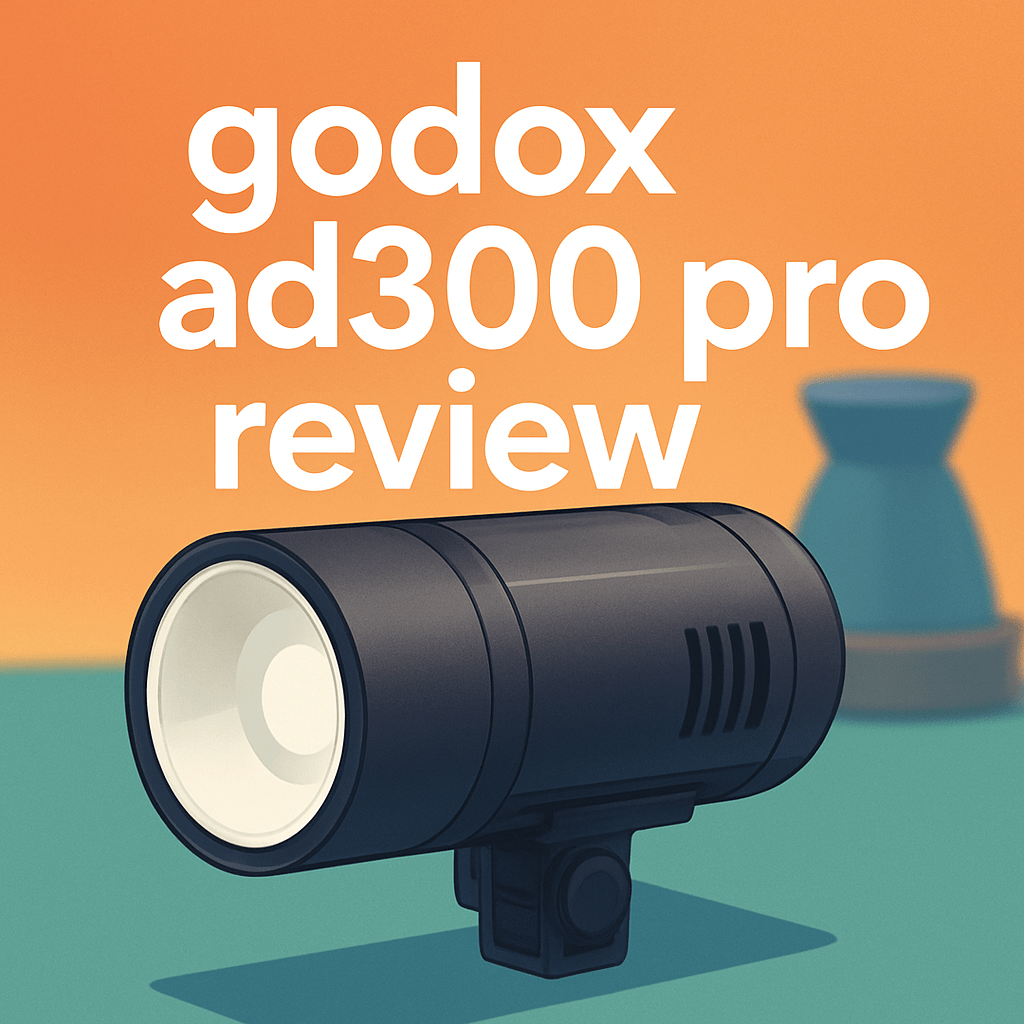
Looking for a strobe that’s powerful enough to tame midday sun but small enough for tight location shoots?
This hands-on Godox AD300Pro Strobe review comes from real days on sets and outdoor gigs, where I pushed the light through fills, softboxes, and fast run-and-gun work.
I’ll evaluate power and recycle performance, TTL/HSS behavior, color consistency, battery endurance, build and handling, and how it fits the broader Godox X-system in real-world setups.
If you shoot portraits, headshots, editorial, small product or events, this review will help you decide if the AD300Pro matches your workflow. Make sure to read the entire review as I break down the practical payoffs—keep reading.

Godox AD300Pro Strobe
Compact, battery-powered monolight delivering punchy output, accurate color and reliable TTL/HSS performance. Fast recycling and robust build make it ideal for on-location portraiture, events, and travel shoots with built-in 2.4GHz wireless control.
Check PriceThe Numbers You Need
| Spec | Value |
|---|---|
| Power output | 300Ws |
| Light modifier mount | Bowens mount |
| Power source | Rechargeable lithium battery |
| Wireless control | Built-in Godox 2.4 GHz radio system |
| TTL support | Yes (with compatible transmitters) |
| High-speed sync (HSS) | Up to 1/8000 s |
| Flash duration | Approx. 1/2200 s at full power |
| Recycling time | Approx. 0.01–1.8 s (depending on power) |
| Color temperature | 5600 K ±200 K |
| LED modeling lamp | Continuous LED, adjustable brightness |
| Weight | Approx. 1.4 kg (body only) |
| Dimensions | Approx. 118 × 247 × 100 mm |
| Compatibility | Compatible with Godox X-series transmitters and receivers |
| Display | OLED display for settings and status |
| Overheat protection | Built-in thermal management system |
How It’s Built
In my testing the Godox AD300Pro feels compact and solid in the hand. It sits neatly on a stand or a boom and doesn’t pull or flop when you tilt it. That balance makes it easy to use with larger modifiers on location.
I found the native Bowens mount to be a huge plus. Swapping softboxes, reflectors, or a beauty dish was quick and worry-free. For beginners that means you can use the same common gear you already own without adapters or fuss.
The OLED display is clear and readable even outdoors, and the buttons and dial respond without lag. The menu takes a moment to learn, but common changes like power and groups are fast to make. One thing I really liked was how quickly I could jump between settings while shooting.
The built-in Godox radio keeps the top plate clean and pairing was straightforward in most of my shoots. In very crowded venues you may need to hunt for a clear channel. Thermal protection works, though during long burst work I noticed slower recycle until things cooled.
The case and ports stood up to being packed and moved around all day. Battery access and the charging routine fit into a normal workflow without drama. One thing that could be better is the small buttons for gloved hands or clumsy moments.
In Your Hands
In everyday use the Godox AD300Pro Strobe behaves like a seasoned studio partner: TTL is reliable across shifting light and only occasionally nudges toward conservative exposures in contrasty scenes, while high‑speed sync gives you clear latitude to tame bright backgrounds without killing ambient mood. Recycling is quick enough to sustain a comfortable portrait cadence, though sustained rapid bursts will bring slightly longer pauses between pops. The flash duration is short enough to freeze most motion, and color holds steady across output settings with no noticeable flicker for stills or hybrid shoots.
The built‑in radio pairs smoothly with transmitters, and range and group control were rock solid in crowded shoots, making multi‑light setups painless. Mixing the AD300Pro with other heads in the Godox system felt seamless; output and trigger behavior stayed consistent so lighting ratios don’t become a guessing game mid‑session.
The adjustable LED modeling lamp proved genuinely useful for framing, low‑light focusing and catchlights, with a comfortable beam that predicts modifier behavior well. It’s bright enough for setups and subtle enough for video fill when you’re doing hybrid work.
In field scenarios—sunny fill, open shade portraits, indoor headshots, dusk environmental shoots and quick editorial runs—the unit delivered predictable, usable light that made setup fast and retouching minimal. As a key, fill or rim light it balances portability with enough punch for most location needs.
Reliability was strong: thermal protection only became evident after prolonged heavy use, producing gentle cooldowns rather than hard failures, and misfires were rare. Radio interference was minimal in busy venues, so the AD300Pro feels dependable for solo operators and small teams.
The Good and Bad
- 300Ws output in a portable package
- TTL and HSS up to 1/8000s for flexible ambient control
- Godox 2.4GHz X-system built in; easy ecosystem integration
- Bowens mount compatibility with a wide modifier selection
- Less raw power than 400Ws+ units for very bright conditions or very large modifiers
- Larger/heavier than ultra-compact options like AD200-class lights
Ideal Buyer
If your work lives on location — run-and-gun editorials, mid‑day fill, or quick portrait sessions — the Godox AD300Pro Strobe hits a sweet spot between punch and portability. It’s powerful enough to tame sun and flexible enough to slip into a travel kit. You’ll appreciate that trade-off when you can’t haul a full studio.
Photographers already building a Godox X-system or planning one will find it an obvious fit. TTL and HSS make fast-changing light manageable, while straightforward manual controls let you lock a look once you need consistency. It’s a strong choice for shooters who switch between speed and precision.
Small teams and solo operators benefit most — a single AD300Pro can play key, fill, rim, or background duty with common Bowens modifiers. Headshot, portrait, and small-product shooters will like the balance of modifier compatibility, recycle speed, and color stability. For editorial days when you need one dependable, portable strobe, it pulls its weight.
If you need the absolute highest single-light output for large modifiers or stadium-bright ambient control, a 400–600Ws class head is a better pick. And if pocketable travel is your highest priority, consider smaller AD200-class options instead.
Better Alternatives?
We’ve dug into the AD300Pro and seen where it shines on location and in the studio. It hits a sweet spot for many of my shoots — enough power to work with medium and large softboxes, built-in radio, and a battery pack that keeps me shooting most of the day without being a load to carry.
If you still aren’t sure it’s the right light for your work, here are a few real-world alternatives I’ve used. Each one trades off power, size, or handling in different ways, so I’ll tell you what they do better or worse than the AD300Pro and what kind of shooter will prefer each option.
Alternative 1:
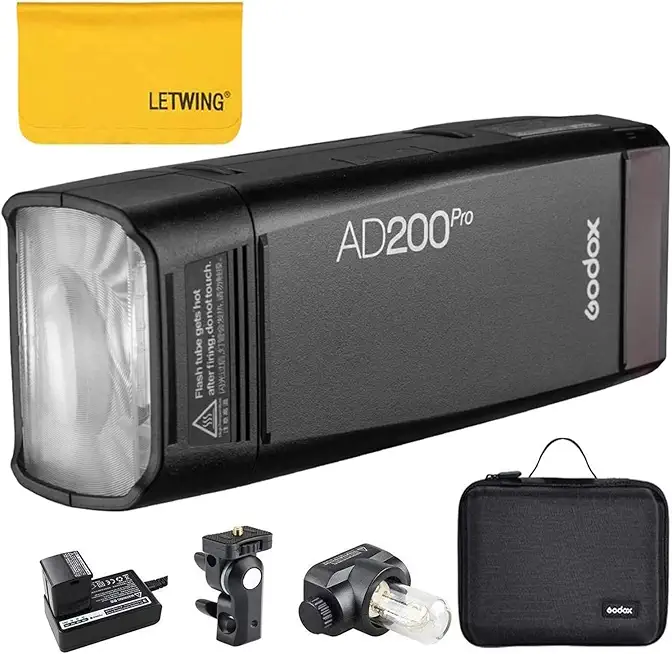
Godox AD200Pro Flash
Pocket-sized dual-head system combining the portability of a speedlight with monolight power. Versatile modifiers, accurate TTL/HSS metering, long-lasting battery, and fast recycle times for nimble location and studio workflows.
Check PriceThe AD200Pro is the pocket rocket. I’ve taken it to weddings, travel jobs, and tight editorial runs where every ounce and inch mattered. It’s far easier to pack and move than the AD300Pro, and that means I can get a light on a stand or speedrail in seconds without needing a big case.
Where it loses to the AD300Pro is raw headroom. In bright sun or when I want a big softbox and shallow depth of field, the AD200Pro forces me to get closer or raise ISO. It also doesn’t accept large modifiers natively — you’ll be using smaller modifiers or adapters more often — so shaping light for larger groups or full-length portraits is harder than with the AD300Pro.
Buy the AD200Pro if you’re a travel, event, or run-and-gun shooter who values size and speed over maximum punch. It’s great as a backup light or for small-location work. If you regularly need one strong, versatile single light for big modifiers or overpowering sun, you’ll prefer the AD300Pro instead.
Alternative 2:

Godox AD400Pro Strobe
High-output battery monolight delivers robust, consistent power for demanding shoots. Reliable color stability, advanced TTL/HSS functions, fast recycling and an efficient battery pack provide freedom for studio and on-location work.
Check PriceThe AD400Pro gives you noticeably more punch than the AD300Pro. I’ve used it when I needed to cut through harsh daylight or when a single modifier had to light a group from farther away. That extra output makes it easier to use big softboxes at lower power settings, which often improves color and recycle time on long jobs.
The trade-off is size and weight. The AD400Pro is bulkier to carry and slower to rig on tight location days. If you’re running and gunning or traveling light, the AD300Pro feels more nimble. Also, when I needed quick one-person setups, lugging the AD400Pro around was more work and sometimes overkill for what I actually needed.
If your work is commercial, wedding second-shooter, or outdoor editorial where you often need extra headroom, the AD400Pro is the better fit. Choose it when single-light power and reserve matter more than compactness. If you need a lighter kit for fast setups, stick with the AD300Pro.
Alternative 3:
Godox AD400Pro Strobe
Bowens-mount-enabled portable strobe with professional-grade modeling lamp and precise power control. Intuitive interface, long-lasting battery, high-speed sync capability and remote-triggering options make it a dependable choice for versatile lighting setups.
Check PriceUsed from a slightly different angle, the AD400Pro also wins on control and consistency. Its modeling lamp and interface make setup fast, and when I paired several of them for a multi-light shoot the power stayed predictable across shots. That steadiness is a real help when matching lights or mixing flash and ambient light in a scene.
Compared to the AD300Pro, the AD400Pro’s strengths are in repeatability and battery reserve for long multi-light days. Its downside is the same — bulk. In small studio spaces or quick location jobs the AD300Pro was easier to move and less likely to slow me down. The AD400Pro can also draw more attention on discreet shoots because it’s a larger unit to handle.
Think about the AD400Pro here if you build multi-light setups or do hybrid photo/video work where a strong modeling lamp and steady output matter. Teams and studios that need consistent color and easy repeatability will like it. Solo shooters who need a balance of power and portability may still prefer the AD300Pro for most everyday jobs.
What People Ask Most
Is the Godox AD300Pro worth buying?
Yes — it’s a great balance of 300Ws power, portability, and modern features, making it a strong choice for shooters who want full-size light quality without lugging a studio head.
How long does the battery last on the Godox AD300Pro?
The removable Li-ion battery typically delivers around 300–400 full-power flashes per charge, with far more shots at lower power settings.
Does the Godox AD300Pro support TTL and high-speed sync (HSS)?
Yes — it supports both TTL and HSS for easier exposure control and fast-shutter outdoor work.
How does the Godox AD300Pro compare to the Godox AD200?
The AD300Pro offers more power and a Bowens mount for larger modifiers, while the AD200 is smaller and more travel-friendly but less powerful and less versatile with modifiers.
What is the power output and recycle time of the Godox AD300Pro?
It’s a 300Ws unit; recycle times are fast, generally under a second at mid to low power and longer at full power, so it’s responsive for most shoots.
Is the Godox AD300Pro compatible with Bowens-mount modifiers?
Yes — it uses a Bowens-style mount, so it works with a wide range of softboxes, reflectors, and other modifiers.
Conclusion
The Godox AD300Pro Strobe is a rare mid‑power light that manages portability without feeling compromised. In the field it strikes a practical balance between punch and packability that suits working photographers.
I came away impressed by its reliable TTL/HSS behavior, native Bowens compatibility and clean integration into the Godox X‑system. Recycling speed, steady color and the bright modeling lamp make setup and run‑and‑gun shooting fast. The build and radio reliability hold up when you push a one‑ or two‑light kit.
It’s not the choice if you need the absolute most output from a single head, nor will it win any pocket‑sized packing contests. Battery life and thermal behavior demand respect on long, heavy‑use days and merit testing against your workflow. Color and flash characteristics are solid but not immune to the usual trade‑offs at extremes.
If you want a do‑it‑all location strobe inside the Godox ecosystem, this is the pragmatic pick for portraits, headshots and editorial work. Choose a smaller head like the AD200Pro when minimal size matters, or a larger unit like the AD400Pro when single‑light punch is paramount. For those considering premium build and ecosystem conveniences, Profoto’s compact alternatives remain worth the premium.
Godox AD300Pro Strobe
Compact, battery-powered monolight delivering punchy output, accurate color and reliable TTL/HSS performance. Fast recycling and robust build make it ideal for on-location portraiture, events, and travel shoots with built-in 2.4GHz wireless control.
Check Price

0 Comments