
Want to upgrade your photos beyond smartphone snapshots without getting overwhelmed?
It’s aimed at beginners moving up from phones or point‑and‑shoots, perfect for family, travel, and learning manual shooting. It adds easy sharing with built‑in Wi‑Fi and simple 1080p video.
After shooting with the Canon EOS Rebel T6 Camera, I’ll show where it excels and where you’ll trade features for simplicity. Make sure to read the entire review — keep reading.
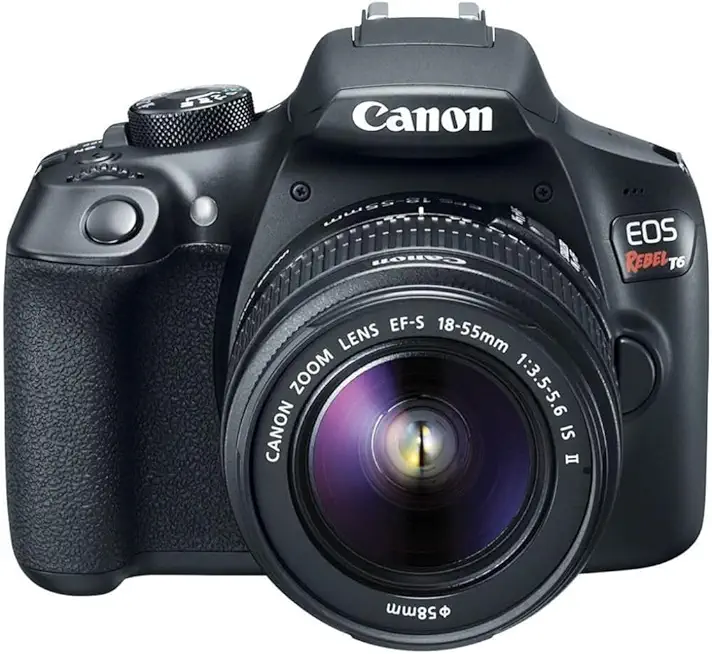
Canon EOS Rebel T6 Camera
Compact, beginner-friendly DSLR with an 18MP APS-C sensor and reliable DIGIC processing. Delivers crisp JPEGs, intuitive controls, built-in Wi‑Fi, and full HD video—perfect for starting photographers and travel shoots.
Check PriceThe Numbers You Need
| Spec | Value |
|---|---|
| Sensor | 18 MP APS-C |
| Lens System | EF/EF-S mount |
| Image Processor | DIGIC 4+ |
| Autofocus | 9-point |
| Video Resolution | 1080p |
| Connectivity | Wi-Fi/NFC |
| ISO Range | 100-6400 |
| Shutter Speed | 1/4000s to 30s |
| Continuous Shooting | 3 fps |
| LCD Screen | 3" |
| Viewfinder | Optical |
| Memory Card Slots | SD/SDHC/SDXC |
| Maximum Burst | 11 frames |
| File Format | JPEG, RAW |
| Video Frame Rate | 30 fps |
How It’s Built
In my testing the Canon EOS Rebel T6 feels like a friendly first DSLR to hold and use. The grip has just enough depth to feel secure, and the main buttons sit where my fingers expect them. That makes it easy to focus on framing instead of fighting the camera when you’re out shooting with family or on a trip.
The optical viewfinder is a real plus — it gives a clear, immediate view of the scene and helps you learn exposure and composition. The rear 3″ LCD is bright and easy to read, but it’s not a touchscreen, so you’ll be tapping buttons to change settings. For beginners that’s fine; it keeps things straightforward but limits fast touch-based control or selfie-style composing.
I liked that the EF/EF‑S mount opens up a huge range of lenses, including affordable used options. In my testing that made it simple to try a prime or zoom without replacing the whole camera. For a beginner this is a practical path to better photos as skills grow.
The camera takes standard SD cards, and swapping cards in the field is painless. I found that using a faster SD card helps clear the buffer sooner and keeps your shooting flow going. That’s useful when you’re chasing a toddler or trying to nail a quick family moment.
Overall the build feels lightweight and reassuring rather than premium. I really liked the comfortable handling and simple menus, but the all-plastic shell and lack of touchscreen could be better. Still, the T6’s straightforward layout makes learning the basics less intimidating for new shooters.
In Your Hands
Out in the field the Canon EOS Rebel T6 feels eager for everyday moments, delivering reliably sharp single frames and quick autofocusing on static subjects. Its continuous-burst behavior is modest, so short spurts of action — a sprinting toddler or a bounding dog — are where it performs best before you notice pauses. For routine shooting it stays responsive, but sustained action sequences expose its limits.
Exposure flexibility is forgiving: the shutter range and basic metering let you confidently handle bright outdoor shoots and experiment with longer exposures for creative blur. Handheld low-light shooting is usable at moderate sensitivities, though grain becomes more apparent as light fades, so a tripod or faster lens helps for tougher scenes. The viewfinder feedback makes dialing exposure intuitive for newcomers learning manual control.
Pairing the camera to a phone via Wi‑Fi and NFC is straightforward, and image transfers are dependable enough for same-day social sharing and backups. The companion app is simple to navigate, so sending a handful of shots to friends or posting to social feeds is painless. Remote triggering and quick previews add practical convenience during family gatherings and travel stops.
In real-world use the T6 excels at family events, travel, casual portraits and basic action where keeper rates matter more than chase‑cam performance. Its optical viewfinder and straightforward controls make learning photographic fundamentals enjoyable and immediate. It’s a friendly, workmanlike tool for beginners, with clear trade-offs if you push into fast-action or advanced live‑view video work.
The Good and Bad
- 18 MP APS‑C sensor with RAW/JPEG capture
- EF/EF‑S mount compatibility
- Built-in Wi‑Fi/NFC for easy image transfer
- Optical viewfinder
- Basic 9‑point AF; weak live-view AF expectations
- 3 fps continuous shooting and 11‑frame burst limit action coverage
Ideal Buyer
The Canon EOS Rebel T6 is ideal for beginners stepping up from smartphones or point‑and‑shoots. Its optical viewfinder, simple button layout, and easy menus make the learning curve gentle and give straightforward exposure guidance. You get real DSLR handling without feeling overwhelmed.
If you’re a smartphone upgrader who wants better images but still shares quickly, the built‑in Wi‑Fi/NFC makes transfers painless. You’ll appreciate its straight‑forward controls and 1080p clips for casual social video. But don’t expect advanced video features or high frame‑rate slow motion.
Family gatherings, vacations, and portraits are where the T6 shines, and its 18MP APS‑C sensor delivers pleasing detail for prints and socials. The 3 fps burst and 9‑point AF handle short action bursts of kids and pets if you time shots. It’s a solid classroom camera for learning manual exposure with an optical viewfinder.
Skip it if you prioritize fast subject tracking, long action sequences, or professional video work. Buyers who want touchscreen composition, 4K, or higher burst rates will be happier with alternatives like the D3500, D5600, or newer Rebels. The T6 is a gateway DSLR, not a workhorse for advanced shooters, but it’s a dependable classroom for fundamentals.
Better Alternatives?
We’ve already gone through how the Canon EOS Rebel T6 performs for everyday shooting — family snaps, travel shots, and learning the basics of exposure. The T6 is simple and reliable, but some buyers want more resolution, longer battery life, or small upgrades to handling and image quality.
Below are a few common alternatives I’ve used in the field. I’ll point out what each does better and worse than the Canon EOS Rebel T6 Camera and who will likely prefer each one so you can match a camera to the way you actually shoot.
Alternative 1:

Nikon D3500 Camera
Lightweight, user-friendly DSLR boasting a 24MP sensor and efficient EXPEED processing for striking detail. Exceptional battery life and simple guide mode make it ideal for learners and everyday shooters.
Check PriceI’ve used the Nikon D3500 on family days out and long walks, and the first thing you notice is the extra detail and the battery life. Compared to the Canon EOS Rebel T6 Camera, the D3500 gives you sharper images and cleaner files at higher ISOs, and you can shoot all day without worrying about a dead battery.
Where it falls short versus the T6 is in connectivity and video AF. Nikon’s SnapBridge can be slower or fussier for full-size transfers, and live-view autofocus still isn’t great for smooth video or quick screen focusing. Ergonomically it’s light and comfortable, but it doesn’t add touchscreen or advanced video features you might want.
Pick the D3500 if you care most about still image quality and long battery life — travel shooters, weekend landscapers, and families who take lots of photos and want better low-light results than the T6. If you need fast live-view AF or fancy video features, look elsewhere.
Alternative 2:

Canon EOS 2000D Camera
Entry-level DSLR featuring a 24MP APS-C sensor, intuitive controls, and Wi‑Fi connectivity for easy sharing. Produces sharp stills and dependable full HD video—an excellent learning tool for hobbyists.
Check PriceThe Canon EOS 2000D feels very familiar if you’ve handled the Rebel T6, but it gives a small, real-world bump in detail thanks to the higher-resolution sensor. I’ve found images have a bit more cropping room, and colors follow the Canon look newcomers expect, which makes editing easier if you already use Canon’s workflow.
However, the 2000D doesn’t fix the T6’s biggest limits: autofocus in live view is still slow, burst shooting isn’t much quicker, and there’s no touchscreen or advanced video modes. So while photos can look a bit nicer, you won’t get a much better experience for fast action or vlogging.
Choose the 2000D if you’re a Canon fan who wants a simple step up in resolution while keeping the same menus and lens choices as the T6. It’s a safe, low-stress upgrade for hobbyists who mostly shoot stills and want a little more detail without learning a new system.
Alternative 3:
Canon EOS 2000D Camera
Affordable kit offering reliable image quality from a 24MP sensor and beginner-friendly features, including creative filters and an optical viewfinder. Great value for newcomers building a lens collection.
Check PriceUsed as a kit camera, the Canon EOS 2000D is a good value — it gives crisp images and includes the basic creative filters and optical viewfinder beginners like. Compared to the Canon EOS Rebel T6 Camera, the 2000D’s stronger point is that extra resolution and the familiar Canon handling, which makes building a lens collection feel straightforward.
On the downside, the user experience in the field doesn’t dramatically change from the T6. You still deal with slow live-view AF and modest continuous shooting for action. The 2000D is more about value and image polish than changing how you shoot day to day.
This version of the 2000D is best for newcomers on a budget who want solid image quality and an easy upgrade path into Canon lenses. If you want more speed, better AF, or a flip-out touchscreen, you’ll want to look at higher-tier bodies instead.
What People Ask Most
Is the Canon EOS Rebel T6 worth buying?
It’s a solid budget DSLR for beginners who want optical viewfinder shooting and control over exposure, but skip it if you need modern features like fast autofocus, high ISO performance, or 4K video.
What are the specs and features of the Canon EOS Rebel T6?
It has an 18MP APS-C sensor, DIGIC 4+ processor, 9-point AF, 3 fps burst, 1080/30p video, a fixed 3-inch LCD, ISO 100–6400 (expandable), and built-in Wi‑Fi for sharing.
How is the image quality and low-light performance of the Canon EOS Rebel T6?
Image quality is good in daylight with clean files at low ISO, but low-light performance is limited—expect noticeable noise and reduced detail above ISO 1600.
Is the Canon EOS Rebel T6 good for beginners?
Yes — it’s affordable, simple to use, and teaches core photography skills with interchangeable lenses; just be aware its features are basic compared with newer entry-level cameras.
What is the difference between the Canon EOS Rebel T6 and the T7/T6i?
The T7 is a mild update with similar 18MP output and slightly improved processing, while the T6i is a bigger upgrade offering a 24MP sensor, more AF points, better autofocus and a touchscreen/articulating display.
What lenses should I buy for the Canon EOS Rebel T6?
Start with the Canon EF-S 18-55mm kit zoom and add the Canon EF 50mm f/1.8 STM for portraits and low light; consider an EF-S 55-250mm for telephoto and a wide or macro lens later based on your shooting style.
Conclusion
The Canon EOS Rebel T6 Camera is an approachable DSLR that makes stepping up from a phone or point‑and‑shoot painless. It delivers straightforward controls and familiar Canon handling. It’s built to teach and to keep things simple.
Image quality and everyday video are perfectly serviceable for family albums and travel journals. Built‑in wireless sharing removes friction for casual shooters. You get the essentials without overwhelming menus.
Ergonomics and viewfinder shooting feel reassuringly traditional and beginner‑friendly. Menus are uncomplicated and easy to learn. That adds real value for new photographers.
Accept that it’s conservative on speed, autofocus and advanced live‑view features. If you chase fast action or modern conveniences like a touchscreen you’ll notice the limits quickly. Those trade‑offs are real and unavoidable.
For budget‑minded novices who want a reliable DSLR and easy sharing, the T6 is a smart, low‑risk choice. If you crave more resolution, stronger tracking or an articulating screen, look at newer alternatives. This one earns a recommendation with clear caveats.
Bottom line: the Canon EOS Rebel T6 Camera does exactly what it promises—simple, dependable results for learners and casual shooters. It’s not cutting‑edge, but it’s honest value for its audience. Buy it if your priorities match; otherwise spend a bit more for room to grow.
Canon EOS Rebel T6 Camera
Compact, beginner-friendly DSLR with an 18MP APS-C sensor and reliable DIGIC processing. Delivers crisp JPEGs, intuitive controls, built-in Wi‑Fi, and full HD video—perfect for starting photographers and travel shoots.
Check Price

0 Comments