
Ever stood beneath a perfect, star‑filled sky and lost a night’s worth of data because your tripod head crept mid‑exposure?
Frustration like that is why the right ball head matters more than many photographers realize.
In this ultimate guide we compare five top ball heads for astrophotography using real‑world testing and user feedback from cold nights and remote locations.
We focus on how they behave under long exposures, their friction control, and ease of use when your fingers are numb and your window of clear sky is small.
Expect concise product overviews, practical notes on friction and smoothness, and clear guidance on matching load capacity to your complete rig.
We also answer the common questions photographers ask before investing in a head that must hold steady for minutes or hours at a time.
Whether you’re a weekend wide‑field shooter, a tracker user, or building a heavier telescope rig, this guide helps you weigh stability, portability, and control.
By the end you’ll know which tradeoffs matter and what to prioritize for consistently sharp nightscapes.
Real‑world user feedback is woven throughout, spotlighting durability, knob ergonomics, and how each head behaves when temperatures drop and time is precious.
This isn’t a spec sheet—it’s a field‑tested roadmap to finding the best ball head for astrophotography that keeps your frames pin‑sharp under the stars.
1. Really Right Stuff BH-40 Ball Head

BH-40 Ballhead with Lever-Release Clamp
Robust, smooth ball movement with a fast clamp for secure, tool-free camera attachment and precise framing.
Check PriceAs a working astrophotographer I reach for the Really Right Stuff BH-40 when I need rock-solid stability in a compact package. It’s exceptionally stable and holds heavy camera/lens setups securely with minimal droop or drift during long exposures.
The BH-40’s dual knob design — separate pan lock and friction control — makes precise adjustments easy even in low light. The tactile knobs and high-quality machining let you micro-adjust framing without fumbling around a bright screen or headlamp.
At roughly ~3 inches tall it’s small enough for travel tripods and remote shooting, yet still durable enough for demanding conditions. That compact size makes it ideal when you need precision but also want to keep your kit portable for dark‑sky sites.
In practice it maintains position over long exposures with very little creep, which is the single most important trait for deep-sky work and long-star‑trail frames. The finish and build quality mean it withstands rough field use and stays smooth over time.
Be aware it does lack some features of larger, heavier heads — if you routinely run very heavy scopes or long telephotos, you might notice limits. For most DSLR/mirrorless rigs with mid-sized lenses it’s a top-tier choice that balances durability, precision, and portability.
- Extremely stable; minimal drift
- Compact and travel‑friendly (~3 inches tall)
- Dual knob system for precise low‑light adjustments
- Durable, high‑quality machining
- May be undersized for very heavy lenses
- Premium price relative to simpler heads
2. Acratech GXP Ball Head

Acratech GXP Ballhead with Quick-Release Clamp
Ultra-stable support with friction control, panoramic base, and lightning-fast plate release for effortless composition and reliable load capacity.
Check PriceThe Acratech GXP Ball Head stands out with a unique design that blends buttery smooth movement with very strong locking and precision. As a photographer I appreciate heads that feel engineered rather than cobbled together, and the GXP gives that impression immediately.
Its real-world behavior is ideal for quick celestial framing — the pan and tilt move fluidly so you can lock on a star field fast. The single large knob combines the lock and tension control, which you can operate by feel in the dark or while wearing gloves.
Mechanically it’s impressive: a Titanium Disulfide-coated ball translates into exceptionally smooth, reliable movement with minimal stickiness. That coating, paired with solid machining, contributes to the long-term reliability and almost zero drift that many users rave about.
Practical features help in the field. The bubble level and Arca‑style quick-release plate speed up setup and make repeatable framing straightforward on successive nights.
For astrophotography this head is mostly a win: it’s compact yet rated to handle heavier setups, and the ergonomic controls are a real plus in cold, low-light conditions. If you crave absolute stability and tactile control over shaving every gram, the GXP is an excellent choice.
Keep in mind there’s a mild learning curve with the single tension/lock knob; dialing it in takes a few sessions. Also, it isn’t the very lightest option for ultralight backpacking if weight is your top priority.
- Smooth, precise control ideal for astrophotography framing
- Compact with high load capacity
- Ergonomic controls for dark/cold environments
- Very secure lock with minimal drift
- Learning curve for tension control knob
- Not the lightest option for ultralight setups
3. Move Shoot Move Nomad Ball Head
Premium camera accessory offering reliable support, smooth adjustments, and secure mounting for on-the-go photographers.
Check PriceThe Move Shoot Move Nomad Ball Head is clearly built with astrophotography in mind — small, simple, and easy to operate at night. Its compact form factor makes quick camera adjustments on star trackers feel natural and unobtrusive.
One of the Nomad’s standout features is the included laser adapter (polar‑alignment laser mount) which speeds polar alignment and gets you under the stars faster. In practice that means less fiddling with alignment scopes and more time exposing.
Portability is the Nomad’s real strength: users repeatedly praise how fast it lets you set up in darkness and move between sites. It’s extremely portable and lightweight for travel to dark sites, so it won’t add much weight to a minimalist astrophotography kit.
The head’s simplified design — fewer knobs and straightforward controls — is excellent for late‑night operation when you want tactile, obvious adjustments. It also benefits field setups that use powered trackers by offering long battery life for paired powered tracking devices, keeping sessions running longer.
That said, there are tradeoffs. Several users report a slight play or slip when the head is tightened fully, which can matter if you demand ultra‑precise sub‑arcminute tracking. It’s also less suitable for very heavy camera and lens combinations, so consider your total rig weight before choosing the Nomad.
- Extremely portable and lightweight for travel to dark sites
- Fast setup with included polar-alignment laser mount
- Simplified design with fewer knobs for night use
- Long battery life for paired powered tracking devices
- Some minimal play/slip reported under full tightening
- Less suitable for super-heavy camera/lens combinations
4. Benro GX35 Ball Head

Benro GX35 Three Series Arca-Swiss Low-Profile Ballhead with PU56 Plate
Low-profile design delivers compact stability, silky-smooth adjustments, and included dovetail plate for secure, professional camera mounting.
Check PriceThe Benro GX35 is a solid, no-nonsense ball head that balances strength and weight thanks to its magnesium alloy construction. It has a high maximum load capacity of 33 lbs, so it will reliably hold DSLR or mirrorless bodies with hefty lenses or heavier astrophotography rigs.
In the field the GX35 feels reassuringly robust. It tilts to 90° for portrait work, offers independent 360° rotation with a lock, and includes three bubble levels to speed up tripod leveling under the stars.
Locking performance is where this head shines for long exposures. Users report that the locking mechanism minimizes drift and sag, which is exactly what you need when doing multi-minute exposures or guiding with a small scope.
If you care about value, the GX35 sits in a dependable mid-price bracket. It isn’t the lightest option, so hikers who prize ultralight kits might look elsewhere, but for most astrophotographers who prioritize stability over shaving ounces, it’s a very practical choice.
One trade-off to note is the feel of the friction control; it’s functional but not as refined as on premium heads. Still, for those who want secure holding power, easy portrait orientation, and practical leveling aids, the Benro GX35 is a dependable, well-built option that handles heavy setups with confidence.
- Very stable locking prevents sag in long exposures
- Magnesium alloy construction for strength-to-weight
- Three bubble levels for quick leveling
- Supports large lenses and heavy camera setups (33 lbs)
- Slightly heavier than ultralight alternatives
- Friction control less refined than premium models
5. Manfrotto XPRO Magnesium Ball Head

Manfrotto XPRO Magnesium Ball Head MHXPRO-BHQ6 with Top Lock Plate
Ultralight alloy construction for rugged durability, precision controls, and a secure top-mounted plate for quick, confident setup.
Check PriceThe Manfrotto XPRO Magnesium Ball Head is a sleek, lightweight head with a slim profile built for travel tripods and remote astrophotography. It supports up to 8 kg of gear and features a quick‑release plate with an integrated cam lock for fast, repeatable mounting. A friction control dial lets you tune the feel between buttery movement and firm locking when composing under the stars.
In the field it’s very user‑friendly: the controls are easy to operate with gloves and you get good stability without a heavy weight penalty. Pan and friction controls are intuitive, so framing and small adjustments on a tracker are straightforward even in cold conditions. That said, the movement isn’t as silky smooth or precision‑tuned as pricier, high‑end heads.
This head shines if you prioritize portability and quick setup — it’s well suited to travel, long center‑column use, and typical astrophotography camera/telescope combinations that stay within the 8 kg limit. If you routinely run very heavy lenses, large guide scopes, or full imaging trains, you may notice slight sag and might prefer a larger capacity head. For most mobile astrophotographers who need a dependable, quick‑mounting head, the XPRO balances weight, strength, and night usability very well.
- Easy controls to use with gloves
- Compact and lightweight — good for travel
- Reliable quick‑release system for fast setup
- Strong enough for typical astrophotography gear (up to 8 kg)
- Movement not as silky smooth as pricier heads
- May show slight sag with very heavy lenses
Friction Control and Smooth Movement
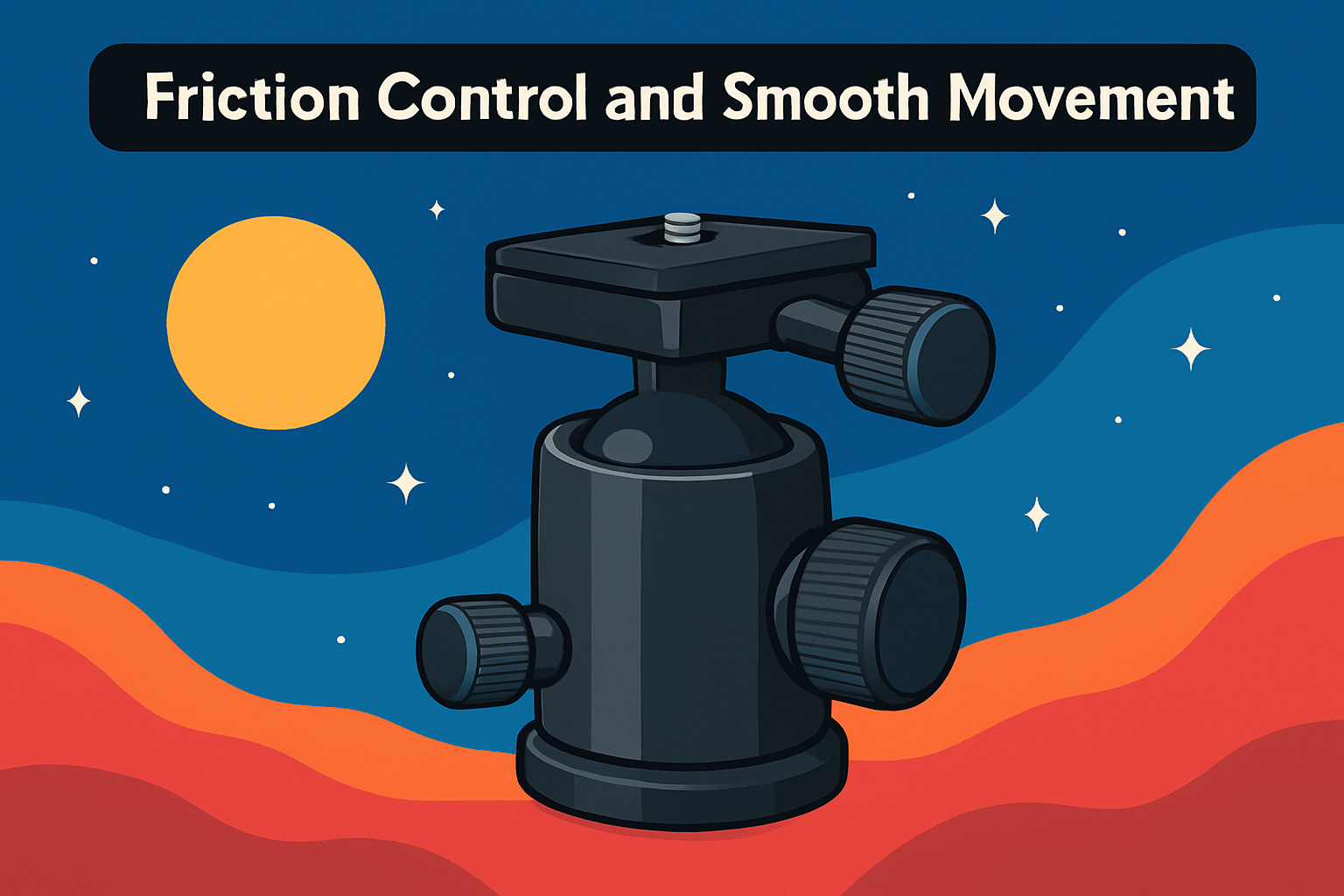
Friction control is one of those small details that makes or breaks a night under the stars. When you’re framing faint nebulae or nudging a tracker into sync, you need movement that’s predictable and smooth. Too loose and the camera drifts during a long exposure; too stiff and you fight every tiny correction.
A separate friction knob works wonders. It lets you dial in a continuous, adjustable resistance while keeping the main lock for absolute hold. In practice I use the friction to fine-tune positioning and the main lock only once the composition is nailed down.
Match the tension to your kit. Start with the tension low enough to make deliberate adjustments, then add firmness until the head moves without jerking yet won’t slip under the camera’s weight. After any change, give the rig a gentle nudge and watch for drift — that’s the quickest real-world test.
High-quality ball coatings and precise machining make that buttery glide possible. Surfaces treated with low-friction coatings (like what you see on premium heads) remove sticky spots and micro-stops, so you can pan slowly without introducing vibration into long exposures.
Don’t overlook knob ergonomics. Large, well-textured knobs are lifesavers when you’re outside in gloves or fumbling a polar alignment at 2 a.m. Some designs even let you feel the friction setting by touch, which speeds up adjustments without hunting for readouts in the dark.
Features like orientation memory or indexed locking dials are more than bells and whistles. They let you return to repeatable framing for mosaics or time-lapse runs, saving minutes of re-composition in cold conditions.
Before heading out, practice balancing friction and lock at home with your heaviest setup. Once you’ve found that sweet spot — smooth movement without any slip — you’ll be able to compose faster and trust the head through long, critical exposures.
Load Capacity for Astrophotography Setups
Load capacity is one of those specs that sounds dry on paper but becomes painfully obvious under a night sky. When you’re doing long exposures, a head that’s undersized will sag, drift, or suddenly slip at the worst possible moment—wasting time and frames. Treat the rating as the foundation of stability.
Remember that your “rig” is rarely just a camera and lens. Astrophotography setups often include a guide scope, mounting adapters, dovetail plates, filters and sometimes a small refractor or off‑axis guider. Add all of those together when you’re checking a head’s capacity, not just the camera body and main lens.
Practical rule: pick a ball head with a capacity that exceeds the total weight of your heaviest complete configuration. Heads in the roughly 40–55 lb range are a good target for mid‑to‑large astrophotography rigs and will handle most camera‑plus‑telescope combinations without drama. Larger balls generally translate to better load performance and improved resistance to flex and drift.
Materials matter. Aluminum and magnesium heads give a solid strength‑to‑weight balance for hauling heavier kits to dark sites. They’re heavier than the ultralight options, but that extra mass often pays dividends in reduced vibration and firmer locks during long exposures.
Also consider performance at steep tilt angles. Some designs keep their stability as you tilt toward the horizon or point low for framing, which is important for widefield and panoramic work. If you regularly shoot with heavy glass or with guiding gear attached, prioritize a head that retains its lock and shows minimal sag at those angles.
Ultimately, matching or exceeding your load requirements is the simplest way to avoid frustrated nights and ruined frames. Balance that requirement with how much weight you’re willing to carry, and choose a head that gives you confidence to leave the shutter open through the night.
What People Ask Most
Are ball heads suitable for astrophotography?
Yes, they are well suited for framing and quick adjustments on a tripod or when paired with a polar-aligned tracker. For long tracked exposures you typically combine them with a dedicated tracking mount or equatorial solution.
What type of tripod head is best for astrophotography?
It depends on your priorities: ball heads offer portability and fast framing, while geared or pan/tilt heads can provide finer manual control. For long-exposure deep-sky work, tracking mounts or equatorial heads are the appropriate choice.
How do I choose a ball head for astrophotography?
Prioritize stability, smooth friction control, and a load capacity that exceeds your complete setup. Also look for easy-to-use knobs and reliable quick-release compatibility for repeatable night setups.
What features should I look for in a ball head for astrophotography?
Independent friction control, a secure locking mechanism, and smooth, jerk-free movement are most valuable. Extras like bubble levels, Arca‑Swiss compatibility, and grippy controls for cold or dark conditions are also helpful.
How much load capacity do I need in a ball head for astrophotography?
Choose a head rated to carry more than your heaviest complete rig so it holds position without sag. Leave a margin if you plan to add heavier lenses, guide scopes, or adapters.
Can I use an Arca‑Swiss compatible ball head for astrophotography?
Yes, Arca‑Swiss compatibility makes mounting fast and repeatable and works well for field setups. It simplifies swapping cameras or plates during a night session and aids consistent framing.
How does a ball head compare to an equatorial mount for astrophotography?
A ball head is intended for static framing and quick orientation on a tripod, while an equatorial mount is designed to track the sky for long exposures. Use a ball head for portability and framing, and an equatorial mount when precise tracking is required.
Conclusion for Best Astrophotography Ball Heads
In short, choosing a ball head for astrophotography comes down to three priorities: rock‑solid stability, controllable friction and smooth movement for fine framing, and sufficient load capacity balanced with the portability you need for fieldwork.
This comparison of five popular heads, grounded in real‑world use and user feedback, highlights how different designs trade off precision, weight, and user‑friendly controls so you can match a head to your shooting style and gear.
Practically, aim for a head that comfortably supports your complete rig, offers independent friction control and tactile knobs for night operation, and uses materials and construction that suit your travel and longevity needs.
If you want to advance your night‑sky work and refine setup choices, explore more articles on the site for tips, gear guidance, and field‑tested techniques to improve your results.
Please share questions or your own experiences in the comments — we usually reply within a few hours and appreciate hearing what works for other astrophotographers.




0 Comments