
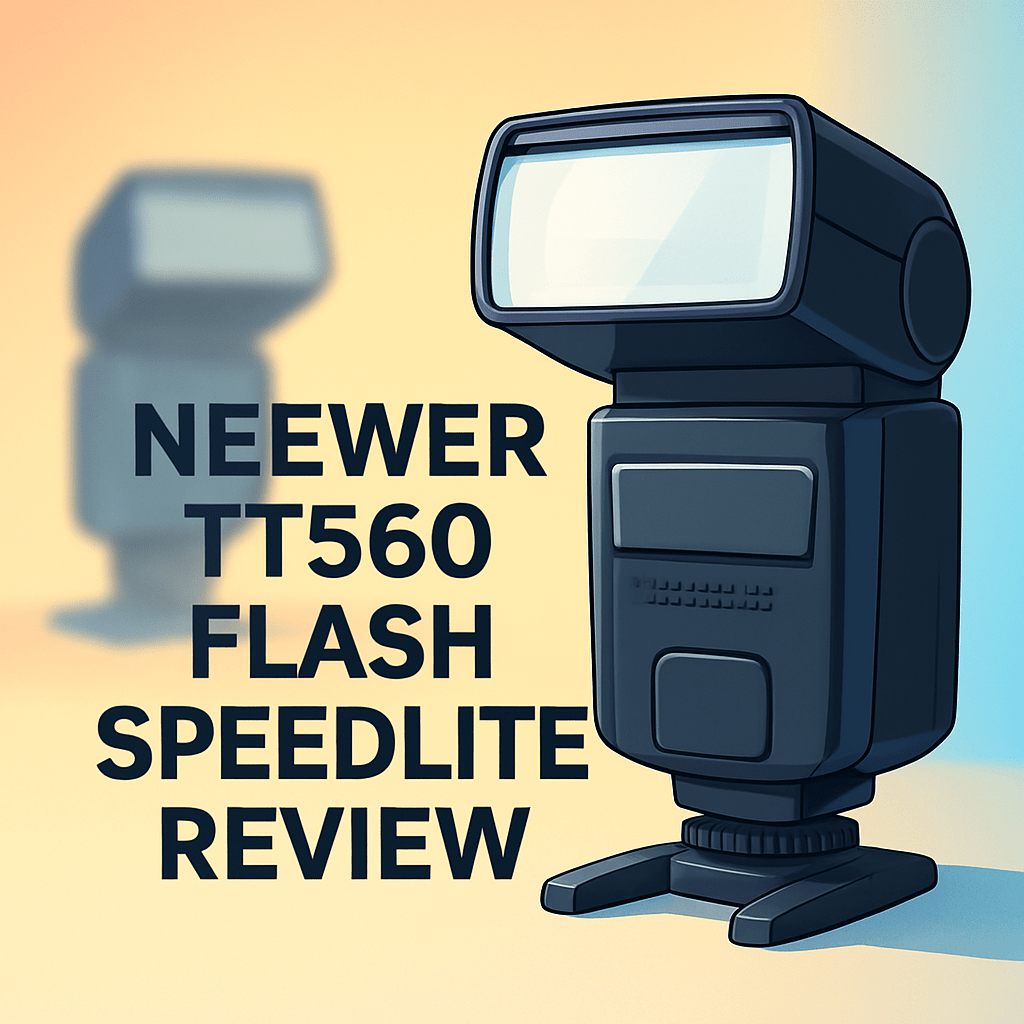
Want to know if the Neewer TT560 Speedlite can give you usable light without fuss or a big budget? I took it into real shoots to see whether this simple, manual shoe-mount flash actually performs where it counts.
It’s a no-frills unit that favors manual control, optical slave triggering, and lightweight portability—ideal for photographers learning manual flash or needing a dependable backup in a compact kit. You’ll see how its simplicity pays off in everyday bounce and basic off-camera setups.
This hands-on review will walk through build and controls, real-world output, triggering flexibility, and who should buy it. Make sure to read the entire review as I break down how it behaved on shoots and when it’s worth bringing along—keep reading.

Neewer TT560 Speedlite
Affordable, lightweight off-camera flash offering consistent output, tilting head and easy manual controls. Ideal for beginners seeking reliable fill light and creative bounce techniques for portraits, events, and on-location shoots.
Check PriceThe Numbers You Need
| Spec | Value |
|---|---|
| Guide Number | 38 (ISO 100, meters) |
| Flash Type | Manual shoe-mount speedlite |
| Power Settings | Adjustable in 9 levels (1/1 to 1/128) |
| Recycle Time | Approx. 5 seconds at full power |
| Flash Duration | Approx. 1/200 to 1/20000 second |
| Triggering | Optical slave mode supported (S1 and S2) |
| Compatible Cameras | Most DSLR and mirrorless brands with hot shoe |
| Power Source | 4× AA batteries |
| Zoom Head | Fixed 35mm (no zoom function) |
| Display | No LCD screen; manual dial controls only |
| Build | Plastic body; compact and lightweight |
| Mount | Standard ISO hot shoe mount |
| Sync Speed | Up to 1/200 second |
| Dimensions | Approx. 72 × 120 × 90 mm |
| Weight | Approx. 220 grams (without batteries) |
How It’s Built
In my testing the Neewer TT560 feels like a no-nonsense little tool — light in your hand and easy to carry all day. The plastic body is compact and snaps onto a camera hot shoe without fuss, so it works with most DSLRs and mirrorless bodies. That makes it an easy grab-and-go option for runs, shoots, or a backup flash in a crowded bag.
The controls are pleasantly simple: a tactile dial and a clearly placed test button. I found the lack of a screen means you learn to trust feel and sound — turn the dial, press test, eyeball the result. For beginners that means a short learning curve: use the test button to dial in power instead of guessing.
The head is fixed, covering a mid-wide field that’s predictable when bouncing or adding a small softbox. I liked how consistent the spill and falloff were — it makes positioning and modifiers easier to plan. What could be better is that you can’t zoom the beam, so you’ll lose some efficiency when trying to mimick longer throw or very wide coverage.
The battery door and overall finish feel serviceable but not overbuilt; after using it for a while I’d treat it gently and carry spare batteries. In real use that means this flash is a great learner’s tool and lightweight backup, but not the one you want to rely on in heavy-duty, daily-stress environments.
In Your Hands
Out in the field the Neewer TT560 behaves like a straightforward, all-manual tool: a multi-step power dial gives precise control once you’ve dialed in a starting exposure, and the test button makes quick checks painless. Output is predictable for portraits and tabletop work, so you can build a reliable recipe of aperture, ISO and distance and then iterate in one-stop steps without surprises.
The flash’s timing is crisp enough to freeze casual motion, and you’ll find it easy to balance ambient light by holding shutter speed at or below your camera’s sync limit. Recycle cadence is deliberate, so for sequences you’ll want to pace bursts and plan your timing rather than rely on rapid-fire shooting.
Triggering is simple and effective: the optical slave modes let the unit live off-camera without radio gear, but they do ask for line-of-sight or a predictable pre-flash strategy. On-camera bounce portraits are forgiving, while an off-camera single-light setup rewards careful placement and quick power tweaks to match ambient exposure.
In practice the fixed wide head is great for tabletop and environmental portraits but requires attention with very wide lenses or aggressive bounce, where coverage and efficiency change. Keep spare AAs handy, work with consistent subject distances, and use the dial to make small, repeatable adjustments—this is a tool that rewards thoughtful pacing more than frenzied shooting.
The Good and Bad
- Manual-only simplicity with 9 power steps (1/1 to 1/128)
- Optical slave modes S1 and S2 for off-camera triggering
- Standard ISO hot shoe; broad camera compatibility
- Compact, lightweight; easy to pack as a backup
- No LCD screen; dial-only interface
- Approx. 5s recycle at full power limits rapid sequences
Ideal Buyer
If you’re the kind of shooter who chooses control over auto, the Neewer TT560 Speedlite fits the bill. It’s a manual shoe‑mount flash that forces you to learn power, distance and modifier relationships. That hands‑on discipline sharpens lighting instincts.
Travel photographers who need a light, packable unit will value its compact size and simple operation. Use it for on‑camera bounce at short indoor distances or as a single off‑camera light triggered optically. It’s ideal when you need reliable light without extra weight.
Photographers building multi‑light kits will appreciate a pragmatic backup or fill head that won’t break the bank. The fixed 35mm coverage suits tabletop and small‑studio work where distance is controlled. For larger scenes you’ll want a different tool, but for controlled setups it’s dependable.
Beginners who want to learn flash without TTL crutches will appreciate the dial‑only interface and test button. You’ll learn to meter and iterate power in stops while managing recycle pacing. It’s a training wheel that actually teaches you to ride.
Avoid this flash if you require built‑in radio triggers, fast recycle for action, or variable zoom coverage. If you’re comfortable working without an LCD and with fixed coverage, the TT560 rewards practice. It’s for photographers who prefer simplicity and hands‑on control.
Better Alternatives?
We’ve gone over the Neewer TT560 and what it does well: a very simple, light, manual flash that’s great as a starter unit or a backup in a small kit. It’s easy to carry, easy to learn on, and it gets the job done when you’re working with one light and don’t need any fancy features.
If you find yourself wanting more—faster recycle, better off-camera triggering, or a head that zooms for bounce and tighter coverage—there are a few common alternatives that I’ve used in real shoots. Below I’ll walk through three options, saying where each one shines compared with the TT560 and which kind of shooter will like each one best.
Alternative 1:

Yongnuo YN560 III Speedlite
Compact high-output strobe with precise manual power adjustments and rapid recycle times, delivering punchy highlights and soft fill when used with modifiers; a versatile choice for hobbyists and emerging professionals.
Check PriceThe YN560 III is the first step up from the TT560 in everyday use. In real shoots I noticed it fires harder and recycles quicker, so you can shoot more frames in a row without waiting. It also has a zoom head and a real radio receiver built in, so I could trigger it off-camera without needing line-of-sight like the TT560’s optical slave—huge when working outdoors or around obstacles.
Where it’s worse than the TT560 is cost and simplicity. It’s a bit bigger and heavier, and it costs more, so it’s not the bargain backup the TT560 is. Also it stays a manual flash—there’s no automatic metering—so if you wanted an all-in-one automatic solution you’ll still have to set power by hand like on the TT560.
If you’re a hobbyist or an emerging pro who wants reliable off-camera work without buying a whole ecosystem, the YN560 III is a great pick. It’s for photographers who outgrew the TT560’s optical-only triggering and want faster, more consistent output for portraits, small events, or tabletop shoots.
Alternative 2:
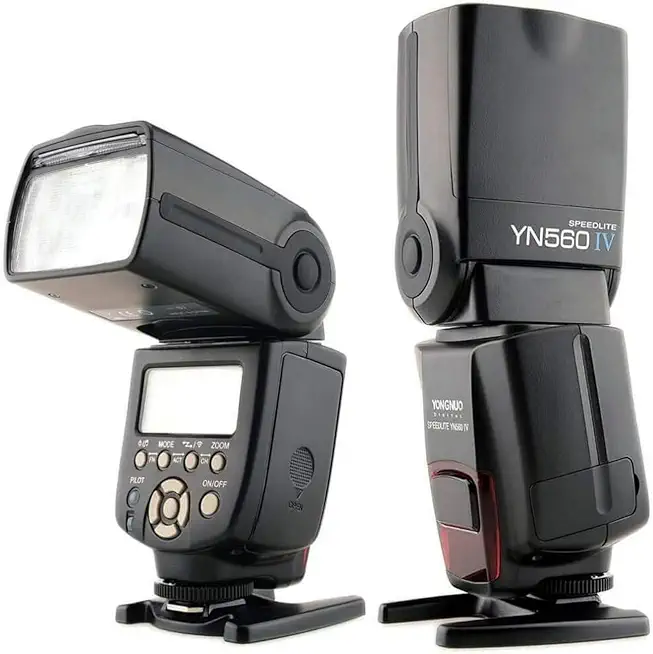
Yongnuo YN560 IV Speedlite
Feature-rich battery-powered flash with on-board wireless control, flexible zoom head and sturdy build—streamlines multi-unit setups for creative lighting, delivering consistent, controllable bursts for portraits and product work.
Check PriceThe YN560 IV builds on the III by adding a master transmitter function on the flash itself. In practice that meant I could put the IV on my camera and control other Yongnuo flashes without carrying an extra transmitter—handy when I wanted to run a two- or three-light setup fast. The head zooms and the output is steady, so shaping light with small softboxes or grids felt easier than with the TT560’s fixed wide head.
The trade-offs versus the TT560 are similar to the III: bigger, heavier, and more expensive. It also remains manual-only, so you still have to dial power by eye. In some long runs I found the IV draws batteries a bit faster than the TT560, so you’ll want fresh AAs or a rechargeable setup for events.
Pick the YN560 IV if you often do small multi-light setups and want simple on-camera control without adding a separate trigger. Wedding second-shooters, portrait shooters who like quick group control, and location shooters who value reliable radio control will get the most from it.
Alternative 3:
Yongnuo YN560 IV Speedlite
Affordable, professional-grade portable strobe offering customizable output, reliable triggering and quick angle adjustment; pairs seamlessly with modifiers and stands for dynamic off-camera lighting during events, studio sessions, and location shoots.
Check PriceUsed another way, the YN560 IV is also a reliable single light for run-and-gun work. Compared to the TT560, the IV feels tougher in the hand and the tilt/swivel action is smoother, which matters when you’re bouncing off ceilings or flagging light with modifiers on the fly. The built-in radio and group control let you keep consistent ratios between lights without running back and forth to each stand like you might with TT560s using only optical slaves.
What it does worse than the TT560 is that it’s overkill if you just want the simplest, cheapest flash for occasional use. The IV’s extra features add complexity and cost that casual users may never need. For very tight packing or ultra-lightweight kits, the TT560 still wins on size and price.
This version of the IV is best for the working photographer who needs one portable, durable strobe that can do both on-camera and off-camera jobs cleanly. If you shoot events, small studio jobs, or location portraits and want fewer headaches with triggers and power balance, the IV will save you time compared with a set of TT560s.
What People Ask Most
Is the Neewer TT560 a good flash for the price?
Yes — it’s a very affordable, reliable manual flash that offers good power for the money, especially if you plan to control settings yourself instead of relying on TTL.
Is the Neewer TT560 compatible with Canon and Nikon cameras?
Yes, it fits standard hot shoes on Canon and Nikon bodies and will fire, but only as a manual flash without camera-specific TTL functions.
Does the Neewer TT560 support TTL?
No — the TT560 is manual-only, so you set power and zoom on the flash rather than using through-the-lens metering.
How do you use the Neewer TT560 off-camera or wirelessly?
It can be used off-camera via its optical slave mode or by pairing it with an inexpensive 2.4GHz radio trigger/receiver, since it has no built-in radio transmitter.
Does the Neewer TT560 have high-speed sync (HSS)?
No — it does not support HSS, so you’ll be limited to your camera’s flash sync speed unless you use other workarounds.
What is the battery life and recycle time of the Neewer TT560?
It runs on four AA batteries; expect recycle times around 2–5 seconds and several hundred pops per battery set depending on whether you use alkalines or rechargeable NiMH cells.
Conclusion
The Neewer TT560 Speedlite is a no-nonsense, hands-on flash that rewards photographers who prefer to control light instead of ceding it to automation. Its compact, lightweight shell, straightforward dial-only controls, and simple optical-slave triggering make it an excellent learning tool and a dependable backup in a pared-down kit. Used deliberately on-camera for quick bounce work or as a single off-camera light, it produces usable, predictable results for portraits, product shots and tabletop work.
That practicality comes with predictable trade-offs: the fixed coverage and lack of a display or built-in radio increase the mental work needed to shape light and manage multi-flash scenes. Recycling and output quirks force you to pace sequences and plan battery swaps, so it’s not the right tool for rapid event coverage. If you want wireless group control, faster cadence, or zooming flexibility, the TT560’s compromises become limiting rather than charming.
For students of light and shooters who need a lightweight, inexpensive spare, the TT560 delivers honest value and teaches good flash habits without fuss. Photographers who require integrated radio control, quicker recycling, or a more robust multi-flash workflow should consider stepping up to Yongnuo or Godox alternatives. Treat the TT560 as a pragmatic, budget-friendly stepping stone that works well until your workflow demands more.
Neewer TT560 Speedlite
Affordable, lightweight off-camera flash offering consistent output, tilting head and easy manual controls. Ideal for beginners seeking reliable fill light and creative bounce techniques for portraits, events, and on-location shoots.
Check Price

0 Comments