
Ever been faced with a dusk or night search for a downed deer and wished you had eyes in the sky? A thermal-equipped drone can turn hours of searching into minutes. But not all thermal drones are built for deer recovery.
This concise guide highlights five top models selected for real-world recovery work and helps you find the best thermal drone for deer recovery. We focus on practical performance over specs-sheet hype. You’ll get an honest look at how they perform in brush, cold, and complex terrain.
Beyond cameras and flight time, the guide covers legal realities that can make or break a recovery mission. State regulations and land‑use rules vary widely, and misuse can carry fines or worse. We’ll explain where drone-assisted recovery is allowed and what restrictions to expect.
You’ll also find hands-on tips for search patterns, timing, and thermal interpretation so you can separate a warm bed from a warm rock. Operational best practices reduce disturbance and improve success rates. Safety, ethics, and coordination with hunters and landowners are emphasized throughout.
If you need to streamline your recovery workflow, minimize time in the field, and stay legal, this guide is for you. Read on for field-tested advice and straightforward recommendations tailored to deer recovery missions. By the end you’ll know which thermal drone fits your needs and how to use it responsibly.
1. DJI Matrice 30T M30T

Remote antenna for DJI RC Plus (Matrice 30T/T40/T20P/M30/M300)
Boosts signal range and reception for industrial RC units; rugged, easy-install design ensures reliable long-distance control in challenging environments.
Check PriceThe DJI Matrice 30T (M30T) is a workhorse built for serious recovery missions and it shows in the imagery. Its thermal sensor delivers 640 × 512 px native resolution and a super mode up to 1280 × 1024, with a 61° FOV and 40mm EFL — paired side‑by‑side with an 8K UHD visible camera and 56× hybrid zoom for precise visual confirmation.
As a photographer I appreciate how the up to 28× thermal zoom and side‑by‑side optical/thermal view allow you to home in on a small heat signature in dense brush and then verify identity with visible detail. That combination, plus the laser rangefinder, makes locating a downed deer far more reliable than thermal alone.
Operationally it’s robust: flight time is roughly 41 minutes and range extends up to 15 km, which covers large properties without constant battery juggling. The platform is rated to operate from −20°C to 50°C and is rain‑resistant, so you can fly in challenging conditions when recovery windows matter most.
It’s built for professionals: anti‑interference Skylink 2.0 transmission, AI subject tracking, omni‑directional collision avoidance, and a modular accessory socket for spotlights or speakers speed up deployments in search & rescue and wildlife recovery. The M30T also holds steady in winds reported up to 27 mph, so turbulence won’t ruin a critical pass.
Tradeoffs are real — it’s heavier and less portable than consumer options, and the system’s complexity rewards training. If you need rugged, high‑performance thermal/optical capability and have the budget and skill to match, the M30T is a top choice.
- 640×512 (super 1280×1024) thermal + 8K visible
- ~41 minutes flight time
- Operates −20°C to 50°C, rain‑resistant
- Skylink 2.0, AI tracking, omni‑avoidance
- Heavier, less portable
- Complex system—needs training
2. Autel Robotics EVO II Dual 640T V3
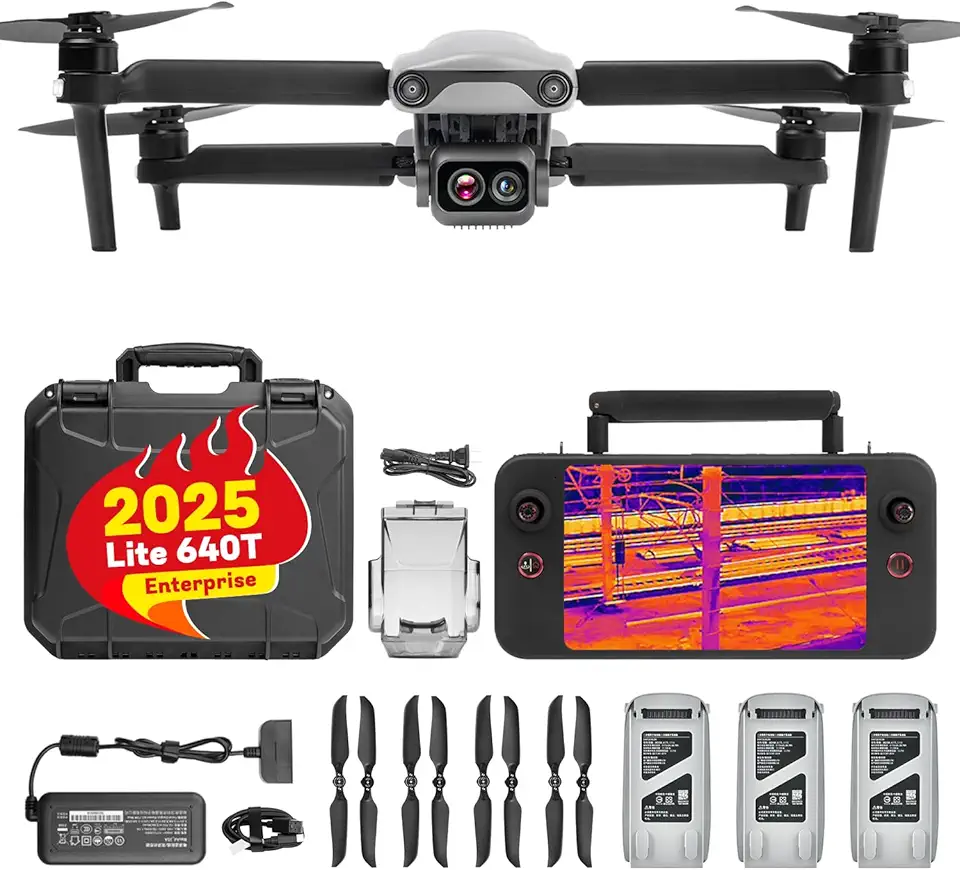
Autel Robotics EVO Lite 640T Enterprise drone
Compact thermal imaging drone delivering high-resolution heat mapping, extended flight time, and enterprise-grade data tools for inspections and search operations.
Check PriceAs a photographer who often works at dusk and in dense cover, I appreciate the Autel Robotics EVO II Dual 640T V3 for its imaging clarity and practical field design. Its thermal sensor is a FLIR Boson at 640 × 512 px, paired with an 8K UHD visible camera, so you get detailed thermal reads and crisp visual confirmation in the same mission.
Flight endurance is solid for extended searches — expect about ~38 minutes of airtime and a control range up to 9 km. The platform is built to stay steady in wind, and users note accurate landings plus reliable auto-RTH when you need a quick return.
The modular layout is a real advantage in the field. Batteries and the camera are easy to swap, which speeds turnaround between sorties. In brush and forested terrain it performs well; you’ll get quick setup and excellent thermal clarity for finding warm-bodied animals among vegetation.
This drone strikes a nice balance between portability and performance. It’s well suited to hunters and SAR teams who want professional thermal capability without an industrial chassis. Be aware of occasional software glitches reported by users, and that it’s larger than typical consumer foldables, so it’s not the lightest option to carry all day.
If you value clear thermal detection, longish flight times, and a responsive controller for precise framing, the EVO II Dual 640T V3 is a strong choice. It’s especially good when you need fast deployment and repeatable results during evening or low‑light recovery missions.
- 640 × 512 FLIR Boson thermal
- 8K UHD visible camera
- ~38 minutes flight time
- Modular design, quick battery/camera swaps
- Occasional software glitches
- Larger than typical consumer drones
3. Yuneec H520 With E10T Thermal Imager

Yuneec H520 + E50 system (E50 3-axis gimbal camera, ST16S controller, 2×520 batteries)
Professional aerial imaging kit with stabilized 3-axis gimbal, crisp interchangeable optics, intuitive controller, and dual batteries for extended missions.
Check PriceThe Yuneec H520 paired with the E10T thermal imager is a solid, workmanlike platform for deer recovery. It offers two thermal options: E10T/X at 320 × 256 px and E10Tv/X at 640 × 512 px (FLIR Boson), so you can choose the balance of clarity and cost that fits your needs.
As a hexacopter with six motors, the H520 brings redundancy and a praised failsafe motor design that translates to very stable flight—critical when you’re trying to resolve a faint heat signature in brush. Flight time is up to 28 minutes, which is respectable for focused recovery sorties where you’ll be searching a defined area rather than sweeping huge properties.
The modular camera and accessory options are the H520’s real advantage: swap sensors or add accessories depending on the mission. For budget-conscious hunters who want flexibility, that modularity means you can upgrade sensors later without replacing the whole airframe.
Thermal resolution is sufficient for deer recovery, especially with the 640 × 512 FLIR option, but it isn’t as clear as the highest-end models. Expect to reliably find warm-bodied deer in many scenarios, though you may struggle at longer distances or through very dense cover compared with higher-resolution systems.
The major tradeoff is portability: the H520 is heavier, bulkier, and not foldable, which limits field mobility and ease of transport. In short, choose the H520 if you value stability, modularity, and a reasonable thermal option on a budget; skip it if you need ultra-compact, highly portable gear or the absolute best thermal clarity.
- Interchangeable cameras
- Reliable, stable flight
- Decent thermal for price
- Relatively long flight time (up to 28 minutes)
- Large / heavy
- Not foldable — reduced portability
4. Parrot ANAFI Thermal
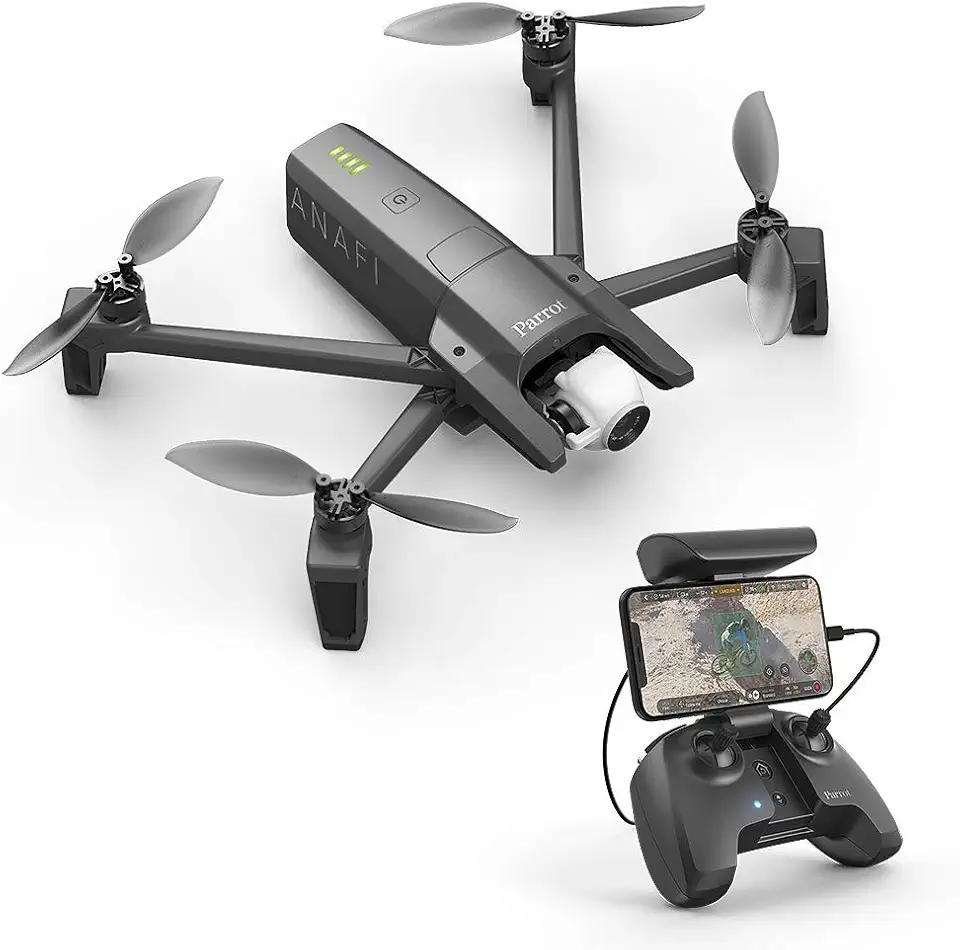
Parrot ANAFI PF728000 drone (4K HDR, 180° vertical swivel camera)
Ultra-flexible camera platform captures 4K HDR footage with full vertical tilt for unique angles; lightweight and foldable for effortless travel.
Check PriceAs a photographer who’s spent nights scanning brush for warm shapes, the Parrot ANAFI Thermal feels like an approachable tool for hunters new to aerial thermal scouting. It pairs a FLIR Boson 320 thermal sensor (160 × 120 px) with a sharp visible camera — 21 MP photos and 4K HDR video — so you can quickly confirm what the thermal view suggests.
At roughly 350 g and about ~32 minutes of flight time, this drone is genuinely portable and stays airborne long enough to sweep a few hundred yards of timber in a single sortie. The IP53 rating and five customizable thermal palettes give you weather resistance and flexibility when conditions or backgrounds change.
The thermal resolution is lower than premium systems, so expect less fine detail at distance or through very dense cover. Still, in my experience the Boson 320 is perfectly capable of spotting warm-bodied deer at typical recovery distances, especially if you fly during cooler evening or night periods to maximize contrast.
Note the trade-offs before you buy: there’s no obstacle avoidance, so you’ll need careful manual piloting around trees and ridgelines. The drone’s quiet operation is a real plus — it’s less likely to spook deer — but the lack of a smart remote makes control a bit less intuitive for absolute beginners.
Overall, the Parrot ANAFI Thermal is a strong entry-level choice for small-scale users or hunters who want an affordable, portable thermal option with good visible imaging and solid flight time. If you value portability and price over top-tier thermal detail and automated safety features, it’s a very practical tool.
- Very portable
- Good thermal image for price
- Long flight duration (~32 minutes)
- Weather-resistant (IP53)
- No obstacle avoidance
- No smart remote—less user-friendly control
5. DJI Mavic 3T Thermal

Thermal camera lens chip for DJI Mavic 3T gimbal camera module
High-sensitivity thermal imaging module component providing precise temperature detection and enhanced scene clarity for critical inspection and rescue tasks.
Check PriceAs a photographer who spends long nights scanning fields, the DJI Mavic 3T balances image quality and portability in a way that truly matters for deer recovery. Its thermal sensor delivers 640 × 512 px resolution with a 61° FOV and side‑by‑side optical/thermal view, which makes isolating a warm-bodied deer in mixed cover straightforward.
The visible system is equally capable for documentation and identification, offering a 48 MP main camera, a 12 MP telephoto, and up to 56× hybrid zoom to confirm details without needing to descend. With a flight time of roughly 43 minutes and an operational range up to 15 km, you can cover large parcels in a single sortie and capture high-quality stills for records.
Practical features matter in the field: omnidirectional obstacle avoidance removes a lot of the stress of flying close to trees and brush, while intelligent flight modes and software-assisted planning speed systematic searches across large properties. Its quiet flight and compact, portable form make it less likely to spook nearby wildlife and simpler to carry between stands or trucks.
There are tradeoffs to consider. It isn’t as rugged as dedicated industrial platforms for harsh-weather operations, so if you expect sustained use in pouring rain or extreme conditions you might need a tougher build. Also, the hybrid zoom system delivers amazing reach but requires some acclimation to get consistent framing and focus at high zoom levels.
- 640 × 512 px thermal with 61° FOV
- 48 MP main + 56× hybrid zoom
- ~43 min flight time; up to 15 km range
- Omnidirectional obstacle avoidance; quiet and portable
- Less rugged in harsh weather
- Hybrid zoom requires acclimation
Legal Requirements for Thermal Deer Recovery
Before you fire up a thermal drone for a deer recovery, treat legality like part of your kit. As of 2026, most states restrict drones in hunting-related activities — about 45 of 50 — so one careless flight can turn into fines or worse.
A few states allow drone-assisted recovery with strict limits; examples include Kentucky, Maryland, Delaware (outside state wildlife areas), Oklahoma, and South Carolina. Others like Michigan and Wisconsin flatly ban using drones to locate dead deer, with Michigan carrying penalties up to 90 days jail and fines up to $1,000 for violations.
Federal and land-specific rules add another layer. National Parks generally prohibit drone flights without a permit, and many state wildlife management areas do the same, so private property is usually the only place you’ll be allowed to operate for recovery.
Where recovery is permitted it’s commonly limited to finding a deer after a confirmed fatal shot — not scouting, tracking live animals, or assisting a hunt. That distinction matters: intent and timing can be the difference between legal recovery and an unlawful hunt-aid.
Practical habits will keep you out of trouble. Always get landowner permission in writing, carry printed or saved copies of any relevant state rule, log your flights and images, and consider a simple “Thermal Deer Recovery” waiver or report to document your purpose. If you need to fly on public or regulated land, contact the managing agency in advance for permits or clarification.
Finally, stay current. Laws change fast — Tennessee, for example, is moving to allow recovery on private land with rules becoming effective in 2026, and places like Pennsylvania are actively debating changes. Check your state wildlife agency before each mission so your recovery helps the animal and doesn’t land you in front of a judge.
Best Practices for Thermal Deer Recovery
Think of a thermal deer recovery like a night shoot: you’re working with contrast, not color. I prefer to fly around dusk or after dark when ambient temperatures fall and warm bodies stand out cleanly; avoid midday when sun-heated rocks, brush, and equipment create false positives that clutter the frame.
Keep altitude between roughly 100 and 400 feet to balance field of view and resolution. Fly a systematic grid over the area where the deer was last seen, concentrating searches within about 150 yards of the shot—most fatally struck deer bed down close to where they fell.
Read thermal images like tonal studies: posture, shape and subtle motion matter more than a single bright hotspot. A live deer usually shows dynamic warmth—breathing, shifting limbs, a heat halo around the chest—while a carcass tends to cool into a flatter, more uniform signature.
Minimize disturbance. Gentle, predictable flight paths and avoiding direct overhead passes reduce the chance of spooking nearby animals. Always secure written permission from landowners and be mindful that many public lands and states prohibit using drones for hunting or scouting; where recovery is allowed it’s typically only after a confirmed kill.
Practical gear habits matter as much as technique. Bring fully charged spare batteries and a plan for swaps so you don’t lose a search mid-grid. Wet nights can improve thermal contrast but make you fight stability—watch wind and heavy rain for safety and image clarity.
Record everything: log flight tracks, timestamps, and thermal stills or video to provide coordinates and context to hunters. Treat this work professionally—get formal thermal-imaging and drone-operation training if you plan to provide recovery services.
When you find the deer, land the drone and allow the hunter to approach; don’t hover or linger above the site. Clear, calm handoff and concise coordinates are the photographer’s equivalent of closing frame—a respectful, efficient end to the mission.
What People Ask Most
What is the best thermal drone for deer recovery?
The best choice depends on your priorities and experience: professionals often prefer rugged, high‑performance systems while hunters may favor compact, portable models. Consider tradeoffs like durability, ease of use, and thermal/optical quality when choosing.
Which thermal camera specs matter most for locating wounded deer?
Thermal resolution, field of view, and optical/thermal integration are the most important factors, along with effective zoom and sensor quality. Weatherproofing, reliable transmission, and the ability to swap cameras or batteries also improve real‑world performance.
How effective are thermal drones for tracking wounded or lost deer at night?
Thermal drones are generally effective at night because lower ambient temperatures increase contrast between animals and surroundings. Dense vegetation, terrain, and operator skill can limit detection, so methodical searching and experience help achieve better results.
What flight time and range are needed in a thermal drone for deer recovery missions?
Longer flight endurance and greater range make searches more efficient and reduce the need for frequent battery swaps. Choose a platform whose endurance matches the size of the area you typically need to cover and carry spare batteries for longer operations.
What features should I look for in a thermal drone for finding downed deer?
Look for a clear thermal sensor, side‑by‑side optical view or good visible camera, useful zoom, stable transmission, and obstacle avoidance if you’ll fly near trees. Portability, weather resistance, modular accessories, and simple controls also make recovery missions easier.
Can thermal drones detect deer through heavy cover or brush?
Detection through heavy cover is limited because dense canopy and thick brush can mask heat signatures. High‑resolution sensors and zoom improve chances through light or partial cover, but dense vegetation often prevents reliable detection.
How do you use a thermal drone to track a blood trail or injured deer?
Conduct a systematic grid search starting from the area where the deer was last seen and fly during cooler times for better contrast. Interpret posture and movement to distinguish live versus dead animals, avoid harassing wildlife, and coordinate findings with hunters or landowners.
Conclusion for Thermal Deer Recovery Drones
Choosing the right thermal drone for deer recovery is largely about tradeoffs—thermal resolution, flight time, portability, and durability should be weighed against your typical terrain and whether you need a compact scout or a professional, weatherproof system.
Before any mission, confirm local regulations and landowner permission, and follow the operational best practices outlined earlier—proper timing, systematic search patterns, minimal disturbance, and thorough documentation keep recoveries effective and legal.
To build confidence and skill, explore more articles on the site for practical tips, planning advice, and real‑world examples that complement this guide.
If you have questions or field experiences to share, please leave a comment below and we usually reply within a few hours.





0 Comments