
Ever tried to pan with a 400mm lens and felt every wobble ruin the shot? Sports photography demands speed, balance and rock‑solid tracking.
This ultimate guide to the best monopod for sports photography walks you through five top picks tested in real‑world action. We compare how each handles heavy glass, rapid height changes and smooth panning under pressure. No jargon—just practical insights that matter on the sideline.
Beyond product picks, you’ll find proven stability techniques that help a monopod act like a third leg when timing counts. We also break down head selection so your setup tracks with less effort and more precision.
Expect hands‑on advice about the trade‑offs every sports shooter faces: weight versus stiffness, quick deployment versus ultimate steadiness, and head compatibility with heavy telephotos. We test performance in realistic scenarios, from courtside action to field sideline work. The goal is simple—help you pick a rig that improves your keeper rate.
Whether you’re shooting high school games, weekend marathons, or pro‑level matches, the right monopod can sharpen your timing and reduce fatigue over a long day. This guide focuses on what actually moves the needle in the field, not specs that look good on paper.
Flip the page to discover the five best monopods for sports photography and the techniques that make them sing. By the end you’ll know which balance of stability, weight and head choice fits your shooting style.
1. Sirui SUP204SR Monopod Review

Sirui P-204SR Monopod
Lightweight, sturdy support with quick-lock leg sections for smooth height adjustment and dependable stability during outdoor and studio photography.
Check PriceWhen I take the Sirui SUP204SR out to shoot fast-paced sports, it shines for what matters most: stability and quick response. Its aluminum build handles heavy telephoto lenses confidently, so tracking a runner or a goal-line scramble feels less like a balancing act and more like controlled handholding.
The removable tripod feet are a practical touch for field work. I routinely detach them when I need to seat myself on a sideline or add them on uneven ground for extra steadiness — either way the monopod adapts without fuss.
Silicon ring twist locks make height adjustments nearly instinctive. They’re fast to operate and very secure, so you can change shooting height mid-play without worrying about slippage.
I appreciate the soft top-section grip in cold weather; it genuinely cuts down the bite of cold aluminum against your palm when you’re waiting for the next play. That said, the rest of the aluminum body can still feel chilly on winter days, so gloves or the soft grip are welcome.
For head and plate choices the SUP204SR keeps things simple and flexible with a reversible mounting plate (¼” and 3/8”), so you can swap heads or plates quickly and get back to shooting. The trade-off is weight: compared to carbon-fiber options this monopod is heavier and can feel tiring on long, handheld sessions.
Overall, if you prioritise solid support for hefty glass, quick locks, and practical field features like the tripod feet and reversible plate, the Sirui SUP204SR is a strong, dependable choice.
- Removable tripod feet for extra stability
- Fast, secure twist locks
- Comfortable grip for cold conditions
- Reversible mounting plate (¼” and 3/8”)
- Aluminum body can feel cold in winter
- Heavier than carbon-fiber alternatives
2. Vanguard VEO 2S CM-264TR Review

Vanguard VEO 2S CM-264TR Carbon Fiber Monopod with Smartphone Holder & Bluetooth Remote
Versatile carbon-fiber support with integrated smartphone mount and wireless remote for effortless mobile shooting, precise framing, and compact travel portability.
Check PriceAs a working photographer, the Vanguard VEO 2S CM-264TR stands out when I need a stable, lightweight support that travels well. Its tri-feet base provides surprising stability on uneven ground, which is a real advantage when you’re shooting from the sidelines or on grass.
The carbon-fiber construction keeps weight down without sacrificing rigidity, so I can carry it all day without tiring. The twist-lock legs are quick to deploy and feel secure once set, letting me change height fast between plays.
Where it trips up a bit is in panning. The panning function can be stiff, which may hinder the smooth tracking you want for fast-moving subjects. If you rely on buttery, continuous pans for action sequences, this is something to test before committing.
Vanguard also bundles a smartphone clamp and Bluetooth remote, which I find handy for B-roll or quick vlogging between games. That said, those extra features aren’t essential for pure sports use and can be seen as nice-to-have rather than mission-critical.
Overall, this monopod is a great choice if you prioritize portability, a solid base on uneven terrain, and rapid setup. If your shooting style demands extremely fluid panning for long tracking sequences, factor that stiffness into your decision.
- Tri-feet base for excellent stability
- Lightweight carbon-fiber construction
- Reliable, fast twist locks
- Compact when folded for transport
- Stiff panning function may impede smooth tracking
- Extra features (smartphone clamp, remote) unnecessary for pure sports use
3. Sirui SVM-145 Rapid Monopod Review

Sirui SVM-145 Rapid Carbon Fiber Monopod with Feet
Rapid-deploy carbon construction with stabilizing feet for rock-solid support, fast setup, and professional-level steadiness in active shooting situations.
Check PriceThe Sirui SVM-145 Rapid is built for photographers who need to move fast. Its rapid height-adjustment system lets you change shooting positions in a heartbeat during fast events, so you won’t miss critical moments when the action shifts on the field.
For static shots it surprises with stability: the metal tripod base gives excellent support and the 360° swivel makes panning smooth for video work or following a runner across the frame. That metal base also helps when you need a steadier platform than a plain monopod foot provides.
Ergonomics are thoughtful — a foam grip and wrist strap keep the rig comfortable and secure through long sessions, which matters when you’re on your feet all day. The carbon-fiber construction keeps weight down and makes the SVM-145 compact and portable for travel, though that same lightness can feel less rigid at full extension with very heavy telephoto lenses.
Bottom line: if you shoot a lot of fast-paced events and want quick height changes, stable static support, and smooth panning for occasional video, the Sirui SVM-145 is a strong choice. Just be mindful that with very heavy lenses fully extended it can feel less stable, and the metal base can be a bit bulky when you’re packing up or carrying it between venues.
- Rapid height adjustments
- Stable metal tripod base
- 360° swivel for smooth panning
- Comfortable foam grip and wrist strap
- Less stable at full extension with very heavy lenses
- Base can feel bulky when not in use
4. Manfrotto XPRO Monopod+ Review

Manfrotto XPRO+ Video Monopod with Fluid Video Head
Integrated fluid head delivers buttery smooth pans and tilts; robust build ensures precise control and reliable support for run-and-gun cinematography.
Check PriceThe Manfrotto XPRO Monopod+ is a straightforward, no-nonsense workhorse that I reach for when I need something I can trust on a busy sideline. Its durable build and quick deployment make it ideal for fast-action sports where you can’t afford to fumble with adjustments.
Flip locks are a highlight — they operate smoothly even with gloves on, which is a real benefit during chilly morning matches or brisk stadium nights. That usability keeps you in the moment and focused on tracking the play instead of wrestling with gear.
In practice it handles mid-telephoto rigs with confidence; it gives you the stability you need for sharp, repeatable frames during extended bursts. However, like many aluminum monopods, it starts to show limitations with very heavy lenses at full extension — you may notice some wobble when fully raised.
The aluminum construction keeps the weight down and makes the monopod easy to carry between courts or around fields, but it’s not as rigid as carbon-fiber alternatives. What you get in return is a simple, reliable design with few moving parts, which translates to long-term durability and fewer things that can fail mid-shoot.
If you shoot primarily with mid-sized telephotos and value quick, dependable setup, the XPRO Monopod+ is a solid choice. If your kit includes 600mm-class glass and you frequently shoot at maximum extension, consider a stiffer carbon option instead.
- Quick deployment and simple operation
- Flip locks usable with gloves
- Lightweight and portable
- Durable construction for heavy use
- Can feel wobbly with very heavy lenses at full extension
- Aluminum less sturdy than carbon-fiber alternatives
5. NEEWER N284L+G0 Camera Monopod Review

Neewer 70.5in Aluminum Travel Monopod with Pan-Tilt Fluid Head & Removable Tripod Base
Compact aluminum travel support with pan-tilt fluid head and removable tripod base for versatile shooting, easy transport, and stable long-range framing.
Check PriceWhen you need to mount a serious telephoto for sports, the NEEWER N284L+G0 earns its keep. Its high load capacity—up to 33 lbs—means it handles heavy glass without fuss, and in practice it feels very sturdy and reliable under pressure. That stability comes at a cost: the monopod itself weighs 5.7 lbs, which can become tiring on long, handheld sessions.
The included 360° panorama ball head is surprisingly useful for sports work; panning is smooth and angle adjustments are precise, so tracking a moving subject is much less of a battle. Pairing that head with quick, confident wrist movements makes following fast action feel natural.
Quick-release twist locks allow very fast height changes during live events, which is a real advantage when you’re jumping between seated, standing and low-angle shots. The locks are practical for on-the-fly adjustments and keep you from missing decisive moments.
The flexible central column is a standout feature for low-angle work—you can get creative with ground-level perspectives without swapping gear. That said, the column can be cumbersome to adjust quickly, so it’s best when planned moves or slower repositioning are acceptable.
Overall, the NEEWER N284L+G0 is a solid choice if your priority is support for heavy lenses and smooth panning. If you frequently carry your monopod for hours or need lightning-fast column adjustments between plays, the weight and column fiddliness are trade-offs to consider. For stable, heavy-duty sports setups it’s mostly a win.
- Supports up to 33 lbs
- 360° panorama ball head for smooth panning
- Quick-release twist locks for rapid height changes
- Flexible central column for low-angle shots
- Heavier (5.7 lbs) — can cause fatigue
- Central column can be cumbersome to adjust quickly
Techniques for Maximum Stability
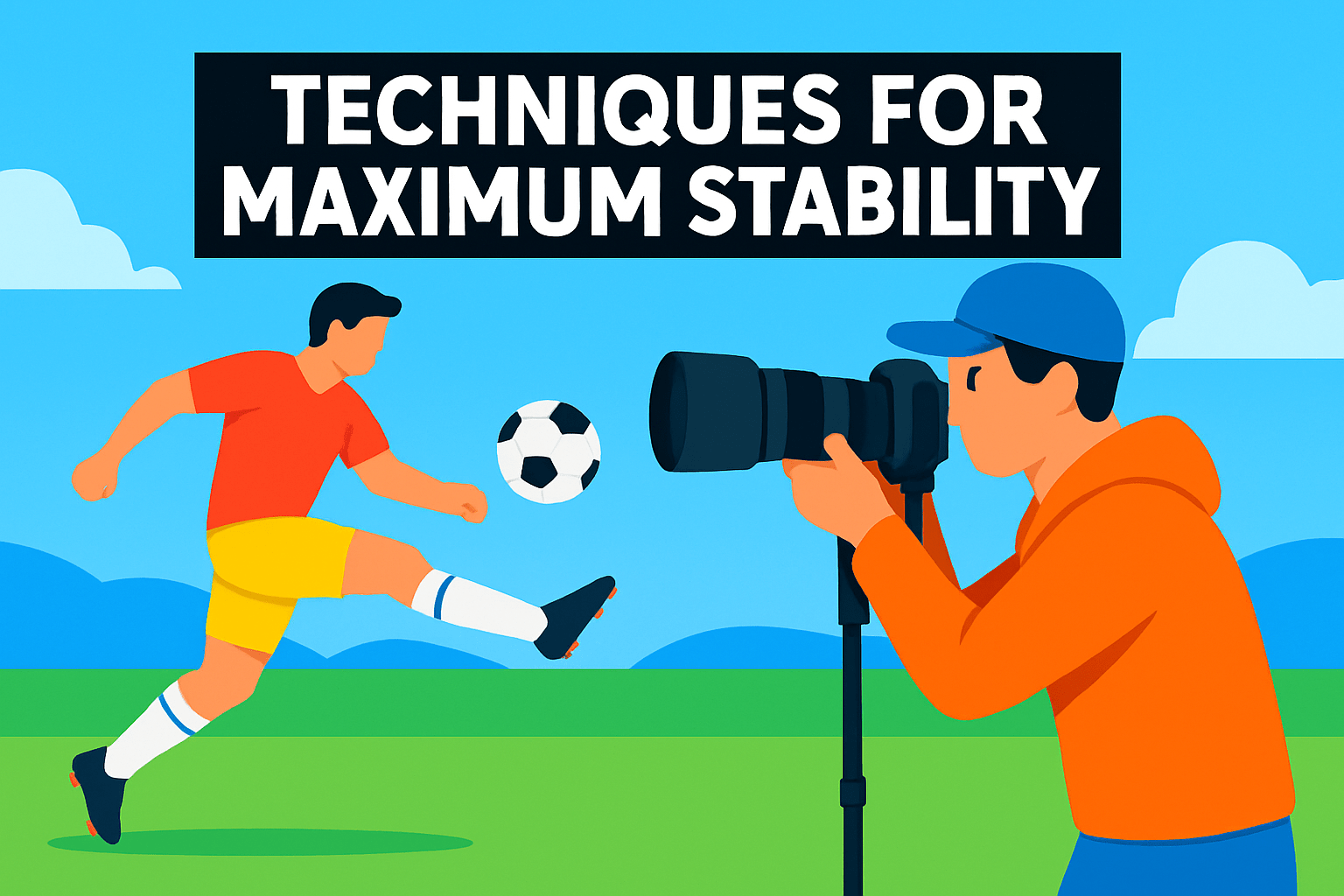
Start with your feet. Stand shoulder-width apart and distribute your weight evenly so you can move quickly without losing balance. A planted stance makes a surprising difference when you’re tracking a sprint or a sliding play.
Place the monopod between your feet or just a little in front of you so your legs become extra points of support. That small triangle you form with your legs and the monopod stabilizes the rig far better than an arm-held monopod alone.
Tilt the monopod slightly toward or away from your body to create a tripod-like effect; you’ll feel the difference immediately. Press the shaft gently into your chest or tuck your elbows in to lock your upper body, which absorbs vibration and reduces wobble when the shutter fires.
When available, lean the monopod against a wall, railing, tree, or even a seat back for instant added stability. These casual contact points are invaluable during long events or when you need a steady follow for a fast play.
Control your breathing. Exhale slowly and initiate the exposure at the end of the breath for crisper frames, especially with longer focal lengths. It’s a small habit that separates sharp keepers from near-miss images.
Work on smooth panning and tilting so your movement matches the athlete’s speed. Use your hips and shoulders to guide the motion rather than yanking with your wrist, and keep the monopod height at or just below eye level for the most natural, steady tracking.
Always use a wrist strap to prevent drops and to take some load off your grip during long sequences. Little rests between bursts and conscious grip changes help stave off fatigue and keep your tracking consistent late into the game.
Finally, practice these techniques off the clock. Drill quick transitions between heights and rehearse panning on moving targets; the muscle memory you build will pay dividends when a decisive moment arrives.
Choosing the Right Monopod Head
The head is the part that turns a good monopod into a tool you actually enjoy using in the heat of a match. For sports I almost always reach for a dedicated monopod tilt head rather than a ball head. Tilt heads give controlled, predictable up-and-down movement and let you use the monopod itself to rotate left and right, which keeps the setup stable and fast when tracking athletes.
Look for smooth, positive tilt action with a usable friction or damping control. You want the head to follow a fast player without jerking, but also lock down rock-solid when you need a steady shot. Avoid heads that have floppy or mushy locks; on a monopod small movements are amplified and any slippage shows in the frame.
Quick-release plates are a small convenience that saves minutes over a long day. Choose a plate system that’s rock-solid and preferably Arca-style for compatibility with many collars and accessories. Always test the head with your heaviest lens attached. If you see sag or creep, the head isn’t up to the task.
Ergonomics matter. Big, tactile knobs are easier to operate while wearing gloves and let you make micro-adjustments without fumbling. If you shoot hybrid stills and video, consider a head with fluid panning and tilt—those deliver buttery motion for follow shots. But if you only do stills, a simple tilt head will be lighter, simpler, and often more durable.
Finally, remember the lens tripod collar. A head that lets you switch between landscape and portrait via the collar saves time and keeps balance. In short: prioritize smooth, secure tilt, a reliable quick-release, sufficient load capacity, and ergonomics that match your shooting conditions. Those choices will make the difference between catching the decisive moment and missing it.
What People Ask Most
What is the best monopod for sports photography?
The best monopod balances stability, weight, and head compatibility to match your lenses and shooting style. Choose one that feels comfortable to carry and pairs well with a reliable head.
Do professional sports photographers use monopods?
Yes, many professionals use monopods to steady heavy lenses while staying mobile. They offer a practical compromise between support and portability for fast-paced events.
Can a monopod replace a tripod for sports photography?
A monopod can replace a tripod in situations where mobility and quick repositioning are priorities, but it won’t provide the same static stability. Use a tripod when maximum steadiness or long exposures are required.
What features should I look for in a monopod for sports photography?
Look for secure locking mechanisms, a comfortable grip or strap, and a stable base or feet option. Also consider material, weight, and compatibility with the head and lenses you use.
How tall should a monopod be for sports photography?
Choose a height that lets you shoot at or just below eye level without strain. Consider whether you’ll be standing, seated, or moving around when selecting a monopod.
How do you use a monopod for capturing fast-moving sports?
Adopt a stable stance and use the monopod as an extension of your body, pressing it gently against your torso for added support. Practice smooth panning and control your breathing to improve tracking and sharpness.
Are monopods allowed at sporting venues or events?
Venue policies vary, so check event rules or contact organizers before bringing one. When allowed, there may be restrictions on placement, size, or where you can stand while using a monopod.
Conclusion for Sports Photography Monopods
In short, the right monopod is the one that balances stability, weight and features for the way you shoot, with some designs favoring rock-solid support and others prioritizing portability for long days on the move.
Put the stability techniques into practice—steady stance, body contact, mindful breathing and smooth panning will multiply the effectiveness of any monopod you choose.
When picking a head, prioritize smooth tilt and panning, secure quick-release compatibility and ergonomic controls so your tracking stays fluid and reliable under pressure.
Choose based on how much load you expect to carry, how quickly you need to change height or orientation, and which trade-offs between mass and stability make sense for your events and gear.
If you want to keep improving, explore more of our guides and practical tips on the site to sharpen your monopod skills, and leave a comment below—we usually reply within a few hours.




0 Comments