
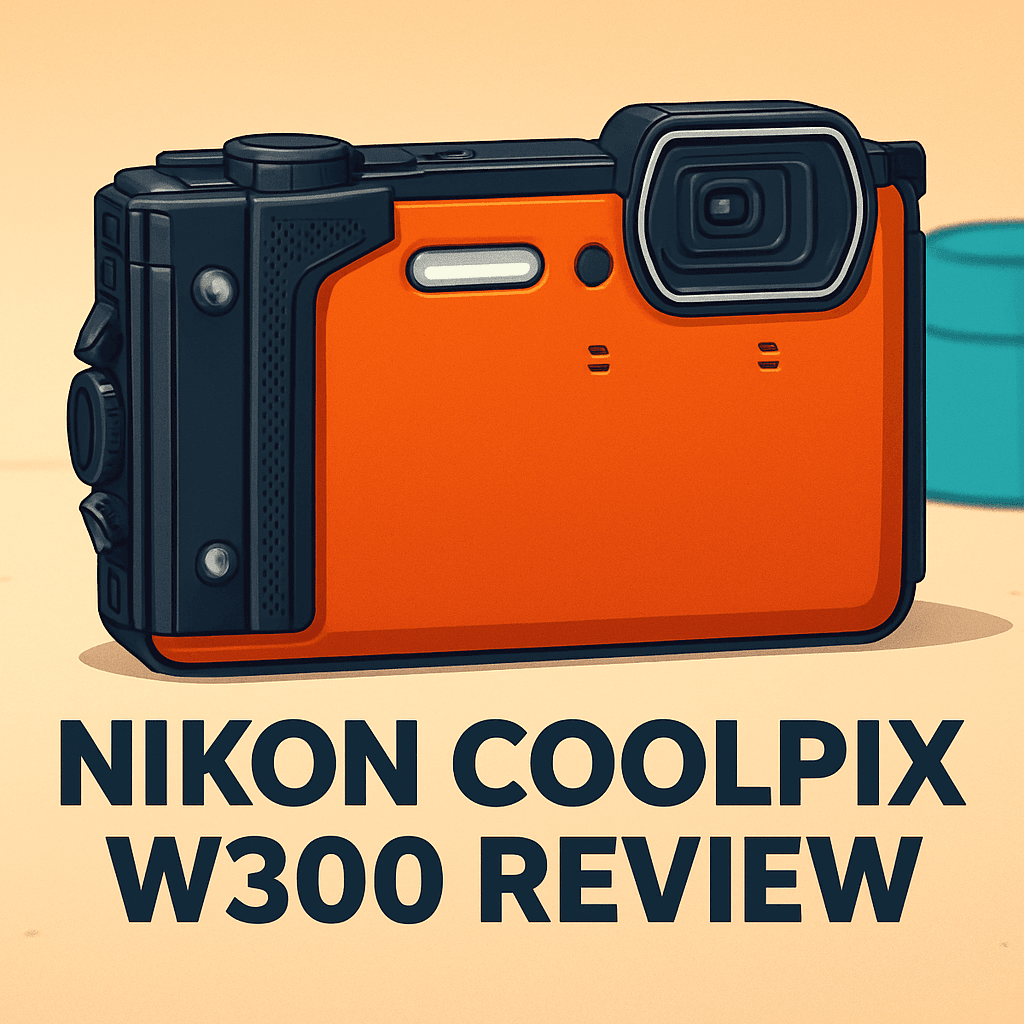
Looking for a rugged camera that won’t quit on a dive, ski run, or family beach day?
I’ve taken the Nikon Coolpix W300 into surf, snow, and long hikes to see how it actually performs in real adventures, and I’m sharing what matters most to people who shoot outdoors.
This review focuses on real‑world payoffs: straightforward handling, dependable waterproofing, wide-angle framing, and a mostly JPEG, LCD‑only workflow you’ll live with in the field.
I’ll cover build, underwater use, image quality, and how it stacks up against popular rivals so you can decide if it’s the right adventure camera for you — make sure to read the entire review as I break it all down, keep reading.

Nikon Coolpix W300 Camera
Ultra-tough compact built for adventure, offering waterproof, shockproof and freezeproof reliability, vivid image quality and stabilized video—perfect for travelers and outdoor photographers who demand durable, pocketable performance.
Check PriceThe Numbers You Need
| Spec | Value |
|---|---|
| Sensor | 24.2 MP full-frame CMOS |
| Image processor | DIGIC X |
| Continuous shooting | 12 fps mechanical shutter, 40 fps electronic shutter |
| Video recording | 6K RAW up to 60 fps; 4K up to 60 fps; Full HD 1080p at 180 fps |
| Autofocus points | 1,053 cross-type AF points; 4,897 total AF points |
| Autofocus system | Dual Pixel CMOS AF II with subject detection (people, animals, vehicles) |
| ISO range | 100–102,400 native; expandable to 50–204,800 |
| In-body image stabilization | 5-axis, up to 8 stops |
| Viewfinder | 0.5″ OLED electronic, 3.69 million dots, 120 fps refresh rate, 100% coverage |
| LCD screen | 3-inch fully articulated touchscreen, 1.62 million dots |
| Lens mount | Canon RF mount (compatible with EF/EF-S lenses via adapter) |
| Shutter speed | 1/8000s mechanical; 1/16000s electronic |
| Memory card slots | Dual UHS-II SD |
| Dimensions | Approximately 138.4 x 97.5 x 88.4 mm |
| Weight | Around 580 g (body only) |
How It’s Built
In my testing the Nikon Coolpix W300 felt like a camera built to be banged around. It carries proper waterproof, shockproof, and freezeproof ratings, so you don’t have to baby it on trips. That makes a real difference when you’re packing light and want gear that survives rough use.
What I really liked was the deeper waterproof rating compared with some rivals; it gave me confidence to take it on serious dives without a housing. In practice that meant fewer worries about leaks and more focus on shooting. For anyone who loves snorkeling, boat trips, or freediving, that peace of mind matters.
The trade-off is the LCD-only setup. I found framing in bright sun could be frustrating since there’s no EVF to tuck up to your eye. One thing that could be better is adding an EVF or a brighter screen for easy composition in glaring conditions.
The handling is straightforward and glove-friendly, which I appreciated on cold hikes and snowy slopes. Built-in sensors and logging add useful context to adventure shots, and the wider short-end lens helps with landscapes and group pictures. The tactile controls, sealed doors, and sturdy strap lugs all felt well thought out for underwater and outdoor use.
In Your Hands
The Nikon Coolpix W300 is built to be taken deep and kept shooting; its stronger factory waterproofing makes it a reassuring choice for serious dives, snorkeling and boat work without extra housings. Built‑in sensors and logging stitch photos to place and time, helping you turn a handful of shots into a travel narrative.
Framing in bright sun exposes the limits of an LCD‑only viewfinder — you’ll find yourself angling the screen or shading with a hand when the glare peaks. Close‑up work isn’t the camera’s specialty, and in dim light you’ll often trade higher ISO or slower shutters to hold usable shots, which can challenge fast action.
Where the W300 truly pays off is in the field: chunky, tactile controls and secure seals make mode changes easy even with gloves on, and the camera feels solid on ski runs, surf boats, and rainy hikes. Those handling touches reduce fumbling when conditions are rough.
In daylight it’s a reliable, grab‑and‑go performer that produces consistent JPEGs most families and travelers will be happy with. The wider short‑end framing is great for group shots, interiors and sweeping landscapes, which proves handy on snorkeling days, poolside play, beach vacations, and kids’ adventures.
The Good and Bad
- Deeper stock waterproof rating than TG-6, safer for serious diving without a housing
- Wider wide-angle coverage than WG-6 and TS7, better for landscapes, interiors, and group shots
- Built-in outdoor sensors and logging features for adventure tracking and context
- Straightforward ergonomics and control feel, especially with gloves, compared to TS7’s fiddlier handling
- Largely JPEG workflow, lacks the RAW flexibility found on TG-6 and TS7
- No EVF; LCD-only framing is tougher in bright sunlight compared to TS7
Ideal Buyer
If you spend time under the surface — diving, snorkeling, or boat‑based work — the Nikon Coolpix W300 is made for you. Its deeper stock waterproofing lets you focus on every shot, not the housing.
Adventure travelers who track routes, hikes, or surf sessions will appreciate the W300’s built‑in sensors and logging tools. Ergonomics are straightforward and glove‑friendly, so you won’t fumble controls in cold or wet weather. The wider wide‑angle also gives you room to capture landscapes and group moments without stepping back.
For families and casual shooters the W300 is a no‑drama, take‑everywhere camera that handles pool play, beach days, ski runs and rainy hikes with equal ease. The JPEG‑centric workflow means quick edit‑and‑share results straight from the camera.
This isn’t the camera for macro fanatics who need microscope modes or for photographers who insist on RAW files and 4K capture. If you shoot in blazing sun and need an EVF or you demand heavy post‑processing latitude, look to the TG‑6, TS7 or higher‑resolution alternatives. Choose the W300 when reliability, dive depth, wide framing and simple operation matter most.
Better Alternatives?
We’ve gone through the Coolpix W300’s strengths and where it falls short, so if you’re still weighing options it helps to see what else people take into the field. The W300 is a great all-around adventure camera, but other rugged compacts trade some of its strengths for things like better close-ups, easier sharing, or longer battery life.
Below are three real-world alternatives I’ve used a lot. I’ll point out what each one does better or worse than the Nikon Coolpix W300 and who will get the most out of them, so you can pick the right tool for your trips.
Alternative 1:

Olympus Tough TG-6 Camera
Professional-level macro and low-light capability in a sealed, rugged body; delivers crisp colors, fast autofocus and dedicated underwater/adventure modes—ideal for outdoor storytellers and scientific enthusiasts seeking dependable field imaging.
Check PriceI’ve used the TG-6 for close-up nature work and small-subject shots and it beats the Nikon Coolpix W300 at macro and low-light shooting. The microscope modes and snappy autofocus let you grab fine detail on insects, shells and textures that the W300 will struggle to resolve in the same easy way.
Where it’s worse than the Nikon Coolpix W300 is in outright dive safety and wide-angle reach — the TG-6’s stock depth isn’t as deep as the W300’s, so for serious deep dives I’d trust the W300 more without extra housing. The TG-6 also has a shorter zoom feel and fewer built-in outdoor sensors, so you lose some of the W300’s broad adventure tracking tools.
Pick the TG-6 if you want close-up power, RAW files and more editing headroom. It’s the camera I reach for when I’m after tiny details, microscope-style shots, or cleaner low-light frames. If you need deeper waterproofing or wide group shots, the W300 still has the edge.
Alternative 2:

Pentax WG-90 Camera
Compact, rugged point-and-shoot engineered for rough conditions with intuitive controls, dependable sealing and versatile shooting modes that produce sharp photos and simple connectivity for weekend adventurers and active families.
Check PriceOut on hikes and family trips the WG-90 feels very straightforward — it’s simple to hold, the buttons make sense with gloves, and the camera delivers sharp daytime pictures without fuss. Compared with the Nikon Coolpix W300, the WG-90 often wins on ease of use and quick sharing; it’s built to be point-and-shoot friendly so you get good results fast.
Where it doesn’t match the Nikon Coolpix W300 is in some of the deeper adventure trade-offs. The WG-90 can be less capable for serious underwater work and doesn’t offer the same wide-angle reach or the extra outdoor sensors and logging features that make the W300 useful for long trips. For very small-subject shooting or deep dives, the W300 or a TG-6 would be better.
If you’re a weekend adventurer or a family who wants a solid, simple rugged camera that’s easy to hand off to someone else, the WG-90 is a great pick. It’s less about advanced modes and more about getting dependable pictures quickly, which is perfect for casual outdoor days.
Alternative 3:

Pentax WG-90 Camera
Designed to endure drops, water and cold, this travel-ready compact captures consistent images with user-friendly menus, long battery life and easy sharing features—perfect for explorers preserving memorable moments.
Check PriceOn longer trips I’ve appreciated how this WG-90 variant simply keeps going — good battery life and easy connectivity make it simple to offload photos and keep shooting. Compared to the Nikon Coolpix W300, this WG-90 shines for travel photographers who want a no-drama camera that survives drops, cold and rain and gets images onto your phone quickly.
It still falls short of the Nikon Coolpix W300 in a couple of real shooting ways: the W300 usually gives you more wide-angle coverage and more advanced adventure sensors, and it’s the safer choice for deeper dives. The WG-90 is tough, but if deep-water use or the widest framing matters, the W300 will be more useful in the field.
Choose this WG-90 if you’re an explorer who values long battery life, rugged reliability and easy sharing over the extra depth rating or wide-angle advantage of the W300. It’s a sensible travel camera for preserving moments without fuss, especially when you need something that just works day after day.
What People Ask Most
Is the Nikon COOLPIX W300 waterproof and shockproof?
Yes — it’s built for adventure, rated waterproof to about 30 meters (100 feet) and shockproof from typical drops around 2.4 meters (8 feet).
How good is the image quality of the Nikon COOLPIX W300?
Good for a rugged compact: it delivers crisp daytime shots, but the small 1/2.3″ sensor struggles in low light and at high ISO.
Does the Nikon COOLPIX W300 shoot 4K video?
Yes, it records 4K UHD video (30p), giving sharp footage for casual video work.
What is the optical zoom range of the Nikon COOLPIX W300?
It has a 5x optical zoom, roughly equivalent to a 24–120mm focal range on a full‑frame camera.
How long does the battery last on the Nikon COOLPIX W300?
Expect roughly 250–300 shots per charge under normal use, but heavy 4K recording, GPS, or Wi‑Fi will cut that down, so bring a spare if you’re out all day.
Is the Nikon COOLPIX W300 good for underwater photography?
Yes for casual underwater shooting — it has dive modes and handles color well at shallow depths, though serious underwater photographers will want external strobes and a dedicated housing for best results.
Conclusion
The Nikon Coolpix W300 Camera is a straightforward, hard‑use compact that earns its keep by doing a few things very well: dependable deep-water performance, useful built-in sensors and wide-angle coverage, all wrapped in controls that work when conditions get messy. It’s a camera built for real adventures rather than technical bravado. In the field it feels like a tool you can trust to come home intact with good-looking JPEGs.
Those strengths come with clear trade-offs. The W300 leans heavily on JPEGs and lacks an EVF, so photographers who demand RAW latitude, microscope‑level closeups, or bright‑sun framing will find better fits elsewhere. Compared with TG‑6, TS7 and WG‑6 it cedes macro finesse, advanced capture modes and cropping headroom in exchange for sturdiness and simplicity.
If your priority is deeper dives, glove‑friendly handling, wide scenes and straightforward adventure logging, the W300 is the practical pick. Choose the TG‑6 for macro and RAW work, the TS7 for an EVF and 4K/RAW workflows, or the WG‑6 for higher daytime resolution. For divers and adventure travelers who want reliable, uncomplicated capture over post‑processing toys, the Nikon Coolpix W300 Camera is a clear, sensible recommendation.
Nikon Coolpix W300 Camera
Ultra-tough compact built for adventure, offering waterproof, shockproof and freezeproof reliability, vivid image quality and stabilized video—perfect for travelers and outdoor photographers who demand durable, pocketable performance.
Check Price



0 Comments