
Tired of soft edges and inconsistent framing ruining otherwise perfect product shots? Choosing the right tripod can change that. Whether you’re shooting studio flat-lays or quick on-location detail work, a stable tripod is the unsung hero behind crisp, repeatable images.
This guide rounds up five of the best tripods for product photography, selected with both studio precision and field portability in mind. We evaluate balance, rigidity, and ease of use. Expect options that span heavy-duty studio setups to lighter travel-friendly rigs.
Inside you’ll find concise summaries that highlight real-world strengths and trade-offs without technical overload. The guide also offers clear advice on picking the right tripod head and practical tips for setup and shooting. A compact FAQ answers the common questions photographers ask when choosing support gear.
Whether you sell online, shoot catalogs, or craft detailed macro work, this guide will help you match a tripod to your workflow. Short on gear knowledge? You’ll walk away knowing which trade-offs are worth paying for.
No matter your budget or subject size, the right tripod reduces blur, improves composition, and speeds repetitive tasks. It also saves your back on long shoots. Read on to discover which styles perform best and why they matter for product photography.

Manfrotto MT055XPRO3 055 Aluminum 3-section Tripod with Horizontal Column

3 Legged Thing Winston 2.0 Pro Range Carbon Fibre Tripod (monopod convertible)
1. K&F 94-Inch Overhead Tripod With Geared Head

K&F Concept T254A8+BH-28L 94in 4-section Aluminum Tripod with 360° Ball Head
Ultra-tall 94-inch aluminum support offering four-section compactness, fluid 360° ball-head control, rock-solid stability for photography and videography on the move.
Check PriceThe K&F 94″/2.4m Overhead Camera Tripod with the K&F Concept 3‑Way Geared Tripod Head is built specifically for overhead and flat‑lay product work in studios. I use geared heads when I need tiny, incremental moves and rock‑solid alignment, and this setup delivers that control without camera slip.
The geared head gives smooth, secure small adjustments so you can fine‑tune tilt, pan and roll with confidence. The horizontal center column makes precise top‑down framing straightforward, and the locking mechanism will hold heavier cameras steady during long shoots.
In real use it’s impressively stable even with heavier equipment, producing sharp images that require minimal post‑alignment. Setup is quick and angle changes are straightforward, so you won’t waste time between shots during a product session.
Build quality is robust, which makes it ideal for dedicated studio or restricted environments where stability and repeatability matter more than portability. If you’re shooting catalogues, flat‑lays, macro stacks, or 360° product spins, this tripod gives you the kind of precision that speeds post‑production.
Be aware it’s heavier than travel tripods, so it’s not the best choice if you’re running between multiple on‑location shoots or need to carry gear long distances. For studio photographers who prioritize accuracy and steadiness, though, this is a strong, no‑nonsense option.
- Exceptional stability for overhead and flat‑lay shots
- Precise geared adjustments to avoid distortion
- Easy setup and angle transitions
- Robust build quality for studio/restricted environments
- Heavier than travel tripods
- Not ideal for photographers needing fast location moves
2. Manfrotto 475B Geared Studio Tripod
Manfrotto MT055XPRO3 055 Aluminum 3-section Tripod with Horizontal Column
Versatile aluminum support with convertible horizontal column for low-angle and macro shots, three-section portability, durable professional load capacity.
Check PriceIf you shoot product work in a controlled studio, the Manfrotto 475B Pro 3‑Section aluminum geared studio tripod is one of those pieces of kit that quietly makes your life easier. It’s widely used for overhead and macro product shots because the geared head gives you the level of precision you need to line up plates, labels, and tiny details perfectly.
The geared head is excellent for fine adjustments and for achieving a true perpendicular alignment; that means less time nudging in post and more keepers from the first frame. The center column can be positioned horizontally, so top‑down flat‑lay and overhead setups are straightforward and rock‑solid.
Build and durability matter when you’re shooting heavy DSLR or mirrorless rigs with macro rails or studio strobes attached, and this tripod handles heavier camera setups without noticeable wobble. For long sessions it stays put, and the geared controls stay smooth so you can make tiny reframing tweaks without redoing the whole composition.
That said, this is a studio workhorse rather than a travel companion. It’s bulkier and less portable than compact tripods, and if you frequently move between locations you’ll notice the extra weight and footprint.
Also expect a slightly slower setup rhythm compared with quick‑release travel tripods; the geared head is about precision over speed. If your priority is absolute alignment and stability for product and macro work, the tradeoffs are worth it.
- Excellent studio stability and precision
- Geared head enables fine alignment
- Durable for heavy camera setups
- Horizontal center column for overhead shots
- Bulky and less portable for location work
- Setup can feel slower than compact tripods
3. 3 Legged Thing Winston 2.0
3 Legged Thing Winston 2.0 Pro Range Carbon Fibre Tripod (monopod convertible)
Lightweight carbon-fiber support converts to monopod instantly, delivering pro-grade rigidity, rapid setup, and superior vibration dampening for demanding shoots.
Check PriceAs a product photographer I look for gear that adapts to many setups, and the 3 Legged Thing Winston 2.0 fits that brief.
It’s described as versatile and robust, making it suitable for both studio and on-location product photography.
The tripod remains rigid and stable even at maximum extension, which matters when you need consistent framing or slow shutter speeds.
That rigidity at full height translates into sharper shots and less time spent rechecking alignment during a shoot.
Its hybrid design balances portability and stability, so you don’t give up sturdiness just because you’re moving between locations.
Quick setup is a real advantage here: quick-action legs get you shooting faster, and the 90° pivot facility opens up macro and wide-angle possibilities without fiddly reconfiguration.
I recommend it for varied shooting scenarios where you might switch from overhead flat-lays in the studio to on-site product work.
It’s particularly useful if you value a single tripod that can handle macro detail, wide compositions, and stable full-height work without swapping gear.
The trade-offs are straightforward: it’s slightly heavier than some travel tripods and commands a higher price than basic models, so it may not suit photographers prioritizing minimal weight or the lowest cost.
Overall, if you want a mostly portable tripod that doesn’t compromise on stability and offers quick, flexible setups, the Winston 2.0 is a strong choice.
- Outstanding rigidity and stability at full height
- Versatile for studio and location use
- Fast setup with quick-action legs
- 90° pivot for macro and wide-angle shots
- Slightly heavier than some travel tripods
- Higher price vs basic models for some users
4. Vanguard Alta Pro 2+ Carbon Fiber

Vanguard Alta Pro 2+ 263CB100 Carbon Fiber Tripod with Alta BH-100 Ball Head
Carbon-fiber system with precision ball head, multi-angle column control, exceptional load stability, and smooth panning for photography and video.
Check PriceThe Vanguard Alta Pro 2+ 263CB 100 Carbon Fiber is a very practical tripod for product photography, especially if you split time between studio and location work. It’s widely praised for its ease of use, stability, and overall versatility, so you won’t waste time fussing with setup during longer shoots.
Made from carbon fiber, it’s noticeably lighter than aluminum alternatives while still feeling strong and rigid. That lightness makes it portable for on-location product work, yet it can still handle a wide range of camera and lens combinations without obvious flex.
The included ballhead locks tightly and the large knobs let you make quick, confident adjustments — great when you need to reframe or tweak composition between shots. The fast, tactile controls speed up flat-lay and tabletop setups, though the ballhead can be less ideal if you run very heavy telephoto or long macro lenses.
Durability is another plus: users report a long lifespan under frequent use, so it’s a good investment if you shoot product catalogs or e-commerce steadily. It’s not the absolute toughest tripod compared with heavier, pricier studio beasts, but for most product photographers who want a balance of portability, stability, and quick operation, it’s a solid choice.
- Lightweight, strong carbon fiber
- Stable and versatile across scenarios
- Ballhead locks tightly
- Large knobs for quick adjustments
- Ballhead may be less suitable for very heavy lenses
- Not as robust as some heavier, more expensive models
5. Gitzo GT2542 Mountaineer Series 2

Gitzo GT2542 Series 2 Mountaineer 4-section Tripod
High-performance four-section leg design built for mountaineering—lightweight carbon construction, precision locking, unmatched stability in rugged outdoor conditions.
Check PriceThe Gitzo GT2542 Mountaineer Series 2 is a tripod built to handle heavy loads and large camera/lens combos, which makes it a strong choice when you need rock-solid support for demanding product shoots. Its carbon fiber construction is praised for stiffness and vibration resistance, so you get sharper images with less post-capture fuss.
Despite that strength, the GT2542 remains portable — it folds down compact while still offering a high maximum height, so it works well when you need both reach and transportability. The removable center column is a thoughtful touch for product work, enabling ultra-low-level shooting without awkward workarounds.
Setup is straightforward thanks to preset leg angles and large selectors; those features speed transitions between angles and keep you focused on composition rather than fiddling with gear. For studio or location product work where load capacity and minimal vibration matter most, this tripod gives you confidence under heavier setups.
There are trade-offs: it sits above basic models in price and is slightly heavier than some travel tripods, so it’s not the best pick if absolute lightness or the lowest budget is your priority. Overall, if your priority is stability and vibration-resistant support for larger gear while retaining useful portability, the GT2542 is mostly a very good fit.
- Exceptional load capacity for heavy gear
- Stiff carbon fiber resists vibrations for sharp images
- Portable and folds to compact size
- Removable center column for ultra-low shots
- Higher price than basic models
- Slightly heavier than some travel tripods
When To Use A Tripod For Products
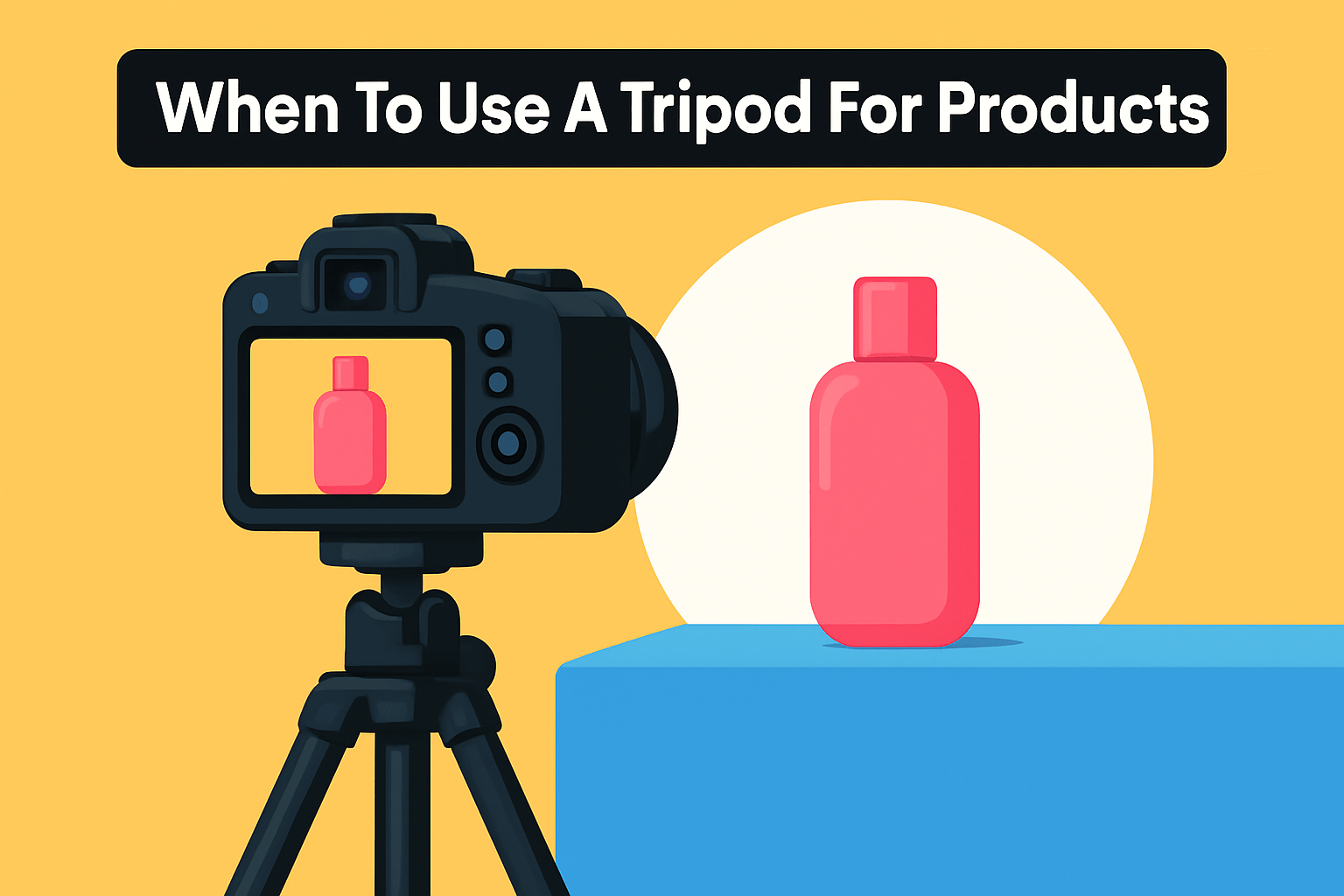
Use a tripod whenever you need images that are reliably sharp and repeatable. If you’re shooting ecommerce, catalog pages, 360° spins or fine-detail items like jewelry, a tripod removes the guesswork and keeps each frame consistent so retouching and alignment become far easier.
Low light and slow shutter speeds are classic tripod moments. When you’re stopping down to get more depth of field or using continuous, moody lighting that forces shutter speeds below handheld-safe thresholds, the camera has to be immobile to capture crisp detail.
Macro work and focus stacking practically demand a solid support. Tiny focus shifts ruin a stack; a geared head or a rigid ball head plus an Arca‑compatible plate lets you make incremental, repeatable adjustments. I also use live view with 100% zoom, mirror lockup and a remote trigger to eliminate any last vibrations.
Consistency in framing is another big reason. If you need identical compositions for multiple products, alternate angles, or a turntable sequence, a tripod keeps your camera axis fixed so every shot lines up without frantic cropping later. For top‑down flat lays, a center column that swings horizontal or an overhead arm makes precise framing painless.
Don’t forget comfort and workflow. Long shoots with heavy lenses get tiring fast; a tripod takes the weight and lets you concentrate on light and styling instead of balancing equipment. On location I pick a lighter carbon fiber model, and in the studio I favor a beefier, more rigid stand.
A simple rule of thumb: if you’re stopping down, dropping below about 1/125s shutter, doing macro or stacking, or you need repeatable framing, put the camera on a tripod. Add ballast when possible, level carefully, and use a remote or timer for the sharpest results.
Choosing The Right Tripod Head For Products
Start with one simple rule: match the head to the level of precision your shoot requires. If you’re lining up perfect perpendicular overheads, macro stacks, or catalogue images where every edge must be parallel, the head matters as much as the legs.
Geared heads are the gold standard for studio product work. They let you nudge pan, tilt and roll in tiny, predictable increments so you can eliminate keystone distortion and lock in exact framing without fiddling the camera by hand.
Three-way (pan‑tilt) heads give independent control of each axis and feel more intuitive than geared heads. They’re slower to use but offer very good precision for product setups where you want distinct controls without the mechanical fine-tuning of gears.
Ball heads are fast and versatile when you need to reposition frequently. They’re great for quick setup and location work, but can sag or drift under heavy camera/lens combos and are less suited to micro‑adjustment tasks.
Practical details make a big difference: the head must hold your kit without flex, accept Arca‑Swiss plates for rapid, repeatable swaps, and have smooth, well‑damped controls. Short panning handles and secure locks reduce accidental shifts during rotations, which keeps your frames consistent.
In the real world I often use a hybrid workflow — a ball head to rough compose and a geared head to finish critical shots. Before buying, try the head with your actual camera and lens to check for sag at extreme angles and to feel the locking action; smooth, fatigue‑free operation matters over long sessions.
Finally, balance precision with portability: pick a head that gives repeatable, confident results for the kind of product work you do most often, rather than the fanciest option on the shelf. Repeatability and stability will save you more time in post than any gimmicky feature.
What People Ask Most
What is the best tripod for product photography?
There is no single best tripod; choose one that matches your shooting style and equipment. Prioritize stability and a head that lets you make the precise adjustments your work requires.
What features should I look for in a tripod for product photography?
Look for solid stability, a head type that supports precise alignment, and enough load capacity for your camera and lens. Portability and compatibility with common quick‑release systems are useful practical considerations.
Do I need a tripod for product photography?
A tripod is essential when you need sharp images, consistent framing, or are working in low light or at slow shutter speeds. For quick, informal shots it may be optional, but a tripod improves control and repeatability.
What type of tripod head is best for product photography?
Geared heads offer the finest incremental control and are well suited to studio overhead and macro work. Three‑way heads balance control and ease of use, while ball heads are fastest but typically less precise for detailed alignment.
Can a tabletop tripod work for product photography?
Tabletop tripods can work well for small items and tight spaces where a full tripod is impractical. They are limited by load capacity and flexibility, so they are best for light setups and smaller products.
How tall should a tripod be for product photography?
Choose a tripod that lets you comfortably compose both overhead and low-angle shots used in your work. Features like an adjustable or removable center column increase versatility without relying on a specific maximum height.
Conclusion For Best Tripod For Product Photography
Choosing the right tripod comes down to four priorities: stability, head precision, load capacity and portability, balanced against the way you shoot.
If you mainly work in a controlled studio environment prioritize precision and rigidity for overhead and macro work, while location shooters will benefit from lighter, faster‑setup designs that still hold steady.
Think about your typical sessions, gear weight and whether features like horizontal or removable columns and smooth, fatigue‑free adjustments will improve your workflow.
If you want to keep improving your images and gear choices, read more of our site’s practical guides and reviews to sharpen technique and decision making.
Have a question or want specific setup advice for a shoot? Leave a comment below and we usually reply within a few hours.


0 Comments