
Which light will make your subject pop, travel with you to a location, and render skin tones accurately in mixed conditions?
This guide focuses on the best light for camera work, comparing five top options across power, portability, color control, and real-world performance.
We cut through marketing and test how lights behave on set, from punchy studio rigs to run‑and‑gun location days.
Expect straightforward comparisons of output, color fidelity, handling, and usability so you can match gear to your workflow.
Instead of one-size-fits-all picks, we outline each option’s strengths and trade-offs so you choose by need, not buzzwords.
We point to who benefits—hobbyists, streamers, portraitists, or full-time studios—while flagging practical caveats such as size and power source.
Our observations come from real shoots, testing lights with modifiers, mixed ambient light, and multi-hour use to reveal true limits.
We emphasize what matters day-to-day: portability, power options, and how easily you can dial color.
By the end you’ll have a short list shaped by what you shoot, how you travel, and how much color and output control you need.
This isn’t about buying the flashiest unit; it’s about finding the best light for your camera and creative process.
Ready to narrow the field and pick the right unit for your kit?
Scroll on and we’ll walk through practical strengths, ideal users, and the trade-offs that matter most to working photographers and filmmakers.
1. Godox SL300II Bi-Color Overview

Godox SL300II-BI 320W Bi-Color LED Video Light
Powerful bi-color continuous lighting with smooth dimming and accurate color, ideal for video, interviews, and studio production.
Check PriceThe Godox SL300II Bi-Color is a continuous bi-color LED designed for photographers who need serious, steady studio light. It covers 3200K–6500K, so you can match tungsten or daylight without fumbling with gels.
Under the hood it’s a 300W COB LED delivering roughly 99,300 lux at 1 meter. That kind of output holds up when you throw large modifiers on it, so you get smooth, even light across the frame instead of hot spots.
Color stability is one of its strengths; users report reliable, stable color output during long shoots. A quiet cooling fan with a silent mode makes it comfortable for video and location work where noise matters.
Mechanically it’s built to be a studio workhorse and accepts Bowens-mount modifiers, giving you access to softboxes, beauty dishes, and other shaping tools. Do keep in mind it’s mains powered only, so it’s best for studios or locations with AC power available.
In short, the SL300II is ideal for serious hobbyists, semi-pros, and professionals who prioritize high continuous output, color control, and modifier flexibility over battery portability. If you need powerful, dependable continuous light and can provide mains power, this is a very good option.
- Powerful 300W output
- Bi-color control (3200K–6500K)
- Quiet operation with silent fan mode
- Accepts Bowens-mount modifiers
- Larger size reduces portability
- Mains powered only (no battery)
2. Profoto B10X Plus Overview

Profoto B10X Plus
Compact, battery-powered studio-quality light delivering consistent power and quick recycling for location work and creative lighting setups.
Check PriceThe Profoto B10X Plus is a portable flash that punches well above its size. At 500Ws it gives you real strobe power while keeping a powerful LED modeling light for shaping light on the fly.
What makes this unit sing for portrait and fashion work is the blend of studio-grade output and location flexibility. It supports both battery and mains operation, so you can move from studio to a rooftop and keep consistent performance.
It also integrates advanced features professionals rely on: TTL, high-speed sync, and freeze modes are all built in, which speeds up your workflow and helps when shooting fast-changing scenes or wide apertures outdoors. Wireless control via the iPhone Bluetooth app makes adjustments quick without running back to the stand.
Build quality and ease of use are repeatedly praised, and that premium feel shows when you’re changing modifiers, mounting the unit, or dialing in settings mid-shoot. Real-world users rate the light quality highly, which matters most in skin tones and fashion detail.
If you’re a pro or creative needing both power and portability, this is an attractive option—the 500Ws output handles large or complex setups but still fits into a mobile kit. The caveat is cost: it’s a premium product, and adding modifiers and accessories raises the total investment.
In short, choose the B10X Plus if you need studio-level power with on-location freedom, TTL/HSS convenience, and a refined build. If budget is the main concern, factor in accessory costs before committing.
- 500Ws power
- TTL & high-speed sync capable
- Battery and AC power options
- Premium build + iPhone Bluetooth app control
- Premium price point
- Accessories increase overall cost
3. Godox AD300Pro Overview

Godox AD300Pro 300W TTL HSS Flash
Versatile portable strobe with reliable TTL and high-speed sync for fast-paced shoots, travel-friendly and powerful.
Check PriceThe Godox AD300Pro is an off-camera flash (strobe) that punches well above its size. It delivers high-quality flash output suitable for full-length portraits and includes wireless multi-group control, so you can manage complex setups without running cables.
In practical shooting it’s a strong performer both in the studio and on location. It competes well in bright daylight and is frequently noted for its ability to overpower natural light when you need a clean, crisp subject separation.
Users consistently praise the AD300Pro for striking a balance between quality and price. The wireless system is intuitive, letting you control multiple groups remotely, which speeds up workflows for small teams or solo shooters who need fast lighting changes.
If you’re a photographer looking for professional flash capability without a premium price tag, this is a very sensible choice. It’s portable enough to carry to location shoots while still offering the punch required for portraits, events, and outdoor setups.
Be mindful of a couple of trade-offs: battery life is limited compared to mains-powered units if you run extended continuous use, and there’s a setup and learning curve that may challenge absolute beginners. For many photographers—especially hobbyists stepping into pro work or pros needing a reliable portable strobe—the AD300Pro offers an excellent mix of portability, control, and output.
- Good balance of power and portability
- Excellent wireless control for complex setups
- Suitable for indoor and outdoor shoots
- Affordable entry to professional flash lighting
- Limited battery life on continuous use vs. mains-powered options
- Setup and learning curve may challenge beginners
4. Nanlite Forza 150 Overview

Nanlite Forza 150B Bi-Color LED Spot Light
Compact spot fixture offering adjustable color temperature, punchy output, and precise beam control for demanding on-location cinematography.
Check PriceThe Nanlite Forza 150 is a compact continuous LED light that punches above its size. It delivers 150W of power and measures 27,960 lux at 1 meter, giving you strong, usable output for portraits and video without lugging a heavy fixture.
At just 1.36 kg it’s easy to carry and set up on location or in a small studio space. The unit’s high color fidelity is consistently praised, so skin tones and color-critical work stay reliable without constant color correction in post.
Power flexibility is another plus: use mains power for longer shoots or swap to an optional V-mount battery when you need true mobility. That battery option makes it a practical choice for run-and-gun videographers and photographers working where AC isn’t available.
Be realistic about its limits — it’s bright for its class, but not a 300W+ studio head, so large studios or setups needing extreme output may require something more powerful. For anyone who values color accuracy, portability, and a clean continuous light for smaller spaces or on-location shoots, the Forza 150 is a very sensible, photographer-friendly choice.
- Bright 150W output (27,960 lux at 1m)
- Lightweight and compact (1.36 kg)
- Excellent color accuracy/high fidelity
- Mains or optional V-mount battery power
- Not as powerful as 300W+ fixtures for large studios
- Battery and accessories sold separately
5. Rotolight AEOS 2 Pro Overview

Rotolight AEOS 2 Pro RGBWW LED Light with HSS Flash
Hybrid continuous and flash unit with full RGBWW palette, rapid HSS firing, and cinematic color effects for photographers and filmmakers.
Check PriceThe Rotolight AEOS 2 Pro is a versatile LED continuous light that also offers flash capability, making it a hybrid tool I reach for on shoots that demand both video and stills flexibility. Its design leans toward portability and creative control, so you get a lot of functionality without lugging heavy kit.
In practical terms it produces 11,700 lux at 3 feet, which gives you solid punch for portraits, interviews, and small set pieces. Where it really stands out is the creative palette: 2,500 digital filters and 16.7 million colors let you craft very specific moods without gels or complicated setups.
Because it doubles as continuous light and flash, the AEOS 2 Pro adapts across workflows — use it for cinematic continuous setups, then switch to flash when you need to freeze motion or nail a highlight. That duality makes it useful on location when you want to travel light but still cover both photo and video demands.
Users often praise it for cinematic looks and multi-function utility; I’ve found it particularly handy for creative portraits and short film lighting where color effects matter. The flip side is the digital control system — it opens a world of options but can take a little time to master if you prefer tactile simplicity.
So who is this for? If you’re a professional or creative who prizes dynamic lighting effects and the convenience of one unit that serves as both flash and continuous source, this is a strong choice. Just keep in mind it trades off some absolute raw output compared to high-power, single-purpose lights.
- Flash + continuous in one portable unit
- 2,500 digital filters and 16.7 million colors
- Lightweight and easy for location work
- Good output (11,700 lux at 3 ft) for many environments
- Digital filters/effects need learning time
- Lower lux output than some high-powered lights
Key, Fill, Hair Light Roles
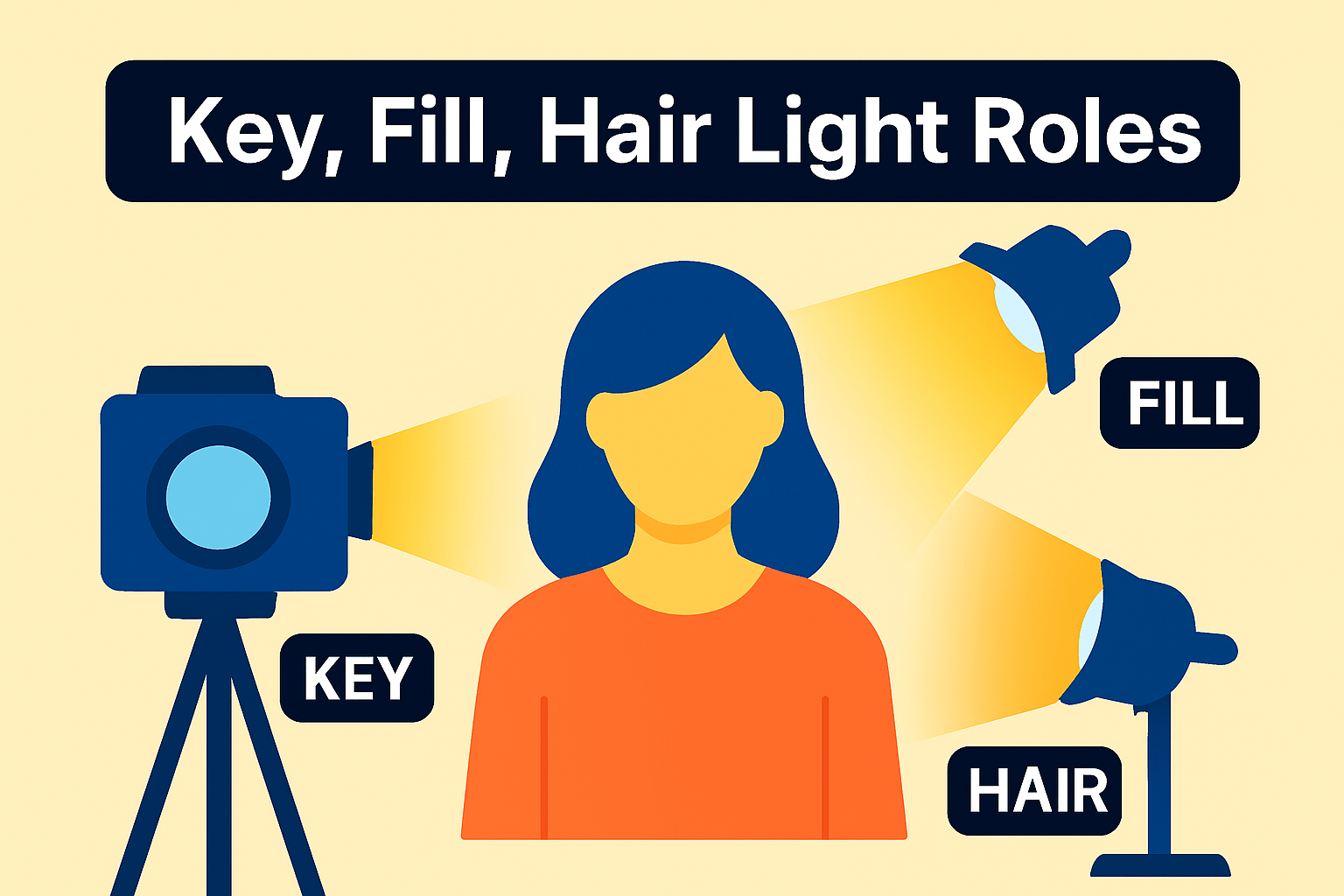
The key light is where you start. It defines mood, direction and the shape of your subject. Place it roughly 45° to the face and decide whether you want soft, flattering wrap or a harder, more dramatic edge by choosing a softbox or a smaller modifier.
The fill light’s job is simple: tame the shadows without flattening the image. Keep it opposite the key and notably dimmer — think a 1:2 or 1:4 ratio for natural depth, or even lower if you want strong contrast. A reflector, bounce card or a soft fill head works beautifully here and keeps skin tones pleasing while preserving modeling.
A hair or rim light is the secret to separation. Set it behind and a little above the subject, aimed at the back of the head and shoulders to create a bright rim that cuts the subject out from a dark background. Use a snoot, grid or barn doors to control spill so the face doesn’t start to pick up unintended highlights.
Think of the three lights as a conversation, not a checklist. If the key is soft and wide, the fill should be subtler; if the key is punchy, the fill can be stronger to balance. Small shifts in angle and distance change contrast quickly, so move lights a few inches and watch the falloff.
Practical tweaks save time on set. Meter your key for baseline exposure, then drop the fill a stop or two and dial the hair until it reads as separation without flare. For dark hair or dark backgrounds, nudge the hair light a touch brighter; for pale skin or light backgrounds, back it off.
Finally, adapt these roles to your gear and space. A single speedlight can be bounced for fill, a compact LED can function as a key, and a tiny bare bulb makes an effective kicker in tight locations. Keep ratios and control in mind, and you’ll get polished, three-dimensional portraits with minimal fuss.
Color Temperature: Matching Ambient Light
Mixed lighting is one of the most common headaches on location. Daylight sits around 5500K while tungsten bulbs run near 2700K, and that gap shows up as green or orange casts if you don’t plan for it.
Matching color temperature isn’t just technical nitpicking — it’s how you keep skin tones honest and the scene feeling cohesive. When lamps and window light fight, the subject looks odd and grading becomes a chore.
Start by measuring. A handheld color temp meter speeds things up, but a simple gray or white card and your camera’s custom white balance work fine in most situations. I also carry an X‑Rite color checker for tricky commercial work; it’s a life-saver in post.
Adjust your lights to the same Kelvin when possible. Modern LEDs let you dial in exact values, and bi‑color heads are great for blending with ambient light. With strobes, reach for CTO/CTB gels to warm or cool the flash so it matches the room.
Shoot RAW and set a deliberate white balance rather than trusting auto WB, especially in mixed scenes. RAW gives you latitude to fine‑tune later, but getting close in camera saves time and reduces noise when you correct big shifts.
On location I decide the dominant source first — usually the look I want is dictated by the window or a practical lamp — then adjust my fixtures to support it. Remember that bounced light changes color too, so test shots of the final setup are essential.
Don’t be afraid to use mismatched temperatures intentionally; warm tungsten against cool daylight creates cinematic separation and mood when used knowingly. If you do, include a color reference in the frame so post work stays consistent.
Ultimately, measure, match, test, and control. A few minutes of profiling and a couple of gels will save you an hour of painful color correction later.
What People Ask Most
What is the best lighting for video recording?
Even, flicker-free continuous lighting with adjustable color temperature and good color accuracy works best for video. Softening light with modifiers helps flatter subjects and reduce harsh shadows.
What is the best lighting for photography?
It depends on the look you want, but controllable lights with consistent output and accurate color rendering are reliable choices. Modifiers and power control let you shape the light for portraits, products, or creative effects.
What color temperature is best for cameras?
Match the color temperature to your ambient light or the mood you want and set white balance accordingly. Neutral, natural-balanced tones are commonly used for accurate skin tones while warmer or cooler settings create stylistic looks.
What type of light is best for filming—LED, fluorescent, or incandescent?
LEDs are often preferred because they offer stable output, adjustable color, and easy dimming. Fluorescent and incandescent lights can still be used but may require more color correction or careful control.
What is the best lighting setup for beginners?
Start with a simple three-point approach—key, fill, and rim—to learn how each light shapes the image. Use soft, controllable lights or modifiers and experiment with intensity ratios to find flattering results.
How many lumens do I need for video or photography?
Required brightness depends on the scene, lens, and camera sensitivity, so focus on getting a clean exposure rather than a single lumen target. Test and adjust lighting on location to balance exposure, depth of field, and motion needs.
What is the best light for live streaming?
A soft, even continuous light with accurate color rendering and adjustable intensity works best for streaming. Place it to minimize shadows and avoid glare or flicker on camera.
Conclusion for Best Camera Lighting
Whether you need a high-power studio fixture, a portable flash, an affordable strobe, a compact continuous light, or a hybrid unit, the five options discussed give you clear starting points for different shooting styles and budgets.
Use the practical trade-offs — power versus portability, continuous versus flash, and how well you can control color — as your decision framework, and match your choice to the subjects, locations, and workflows you shoot most often.
If you want to build skills and confidence with these tools, explore more of our site for technique guides, setup walkthroughs, and real-world tips that will speed your progress.
Have questions or want advice for a specific setup? Leave a comment below and we usually reply within a few hours.


0 Comments