
Ever watched a dancer’s leap and wondered how to freeze that perfect moment while keeping the atmosphere of the stage? Dance photography forces you to balance speed, light, and emotion in a single frame. This guide reviews five top lenses for dance work and pairs those reviews with practical shooting tips and a handy FAQ to help you choose and shoot with confidence across theater, studio, and outdoor settings.
Whether you photograph dim theaters, cramped rehearsal studios, or bright outdoor stages, the lens you pick changes everything. You’ll want glass that excels in low light, creates subject separation with smooth background blur, and locks focus on split-second movement even with minimal lighting rigs. I’ll break down how different focal lengths, apertures, and stabilization features affect the way you capture dancers so you can match gear to your shooting style.
Expect real-world observations about autofocus performance, depth-of-field control, reach versus context, and handling under theater lights. I’ll also offer practical tips on framing from different angles and working with tricky stage lighting and color casts so your images stay sharp and expressive. By the end you’ll know which compromises matter most for your dance work and how to get the look you want in challenging conditions.
1. Canon EF 70-200mm f/2.8L III IS USM

Canon EF 70-200mm f/2.8L IS III USM
Professional telephoto zoom delivering constant f/2.8 brightness, advanced stabilization, rapid USM autofocus and rugged weather-sealed construction for sharp, reliable results in any shooting condition.
Check PriceThe Canon EF 70-200mm f/2.8L III IS USM is widely regarded as the gold standard for dance and indoor sports work. It combines fast, accurate autofocus with effective image stabilization to give consistently usable frames in challenging conditions.
It excels on stage and in theaters. Photographers commonly reach for it for ballet, stage performances, and fast-moving dancers in low light because it maintains sharp focus during quick movement.
The constant f/2.8 aperture is a real asset for dance photography. It provides strong background separation and reliable low-light performance, letting you isolate performers and keep shutter speeds high enough to freeze motion.
Sharpness is consistent across the zoom range, even at maximum aperture, so you can zoom in and out without worrying about a sudden drop in detail. The build is durable and weather-sealed, which makes it a dependable workhorse for regular, heavy use in varied venues.
Be aware of the trade-offs. The lens is heavy and bulky, so it can become tiring during long shoots. Also keep in mind that repairs or maintenance can be expensive if the lens is damaged, so treat it as a serious investment.
If you need a lens that reliably tracks motion, separates subjects from busy backgrounds, and performs in dim theaters, this lens is a top choice. If you frequently carry gear for long stretches or are on a tight budget for repairs, weigh those concerns before committing.
- Fast, reliable autofocus for tracking moving dancers
- Excellent image stabilization for reduced handheld blur
- Consistent sharpness across the zoom range, even at maximum aperture
- Durable, weather-sealed build
- Heavy and bulky; tiring during long shoots
- Expensive to maintain or repair if damaged
2. Sigma 50-100mm f/1.8 DC HSM Art

Sigma 50-100mm f/1.8 Art DC HSM for Canon EF
Ultra-fast constant f/1.8 zoom delivering stunning sharpness, creamy bokeh and professional-grade optics—perfect for portraits and low-light creative shooting.
Check PriceThe Sigma 50-100mm f/1.8 DC HSM Art is a go-to for APS-C shooters who need a fast, versatile zoom for dance and action. It’s popular with APS-C users needing a fast zoom for dance and action, and that reputation is well earned in dim theaters and rehearsal studios.
That constant f/1.8 aperture is the headline here. f/1.8 aperture effective in low light for faster shutter speeds and motion freezing, and it gives you the shallow depth of field needed to isolate a dancer from a busy stage even when you’re relatively close.
In practice the lens delivers on sharpness and color. Praised for sharpness and color rendition, especially for solo dancers or small groups, it keeps detail where it matters — faces, hands, and the crisp lines of costumes. The autofocus is responsive and reliable enough to track quick moves, and the build feels solid without being cumbersome.
Because it’s designed for APS-C bodies it feels more compact and lightweight than many full-frame professional zooms, which makes long rehearsals and run-throughs less tiring. Do note the limitations: only compatible with APS-C cameras, and some minor chromatic aberration reported at wider apertures. For most dance shooters using crop-sensor bodies who want a fast, sharp zoom for portraits, solos, and small-group coverage, this lens is a very practical and creative tool.
- Exceptionally fast f/1.8 aperture, ideal for low-light performances.
- Sharp image quality throughout the zoom range.
- Good autofocus speed for a wide-aperture zoom.
- More compact and lightweight than many professional zooms.
- Only compatible with APS-C cameras.
- Some minor chromatic aberration reported at wider apertures.
3. Canon EF 85mm f/1.4L IS USM

Canon EF 85mm f/1.4L IS USM
Fast f/1.4 portrait prime with image stabilization, smooth bokeh, precise autofocus and durable pro-level construction for flattering subject isolation.
Check PriceThe Canon EF 85mm f/1.4L IS USM is a go-to for dance portraits and tight close-ups where background blur and subject isolation matter most. Its fast f/1.4 aperture gives you creative depth-of-field control, letting dancers separate from busy stage backgrounds with beautiful, creamy bokeh.
In dim venues this lens delivers sharp, detailed images, so you can rely on it when theater lighting is less than ideal. The built-in image stabilization is a real advantage for handheld shooting, helping maintain sharpness at slower shutter speeds without pushing ISO too high.
Autofocus behavior is solid in challenging lighting, so you can track expressions and subtle movement during intimate moments. That combination of reliable AF, wide aperture, and IS makes it especially useful for portrait-style shots, rehearsal coverage, and dress rehearsals where access is close.
Be mindful of its framing limitations: this focal length is primarily suited to portraits and close-ups rather than wide group or ensemble shots. Some users also note it can feel slightly heavy during extended handheld sessions, so plan for breaks or use a monopod if you’ll be on your feet for hours.
Overall, if your work emphasizes isolating individual dancers, capturing facial expressions, or creating moody stage portraits, this lens is a strong choice that balances optical quality with practical stabilization. It’s less ideal when you need wide coverage of groups or full-stage context, but for intimate, high-impact dance images it excels.
- Outstanding image quality with rich detail and smooth bokeh
- Image stabilization helps maintain sharpness in low light
- Fast f/1.4 aperture for creative depth-of-field control
- Reliable autofocus in challenging lighting
- Suited mainly for portraits/close-ups; not ideal for wide group shots
- Slightly heavy for extended handheld use
4. Nikon 70-200mm f/2.8G ED VR II

Nikon AF-S NIKKOR 70-200mm f/2.8G ED VR II
Pro-grade telephoto zoom with constant f/2.8, vibration reduction, superior ED glass and swift AF—built for sports, wildlife and event photographers.
Check PriceAs a working dance photographer I often reach for the Nikon 70-200mm f/2.8G ED VR II. It’s favored for versatility and performance in low-light dance photography.
The 70–200mm reach and constant f/2.8 aperture give you room to frame dancers on stage while still enabling subject separation and usable shutter speeds in dim venues. It delivers sharp, vibrant images with accurate color rendition, which is crucial when costumes and lighting are varied.
The VR system reduces camera shake during handheld shooting, letting you shoot longer focal lengths without immediately resorting to a monopod. That excellent image stabilization is especially useful during longer performances where tripods are impractical.
Autofocus is fast and accurate, so you can trust it to catch sudden movements and changing poses. Consistent sharpness and color across the zoom range means you won’t lose image quality as you zoom in or out during a set.
This lens is built to take a beating—durable and reliable after heavy use, with a robust build quality that stands up to regular gigs. The trade-offs are clear: it is heavy and bulky and can get tiring during long shoots.
If you mostly shoot stills of live performances and need dependable low-light performance with stabilization, this is a lens that will serve you very well. If you also do a lot of video, be aware some users report minor focus breathing when shooting video.
- Fast, accurate autofocus for capturing moving dancers.
- Excellent image stabilization for handheld low-light work.
- Consistent sharpness and color across the zoom range.
- Robust build quality.
- Heavy and bulky; tiring during long shoots.
- Some users report minor focus breathing when shooting video.
5. Fujifilm XF 56mm f/1.2 R

Fujifilm XF 56mm f/1.2 R
Wide-aperture portrait prime delivering gorgeous bokeh, exceptional low-light performance and tactile manual aperture control for expressive imagery.
Check PriceThe Fujifilm XF 56mm f/1.2 R is a staple for Fujifilm shooters who want intimate, portrait-style dance images. It excels at close-up dance shots where subject isolation and expression matter most.
What stands out is the bokeh and sharpness even at maximum aperture. That creamy background separation makes a dancer pop off the stage and keeps attention on lines and expression.
Autofocus is fast enough to be useful for moving subjects, which helps when you need to nail fleeting moments in a performance. Many users also report excellent image quality in low-light conditions, so you can work in dim theaters without sacrificing detail.
Physically the lens is compact and lightweight, making it easy to handhold through rehearsals and long shows. That handling comfort matters when you’re moving around to find angles and don’t want to be weighed down.
There are practical limitations to consider. It’s a prime 56mm focal length on APS-C Fujifilm bodies, so it’s mainly for portraits and tighter shots rather than wider stage coverage. Also, some users note the autofocus can slow in very low light, so plan your shooting positions and exposure strategy accordingly.
- Exceptional bokeh and subject isolation for dance portraits.
- Fast, accurate autofocus in low light.
- Compact and lightweight; easy to handle during long shoots.
- Consistent sharpness and color rendition.
- Limited to Fujifilm X-mount cameras.
- Can be slow to focus in very low light for some users.
Shooting From Different Angles
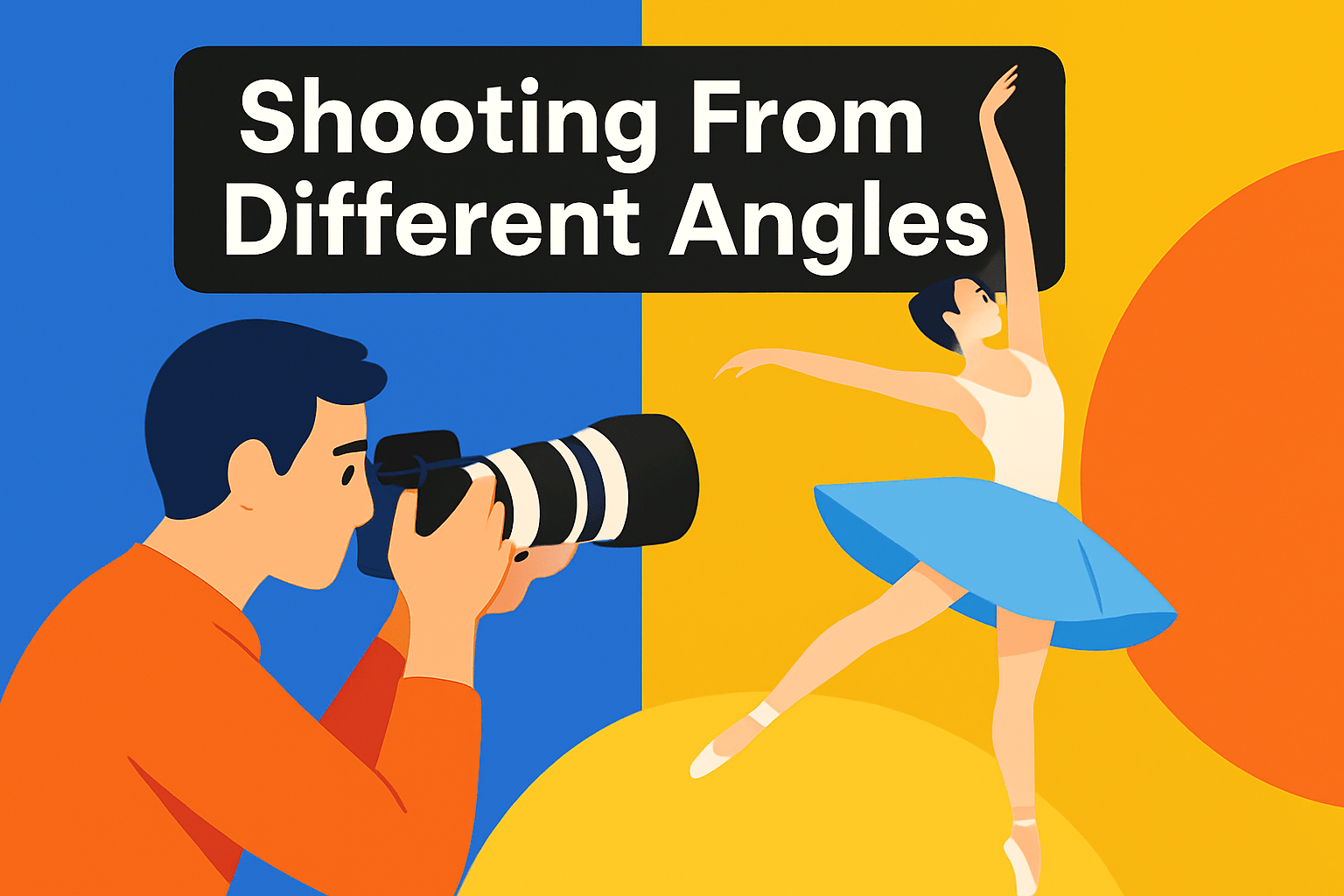
Angles change the story you tell with a single frame. A small shift left or right can turn a static pose into a sweeping line or reveal a fleeting expression. When you move with intention, your images gain energy and variety.
Where you stand matters: center, side, and balcony all give different perspectives. Straight-on frames are great for symmetry and reading facial expressions. Side positions reveal the flow of limbs and the arc of movement.
For jumps and lifts I often drop my viewpoint a little. A slightly lower angle exaggerates height and drama and makes leaps feel airborne. For intimate portraits I step to eye level so emotion reads true and personal.
Think about proximity versus context before the shutter fires. Close-ups isolate expression and costume detail. Stepping back or using a longer view preserves choreography, set, and the relationship between dancers.
If you lack stage access, try shooting at ground level a few rows behind front center. That spot usually balances closeness with a clean view over heads. It’s a reliable compromise when you can’t get into the pit.
Be cautious with high balcony positions. From too far up dancers lose detail and appear flat, and images can suffer from atmospheric haze. If you must shoot from distance, tighten your framing and make sure you have enough resolution to crop without losing detail.
Every angle changes the light on your subject. Side and backlight can create gorgeous rim highlights and depth, but they also risk silhouettes or lens flare. When backlight occurs, expose for the dancer or add a bit of fill so faces don’t disappear into shadow.
Vary your angles throughout the performance rather than settling on one vantage. Alternate frontal, side, low, and pulled-back shots to build a gallery that shows technique, emotion, and context. With practice you’ll learn which vantage best suits each choreography and moment.
Isolating the Dancer From the Background
Isolation is about making the dancer the clear subject, not just blurring the background. Open the aperture — f/1.4-f/4 gives shallow depth of field and creamy bokeh in low light. A fast lens also lets you keep shutter speeds high to freeze motion.
Distance from dancer to backdrop matters. Even a few extra meters will soften lights and set details. If you can’t move the dancer, back up and use a longer focal length to increase background blur or reposition to find cleaner angles.
Longer focal lengths change perspective and blur. Shooting tighter with a longer reach, especially with telephoto lenses, squashes the scene and smooths backgrounds. That’s handy when the set is busy and you can’t remove distractions.
Add soft foreground layers to create depth and help the dancer pop. A hand, curtain edge or rail from the wings in soft focus frames the shot and guides the eye. Keep them subtle so they support the dancer, not steal attention.
Keep backgrounds simple and use negative space to emphasize poses. Use plain curtains, dark wings or empty stage areas to position the dancer behind them. If nothing is clean, crop tighter to remove clutter and focus on expression or line.
Light and color do most of the heavy lifting. Make the dancer the brightest part of the frame, or choose costumes that contrast with the set for instant separation. Side or backlight adds a rim that separates the figure without needing extreme blur.
When separation must be absolute, use short-duration off-camera flash to freeze motion and light only the subject. With wide apertures, place your focus point on the eyes, use back-button focus, and be ready to shift as the dancer moves. Nail the focus; pair shallow DOF with directional light, crop tight if needed, and the dancer will stand out.
What People Ask Most
What is the best lens for dance photography?
The best lens depends on your shooting needs, balancing low-light performance, subject isolation, and reach. Choose a lens that offers a wide aperture and the focal length you need for your typical framing.
What focal length is best for dance photography?
Is a prime or zoom lens better for dance photography?
Primes often deliver wider apertures and strong subject isolation, while zooms give flexibility to reframe quickly without changing position. Consider whether low-light aperture or compositional versatility matters more for your work.
What aperture should I use for dance photography?
Wide apertures are generally preferred to achieve shallow depth of field and aid low-light shooting, with common choices spanning from very wide to moderate settings. Stop down as needed to keep multiple dancers in focus or increase depth of field for group shots.
What lens is best for indoor/low-light dance photography?
For indoor and low-light situations, prioritize lenses with wide apertures and reliable autofocus, and consider image stabilization if you shoot handheld. These features help maintain sharpness and subject separation in dim venues.
Which lens is best for ballet photography?
Ballet often benefits from lenses that combine reach with subject isolation to capture stage performances and expressive close-ups. Choose optics that deliver sharpness, smooth bokeh, and consistent autofocus in theater lighting.
What lens is best for capturing fast movement in dance?
To freeze fast movement, use lenses with quick, accurate autofocus and a wide aperture so you can use faster shutter options. Stabilization can help when shooting handheld, but reliable focus tracking is most important for action.
Conclusion for Best Lenses for Dance Photography
In short, choosing the right lens for dance photography is about balancing mount compatibility, aperture for low-light and subject isolation, stabilization for handheld work, and focal lengths that suit your intended framing and distance.
Think about how those trade-offs affect autofocus reliability, handling during long shows, and the kind of motion and detail you need to capture most often.
Whenever possible, test gear in the venues and lighting you use—borrow, rent, or try lenses at workshops to see how weight, reach and depth of field perform in real conditions.
If you want to improve your skills and refine gear choices, read more articles on this site for practical tips and comparative guidance to build confidence behind the camera.
Have questions or experience to share? Leave a comment below and we’ll usually reply within a few hours to help you move forward.


0 Comments