
What separates a beautiful, frame-filling bird portrait from a distant, underwhelming dot of feathers?
More often than not it comes down to lens choice—reach, sharpness, handling and budget all shape the final image.
Tiny songbirds, wary shorebirds and birds in fast flight present very different challenges.
The right lens gives optical reach, reliable AF and the sharpness to show fine feather detail.
Handling affects how long you can stay in the field and how steady your tracking will be.
Weight, balance and stabilization often matter as much as raw focal length for practical shooting.
This guide evaluates five standout options across the spectrum.
You’ll find travel-friendly long-reach models, versatile long-range zooms for backyard to distant birds, compact mirrorless tele options, pro-grade long primes, and flagship super-tele lenses for demanding work.
Expect real-world notes on handling, autofocus, image quality and value to help match a lens to your shooting style.
No marketing fluff—just practical advice drawn from field experience and common trade-offs.
Whether you prefer to travel light or you need ultimate reach and resolution, there’s a lens that fits your needs.
Let’s cut through specs and marketing and focus on what works in real birding situations.
Ready to upgrade your kit and capture sharper, closer bird images?
1. Olympus M.Zuiko 300mm f/4 IS Pro

Olympus M.Zuiko Digital ED 300mm f/4.0 Pro
High-resolution telephoto lens delivering superb sharpness and fast autofocus for wildlife and sports; lightweight build for handheld shooting and rugged weather sealing.
Check PriceThe Olympus M.Zuiko 300mm f/4 IS Pro is a surprisingly versatile telephoto for bird photographers who prioritize portability without sacrificing image quality. On Micro Four Thirds bodies like the Olympus OM‑1 it gives a 35mm‑equivalent reach of 600mm, so you get serious reach in a package you can actually carry all day.
Optically it’s strong — users praise its sharpness and fine detail, and in the field I’ve found it resolves feathers and eye detail very reliably. It pairs especially well with the OM‑1’s Pro Capture mode for nailing fast bird movement, increasing keeper rates when birds flare or take off suddenly.
One of the lens’s biggest selling points is how light and travel‑friendly it is compared with longer primes. The effective 5‑axis image stabilization lets you handhold longer than you’d expect, which is a game changer for hikes, shorelines or quick roadside stops where setting up a tripod isn’t practical.
You should be aware of the trade‑offs: the f/4 aperture won’t give as much background separation as faster primes, so you may need to work your angles more to blur busy backgrounds. Also, while 300mm native (600mm equiv.) is excellent for many situations, it can feel short for very distant or ultra‑shy species where extra reach or a teleconverter would help.
- Excellent sharpness and optical detail
- Very lightweight for its reach
- Effective 5‑axis image stabilization
- Weather‑sealed construction
- f/4 gives less background separation than faster primes
- 300mm native (600mm equiv.) may be short for very distant or shy birds
2. Tamron 150-600mm f/5-6.3 G2

Tamron SP 150-600mm f/5-6.3 Di VC USD G2 for Nikon
Versatile super-telephoto zoom with stabilized optics, fast autofocus, and durable construction—ideal for distant wildlife, birding, and action photography.
Check PriceThe Tamron SP 150-600mm f/5-6.3 Di VC USD G2 is the kind of zoom I reach for when I need serious reach without the weight or price of a prime 600mm. Its 150–600mm range covers everything from backyard birds to distant wildlife, and Tamron’s generation‑2 improvements make autofocus noticeably snappier for the money.
In the field it feels lighter and more handy than a prime 600mm, so you can realistically handhold it for longer bursts or hike with it all day. The lens also includes effective vibration compensation (VC), which, combined with good AF speed and accuracy, means more keepers when birds are moving or conditions aren’t perfectly still.
One practical plus is how many users pair this lens with teleconverters to get extra reach; that flexibility makes it a very versatile choice for hobbyists and serious enthusiasts who don’t want to switch to heavier glass. Optically it delivers strong sharpness across the zoom range, so you’re not sacrificing image quality for flexibility—especially important when you need to crop into a distant bird.
Be realistic about the tradeoffs: the f/5–6.3 aperture limits low‑light performance compared with faster primes, and autofocus can slow down in dense foliage or very dim conditions. Still, for the price, reach and handling, it’s a mostly positive package that balances performance and practicality for most bird photographers.
- 150–600mm reach for distant birds
- Fast, accurate autofocus for the price
- Strong sharpness across the zoom range
- Effective VC and relatively lightweight
- Slow f/5–6.3 aperture in low light
- AF can lag in dense foliage or dim scenes
3. Nikon Z 400mm f/4.5 VR S

Nikon NIKKOR Z 400mm f/4.5 VR S
Compact prime delivering crisp detail, fast tracking, and advanced vibration reduction—made for sports and long-range wildlife with professional-grade optics.
Check PriceThe Nikon Z 400mm f/4.5 VR S is a compact, sharp telephoto built with Nikon Z users in mind. It’s described as suited for larger birds and birds in flight, delivering the reach and resolution you need without the bulk of heavier primes.
With an f/4.5 maximum aperture it’s slightly faster than many zooms, so you get better low‑light performance and subject separation than typical zoom options. That extra stop of light makes a real difference at dawn and dusk when bird activity is highest.
Handling is a strong point: effective VR and a lighter overall weight improve handheld usability and reduce fatigue during long stakeouts. On Z bodies the lens offers stable autofocus and good image stabilization, which helps keep more keepers when birds are moving or when panning for flight shots.
If you need more reach, the lens accepts a 1.4x teleconverter to extend focal length to roughly 560mm, giving extra reach for shy or distant subjects while keeping retained image quality and autofocus performance reasonable. That makes it a versatile tool for field photographers who don’t want to carry a giant prime.
In short, this lens is great for Nikon Z shooters who want a balance of sharpness, manageable weight, and enough reach for most birding situations. Be aware that f/4.5 is slightly slower than classic f/4 primes, and the maximum focal length is limited compared with 600mm+ primes, so it’s a trade‑off between portability and ultimate reach.
- Excellent sharpness and image quality at 400mm
- Lighter than 600mm f/4 primes, improving handheld usability
- 1.4x teleconverter compatibility (extends to ~560mm)
- Stable autofocus and good image stabilization on Z system
- f/4.5 is slightly slower than classic f/4 primes
- Max focal length limited compared with 600mm+ primes
4. Canon RF 600mm f/4 L IS USM
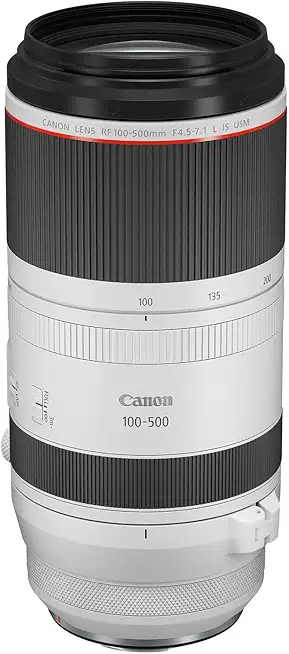
Canon RF 100-500mm f/4.5-7.1 L IS USM for EOS R
Flexible zoom offering broad reach, quick autofocus, and stabilisation; pro-grade build ensures reliable performance in travel, wildlife, and sports.
Check PriceThe Canon RF 600mm f/4 L IS USM is widely considered a gold standard for Canon wildlife and bird photography, and for good reason. It pairs long reach with a true f/4 aperture to deliver exceptional image quality and subject isolation.
Autofocus performance is a standout — fast and accurate for tracking fast birds in flight or sudden movements at a distance. Optically it stays very sharp even wide open, so you get edge‑to‑edge detail without stopping down excessively.
Construction is built for pro use: a professional build with robust weather sealing that stands up to field conditions. That durability comes at a cost in size and weight, though; the lens is bulky and heavy, and is typically used with solid support gear.
This lens suits photographers who prioritize ultimate image quality, low‑light ability and reliable AF over portability. If you routinely shoot distant subjects, need strong background separation at f/4, and can carry or mount a heavy prime, this lens will reward you with images that justify the investment.
On the flip side, if you hike light, travel solo without support gear, or need a budget‑friendly option, the Canon RF 600mm f/4 L IS USM may feel impractical. Expect to pair it with a sturdy tripod or gimbal head for extended sessions to get the most from its optical and AF advantages.
- Outstanding image sharpness and detail
- f/4 for strong subject isolation and low‑light ability
- Fast, reliable autofocus optimized for wildlife
- Durable, weather‑sealed construction
- Heavy and large; needs sturdy tripod/gimbal
- Very expensive
5. Nikon 600mm f/4E FL ED VR

Nikon NIKKOR Z 600mm f/4 TC VR S
Extreme telephoto with integrated 1.4x converter, superior sharpness, and powerful stabilization; built for pro wildlife and action at extreme distances.
Check PriceThe Nikon 600mm f/4E FL ED VR is widely regarded as Nikon’s pinnacle telephoto prime for bird and wildlife work, and for good reason. It delivers extremely sharp images with superb autofocus and effective vibration reduction, making it a go‑to for professionals who need ultimate reach and resolution.
Optically it’s built to resolve fine feather detail and maintain contrast at long distances, so you’ll get the kind of razor‑sharp results that stand up to heavy cropping and large prints. The AF and VR are tuned for serious field use, helping you track fast birds and reduce motion blur in challenging light.
That performance comes at a cost in size and weight. This lens is heavy and typically used with benches or strong tripods to avoid fatigue during long sessions, so handheld work is limited unless you have exceptional stamina or support gear. It also supports teleconverters, extending focal length up to 840mm at f/5.6, which is invaluable when you need extra reach without changing lenses in the field.
In short, if you’re a dedicated bird photographer with access to sturdy support gear and the budget for professional glass, this Nikon will reward you with uncompromising image quality and reliability. If you shoot casually, travel light, or can’t comfortably manage heavy kit, it may be more lens than you need.
- Supreme optical performance and razor‑sharp images
- Fast autofocus and effective vibration reduction
- Compatible with teleconverters — extends to 840mm at f/5.6
- Robust, weather‑sealed build
- Very heavy and bulky; needs strong support gear
- High price and maintenance cost; impractical for casual birders
Choosing Focal Lengths for Birding
I always start with three practical questions: how close can I get, how big is the bird, and how much of the habitat do I want in the frame. Those answers quickly point you toward shorter glass for context or longer glass for tight portraits. Keeping those distances in mind—backyard feeders, shoreline edges or distant treelines—helps avoid buying reach you won’t use.
For perched birds I typically reach for 300–600mm. That range lets you fill the frame without crowding the subject, and it’s often light enough to handhold or use with modest support. It’s a great starting point for most backyard and woodland situations.
When I’m shooting birds in flight I step up to 400–800mm whenever possible. In the field 400mm is often the sweet spot: long enough for close-ups but short enough to track and compose without constantly swapping lenses. Tiny songbirds on the wing or distant seabirds will push you toward the long end of that range.
Think about species size: small, skittish birds usually need 400–800mm to fill the frame without disturbing them, while large birds like herons, geese or raptors often look better at 200–400mm when you want habitat included. Deciding whether you want isolation or storytelling should come before you pick glass. Focal length is the simplest creative control you have over that choice.
Going out to 600–800mm buys distance, stronger background compression and pleasing subject separation, which can create dramatic portraits from afar. The trade-off is handling—longer lenses demand steadier support and more careful technique to avoid blur. If you plan long sessions at those distances, factor in tripods or gimbal heads and how much gear you’re willing to carry.
Finally, remember sensor size affects reach: crop bodies increase effective focal length by roughly 1.5–1.6×, so a 300mm on crop behaves like about a 480mm equivalent on full frame. That can let you choose smaller, more portable glass without losing reach, but it won’t eliminate the need for proper support or thoughtful composition. If you’re unsure, a 400mm-class lens is the most versatile compromise between reach, handling and image-making options.
Prime Vs Zoom For Birds
Choosing between a prime and a zoom is one of the most practical decisions you’ll make as a bird photographer. It’s essentially a trade-off: zooms buy you flexibility and reach, primes buy you aperture, separation and sometimes that last bit of sharpness.
Zooms shine when birds move unpredictably or you’re moving yourself. Being able to reframe from 300mm to 600mm without changing lenses keeps you on the bird and reduces missed opportunities. Modern zooms are also surprisingly sharp and often lighter to carry, which matters on long walks or travel days.
Primes repay you when image quality and low‑light performance matter most. A faster f/4 or f/2.8 prime gives stronger subject isolation and lets you hold faster shutter speeds at lower ISO — a real advantage for freezing wing motion or rendering delicate feather detail. For deliberate work from a hide or tripod, a prime will often produce the punchier images you want.
Weight and handling are part of the decision. Long primes can be heavy and need a solid tripod or gimbal to be usable for hours, while many mid‑telephoto primes are compact and handholdable. Pick gear that matches how you shoot: if you move a lot, choose lighter; if you sit and wait, prioritize optics.
Teleconverters extend reach but come with trade‑offs: they reduce effective aperture and can tax autofocus. They usually behave best on high‑quality primes, so factor converter use into your choice if you need extra reach without swapping lenses.
My practical rule is simple: start with the best zoom you can afford unless your shooting style clearly demands a fast prime. As you learn what you shoot most, add a prime for the situations where that extra stop and resolution really change the picture.
If you can, rent or borrow before you buy. Try a zoom on a day of mixed habitat and a prime on a focused trip; feeling how each matches your rhythm will tell you more than any spec sheet.
What People Ask Most
What focal length is best for bird photography?
It depends on how far you can get from the bird, the bird’s size, and the composition you want. Longer focal lengths help fill the frame from a distance while shorter focal lengths include more of the habitat. Choose a focal length that matches your typical shooting distance and style.
Do I need a telephoto lens for bird photography?
A telephoto lens is very helpful for avoiding disturbance and getting tight images of distant birds. For large or very approachable birds you can often use shorter lenses, but telephoto reach is generally recommended. Consider how close you can reasonably get when deciding.
Is a 300mm lens enough for bird photography?
A 300mm lens can be plenty for many perched or nearby birds and is often a convenient travel option. However, it may be limiting for very small or distant subjects. Think about the distances you typically shoot and whether you need extra reach.
Is a zoom or prime lens better for bird photography?
Both have strengths: zooms offer framing flexibility for changing distances and scenes, while primes often provide wider apertures and top optical quality. Choose based on whether versatility or the ultimate image quality matters more to your shooting style. Many photographers use both depending on the situation.
What aperture is best for bird photography?
A wider aperture helps isolate the subject and improves low-light performance, while a narrower aperture increases depth of field for sharp subjects. Balance aperture choice with the shutter speed you need to freeze motion. Aim for an aperture that delivers acceptable subject separation without sacrificing sharpness.
Do I need image stabilization for bird photography lenses?
Image stabilization is useful when handholding, especially with long lenses or slower shutter speeds, to reduce blur from camera shake. For birds in flight you will often use faster shutter speeds, but stabilization still helps for perched birds and tracking. It’s a helpful feature to improve keeper rate in many real‑world situations.
What features should I look for in a lens for bird photography?
Prioritize sharp optics, reliable and fast autofocus, and comfortable handling for prolonged use. Weather sealing and effective stabilization are also valuable, along with compatibility with support gear and teleconverters if you need extra reach. These features make a lens more versatile and durable in field conditions.
Conclusion On Bird Photography Lenses
Choosing the right lens ultimately comes down to distance to the subject, the size of the bird, your shooting style and the budget and support you have available.
Whether you favor a flexible zoom for changing situations, a compact long‑reach option for travel, or a heavy prime for ultimate image quality, each approach carries trade‑offs in reach, handling and background separation.
Match your lens choice to real‑world needs—consider how often you shoot distant or fast birds, how much weight you can carry, and what support gear you’ll use to keep shots sharp.
If you want to keep improving, read more of the site’s articles for practical tips and comparisons to help refine your gear and technique.
Have questions or want to share your experiences with different lenses? Leave a comment below and we usually reply within a few hours.


0 Comments