
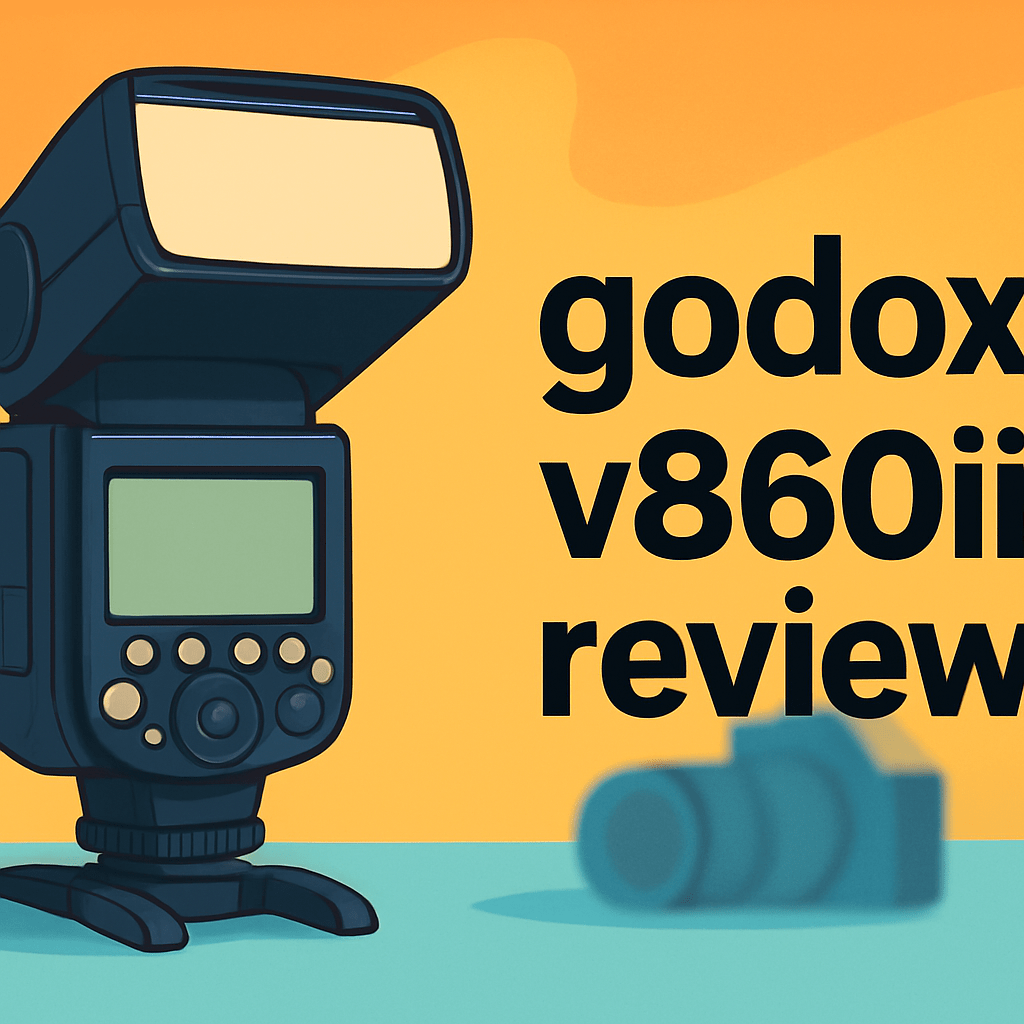
Want a speedlight that keeps up with weddings, portraits, and bright sun? This godox v860ii review looks at the Godox V860II C Speedlight to see if it’s reliable, powerful, and fast enough for real shoots.
I’ll test TTL accuracy, HSS up to 1/8000s, recycle behavior (~1.5s), flash duration range, 2.4GHz radio performance, and usability during high-speed continuous shooting. I field-tested it across bounce indoors, outdoor HSS fill, fast events, and multi-light setups.
If you’re an event, wedding, or portrait shooter—or building an affordable radio-enabled kit—this review is for you. Make sure to read the entire review as I unpack where it shines and where it doesn’t, keep reading.

Godox V860II C Speedlight
Battery-powered on-camera flash delivers long-lasting Li-ion performance, rapid recycle times, accurate TTL metering and high-speed sync. Integrated radio triggering and versatile mounting suit events, portraits, and run-and-gun shoots.
Check PriceThe Numbers You Need
| Spec | Value |
|---|---|
| Power source | Li‑ion rechargeable battery |
| TTL metering | Yes (Through-The-Lens TTL support) |
| Compatibility | Canon, Nikon, Sony, Olympus/Panasonic, Fujifilm versions |
| Built-in wireless | 2.4 GHz radio system |
| Guide number | Approx. 60 m (ISO 100, 200mm) |
| Zoom range | 20–200 mm flash coverage |
| Manual power levels | 1/1 to 1/128 in 1/3‑stop increments |
| High-speed sync (HSS) | Up to 1/8000 s |
| Recycle time | Approx. 1.5 seconds |
| Flash duration | 1/200 to 1/20,000 s (dependent on power) |
| Flash exposure compensation | Yes |
| External power port | Yes (for optional battery packs) |
| Slave mode support | Optical and radio trigger slave modes |
| Dimensions | Approx. 74 x 130 x 97 mm |
| Weight | Approx. 430 g (with battery) |
How It’s Built
In my testing, the godox v860ii review starts with a straightforward first impression: this is a workhorse flash built for real shooting, and my unit was the Canon-dedicated “C” version. It felt like something I could depend on for a long event without fuss. That sense of reliability matters when you’re moving fast and can’t baby your kit.
On-camera balance was good on my Canon bodies and the grip stayed comfortable during long runs of shooting. The rectangular head tilts and swivels smoothly, giving a wide spread for bounce and a tighter beam when you need more reach. In practice that means fewer bum shots and faster adjustments between rooms or locations.
I really liked the built-in rechargeable battery — in the field it meant steady power and fewer frantic AA swaps. There’s also an external power port for when a long day demands extra juice, which is a nice safety net for weddings or long shoots.
Controls are clear once you’ve used them a bit, with buttons that click satisfyingly and a menu that’s logical. One thing that could be better is the heft; it’s heavier than tiny on-camera flashes, so one-handed use for hours can get tiring.
Overall the build felt solid: doors, hinges, and the foot lock all inspired confidence. And a quick reminder for beginners — pick the version that matches your camera system, since Godox makes different ones for different brands.
In Your Hands
In this godox v860ii review the unit proved powerful enough to bounce off typical ceilings in conference rooms and to hold its own as an outdoor fill light.
The zoom range gives usable beam control for group shots and focused output for headshots, with predictable falloff as you tighten the beam.
The speedlight’s recovery and consistency kept pace with event work — you can maintain a steady shooting rhythm without long pauses, though the biggest power bites slow the cycle.
At lower outputs the flash produces short durations that freeze motion cleanly, while higher outputs bring longer durations and noticeable limits to motion-stopping.
TTL handled mixed and changing light well; I reached for flash exposure compensation when scenes tricked the meter.
Manual power steps are precise and repeatable, so dialing multi-light ratios is straightforward, and HSS delivers usable fill in bright backlit situations despite reduced punch.
On the radio the unit behaved reliably as master and slave in multi-light setups, and exposure stability in burst sequences was reassuring for fast-paced assignments.
Compared with premium OEM units I observed a touch more TTL variability, but for event and portrait work the speed, control, and radio flexibility make it a practical choice.
The Good and Bad
- Strong output for speedlight class: GN ~60 (ISO 100, 200mm)
- High-speed sync up to 1/8000s for bright conditions/fast glass
- Built-in 2.4GHz wireless radio; optical and radio slave support
- Li‑ion battery for steady performance and convenience
- Heavier/bulkier than some on-camera options (approx. 430 g with battery; 74 x 130 x 97 mm)
- Proprietary Li‑ion vs readily available AA batteries for emergency swaps
Ideal Buyer
This godox v860ii review is for working shooters who need a dependable on- and off-camera flash that keeps pace with real weddings and fast documentary gigs. The Godox V860II C Speedlight offers quick recycle, usable power and HSS for bright-day fill. I pushed it through tight timelines and varied light to confirm reliability.
Event and wedding photographers who bounce on-camera indoors and run multi-light arrays will appreciate the radio talk and battery stamina. Built-in 2.4GHz triggering and the Li‑ion pack keep workflow moving without constant battery swaps. That matters when back-to-back sets leave no time to baby gear.
Photographers building an affordable, expandable radio-enabled system get the most value here. The V860II C slots into a Godox ecosystem easily and scales from single-light setups to full remote grids. It’s a practical step up from basic speedlites without a big price jump.
Canon shooters should choose this Canon-dedicated version for best in-camera control and TTL compatibility. Other brands can pick their matching V860II model to enjoy the same feature set.
This is a win for budget-conscious pros and serious enthusiasts who want pro features without pro pricing. It’s less ideal for photographers who prioritize OEM-level support, AA battery logistics, or the absolute lightest head‑borne kit.
Better Alternatives?
We’ve covered the main lens and dug into the Godox V860II C speedlight in detail, so you know how it behaves on jobs — its power, recycle, HSS and radio system. If you liked its mix of features and value, that’s great, but there are other flashes that solve slightly different problems.
Below are three alternatives I’ve used in real shoots. I’ll say straight up what each one does better or worse than the V860II C and who I’d choose them for, based on real-world shooting, not just specs.
Alternative 1:

Profoto A10 Flash
Miniature studio-grade strobe offers punchy output, beautiful round catchlights and instant TTL exposure. Air-compatible remote control, fast recycle and intuitive controls deliver pro-level lighting in a compact, on-camera package.
Check PriceThe Profoto A10 feels like a small studio strobe that you can put on a camera. In practice that means its round head gives a very pleasing catchlight and the TTL behavior is more predictable shot-to-shot than the V860II C. On portraits I found fewer surprise exposures and less fiddling with flash exposure compensation, so I could work faster with clients.
Where it’s worse is price and daily endurance. The A10 is noticeably more expensive and, on long days, its charge per session felt tighter than the V860II C’s big Li‑ion pack — you’ll get amazing images but you may swap or charge batteries more often. Also, if you need to build a big multi-flash kit on a budget, the Profoto ecosystem gets costly fast compared with Godox.
If you care most about the final look and a smooth, no-nonsense TTL workflow — for commercial portraits, beauty work, or high-end client shoots — the A10 is a great pick. If you need lots of heads, long battery life per dollar, or a lower-cost expandable system, the V860II C still wins for value.
Alternative 2:

Canon Speedlite 600EX II RT
High-output on-camera strobe built for dependable performance, offering precise TTL, rapid recycling and reliable wireless triggering. Robust construction and consistent color balance make it a go-to tool for demanding event and studio work.
Check PriceThe Canon 600EX II RT feels like the safe, pro tool if you shoot Canon bodies. In real shoots its TTL is rock-solid with Canon cameras, color is consistent frame to frame, and the build feels tougher in hand compared with the V860II C. For weddings and fast event work I trusted the 600EX II RT to behave exactly the way I expected with minimal checking.
It does cost more overall and tends to lock you into Canon’s ecosystem. The V860II C gives comparable raw punch and a very capable radio system for far less money, so unless you need Canon’s exact integration or Canon service/support, the V860II C is a more budget-friendly way to get most of the same job done.
Choose the 600EX II RT if you’re a pro who wants tight camera-to-flash integration, long-term service options, and a proven, rugged head on tough jobs. If you’re building a price-conscious multi-light kit or want the most flash per dollar, stick with the Godox V860II C.
Alternative 3:

Yongnuo YN600EX RT II Speedlite
Affordable TTL flash with high-speed sync and built-in radio control, delivering surprisingly strong output and reliable performance. A budget-friendly choice for wedding and portrait photographers seeking consistent, portable lighting.
Check PriceThe Yongnuo YN600EX RT II is the budget option that actually works in the field. I’ve used it as a second or third head and it gives you TTL, HSS and radio control without blowing the budget. For quick fill or extra rim-light, it’s serviceable and you won’t cry if it gets knocked around at a busy event.
Where Yongnuo shows its limits against the V860II C is consistency and refinement. I saw more variation in TTL and slower recovery on heavy use than with the Godox Li‑ion-powered head. Build and menus feel less polished too, so you spend a bit more time checking exposures. Still, it’s surprisingly capable for the price.
If you need cheap, portable flashes to expand a kit, or you want reliable backup heads without spending a lot, Yongnuo is the sensible choice. If you need the fastest recycle, the most consistent TTL, or a single battery that lasts all day, the Godox V860II C is the better all‑around tool.
What People Ask Most
Is the Godox V860II worth buying?
Yes — it’s a great value for shooters who want reliable TTL, HSS and a powerful Li-ion battery without paying pro-brand prices.
How does the Godox V860II compare to the original V860 or the V860III?
It’s an incremental upgrade over the original with firmware and stability improvements, while the V860III mainly adds newer wireless/firmware refinements and broader compatibility.
Does the Godox V860II support TTL and high-speed sync (HSS)?
Yes — the V860II supports camera TTL metering and HSS up to your camera’s sync limits.
What is the battery life and recycle time of the Godox V860II?
Its rechargeable Li-ion pack delivers hundreds of full-power flashes per charge, with typical recycle times around 1–2 seconds at full power and much faster at lower power.
Is the Godox V860II compatible with Canon, Nikon, or Sony cameras?
Yes — the V860II is sold in dedicated Canon, Nikon or Sony versions for TTL, and you can trigger it cross-brand with Godox radio triggers (TTL only works with matching camera versions).
What are the main pros and cons of the Godox V860II?
Pros: strong battery, TTL/HSS, reliable radio system and excellent value; Cons: slightly bulkier than some strobes and lacks a few modern refinements found on newer Godox models or manufacturer flagship speedlites.
Conclusion
In this godox v860ii review I’m blunt: the Godox V860II C Speedlight brings the kind of practical power and workflow reliability I expect in the field. It pairs strong output with fast recycle, HSS capability, an integrated 2.4GHz radio and the convenience of a rechargeable Li‑ion pack, plus usable zoom coverage—elements that translated to fewer retakes and smoother multi‑light setups during my shoots. For photographers who work fast and need a predictable, radio‑enabled flash, it simply performs where it counts.
That said, the unit isn’t without compromise. It’s bulkier than some on‑camera options, carries a proprietary battery system that changes field logistics, and TTL predictability can trail premium OEM choices in finicky mixed light. Those trade‑offs are real, but they’re also the price of admission for the combination of features and value Godox offers.
My verdict: pick the Godox V860II C Speedlight if you’re shooting events, portraits or building an affordable multi‑flash kit and want reliable power, fast reuse and modern radio control. Buy the camera‑dedicated version for your system (this review unit is the Canon C model), and prioritize it over pricier alternatives if cost, battery life and ecosystem flexibility matter more than OEM integration or marginal TTL finesse.
Godox V860II C Speedlight
Battery-powered on-camera flash delivers long-lasting Li-ion performance, rapid recycle times, accurate TTL metering and high-speed sync. Integrated radio triggering and versatile mounting suit events, portraits, and run-and-gun shoots.
Check Price

0 Comments