

Have you ever stood on a ridge at dawn, spun your camera across the scene, and wished the whole vista would fit into one seamless image? Which lens will let you stitch flawless horizons without the usual headaches?
Panoramic photography can make that wish real, but the difference between a clumsy stitch and a gallery-worthy sweep is usually the lens. We’ve handpicked five lenses that excel at panoramic work, with a focus on wide-angle and landscape performance.
The selections span full-frame, APS‑C and Micro Four Thirds systems so you can find a match for your camera and budget. Each option was chosen for its ability to deliver consistent results in the field.
We evaluated optical performance alongside practical traits like stabilization, autofocus, weight and weather sealing. Field of view and edge-to-edge image quality were priorities because they determine how cleanly images stitch.
Whether you favor a single ultra-wide capture or a multi-shot stitched panorama for maximum resolution, gear choice changes your approach. This guide keeps the technicalities clear and useful so you can make real-world decisions.
Expect concise, photographer-tested advice that helps you match lens strengths to scenes — from travel and cityscapes to sweeping landscapes and night-sky panoramas. By the end you’ll know which kind of lens will let your horizons breathe.
1. Canon RF 15-35mm f/2.8L IS USM

Canon RF 15-35mm f/2.8L IS USM for EOS R
Professional ultra-wide zoom with constant bright aperture, advanced stabilization, and exceptional edge-to-edge sharpness for landscapes, architecture, and low-light shooting.
Check PriceThe Canon RF 15-35mm f/2.8L IS USM is an ultra-wide 15–35mm zoom with a constant f/2.8 aperture and Image Stabilization rated up to 5 stops. It’s built to L-series standards with weather sealing, so it feels like a tool made for serious outdoor work.
In the field it delivers superb edge-to-edge sharpness that makes stitching panoramas remarkably seamless. Autofocus is fast and silent, which helps when you’re shooting multiple frames in succession across a scene. The IS actually lets you handhold panoramas in dim light without resorting to a tripod for every shot.
The wide f/2.8 aperture is genuinely useful beyond daytime landscapes — it gives you reach for star fields and low-light foregrounds when you want fewer stitched frames or night panoramas. Weather sealing and robust construction mean you can keep shooting through wind, spray, or light rain without worrying about your gear.
There are trade-offs: the lens is relatively heavy and large, so it’s less ideal for minimalist travel setups. Users also note a premium price, but that cost buys a combination of wide coverage, low-light capability, stabilization and pro-grade build that many landscape and astro photographers will appreciate.
- Ultra-wide 15–35mm zoom
- Constant f/2.8 for low light and stars
- Image Stabilization up to 5 stops
- L-series weather-sealed construction
- Relatively heavy and large
- Premium price noted by users
2. Olympus M.Zuiko Digital ED 7-14mm f/2.8 PRO

Olympus M.Zuiko ED 7-14mm f/2.8 PRO for Micro Four Thirds
Extreme ultra-wide-angle lens offering constant f/2.8 performance, weather-sealed build, and impressive distortion control for dramatic landscapes and interiors.
Check PriceThe Olympus M.Zuiko Digital ED 7-14mm f/2.8 PRO is a go-to ultra‑wide for Micro Four Thirds shooters, offering 7–14mm (≈14–28mm full‑frame equivalent) coverage that truly captures sweeping landscapes and dramatic panoramas. Its constant f/2.8 aperture gives you real flexibility in early/late light and even for astrophotography when you want to push for stars.
Optically it’s very sharp across the entire zoom range, which makes stitching multiple frames together feel seamless and detailed. Users consistently praise its minimal distortion for such an ultra‑wide design, so you get expansive compositions without wrestling with warped edges.
Build quality follows the PRO line: weather‑sealed and robust, so you can work in harsh outdoor environments without second‑guessing your gear. That reliability combined with the lens’s strong image performance means you can confidently shoot long panorama sequences in the field.
For landscape photographers on Micro Four Thirds bodies who prioritize image quality, low‑light capability and a tough build, this lens is mostly a no‑brainer. Keep in mind it’s designed for MFT systems, so it’s not appropriate for full‑frame users, and some photographers note it feels relatively heavy compared to other mirrorless options.
- Ultra‑wide 7–14mm (≈14–28mm FF equiv)
- Constant f/2.8 for low light and stars
- Weather‑sealed, professional build
- Extremely sharp across the zoom range
- Designed for Micro Four Thirds; not for full‑frame
- Feels heavy for mirrorless standards
3. Sigma 17-40mm f/1.8 ART (APS-C)

Sigma 17-40mm f/1.8 DC Art, APS-C, Canon RF mount — bundle: 67mm UV filter, lens cap keeper, cleaning kit, cloth
Fast-aperture standard zoom for crop sensors delivering striking background separation and sharpness; bundle includes 67mm UV filter, cap keeper, and cleaning kit.
Check PriceThe Sigma 17–40mm f/1.8 ART for APS‑C bodies is an unusual but compelling tool for panoramic work — a wide-to-standard zoom with a remarkably bright f/1.8 maximum aperture. It’s built as part of Sigma’s ART line, so optics prioritize sharpness and clarity, and it’s offered for multiple mounts such as Sony E and Fujifilm X.
In real-world use the lens delivers exceptional center and mid-frame sharpness, which is exactly what you want when stitching multiple frames into a panorama: consistent detail in the overlapping areas makes seams disappear. Edge performance shows minor softness at 17mm when shot wide open, but that weakness is often negligible for pano stitching where you rely on center detail and can stop down slightly if needed.
The f/1.8 aperture is a genuine advantage for handheld panoramas in low light or for adding separation in layered scenes; it also helps you keep shutter speeds up between shots. Autofocus is smooth and fast, useful when you’re working quickly or capturing mixed photo/video sequences, and flare control is generally good so highlights and sunlit scenes stay manageable.
There are trade-offs: the lens is larger and heavier than some APS‑C competitors, so it’s less of a “travel light” option. Still, for photographers prioritizing image quality, low‑light flexibility and multi‑mount compatibility, this Sigma is a mostly excellent choice for stitched panoramas and detailed wide-to-standard composed panoramas.
- Very bright f/1.8 for varied lighting
- Strong center performance for fine detail
- Smooth, fast AF
- Multi-mount availability
- Slight edge softness at the widest focal length
- Larger and heavier than some APS‑C competitors
4. Canon RF-S 10-18mm f/4.5-6.3 IS STM
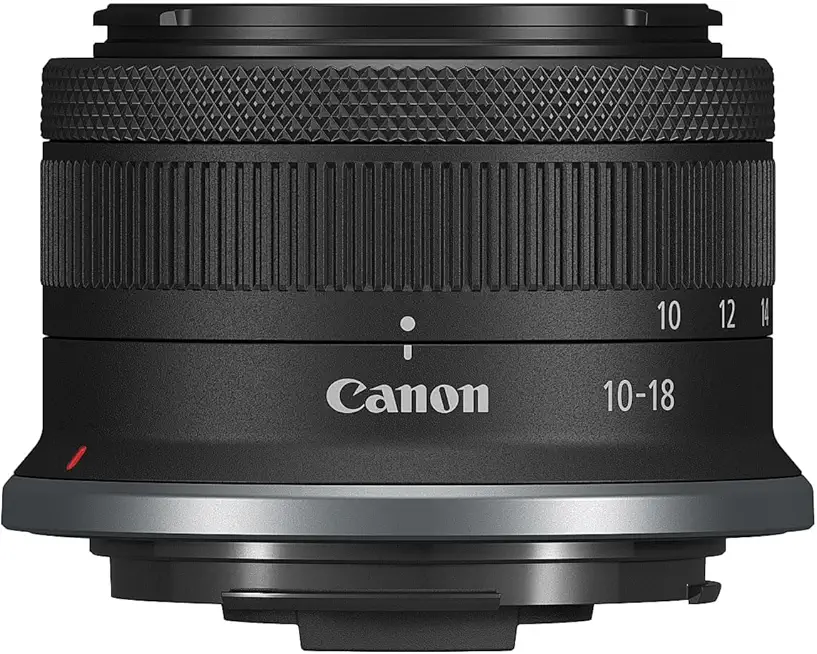
Canon RF-S 10-18mm f/4.5-6.3 STM for EOS R, APS-C
Compact ultra-wide zoom optimized for crop-sensor cameras, whisper-quiet focusing, lightweight design ideal for vlogging, travel, and expansive perspectives.
Check PriceThe Canon RF-S 10-18mm f/4.5-6.3 IS STM is an ultra-wide 10–18mm zoom designed specifically for Canon APS‑C mirrorless cameras. Its compact, lightweight collapsible design makes it a lens I reach for when I want to travel light but still capture expansive scenes.
Image Stabilization rated up to 4 stops is a practical advantage for handheld panoramas, especially during golden hour or on overcast days when tripods are a hassle. The STM motor delivers quiet, smooth focusing that helps keep capture sequences steady and unobtrusive when stitching multiple frames.
Optically, it produces sharp images with good contrast that stitch together nicely for panoramas, and Canon’s in-camera corrections do a solid job handling barrel distortion. That means fewer headaches in post and cleaner seams when you’re blending frames across a wide scene.
For travel and spontaneous landscape work this lens is a real asset — its small footprint encourages shooting more angles and capturing more pano opportunities on the move. If you’re shooting on a Canon APS‑C body and prioritize portability and ease of use, it’s mostly a win.
Keep in mind the trade-offs: the variable, relatively narrow aperture limits low-light flexibility compared with faster lenses, and there’s no weather sealing, so you’ll want to be cautious in rough conditions. Overall, it’s a very usable, photographer-friendly option for handheld and travel panoramas.
- Small, lightweight collapsible design
- Image Stabilization up to 4 stops
- Quiet, smooth STM autofocus
- Good sharpness with in-camera distortion corrections
- Narrower aperture limits low-light flexibility
- Not weather-sealed
5. Nikon Z 14-30mm f/4 S

Nikon NIKKOR Z 14-30mm f/4 S for Nikon Z
Versatile full-frame wide-angle zoom with constant f/4, ultra-slim profile and weather-sealed construction for seamless landscape and architectural photography.
Check PriceThe Nikon Z 14-30mm f/4 S is a practical ultra-wide zoom for Nikon Z full-frame shooters who want a lightweight, travel-friendly option for panoramas. Its 14–30mm range gives plenty of coverage for sweeping scenes while remaining compact enough to carry on long hikes or travel shoots.
Optically it’s built for stitch-friendly results: high image quality with low distortion means seams line up cleanly and you spend less time fixing geometry in post. That constant f/4 aperture isn’t a night-owl’s friend, but for daylight and golden-hour landscape work it stays sharp across the frame, which is exactly what you want when you’re blending multiple frames into a single panoramic file.
Autofocus is another strong suit — quiet and quick — which helps when you need to capture a series of overlapping frames without jerkiness or focus hunting between shots. The combination of reliable AF and consistent optics makes it easy to fire off sequential exposures for horizontal or vertical panoramas with confidence.
There are a couple of practical caveats to consider. The f/4 limit reduces low-light flexibility compared with faster lenses, so plan for tripods or higher ISOs if you’re shooting at dawn, dusk, or the Milky Way. Also, the barrel extends when zooming for some users, which can slightly change the balance on a gimbal or tripod head during long stitch sequences.
- Lightweight, compact full-frame ultra-wide zoom
- Good image quality with frame-wide sharpness
- Handles distortion well for stitching
- Smooth, quiet autofocus
- Constant f/4 less ideal in very low light
- Barrel extends when zooming, can unbalance setup
Telephoto Benefits for Panoramic Photography
Telephoto lenses—typically 70mm and longer—offer a different approach to panoramas. Rather than swallowing a scene in one frame, you photograph tight, overlapping slices and build a high‑resolution whole in post.
Because each shot covers a smaller area, you capture more pixels per unit of scene. The stitched panorama delivers far greater final resolution than a single wide frame, which is ideal for large prints or aggressive cropping.
Telephotos also simplify stitching. They tend to have less geometric distortion than wide lenses, and when your subjects are distant parallax is much reduced. That combination makes seams less obvious and straight lines hold together across panels.
Creatively, the compressed perspective is powerful. Distant ridgelines, cityscapes or cloud layers stack closer together and read denser on the frame. This compression helps isolate the subject and strips away distracting foreground clutter for a cleaner composition.
They’re surprisingly flexible in the field. You can refine composition by zooming instead of moving, and switching to portrait orientation for a tall pano is straightforward—lens collars or a solid tripod make rotations easier. Look for natural distant elements to act as frames; telephoto reach lets those features remain prominent without crowding the scene.
Practical workflow pays off. Shoot RAW, lock focus and exposure, and keep aperture and focal length consistent across frames; stopping down a stop or two from wide open often improves edge sharpness. I aim for roughly 25–40% overlap, use a tripod and remote release when possible, and rely on IS or higher shutter speeds only if handheld is unavoidable.
The trade-off is time and planning: more frames and steadier conditions are required. Do the work, though, and you’ll get panoramas with exceptional sharpness, massive resolution and a cinematic, layered look that wide glass can’t replicate.
Pros of Wide-Angle Lenses for Panoramas
I reach for wide-angle glass when I want to convey scale and place. Its broad field of view captures sweeping vistas in a single frame or trims the number of stitched panels needed. That saves time in the field and in post.
Wide lenses exaggerate depth, pushing foregrounds forward while keeping distant layers readable. That perspective feels immersive and makes scale obvious. It’s perfect for showing the relationship between rocks, water and sky.
Depth of field is another practical advantage. Wide glass gives a larger plane of focus so you don’t have to stop down as much to keep foreground and background sharp. Hyperfocal focusing works especially well here.
Distortion can be a creative asset when used deliberately. Curved lines and stretched perspective make strong leading lines and dynamic frames. If you need straight geometry, small corrections in post or careful framing do the job.
On the road a wide lens often means single-shot panoramas, which is a huge advantage when light or subjects change. You capture the scene quickly instead of assembling many frames. That speed is invaluable in travel and event situations.
Ultra-wide glass begs for a strong foreground. Get low, include texture, and use that anchor to pull the eye into the background. The interplay of near and far gives panoramas real presence.
Be aware of stitching pitfalls: moving elements at the edges and extreme barrel distortion can cause seams. Shoot with good overlap, consistent exposure, and a stable axis to reduce parallax. A leveled tripod and nodal head are worth the effort.
Modern bodies and software do a lot of correction, but composition still decides the picture. Choose your foreground, level the horizon, and decide where distortion can live. Done right, wide-angle panoramas feel immediate and dramatic.
What People Ask Most
What lens is best for panoramic photography?
There is no single best lens; the right choice depends on the scene and the look you want. Wide-angle lenses capture immersive vistas while longer lenses are useful when stitching multiple frames for higher detail.
What focal length is best for panoramic photography?
The best focal length varies with your approach and subject. Wider focal lengths work well for single-frame panoramas, while longer focal lengths help when creating multi-shot stitched images for greater detail.
Do you need a wide-angle lens for panoramic photos?
No, a wide-angle is not strictly required. Wide lenses make single-shot panoramas easier, but you can stitch multiple images taken with longer lenses to achieve the same result.
Is a tilt-shift lens useful for panoramic photography?
A tilt-shift lens can be very helpful for controlling perspective and keeping architectural lines straight. It also reduces some stitching complications by minimizing geometric distortion and parallax.
Can you use a telephoto lens to shoot panoramas?
Yes, telephoto lenses are commonly used to capture panoramas by stitching overlapping frames for high resolution. They tend to produce less distortion and a compressed perspective that suits layered landscapes.
Should you use a prime or a zoom lens for panoramic photography?
Both options have advantages: primes often offer excellent sharpness while zooms provide framing flexibility and speed. Choose based on whether maximum image quality or versatility is more important for your workflow.
What lens is best for 360-degree panoramic photography?
Specialized 360-degree or fisheye optics are typically used to efficiently capture full spherical panoramas. You can also create 360s with standard lenses, but that approach requires careful overlap and more images.
Conclusion for Best Lenses for Panoramic Photography
The five lenses reviewed span the ultra‑wide to wide spectrum across full‑frame, APS‑C and Micro Four Thirds, giving you flexible options for both sweeping vistas and tightly composed panoramas.
For ultimate detail and compressed perspective, a telephoto approach and multi‑frame stitching will serve you best, while wide‑angle choices deliver immersive single‑shot panoramas and exaggerated depth for dramatic foregrounds.
Let practical factors like sharpness, stabilization, autofocus, weight and weather sealing guide your selection based on the conditions you’ll shoot in and the story you want the image to tell.
Your final decision will come down to the scene, the look you’re after and how much planning or mobility you want to commit to—don’t be afraid to experiment with both approaches to find your signature style.
If you’d like to keep improving your skills and gear decisions, read more articles on our site for tips and workflows tailored to panoramic shooting.
Have questions or experiences to share? Leave a comment below and we usually reply within a few hours.


0 Comments