
Which Nikon lens will help you turn a sweeping vista into a jaw‑dropping photograph? Landscape photography demands lenses that capture fine detail, dramatic perspectives, and faithful color. This guide exists to help you choose the best Nikon lenses for landscape photography with confidence and clarity.
Rather than drowning you in specs, we highlight five standout Nikon options that cover the needs of landscape shooters. They span the tools you’ll reach for on cliffs, coastlines, and starry nights. Each recommendation reflects field performance, not marketing claims.
We’ll also offer practical buying guidance to match gear to your style, shooting habits, and travel plans. Expect clear, usable advice on trade‑offs like weight versus reach and sharpness versus flexibility. The goal is simple: help you pick a lens you’ll actually use when the light is perfect.
Whether you own a Nikon DSLR or shoot on a mirrorless body, the right lens can elevate your landscapes. Read on for approachable recommendations and real‑world tips that make choosing easier. By the end, you’ll know which direction to take your kit and why.
You’ll also get concise, real‑world shooting notes so you can use each lens effectively in the field. Whether you prize portability for travel or absolute sharpness for large prints, we’ll point you in the right direction. Consider this a practical roadmap to sharper, more expressive Nikon landscapes.
1. Nikon 14-24mm f/2.8G ED Ultra-Wide Zoom

Nikon AF-S NIKKOR 14-24mm f/2.8G ED
Professional ultra-wide zoom with bright aperture for dramatic landscapes and low-light interiors, delivering edge-to-edge sharpness and robust build.
Check PriceThe Nikon 14-24mm f/2.8G ED is an ultra-wide zoom built for sweeping, expansive landscape work where you want everything from foreground drama to vast skies in a single frame. It’s exceptionally sharp, delivering outstanding detail across the frame, and is praised by professionals for creating dramatic, large-scale compositions that really convey scale.
This lens shines on mountain ranges, cityscapes, and night skies thanks to excellent color rendition and clarity. The fast f/2.8 aperture gives genuine low-light performance, so you can push into blue hour or capture stars without always needing extreme ISO or long exposures.
That very wide field of view is both the lens’s power and its challenge: composition can be tricky, and it’s easy to produce busy images if you don’t simplify the scene. Be mindful of nearest foreground objects — the wide perspective can distort them, so place foreground elements carefully to avoid unwanted stretching.
Build quality is professional and weather-sealed, which makes the lens a dependable choice for harsh outdoor conditions. It’s on the bulky and heavy side compared with smaller primes or standard zooms, so pack accordingly; this is a tool aimed at landscape shooters who prioritize image quality and dramatic wide-angle capability over minimal weight.
- Incredible sharpness and detail
- Excellent low-light performance at f/2.8
- Professional build quality and weather sealing
- Produces dramatic wide-angle perspectives
- Hard to compose—very wide can feel busy
- Bulky and heavy to carry
2. Nikkor 24-70mm f/2.8E ED VR Standard Zoom
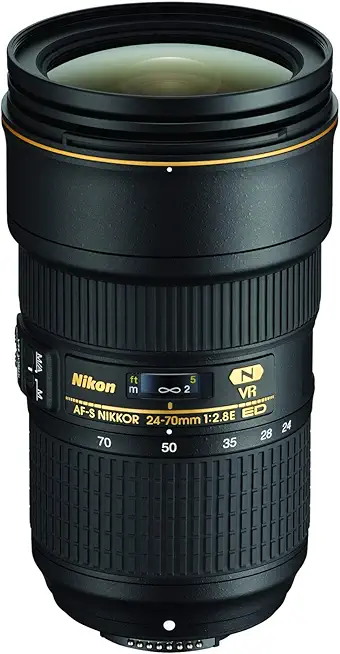
Nikon AF-S FX NIKKOR 24-70mm f/2.8E ED VR
Versatile standard zoom offering constant bright aperture, silent autofocus and image stabilization for weddings, events, and everyday professional shooting.
Check PriceWhen I’m packing for a landscape shoot that demands flexibility, the Nikkor 24-70mm f/2.8E ED VR often goes into my bag first. It’s a standard zoom with Vibration Reduction (VR) that covers everything from a roomy 24mm wide to a useful 70mm short telephoto, so you can switch from sweeping vistas to tighter detail without changing lenses.
Optically, Nikon improved the formula to resolve earlier corner softness, and in the field I find it sharp across the focal range with pleasing color and contrast. The f/2.8 speed helps with low-light handheld work at dawn or dusk, and the built-in VR genuinely assists when I can’t mount a tripod for sunrise shots.
That said, VR is a tool, not a miracle — it’s effective for reducing handshake but not a substitute for a tripod on long exposures or when you need absolute pixel-level sharpness. Autofocus is fast and dependable, and the lens feels solidly built and weather-sealed, which matters when you’re out in changing conditions.
For landscape shooters who want one reliable, professional-grade lens that handles most scenarios, this 24–70mm is a great workhorse. If you prioritize ultimate lightness or need very long reach for distant details, you may find it heavier than alternatives and limited by the 70mm short end for distant subjects. Overall, it’s widely used by pros as a go-to Nikon FX landscape lens because of its balance of image quality, versatility, and rugged construction.
- Excellent sharpness and image quality from 24–70mm
- VR aids low-light handheld shooting
- Versatile for broad scenes and isolated details
- Weather-sealed, robust construction
- Heavier and less compact than slower zooms
- 70mm may be short for some distant landscape detail work
3. Nikon Z 14-30mm f/4 S Mirrorless Zoom

Nikon NIKKOR Z 14-30mm f/4 S
Compact ultra-wide zoom for mirrorless systems, lightweight design and consistent sharpness ideal for travel, architecture, and landscapes.
Check PriceI often reach for the Nikon Z 14-30mm f/4 S when I need ultra-wide coverage without hauling a heavy kit. The 14–30mm range with a constant f/4 gives me sweeping vistas and reliable depth of field control across the zoom, which is great for landscapes and travel work.
One of the biggest practical wins is the flat front element that accepts standard 82mm filters. That makes using NDs and GNDs straightforward, and for many landscape shots I rely on filters more than extreme wide angles themselves. Users and I both see excellent image quality and sharpness from the lens, which translates to crisp foreground detail and clean sky gradations.
In the field the lens is compact and lightweight, so it’s easy to carry all day on a Z-series body. Autofocus is fast, though not a critical factor for most landscape setups; nonetheless it helps when composing handheld or grabbing quick environmental shots.
Be mindful when shooting toward bright light. The lens can be prone to flares and sunstars, so careful composition or a small hood can be necessary. Chromatic aberration is generally well-controlled, but you may spot slight fringing in harsh contrast situations that’s usually easy to correct in post.
- 14–30mm coverage with constant f/4
- Accepts standard 82mm filters
- Compact, lightweight and travel-friendly
- Fast autofocus and good handling on Z bodies
- Prone to flares and sunstars toward bright light
- Slight chromatic aberrations visible on camera
4. Nikkor 24mm f/1.8G ED Prime Lens

Nikon AF-S FX NIKKOR 24mm f/1.8G ED
Fast wide-angle prime delivering creamy bokeh, crisp low-light performance and precise rendering for street, astro, and environmental portraits.
Check PriceThe Nikkor 24mm f/1.8G ED is a wide-angle prime that delivers outstanding sharpness at 24mm. In the field it frequently outresolves zooms at the same focal length, so your landscape frames will show remarkable detail and clarity.
Its fast f/1.8 aperture makes it a go-to for very low-light work. That means golden hour, blue hour, and Milky Way shots are much easier, and you can even handhold in darker conditions when needed.
Optically, it’s an improvement over the older 24mm f/1.4, trading a little maximum aperture for better overall image quality. The lens is also compact and lightweight, which makes it comfortable to carry all day and ideal for travel or long hikes where pack weight matters.
In practice you’ll notice minimal distortion and strong, pleasing color straight out of the camera. If you shoot astro-landscapes or want tack-sharp wide vistas with excellent low-light capability, this lens is a very attractive choice. The trade-off is the fixed focal length; you’ll need to move to reframe or swap lenses for different perspectives.
- Exceptional sharpness and resolution
- Excellent low-light and astrophotography performance
- Compact and lightweight
- Minimal distortion and pleasing color
- Fixed focal length limits compositional flexibility
- Requires moving or lens changes for different framing
5. Nikon Z 24-120mm f/4 S Mirrorless Zoom

Nikon NIKKOR Z 24-120mm f/4 S
All-in-one travel zoom with constant aperture, smooth autofocus and exceptional edge-to-edge clarity for versatile everyday and travel photography.
Check PriceThe Nikon Z 24-120mm f/4 S is a midrange zoom designed for Z-series shooters who want a single, versatile lens for landscapes. It covers 24–120mm with a constant f/4 aperture, making it an all-in-one choice for wide vistas and moderate telephoto work.
Optically this lens is praised for very consistent sharpness across the zoom range, including the far corners. It isn’t the absolute sharpest in controlled lab tests, but in the field it delivers more than adequate resolution for landscape workflows.
That constant f/4 is a practical compromise: it balances size, weight, and image quality so you can carry it all day. The lens is lightweight, compact, and ergonomically designed for handheld use, which is a big advantage on long hikes or travel shoots.
In practice the 24–120mm range gives you real flexibility. You can capture sweeping foreground-to-background scenes at 24mm, then reach out to 120mm to isolate distant details or compress the scene without changing lenses.
Build quality is solid and weather-sealed, so it stands up to typical outdoor conditions. Travel photographers and landscape shooters who want one reliable lens for many scenarios will appreciate the combination of reach, handling, and consistent performance.
Be aware of the trade-offs: the f/4 maximum will limit very-low-light handheld possibilities compared with faster lenses, and lab comparisons sometimes show other Z lenses pulling ahead in peak sharpness. For most landscape work, though, this is a highly practical, high-performing all‑rounder.
- Consistent sharpness across 24–120mm (including corners)
- 24–120mm range covers wide to 120mm tele
- Constant f/4 balances size, weight, and image quality
- Lightweight, compact, and weather-sealed build
- f/4 limits very low‑light performance vs f/2.8 options
- Not the absolute sharpest in lab comparisons
Choosing the Right Focal Length
There is no single perfect focal length for landscapes. The focal length you choose should answer one simple question: what do you want to say about the place?
For vast vistas and dramatic skies reach for ultra-wide glass in the 12–24mm or 14–35mm range on full frame. Those focal lengths exaggerate depth, let foreground elements dominate and pull the eye into the scene. They can also introduce distortion and a busy foreground, so simplify what sits nearest the lens.
Mid-range lenses around 24–70mm are the workhorses for most landscape days. They produce a natural perspective that balances foreground and background and make switching between context and detail fast and intuitive.
Telephoto focal lengths—70–200mm and beyond—offer a very different toolset. They compress distance, reveal layers, and isolate distant patterns that wider glass misses. Be mindful of atmospheric haze at long range and use a tripod or faster shutter speeds for critical sharpness.
A practical sweet spot for many scenes is roughly 21–24mm on full frame. That range keeps foreground interest punchy while still showing the background clearly, which is why I often default to it when I have to carry just one lens.
My workflow is simple: shoot a scene at several focal lengths before committing to a frame. Move closer, step back, and test different crops; sometimes a different angle, not a different lens, makes the shot work.
If you need extreme detail or cleaner compositions, consider stitching a set of overlapping frames at a moderate telephoto and combining them in post. That gives you control over perspective and much higher resolution than a single wide capture.
Ultimately choose focal lengths based on the story you want to tell, not just the gear in your bag. Practice this habit and you’ll start instinctively reaching for the focal length that best matches the landscape in front of you.
Choosing Between Prime and Zoom Lenses
Deciding between prime and zoom lenses for landscapes comes down to a trade-off: optical purity versus flexibility. Both are useful in different situations, and the right choice depends on how you actually shoot. Think in terms of field workflow, not just lab numbers.
Primes use simpler optical formulas, and that usually translates to edge-to-edge sharpness and lower distortion. Their wider maximum apertures are handy for blue‑hour work, astrophotography, or when you want selective separation in a scene.
The downside is obvious: a fixed focal length forces you to move or change lenses to reframe. That slows you in fading light and increases the chance of missed moments.
Zooms pack several focal lengths into one tool, so you can quickly shift compositions without swapping glass. Modern landscape zooms often come surprisingly close to primes in image quality, and that practicality is why many shooters favor them.
A pragmatic approach many pros use is to shoot mostly with high-quality zooms and bring one prime for when ultimate sharpness or a very fast aperture is required. This keeps your kit light and responsive while still letting you pull out the best possible image when it matters.
If you want coverage for most landscape situations, aim for a wide, a mid-range zoom, and a telephoto — classically 14–24, 24–70, and 70–200mm. That trio gives sweeping vistas, flexible framing, and reach for compressed compositions.
Also consider how you work in the field. On long hikes or in windy, dusty conditions, minimizing lens changes favors zooms; when you can set up a tripod and plan shots, a prime will reward you with the finest files.
In short: choose zooms for flexibility and fewer missed shots, and pick primes when you need absolute sharpness or specialized low‑light performance. The smartest kit mixes both according to your shooting style.
What People Ask Most
What is the best Nikon lens for landscape photography?
There is no single best Nikon lens for landscapes because the ideal choice depends on your scene, style, and how you work in the field. Choose a lens that balances the coverage, sharpness, and handling that match your shooting needs.
What focal length is best for landscape photography with a Nikon camera?
The best focal length depends on the scene and your creative goals: wide angles emphasize foreground and vast skies, medium focal lengths offer balanced compositions, and longer lenses isolate distant details. Match focal length to the look you want rather than searching for a single number.
Is a wide-angle lens better for landscape photography?
Wide-angle lenses are excellent for capturing expansive vistas and adding foreground drama, but they are not always the best choice for every landscape. Other focal lengths can be better for isolating subjects or compressing distance, depending on your vision.
Are prime lenses better than zoom lenses for Nikon landscape photography?
Primes often deliver very high image quality and wider apertures, while zooms provide flexibility and reduce the need to change lenses in the field. The right choice depends on whether you prioritize ultimate sharpness or practical versatility.
Which Nikon lenses are the sharpest for landscape photos?
Many modern Nikon lenses provide excellent sharpness, and newer optical designs often perform consistently across the frame. Consult reviews and sample images to compare real-world sharpness for landscape use and choose lenses known for consistent corner-to-corner performance.
Is the Nikon 14-24mm a good lens for landscape photography?
Yes, the Nikon 14-24mm is widely regarded as an excellent ultra-wide option for dramatic landscape compositions and wide vistas. It can be heavier and requires careful composition to avoid crowded frames, but it excels at expansive scenes.
Do I need vibration reduction (VR) for landscape photography with Nikon lenses?
Vibration reduction is helpful for handheld low-light shooting and modest shutter speeds, but it is not essential when you use a stable tripod for long exposures. It is a useful feature to have, though good technique and proper support remain most important.
Conclusion for Best Nikon Landscape Lenses
Choosing the right Nikon lens for landscape work comes down to balancing sharpness, focal-range flexibility, weight and low-light capability, and this article aimed to make those trade-offs clear so you can pick what matters most for your shooting.
Primes tend to reward you with ultimate sharpness and low-light performance while zooms offer practical versatility and fewer missed moments, so align your choice with the scenes you shoot and how much gear you want to carry.
Many photographers find a compact kit that covers wide, midrange and telephoto needs gives the best balance between creative options and portability, while keeping a high-quality prime on hand for critical, detail-oriented shots.
If you want to grow your skills and refine your lens decisions, explore more articles on the site to learn techniques, workflow tips, and practical buying guidance tailored to landscape photography.
Have questions or want personalized advice? Leave a comment below — we usually reply within a few hours and are happy to help you choose the right path for your photography.




0 Comments