
Ever wondered how much of the night sky you could explore with a good pair of binoculars?
This guide cuts through the hype and helps you find the best binoculars for star gazing. It’s a concise, practical overview for backyard stargazers, commuters who chase dark skies, and anyone curious about the cosmos.
Whether you’re after wide Milky Way sweeps or a closer look at clusters and planets, the right optics can change what you see. We focus on real‑world performance, ease of use, and value. Expect honest guidance, not marketing spin.
Five standout models featured in this guide are the Celestron SkyMaster Pro 20×80, Celestron SkyMaster 15×70, and Celestron SkyMaster 20×80 (non‑Pro). Also included are the Bushnell Legacy WP 10×50 and the Levenhuk Bruno Plus 20×80.
Across these picks you’ll find heavy hitters for deep‑sky work, versatile all‑rounders, and solid choices for beginners. Each selection comes with practical advice so you know what to expect under real skies. We also highlight handling and support options to help you match gear to your observing style.
If you’re ready to upgrade your backyard sessions or take stargazing on the road, this guide will point you to binoculars that deliver the best views for your needs. Grab a blanket, find a dark patch of sky, and let’s get exploring.
1. Celestron SkyMaster Pro 20×80 Review

Celestron SkyMaster Pro 20x80 Binoculars with tripod adapter & case
High-power 20x magnification with large objective lenses for stunning low-light astronomical and terrestrial viewing; includes mounting-ready stability and protective storage.
Check PriceAs a photographer who spends nights under the sky, the Celestron SkyMaster Pro 20×80 feels like a portable telescope. Its 20× magnification with 80 mm objectives delivers telescope‑like views of Jupiter’s moons, Andromeda, the Orion Nebula and the Pleiades, making deep‑sky observing rewarding.
The optics are solid for visual work — Celestron XLT coatings and BaK‑4 prisms boost light transmission and clarity, so stars pop and faint patches gain definition. The smooth, precise focus wheel lets you dial in detail without hunting, which matters when you’re chasing faint nebulosity or splitting doubles.
Build quality is robust and heavy‑duty, so the instrument feels like it can take field use and occasional rough handling. That heft is a double‑edged sword: it’s extremely heavy (over 5 lbs), so tripod use is essential rather than optional.
This model is best for intermediate to advanced skywatchers who want telescope‑like performance without the complexity of a mounted scope. It’s not the best pick for beginners — the narrower field of view and tripod dependence make locating and tracking targets harder for newcomers. Also expect some noticeable chromatic aberration (color fringing) around bright objects, which can soften planetary views.
In short, if you value large aperture and high magnification for deep‑sky sweeps and don’t mind mounting it on a tripod, the SkyMaster Pro 20×80 is a very capable choice. If you need lightweight, handheld versatility or pristine planetary contrast, look elsewhere.
- 20× magnification with 80 mm objectives — telescope‑like views
- Celestron XLT coatings and BaK‑4 prisms
- Smooth, precise focus wheel
- Robust, heavy‑duty build
- Extremely heavy (over 5 lbs); tripod use essential
- Noticeable chromatic aberration around bright objects; weaker planetary views
2. Celestron SkyMaster 15×70 Review

Celestron SkyMaster 15x70 Binoculars with tripod adapter & case
Bright 15x optics deliver wide-field views and excellent low-light performance; sturdy mounting capability and padded storage for field convenience.
Check PriceThe Celestron SkyMaster 15×70 is a workhorse for anyone stepping up from casual stargazing to serious deep‑sky hunting. With 15× magnification and 70 mm objectives it delivers bright, detailed views of star clusters and galaxies — I’ve seen crisp structure in targets like M81 and M82 that lower‑power bins simply miss.
Optically it punches above its price. Images are generally sharp and contrasty with a decent field of view, so sweeping star fields and pinpointing clusters feels natural rather than cramped.
Build-wise it’s reassuringly rugged: a rubber‑armored body offers a secure grip and Celestron includes a tripod adapter, which you’ll appreciate given the size. The overall construction leans toward durability, so it will survive regular outdoor use.
That said, practicality depends on how you plan to use them. At 1.36 kg they’re on the heavy side for hand‑holding; a tripod is not an optional extra if you want steady, fatigue‑free sessions. The included adapter makes mounting straightforward and markedly improves the viewing experience.
Optical compromises are modest but real. There is some chromatic aberration around bright objects, though the outline notes it’s less pronounced than many competitors. Also, they aren’t fully waterproof and are less compact, so keep that in mind if you need all‑weather portability.
Overall, the SkyMaster 15×70 is an excellent, affordable choice for amateur astronomers who want larger aperture and higher magnification without breaking the bank. If you’re prepared to use a tripod and don’t need compact, all‑weather gear, these are a smart, performance‑focused buy.
- 15× magnification with 70 mm aperture — bright, detailed views (M81, M82)
- Good value for magnification — reveals faint deep‑sky objects
- Sharp, contrasty images with decent field of view
- Rubber‑armored body with tripod adapter — sturdy build
- Heavy — 1.36 kg; tripod recommended
- Some chromatic aberration on bright objects; not fully waterproof
3. Celestron SkyMaster 20×80 (Non-Pro) Review
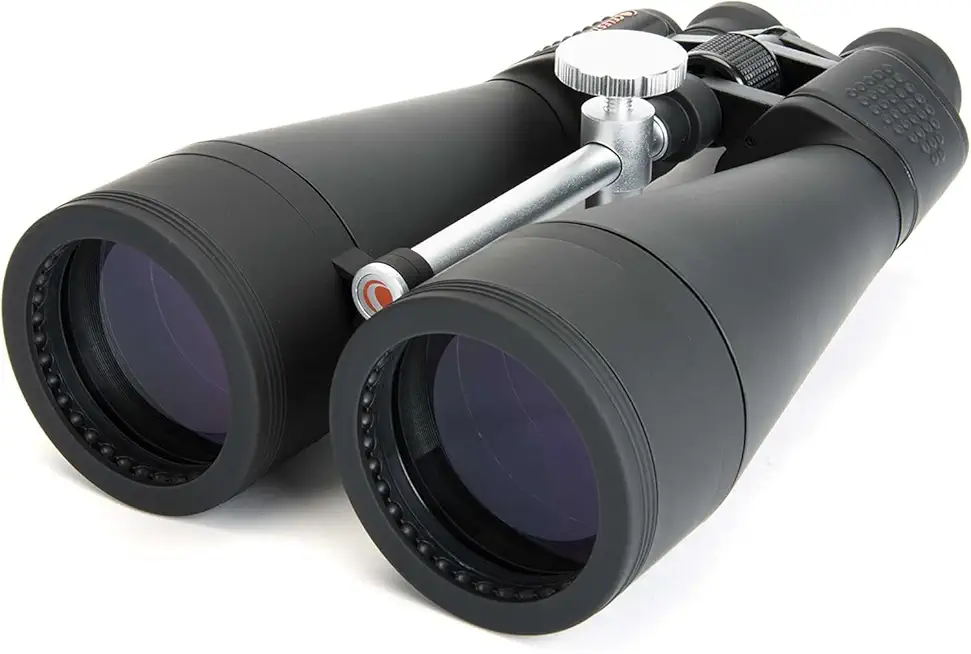
Celestron SkyMaster 20x80 Binoculars with tripod adapter & case
Powerful 20x optics paired with oversized lenses provide crisp, detailed views at night; tripod-ready stability and protective carrying solution.
Check PriceThe Celestron SkyMaster 20×80 (non‑Pro) is a workhorse for deep‑sky viewing, delivering 20× magnification with 80 mm objectives that produce bright, sharp views of star clusters and faint nebulae. As a photographer used to judging contrast and detail, I appreciate how the optics pull out structure in the Pleiades and other open clusters with pleasing clarity.
Image quality is excellent and the center focus is smooth and precise, so fine adjustments are straightforward when centering a dim galaxy or tightening focus on a double star. The generous 18 mm eye relief keeps viewing comfortable for eyeglass wearers during long sessions under the sky.
Build-wise this SkyMaster is rugged and water‑resistant with a secure tripod mount, so it stands up to field work and evening dew without fuss. That said, the size and weight make handheld use impractical; plan to mount it for steady, fatigue‑free observing and for better results at 20×.
Be aware of the narrow field of view—about ~3.7°—which means initial target acquisition and tracking require patience or a finder strategy. For experienced astronomers who already use tripods and star maps, this pair offers telescope‑like performance without the setup complexity of a large scope.
- 20× magnification with 80 mm aperture — bright, sharp views
- Excellent image quality; smooth, precise focusing
- 18 mm eye relief — comfortable for eyeglass wearers
- Water‑resistant, rugged build with secure tripod mount
- Heavy and tripod‑dependent
- Narrow field of view (~3.7°), harder to find/track objects
4. Bushnell Legacy WP 10×50 Review

Bushnell Legacy WP
Rugged waterproof construction with bright, high-contrast optics for hunting, boating, and adverse weather use; comfortable grip for all-day observation.
Check PriceThe Bushnell Legacy WP 10×50 is a capable, no-nonsense choice for photographers and skywatchers who want dependable optics without fuss. It’s fully waterproof and reasonably fog‑proof, so you won’t have to cut a session short when the weather turns. The BaK‑4 prisms and fully multi‑coated lenses produce bright, sharp images with pleasing contrast — important when you’re trying to split a double star or pull detail from a star cluster.
With a wide 6.5° field of view you can sweep the Milky Way and large open clusters comfortably, and the 20 mm eye relief makes it friendly for eyeglass wearers. Practical touches — twist‑up eyecups and eyepiece caps that stay attached to the neck strap — keep setup simple and speed up transitions between observing and photographing. That combination makes these binoculars useful for both night and daytime work.
At 10× magnification this pair sits right on the practical handheld limit, so you’ll get steady views for short periods using good holding technique. However, the weight can become tiring during extended handheld use, especially for children or lighter users, so plan on a monopod or tripod for long sessions. They aren’t as powerful as larger astronomy binoculars for very faint deep‑sky objects, but that’s the tradeoff for portability and ease of use.
All told, the Bushnell Legacy WP 10×50 is an excellent entry-level to intermediate option if you want reliable, all‑weather performance and a wide field for scanning the sky. If you value contrast, sensible ergonomics, and the ability to use the bins for casual daytime spotting, these are a solid, practical pick.
- Fully waterproof and reasonably fog‑proof
- BaK‑4 prisms with fully multi‑coated lenses — bright, sharp contrast
- Wide 6.5° field of view for easy sky scanning
- 20 mm eye relief — comfortable with glasses
- 10× is the practical handheld limit; weight tiring for extended handheld use (children or lighter users)
- Less powerful than larger astronomy binoculars for faint deep‑sky objects
5. Levenhuk Bruno Plus 20×80 Review
Versatile outdoor optics offering clear, steady images, durable build, and ergonomic handling—ideal for wildlife spotting, stargazing, and travel.
Check PriceLevenhuk Bruno Plus 20×80 is a no‑nonsense, budget‑minded astronomy binocular that punches above its price. With 20× magnification and 80 mm objectives it gathers plenty of light, giving telescope‑like views of bright deep‑sky objects when paired with a steady mount.
Optically the Bruno Plus is straightforward and effective: Porro prisms and good coatings deliver a surprisingly bright, clear field for the money, and the aluminum chassis feels more solid than its price tag suggests. The binoculars are waterproof and fog‑proof, and the twist‑up eyecups (not folding) are convenient for eyeglass wearers and quick observing sessions.
Be realistic about handling: these are heavy and bulky, and a tripod is essentially required for comfortable, steady viewing at 20×. The field of view is narrow, so locating and tracking objects takes some patience and a little sky familiarity — not a great choice if you want wide sweeps or quick handheld scanning.
In short, if you’re a budget‑conscious observer who wants large aperture and high magnification for star clusters and brighter galaxies, the Levenhuk Bruno Plus 20×80 is a solid value. It rewards users who invest in a good tripod and spend time learning star hops, but it won’t satisfy those who need portability or wide panoramic views.
- 20× magnification, 80 mm objectives
- Aluminum chassis; surprisingly bright, clear field for the price
- Waterproof and fog‑proof
- Porro prisms with good coatings
- Heavy and bulky (tripod required)
- Narrow field of view
How to Choose Stargazing Binoculars

Choosing binoculars for the night sky is a lot like choosing a lens for low‑light photography. Both demand a balance of brightness, sharpness and handling that fits how you actually work under the stars.
For most of the skywork I recommend 7–10× magnification. 7–8× saves shake and gives a wide view, great for scanning the Milky Way. 9–10× brings more detail on planets and double stars, but you may need support.
Aperture controls how much light reaches your eyes. 40–80 mm is common; 50 mm is a practical compromise between brightness and weight.
Check exit pupil — objective divided by magnification. An exit pupil of about 5–7 mm matches a dark‑adapted eye; older observers with smaller pupils will prefer smaller values.
Field of view is underrated. Wider fields make finding objects and sweeping the sky far less frustrating; high‑power bins give a narrower window that can make locating targets harder.
Optical coatings and prisms matter. Fully multi‑coated lenses and BaK‑4 prisms give noticeably better contrast and light transmission in dim skies.
Think about weight and handling. If you plan long sessions, pick something you can hold comfortably, or that fits a tripod adapter. Good eye relief and twist‑up eyecups matter if you wear glasses.
If you want one practical pick, a balanced 10×50 pair is a dependable workhorse for most observers. Stepping up to 15×70 or 20×80 boosts deep‑sky performance, but expect more weight, a narrower field, and the need for a mount. Higher magnification can also reveal chromatic fringing around bright objects, so temper expectations for planetary views.
Finally, match the bins to how you’ll actually use them. Try them in hand if you can, and choose portability for backyard sessions or larger apertures for planned dark‑sky trips.
How to Use Astronomy Binoculars
As a photographer who spends many nights under the stars I treat binocular sessions like framing a wide landscape shot. A little preparation — steady support, correct focus, and dark adaptation — transforms what looks like faint fuzz into structured, beautiful scenes. Think of binoculars as your wide-angle lens on the sky.
For 7–10× pairs you can hold them comfortably with both hands, elbows tucked into your ribs, and breathe gently between looks. Larger 15×–20× bins or 70–80mm objectives will quickly tire your arms and demand a tripod or monopod. Use the tripod adapter and a ball head or binocular cradle for smooth panning and tracking.
Get the optics dialed in before you hunt targets. Set interpupillary distance so the images merge, focus the left eye with the center wheel, then adjust the diopter for the right eye using a bright star or distant light. If you wear glasses, use the twist-up eyecups and confirm you have enough eye relief for comfortable viewing.
Choose a dark spot away from streetlights and let your eyes adapt for 20–30 minutes; that time matters more than a slightly better lens. Carry a red headlamp or switch your phone to red mode so you can consult charts without destroying night vision. Apps are handy, but a printed chart can save you if batteries die in the cold.
Start with easy, bright objects — the Moon, Pleiades, and big open clusters — to learn framing and motion. Sweep the sky slowly in systematic passes, and use averted vision (look slightly to the side) to tease out faint nebulae and galaxies. When you want planetary detail or tight doubles, mount the bins and be patient; steady support makes all the difference.
Protect and maintain your gear like you would a camera lens. Use a blower and microfiber cloth; never rub grit across the glass or spray household cleaners on coatings. Store binoculars in a padded case with silica gel, avoid rapid temperature swings to prevent internal fogging, and let them acclimate if they fog up.
Finally, think like a field shooter: bring gloves, a small towel, and a notepad for sketches or quick notes. A beanbag, car roof, or simple picnic table often makes a fine stable platform when a tripod isn’t handy. With these small habits your binocular nights will be more comfortable and far more rewarding.
What People Ask Most
What magnification and objective lens size are best for stargazing binoculars?
Aim for magnification in the 7×–10× range for general stargazing, with larger magnifications used when you have a mount. Objective sizes from about 40 mm up to 80 mm increase light gathering, and a 50 mm pair is a common practical compromise.
Are binoculars good for viewing planets and deep-sky objects?
Yes, binoculars excel at wide-field targets like star clusters, the Milky Way, and many bright deep-sky objects. Planets and very faint nebulae benefit from higher magnification or a telescope and are easier to observe with steady support.
Should I choose 7×50 or 10×50 binoculars for astronomy?
Choose 7×50 for wider fields and easier handheld stability, and 10×50 if you want more detail on smaller objects while being prepared to use a tripod. Both are practical, classic options depending on your observing style.
Do I need a tripod or mount for astronomical binoculars?
A tripod or mount is recommended for higher magnifications and larger, heavier binoculars to reduce shake and fatigue. For lower magnifications in the handheld range, steady holding techniques can be sufficient for short observing periods.
What features should I look for when choosing binoculars for stargazing?
Look for good optical coatings and quality prisms to improve light transmission and contrast, plus comfortable eye relief for eyeglass wearers. A wide field of view, durable weather sealing, and a tripod adapter are also useful features.
Can binoculars replace a telescope for amateur astronomy?
Binoculars are excellent complements to telescopes but do not fully replace them for high-magnification work. Telescopes generally perform better for detailed planetary views and the faintest deep-sky objects.
How does exit pupil affect binocular performance for night sky viewing?
Exit pupil determines how much light reaches your eye and should be close to your eye’s dark-adapted pupil for the brightest view. Observers with smaller pupils or observing from brighter skies will often prefer a smaller exit pupil.
Conclusion for Best Binoculars for Stargazing
This guide pulled together practical comparisons and buying considerations—magnification, aperture, weight, field of view and usability—so you can match binoculars to your observing goals and experience level.
Use the advice to balance portability against light‑gathering power, decide whether a tripod or mount is necessary, and try promising pairs in person when you can.
If you want to sharpen your technique or dive deeper into gear choices, read more articles on our site to build your skills and confidence under the night sky.
Have a question about a particular setup or looking for a personalized recommendation? Leave a comment below — we usually reply within a few hours.


0 Comments