
Which DJI drone will give you pro-grade images without turning every shoot into a logistics problem? This guide compares five DJI models across camera performance, flight behavior, portability, battery life, obstacle systems, and day-to-day usability. It’s written for photographers who want crisp images first and fuss-free flying second, whether for travel, commercial jobs, or social content.
We evaluated candidates on image quality, portability, flight time, obstacle avoidance, versatility, and regulatory impact — the metrics that shape real shooting decisions. Those factors determine whether a drone is ideal for travel, landscape work, event coverage, or studio-style shoots. Practical considerations like where regulations restrict flights can be as decisive as sensor size or frame rate.
Our judgments are grounded in user reviews and expert commentary from photographers, pilots, and reviewers who fly in real conditions. We leaned on hands-on impressions, sample RAW files, flight reports, and pilot notes rather than marketing blurbs or lab numbers alone. That approach lets us surface the genuine strengths, the routine annoyances, and the compromises you’ll actually feel on a shoot.
Expect clear, photographer-focused guidance on which DJI option fits travel, prosumer work, social content creation, or high-end commercial shoots. We’ll spell out the trade-offs you’ll face — better sensors usually mean more weight, and longer flight time often brings bulk or stricter rules. Use this guide to choose the best DJI drone for photography for your vision, your shooting style, and the realities of the locations you fly.
1. DJI Mavic 4 Pro Overview

DJI Mavic 4 Pro with DJI RC 2
Advanced aerial imaging with premium sensors, extended range, and intelligent flight modes for smooth cinematic footage and confident long-distance missions.
Check PriceThe Mavic 4 Pro is a premium, foldable drone aimed at prosumers and serious enthusiasts who prioritize image quality and in-flight flexibility. Its standout feature is a triple-camera system: a Micro Four Thirds wide-angle 25MP sensor, plus 1/1.3″ and 1/1.5″ telephoto modules, so you can change framing without landing.
As a photographer I lean on the 25MP MFT wide for landscapes and the variable aperture for subtle depth-of-field control. The wider dynamic range and resolution make it easy to pull detail from shadows and highlights in RAW files.
Build quality is substantial, which pays off in stability; the heavier construction keeps the platform steady in wind. Reviewers also praise excellent battery life, and OcuSync 4+ gives reliable long-range transmission for confident framing at distance.
Obstacle-detection is advanced and works well even in low light, so you can focus more on composition and less on emergency maneuvers. The three-camera setup delivers real-world versatility — wide, mid, and telephoto options without interrupting a shoot.
That said, it’s not for everyone. The drone is bulky and heavy (over 1 kg), so it’s less travel-friendly than lighter models. Switching between cameras can be confusing because each camera has different settings and image characteristics, and it falls into the stricter C2 EU category, which means more certification and paperwork for some users.
If you value top-tier stills, depth control, and on-the-fly focal flexibility and don’t mind the weight or regulatory overhead, the Mavic 4 Pro is an excellent choice.
- 25MP Micro Four Thirds wide camera
- Triple-camera system with 1/1.3″ and 1/1.5″ telephotos
- Variable aperture for depth-of-field control
- OcuSync 4+ long-range transmission / excellent battery life
- Bulky/heavy (over 1 kg)
- Stricter C2 EU category — more certification required
2. DJI Mini 5 Pro Overview

DJI Mini 5 Pro Fly More Combo with DJI RC 2
Ultra-compact powerhouse delivering crisp, stabilized 4K capture, generous battery bundle, and effortless portability for spontaneous adventures and travel.
Check PriceAs a photographer who shoots on the road, the DJI Mini 5 Pro immediately stands out for what matters most: portability and image quality. It’s the latest Mini-series offering and weighs under 250g, which keeps it travel-friendly and easier to fly under lighter regulations.
Image quality punches above its weight thanks to a 1-inch sensor that delivers strong low-light performance and supports 4K at 120fps for slow-motion clarity. There’s also 42GB of onboard storage, which is genuinely useful when you’re shooting long sequences or far from a laptop.
In the air it feels confident — reviewers noted improved Return-to-Home and ActiveTrack 360, plus faster top speeds and solid wind resistance for its class. Real-world flight times varied in tests from ~27 minutes (hover) to nearly 52 minutes with an enhanced intelligent flight battery, so you can plan shoots with some flexibility depending on battery choice.
Safety has been stepped up with omnidirectional sensing and LiDAR front sensors, a meaningful improvement for tracking and obstacle avoidance when flying in tighter scenes. That extra sensing makes it easier to focus on composition instead of babysitting the drone.
The trade-offs are honest: it’s a single-camera design, so focal versatility is limited compared with multi-camera models, and some users may find the upgrades over the previous Mini 4 Pro incremental. Overall, it’s an excellent pick for travelers, content creators, and hobbyists who want top-tier portability without sacrificing image quality.
- Under 250g — travel-friendly
- 1-inch sensor; 4K at 120fps
- Omnidirectional sensing with LiDAR front sensors
- 42GB onboard storage
- Single-camera limits focal versatility
- Upgrades from Mini 4 Pro may be incremental for some
3. DJI Air 3S Overview

DJI Air 3S with RC-N3
Versatile mid-weight drone with exceptional HDR imaging, dual-sensor clarity, and responsive controls for precise tracking and smooth aerial storytelling.
Check PriceAs a working photographer I appreciate drones that balance image quality with real-world usability, and the DJI Air 3S sits squarely in that sweet spot. It packs a main 1-inch sensor that delivers strong stills and video, while staying relatively portable compared with bulkier pro rigs. The battery and flight figures are solid too — the Air 3S uses a ~4276mAh cell and advertises flight times in the ~45–46 minute range under ideal conditions, which gives you serious on-air shooting windows.
The dual-camera setup is where this drone earns its keep: a wide-angle paired with a 3x telephoto opens creative moves like parallax shifts and compressed backgrounds that elevate landscape and portrait-style aerials. Its telephoto is useful for composition, though the outline notes telephoto image quality lags the main 1-inch sensor, so I treat it as a compositional tool more than a primary high-res shooter. You also get robust wind resistance and reliable omnidirectional obstacle avoidance, with forward-facing LiDAR plus downward infrared ToF and multiple vision sensors helping keep shots safe in tighter environments.
In short, the Air 3S is ideal for enthusiasts and semi-pros who want dual-camera flexibility, intelligent flight modes, and subject-tracking without the size and weight of flagship Mavic models. Be aware it’s pricier than entry-level options and heavier than Mini-series drones, so regulatory limits may apply depending on where you fly.
- 1-inch main sensor
- Dual-camera: wide + 3x telephoto
- ~45–46 min advertised flight time (4276mAh)
- Robust wind resistance & obstacle avoidance
- Pricier than entry-level models
- Telephoto image quality lags main sensor
4. DJI Flip Overview
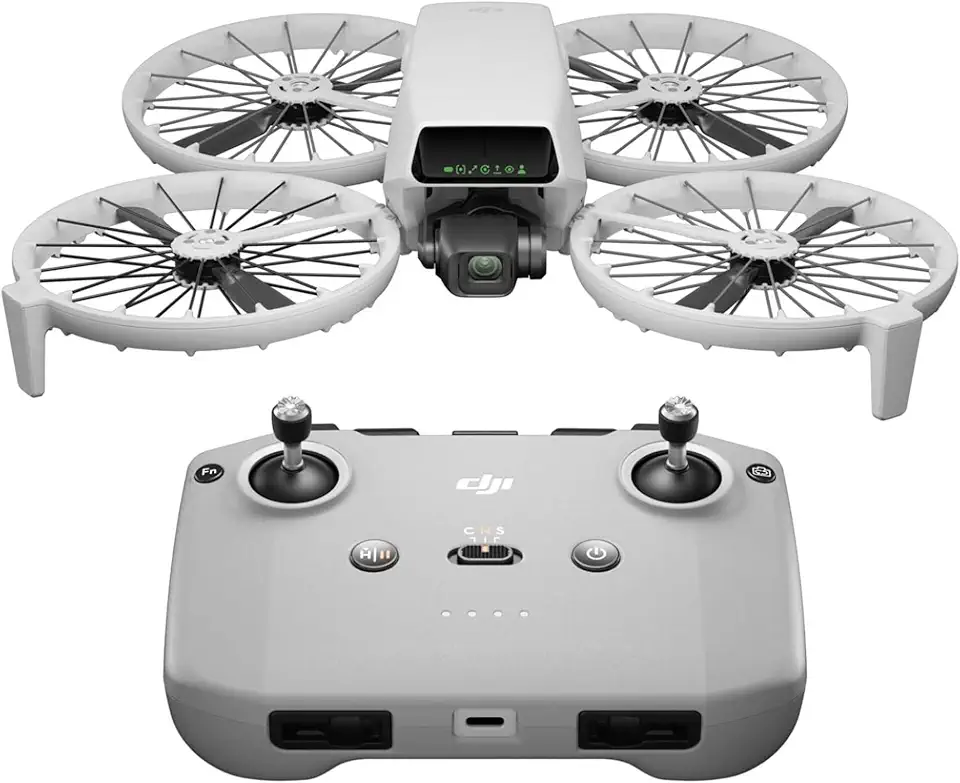
DJI Flip with RC-N3
Pocketable foldable camera that shoots vertical video, intuitive controls, and quick deployment for dynamic social-ready clips and vlogging.
Check PriceAs a photographer who shoots fast-moving social content, the DJI Flip stands out as a surprisingly capable little tool. Its 1/1.3″ sensor delivers 48MP stills and clean 4K 60fps HDR video, and the 10-bit internal recording plus D-Log support give you real flexibility in post. For quick edits and vibrant social posts, that combination means files with latitude and color depth you won’t expect from a budget drone.
Portability is where the Flip truly shines. It’s fully foldable and weighs under 249g, so you can slip it into a small bag and avoid heavier regulations in many regions. That light weight does come with trade-offs, but for street shoots, travel and indoor work it’s a huge win.
DJI designed the Flip for beginners and creators. Palm takeoff/landing, a voice command feature (“Hey Fly”), and AI subject tracking make it very easy to operate and frame shots without a lot of piloting skill. Vertical shooting mode is handy for Reels and Stories, so you can capture native social formats without extra cropping.
Be aware of limits: battery life tops out at about 31 minutes max, so plan on swapping batteries for longer sessions. Obstacle sensing is basic — only forward-facing 3D infrared sensors — and the range is limited without a dedicated controller, so you’ll want to avoid complex environments and long-distance shots until you’re comfortable.
- Great image quality (48MP, 1/1.3″ sensor)
- 4K60 HDR, 10-bit internal + D-Log
- Under 249g and fully foldable
- Easy controls: palm takeoff, “Hey Fly”, AI tracking
- Short battery life (31 minutes max)
- Only forward-facing obstacle sensing; limited range without controller
5. DJI Mavic 3 Pro Overview

DJI Mavic 3 Pro with DJI RC
Flagship cinematic platform offering large-sensor imagery, extended flight time, and precision controls for professional filmmakers and ambitious aerial projects.
Check PriceAs a working photographer, the DJI Mavic 3 Pro feels like a precision tool rather than a toy. Its Hasselblad 4/3 sensor delivers the kind of dynamic range and tonal depth I trust for commercial stills, and the ability to shoot 5.1K video gives me latitude in post.
What really sets it apart are the optics: a triple-camera setup with two dedicated telephoto lenses (70mm and 166mm) alongside the wide Hasselblad. That combo lets me change composition dramatically in the air without swapping gear on the ground, ideal for landscapes, portraits from a distance, or compression shots over architecture.
On practical shoots the variable aperture is a blessing — I rarely need to slap on ND filters in bright light, which speeds workflow. The airframe carries a large battery (around 5000mAh) and advertises up to 43 minutes per charge, so I can plan longer passes and more bracketed sequences, though real-world wind cuts that number down.
Safety and reliability matter when I’m flying over clients or sensitive sites. The Mavic 3 Pro uses omnidirectional avoidance with six fisheye and two wide-angle sensors, plus robust follow-me and tracking features, so it maintains position and tracks subjects confidently. The trade-offs are its larger size and price, which push it into stricter regulatory categories and a higher budget — but for pros who need top image quality and endurance, it’s hard to beat.
- Hasselblad 4/3 sensor
- 5.1K video capability
- 70mm & 166mm telephoto lenses
- Up to 43 minutes flight time (product spec)
- Larger size triggers stricter regulations
- High cost; real-world flight time shorter in wind
Obstacle Avoidance Systems Explained
When I’m framing a tight shot between tree limbs or skimming a cliff face, obstacle avoidance is the feature that lets me push creative boundaries without constantly stopping to replan. Modern systems combine forward, backward and downward vision sensors with infrared, ToF and even LiDAR to scan the environment and nudge the drone away from trouble.
Not all sensors are equal. Some models use forward-facing LiDAR for pinpoint detection in low light (the Air 3S and Mini 5 Pro use that approach), while flagships like the Mavic 3 Pro rely on omnidirectional arrays to cover nearly every angle. That difference matters when you’re working around crowds, narrow corridors, or at dusk.
APAS-style automation takes raw sensor data and calculates a safe path in real time, which is a lifesaver in dense woods or near buildings. It can route you around obstacles smoothly, but it also sometimes makes unexpected avoidance moves that change your composition.
There are limits. Very thin wires, small branches and abrupt overhangs can still fool vision sensors, and some LiDAR setups only scan a single direction, leaving gaps elsewhere. Low light improves with LiDAR and ToF, but you shouldn’t assume perfect detection at night.
Practical workflow matters more than tech faith. Before a close pass, scout the line, fly slowly in tripod mode, and keep the drone within visual line-of-sight. Keep firmware updated and leave obstacle sensing on for most shoots—then practice intentional manual passes in an open area before attempting risky maneuvers.
Finally, think of avoidance systems as a safety net, not a substitute for piloting skill. They let you safely get closer for foreground interest or dramatic low-angle shots, but smart planning and conservative margins are what keep your gear—and your shot—intact.
Understanding Flight Time
Flight time is one of those specs that sounds simple on paper but behaves very differently in the field. Manufacturers often quote ideal numbers — flagship models commonly claim around 45–46 minutes, and DJI’s Mavic 3 Pro is listed at up to 43 minutes in product notes — but those are measured in perfect conditions: no wind, minimal maneuvering, and gentle hovering.
In real shoots you’ll see much more variance. Wind, aggressive panning, high frame-rate video, carrying accessories, and cold temperatures all shave minutes off the clock. Battery capacity plays a role — for example, the Air 3S uses a ~4276mAh pack while the Mavic 3 Pro leans on a larger ~5000mAh battery — but flying style matters just as much.
Mini-series drones offer a useful lesson: their light weight helps efficiency. Tests show Mini models range widely — from roughly 27 minutes when pushed, to nearly 52 minutes with an “enhanced” intelligent battery in conservative flight. That tells you battery chemistry and flight profile can swing endurance dramatically.
As a working photographer I plan shots around realistic endurance, not advertised maxima. I set conservative return-to-home thresholds, bring at least one spare battery per expected 20–30 minutes of shooting, and stage batteries warm before takeoff in cold weather. I also break complex sequences into short bursts so I’m never chasing a dying power bar mid-composition.
If your priority is long continuous airtime, choose heavier, flagship models. If portability and ease of travel matter more, accept shorter sorties and carry spares. Either way, think in cycles: plan, fly, swap batteries, and review. That workflow keeps you shooting without surprises and lets you get the decisive aerial frames you came for.
What People Ask Most
Which DJI drone is best for photography?
It depends on your priorities: choose a flagship model for the best image fidelity, a mid-tier drone for a balance of features and portability, or a compact model for travel and easier regulation. Match the drone’s strengths to the type of photography you plan to do.
What is the best DJI drone for professional aerial photography?
Flagship models designed for professionals are generally the best choice because they prioritize sensor size, lens options, and robust safety systems. These platforms trade portability and simpler regulation for superior image quality and flexibility.
Which DJI drone has the best camera sensor for stills?
Drones equipped with larger, higher-quality sensors typically produce the best still images due to improved dynamic range and low-light performance. If stills are the priority, look for models marketed around photography performance rather than pure portability.
Which DJI drone is best for low-light photography?
Choose a drone with a larger sensor and good noise handling for stronger low-light results, and prioritize stable flight and reliable exposure control. Proper shooting technique and post-processing also play a big role in low-light images.
Which DJI drone is best for landscape and panorama photography?
Drones with wide-angle high-resolution sensors, stable flight, and reliable obstacle sensing work best for landscapes and panoramas. Longer effective flight time and precise hovering make it easier to compose and capture stitched panoramas.
What DJI drone is best for beginner photographers?
Entry-level, lightweight models with user-friendly controls and safety features are ideal for beginners, as they simplify learning and reduce risk. Look for devices with helpful automated modes and a balance of image quality and affordability.
Which DJI drone offers the highest image quality and dynamic range?
Top-tier models with premium camera systems and larger sensors generally deliver the highest image quality and dynamic range. These drones are aimed at users who prioritize image fidelity and are willing to accept trade-offs in size and regulatory requirements.
Conclusion for Best DJI Photography Drone
This comparison distills the core strengths and compromises across five DJI drones to help you match gear to your shooting goals and skill level.
Travelers and creators should prioritize portability and regulation-friendly weight, enthusiasts will appreciate dual-camera flexibility and tracking, professionals will lean toward flagships that favor image fidelity and flight reliability, and beginners should focus on ease-of-use and value.
Keep the key trade-offs in mind: higher image quality often brings more bulk and regulatory complexity, longer flight times usually require heavier batteries, and advanced sensing improves safety but can affect size and cost.
Let real-world strengths and weaknesses reported in user reviews and expert commentary guide your final choice, since everyday performance and workflow fit matter more than specs alone.
If you want to sharpen your aerial photography skills and stay up to date with practical tips and gear guidance, please read more articles on our site to continue learning.
Have a question or want to share your experience? Leave a comment below — we usually reply within a few hours and welcome the conversation.


0 Comments