
What if the next unforgettable cinematic shot in your film could be flown rather than fought for? Aerial footage now plays a starring role in storytelling, turning ordinary locations into sweeping, emotive landscapes. But choosing the right drone and learning to fly it artistically can be overwhelming.
This guide is a practical roadmap to choosing the best drone for filmmaking and getting the most from it. It distills what truly matters on set and in post so you can match gear to your creative goals. You’ll also find actionable shooting tips and planning strategies to make each flight productive.
Rather than burying you in specs, this guide compares the capabilities that shape real-world results. Expect candid pros and cons, firsthand shooting notes, and plainspoken workflow advice about portability, endurance, and image control. These insights will help you decide which trade-offs fit your projects and budget.
Beyond gear, the guide walks you through shot planning, preflight routines, and safety essentials so your creative ambitions are grounded in reliable practice. With thoughtful prep and confident flying, you’ll spend more time shaping memorable frames and less time troubleshooting mid-shoot.
Whether you fly solo with a backpack or coordinate a small crew, the goal is the same: precise motion, predictable results, and safe operation. Read on to learn how to prioritize shots, streamline preflight workflows, and turn aerial footage into storytelling assets.
1. Flagship Pro Filmmaking Drone

DJI Mavic 4 Pro with DJI RC 2, Tri-camera 100MP 4/3 CMOS Hasselblad
Triple-sensor aerial camera system delivering exceptional large-format image quality, premium color science, and responsive remote control for professional cinematography.
Check PriceAs a flagship pro filmmaking drone, the Flagship Pro Filmmaking Drone pairs a 100 MP 4/3″ Hasselblad wide-angle sensor with medium-telephoto and telephoto lenses in a true triple‑camera system. Expect exceptional image quality, crisp details and strong dynamic range that hold up across high-end projects.
For motion work it records up to 6K/60fps HDR and 4K/120fps slow motion, giving you both cinematic large-frame grabs and buttery slow‑motion for action or dramatic moments. The Infinity Gimbal with 360° rotation opens up creative, complex camera moves you can’t easily replicate with smaller rigs.
On the practical side you get up to 51 minutes of flight time and O4+ transmission technology, so long shooting sessions and a stable, responsive live feed are realistic. The drone’s weight (~1063g) actually helps stability in wind, producing smoother footage when conditions aren’t perfect.
Safety is taken seriously: omnidirectional obstacle sensing plus forward‑facing LiDAR assistance makes automated and low‑light flights far more reliable. That said, this is a professional tool — its size, weight and sophistication favor experienced operators or productions that need cinema-level imagery rather than casual travel shooters.
If you prioritise ultimate image quality, versatile focal lengths without swapping craft, long flight times and advanced gimbal moves, this drone is an excellent choice. If you need ultra‑light portability or minimal regulatory hassle, consider those tradeoffs first.
- 100 MP 4/3″ Hasselblad sensor
- Triple‑camera system (wide + medium tele + tele)
- Up to 51 minutes flight time
- Omnidirectional sensing + forward‑facing LiDAR
- Heavier and larger footprint limits portability
- C2 classification/stricter regulations require certifications in some countries
2. Versatile All-Around Filmmaking Drone

DJI Air 3S (RC-N3), Dual-camera with 1-inch CMOS wide-angle
Compact long-flight drone pairing large-frame sensors with wide-angle versatility for high-resolution, low-light aerial photography and reliable intelligent flight modes.
Check PriceThe Versatile All-Around Filmmaking Drone brings a professional toolbox in a travel-friendly package. It uses a dual-camera setup — a 1″ CMOS wide-angle and a 1/1.3″ CMOS telephoto — so you can switch between expansive establishing shots and tighter, cinematic framing without swapping gear.
Video capability is strong: up to 4K/60fps HDR for clean, high-dynamic-range footage and 4K/120fps for silky slow motion. With up to 14 stops of dynamic range you get more headroom for highlights and shadows, which is huge when grading for a cinematic look.
Flight performance balances endurance and portability. Expect around 45 minutes of flight time, and the drone sits at roughly ~724g — light enough to travel with, yet substantial enough to feel stable in wind. Omnidirectional obstacle sensing adds confidence when you’re flying complex paths.
Practical use is where this model shines. The dual cameras offer genuine creative flexibility and seamless switching during shoots, which speeds up production. Nightscape mode extends usable shooting time into golden hour and dusk, and next‑gen Smart RTH helps protect your shots and gear if something goes wrong.
If you’re a solo filmmaker or a small crew wanting professional-quality aerials without lugging cinema rigs, this drone is a compelling middle ground. It’s not the smallest option, so if ultra-light packing is your priority you might consider alternatives. Also be prepared for an initial learning curve to unlock the advanced features.
- Dual 1″ / 1/1.3″ cameras for varied shots
- 4K/60 HDR and 4K/120 slow motion
- 45 minutes flight time
- Omnidirectional obstacle sensing
- Bulkier than mini drones (~724g)
- Advanced features add complexity for casual users
3. Ultra-Light Travel Filmmaking Drone

DJI Mini 5 Pro Fly More Combo with DJI RC 2, 1-inch CMOS, 3 batteries
Ultra-lightweight portable flyer featuring a large sensor, extended battery kit and intuitive controller for effortless, high-quality travel videography.
Check PriceAs a travel shooter, I reach for an ultra-light tool that won’t slow me down—this sub-250g filmmaking drone is exactly that. It packs a large 1″ sensor and can record 4K up to 120fps, giving you crisp footage and useful slow-motion capability in a compact package.
The camera is modular with 225° roll rotation, so switching between vertical and horizontal framing is quick and reliable for social and narrative work. It also includes 42GB of built-in storage, ActiveTrack 360, improved Return-to-Home, and LiDAR front sensors to boost confidence when flying tight shots.
In practice the portability is the standout: setup is fast, and image quality in good light rivals much larger rigs, which makes it perfect for solo creators and travel vloggers who need cinematic results without a crew. The camera orientation options let you capture both traditional landscape sequences and social-ready vertical clips without juggling gimbals or adapters.
There are trade-offs to accept. Flight time is solid for a mini at up to 34 minutes, but it’s shorter than bigger drones, so plan your battery swaps. And being a single-camera platform, you won’t have the focal flexibility that multi-camera systems offer, so think carefully about your shot list before takeoff.
- Sub-250g, regulation-friendly
- 1″ sensor with 4K up to 120fps
- 225° camera rotation for vertical/horizontal shots
- ActiveTrack 360 + LiDAR front sensors
- Single camera limits focal flexibility
- Shorter flight time (up to 34 minutes)
4. Cinema-Grade Production Powerhouse

DJI Inspire 2
High-performance cinematic platform engineered for professional filmmakers, offering agile flight, dual-operator control and scalable payload compatibility.
Check PriceThis is a true cinema-grade production powerhouse built for crews who demand the absolute best image and control. It records full-frame 8K/75fps ProRes RAW and 8K/25fps CinemaDNG, paired with dual-native ISO and 14+ stops dynamic range, so the latitude and color fidelity are exceptional for high-end grading workflows.
Interchangeable DL‑Mount lenses (18mm, 24mm, 35mm, 50mm) let you choose glass for the scene rather than compromising with a single focal length, which is a game-changer for cinematic coverage. Dual-operator capability (pilot + camera operator) and systems like RTK positioning and Waypoint Pro make precise, repeatable moves easy to execute on complex shoots.
Practically speaking, this rig rewards experienced teams: the 1/1.8″ night‑vision FPV camera and strong low‑light performance give you usable imagery in challenging conditions, but the platform is powerful and heavier, so plan for a dedicated operator and grip. The 20 minute flight time is short compared with smaller models, so expect to rotate batteries and schedule longer setups accordingly.
If you’re running commercials, narrative sequences, or top-tier aerials, the image quality and creative freedom are hard to beat. But if you’re a solo creator, traveling light, or on a tight budget, the cost, complexity, and battery cadence make this less practical. For productions that can support it, though, it’s a tool that elevates your aerial cinematography to true cinema standards.
- Full-frame 8K/75fps ProRes RAW & 8K/25fps CinemaDNG
- Interchangeable DL‑Mount lenses (18/24/35/50mm)
- Dual-native ISO with 14+ stops dynamic range
- RTK positioning, Waypoint Pro and dual control
- Very expensive and complex
- Short 20 minute flight time
5. Low-Light Filmmaking Specialist
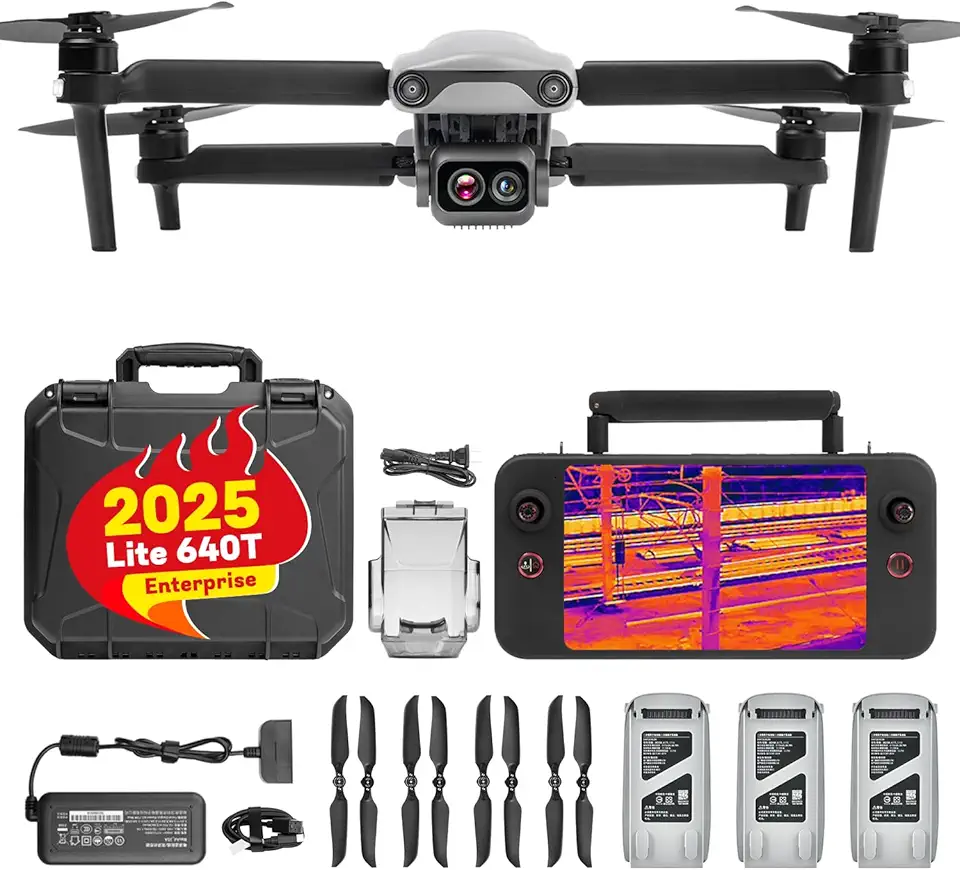
Autel EVO Lite 640T Enterprise, 640x512 30Hz thermal + 1/2-inch CMOS 48MP
Enterprise-grade inspection drone integrating high-resolution thermal sensing and a detailed visual imager for accurate mapping, search, and critical asset monitoring.
Check PriceAs a photographer who often shoots at dusk and into blue hour, the Low-Light Filmmaking Specialist is a practical workhorse. It pairs a 1″ CMOS wide camera with a 1/1.3″ telephoto, giving you real compositional flexibility without swapping gear.
Video capabilities reach up to 4K/60fps HDR and even 4K/120fps for slow motion, so you can capture both cinematic movement and detailed slow-motion moments. The Nightscape mode and sensor improvements make it noticeably better in low light than typical consumer drones.
Dynamic range up to 14 stops helps retain highlight and shadow detail when shooting high-contrast scenes at golden hour. That range reduces time spent wrestling with recoveries in post and preserves a more natural look straight out of the camera.
At roughly ~724g it’s light enough to travel with but solid enough for stable handheld-style moves in moderate wind. The balance between portability and professional output means you won’t feel held back on most location shoots.
Omnidirectional obstacle sensing and robust avoidance let you focus on composition and movement rather than last-second corrections. In practice this increases confidence when flying complex reveal shots around trees and architecture.
Battery life around 45 minutes gives you room for multiple setups during a single golden hour window, which is very useful when coordinating talent and light. Overall, it’s an excellent choice if your priority is low-light capability combined with flexible framing.
It’s not perfect for ultra-minimal travel kits, and hobbyists may find the feature set a touch complex at first. But for filmmakers who want strong low-light performance and professional results without a cinema-sized rig, it’s a top pick.
- Dual-camera system (1″ + 1/1.3″).
- 4K/60 HDR and 4K/120 slow motion.
- Dynamic range up to 14 stops.
- 45-minute flight time and ~724g balance.
- Bulkier than mini drones.
- Advanced features add complexity for casual users.
Essential Tips for Drone Filming
Great aerial footage starts with how you move the camera. Ease into starts and stops, fly slow and steady, and let the gimbal smooth small corrections; jerky inputs are the fastest way to ruin a beautiful shot. I prefer manual flying over auto modes for creative control—you can always use assisted modes for safety, but the feel comes from your hands.
Think in flight patterns rather than single frames. Orbiting, tracking, and reveal shots are staples, but the most cinematic results come from combining moves—rise while rotating or push forward as you pull back the gimbal. Always start the drone path before you intend the frame and keep flying after it; “fly through your shots” gives you usable lead-in and exit footage for seamless edits.
Expose like a photographer, not a phone operator. Avoid full auto: set aperture, shutter and ISO yourself, keep ISO low, and use ND filters in bright conditions. Aim for a shutter speed roughly double your frame rate for natural motion blur—this 180° rule keeps motion looking cinematic.
Light dictates mood, so plan your schedule around it. Golden hour and blue hour transform ordinary locations into cinematic landscapes, while harsh midday sun flattens contrast and blows highlights. Night flying needs extra prep—lights, permissions and a clear plan—don’t improvise low‑light aerials unless you’re ready.
Composition still matters in the sky. Use the rule of thirds, leading lines and foreground elements to add depth and scale, and vary altitude to switch between intimate low passes and grand wide establishing shots. Framing a subject against negative space often makes footage feel more cinematic than a centered, static object.
Practice deliberately and study work you admire. Rehearse multi-directional moves until muscle memory kicks in, and resist over-reliance on presets—develop a style by experimenting with pacing and lens choices. Watch other drone cinematography with an eye for transitions and pacing rather than just hot shots.
Finally, prioritize safety and logistics. Check weather, airspace rules and local permissions, set sensible RTH altitudes and test systems before rolling, and always have spare batteries and formatted cards ready. Obstacle sensing helps, but never treat it as a substitute for good judgment and manual control.
Planning Shots for Drone Filmmaking
Start with story, not gear. Sketch a quick visual storyboard or a shot list that ties each drone move to emotion or information you want the audience to take away. Even a loose sequence of reveals, establishes and intimate moments saves time on set and keeps the footage purposeful.
Before you power on, run a pre-flight checklist as if it were a film set call sheet. Charge and label batteries, format cards, inspect props and rotors, confirm airspace clearance and watch the weather window; small oversights ruin otherwise perfect light and timing.
Plan flight paths that match the story and lighting. Use waypoint missions or orbit modes for precise, repeatable moves when you need multiple takes or VFX plates, and practice the same moves manually to keep creative flexibility when the moment calls for it.
Execute like a camera operator. Start the drone before the intended frame and keep flying a beat after you stop the action — “fly through” your shots so you capture usable lead-in and out footage for smooth edits. Choose altitude and angle deliberately: low and slow for intimacy and action, high for scale and geography.
Respect light above all. Schedule golden hour and blue hour runs for consistent mood, and build timing buffers into your plan for changing shadows and sun positions. If the light will shift mid-take, prioritize shorter passes or bracket exposures to protect highlights and shadow detail.
Shoot extra coverage. Capture wider reveals, tighter inserts and neutral plates before and after key moments so editors can breathe. Think about how you’ll grade the footage and leave headroom for color correction by avoiding clipped highlights in-camera.
Mitigate risk with simple redundancies. Set sensible RTH altitudes, have a landing plan and a backup battery, and be ready to switch to manual landings if conditions change. A calm, rehearsed approach keeps everyone safe and keeps the creative flow going.
What People Ask Most
What is the best drone for filmmaking?
The best drone depends on your priorities like image quality, portability, and budget. Choose a model that balances the features you need with ease of use and local regulations.
What drone do professional filmmakers use?
Professional filmmakers typically use drones tailored for cinema workflows that offer advanced controls and high-quality imaging. These platforms are often flown within coordinated productions by experienced pilots and camera operators.
Which drone has the best camera for cinematic video?
Cameras that perform well for cinematic video generally have larger sensors, good dynamic range, and flexible focal options. The ideal choice depends on the aesthetic you want and how the footage will be graded and edited.
What features should a filmmaking drone have?
Important features include stable flight performance, reliable obstacle sensing, and manual camera controls for exposure and framing. Consider also how the drone fits into your shooting workflow and accessory ecosystem.
Can drones achieve cinema-quality footage?
Yes, drones can capture cinema-quality footage when flown skillfully with proper camera settings and lighting. Post-production work such as color grading and stabilization also contributes significantly to the final result.
How do I choose a drone for filmmaking?
Start by defining your shooting needs, such as portability, image quality, and typical shooting environments, then compare models that meet those priorities. Also factor in regulations, available accessories, and support for your production workflow.
Are there drones specifically designed for filmmaking?
Yes, some drones are built specifically for filmmaking and offer features like larger sensors, interchangeable lenses, and cinema-oriented recording options. These platforms are usually best suited to experienced operators and production teams.
Conclusion for Best Drone for Filmmaking
This guide compared key features, real-world pros and cons, and how different drones fit distinct filmmaking needs so you can match gear to your creative goals and constraints.
Remember that no single drone is perfect for every job; prioritize the platform that supports your workflow, shooting conditions, and production scale.
Above all, planning, steady practice, and strict attention to safety and local regulations will have more impact on your final footage than any single spec sheet.
If you want to keep sharpening your aerial skills and creative approach, explore more articles on the site to learn techniques, planning methods, and workflow tips tailored to drone filmmaking.
Please leave a comment with questions or experiences to share — we usually reply within a few hours and welcome the conversation.



0 Comments