
Which flash will rescue your low-light portraits and still keep pace with a nonstop wedding day?
We put five Canon-compatible flashes through real shoots to see which ones actually deliver when it matters. They represent pro workhorses, versatile mid-level units, compact on-camera options, dedicated macro lights, and wallet-friendly budget choices.
This isn’t a spec sheet rehash or a parade of numbers. Expect clear product highlights and candid real-world notes from portraits, events, and close-up work. You’ll also get straightforward pros and cons, practical buying tips, and guidance for using flashes on and off the camera.
We focus on the things that matter in actual shooting: reliability, color consistency, ease of use, and how each unit handles in the field. Battery strategy, size versus power, wireless control and modifier compatibility all affect how a flash performs in practice. Photographers who shoot weddings, studio portraits, macro subjects, or weekend events will find advice tuned to their priorities.
If you want the best match for your Canon kit and shooting style, this guide narrows the field with honest context. Keep reading to find the flash that gives you better light, cleaner images, and fewer headaches on the job. We highlight practical setups so you can confidently choose and operate the right flash for each shoot.
1. Canon Speedlite EL-1 and EL-1 Ver. 2

Canon Speedlite EL-1 Version 2
Pro-level flash with fast recycling, consistent TTL metering, robust weather-sealed build, and advanced power for demanding studio and location photography.
Check PriceThe Canon Speedlite EL-1 is Canon’s flagship professional flash, built for reliability and power in demanding shoots. It combines a weather-resistant body with robust output, so you can work in rain or dust without constant worry about failure.
In practical terms it delivers consistent color temperature thanks to a high-quality Xenon tube, which matters when you’re mixing ambient and flash light across a long event. I’ve trusted it for weddings and events where color consistency and repeatable results matter shot after shot.
Battery performance is excellent: the rechargeable Li‑ion pack yields roughly 330 full-power flashes per charge, and recycle times are very fast—around one second at typical power levels. For long stints the EL-1’s fan-driven active cooling is a game changer; Canon rates it for up to 170 full-power flashes continuously without thermal cutouts.
Control-wise the EL-1 is pro-grade: you get very precise manual power steps down to 1/8192, plus programmable strobe modes and full wireless control (RF and infrared). That lets you integrate it into on- or off-camera multi-flash setups and fine-tune repeat firing or high-speed sync work.
If you need a durable, high-end flash that won’t quit during an all-day shoot, the EL-1 is hard to beat. The trade-offs are size and cost, but for pros who need endurance, color stability, and thermal management, it’s often worth it.
- Superb durability and weather sealing
- Very fast recycling (~1 second)
- Active cooling allows up to 170 full-power flashes continuously
- Precise low-power control (1/8192) and ≈330 full-power flashes per charge
- Heavier and bulkier than smaller flashes
- High cost limits accessibility for beginners/casual users
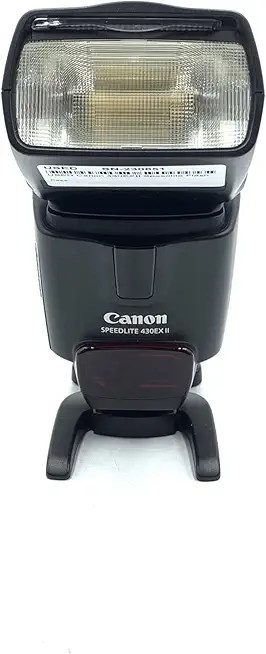
2. Canon Speedlite 430EX III-RT
Canon Speedlite 430EX II
Compact shoe-mount flash delivering reliable TTL output, versatile bounce and swivel head, ideal for event and travel photography.
Check PriceThe Canon Speedlite 430EX III-RT is a mid-level, versatile flash aimed at advanced amateurs and enthusiasts who need reliable on- and off-camera performance. Its motorized zoom head covers 24–105mm, so the head auto-matches common focal lengths for clean light falloff without fiddling with zoom rings.
In real shooting the 430EX III-RT shines as a bounce flash thanks to its swivel and tilt head, making portraits and event work look natural without harsh shadows. It has a built-in wireless master and infrared slave, so you can control basic multi-flash setups without adding extra transmitters.
Practicalities matter: it runs on AA batteries, which keeps the unit lighter and more portable than larger Li‑ion powered heads and makes it easy to carry spares. Expect recycling around ≈ 2.5 seconds on fresh alkalines; that’s fine for many situations but worth noting if you shoot long bursts or fast action.
The user interface is friendly for busy shoots, with a backlit screen that makes changing modes and settings quick. Overall, if you want a compact, capable Speedlite for portraits, events, and casual off-camera setups, the 430EX III-RT balances features and portability well—just be mindful of battery choice and recycle speed if you need heavy-duty performance.
- Motorized zoom head (24–105mm)
- Effective bounce with swivel/tilt head
- Built-in wireless master and infrared slave
- User-friendly interface with backlit screen
- Slower recycling (≈ 2.5 seconds)
- AA batteries less convenient than Li‑ion packs
3. Canon Speedlite EL-100

Canon Speedlite EL-10 for EOS R series
Pocket-sized, high-speed sync flash optimized for mirrorless cameras, offering precise TTL control and portable lighting for run-and-gun shooters.
Check PriceThe Canon Speedlite EL-100 is a compact, lightweight flash built for beginners and smaller mirrorless bodies. Its size makes it easy to carry on long shoots or travel when you don’t want the bulk of pro gear.
Despite the small footprint, the head tilts and swivels for bounce lighting — a feature rare in compact units. That gives you softer, more flattering light for portraits and quick fill on location.
Output sits around GN 26 (ISO 100, meters), which is modest but useful for close- to mid-range work and on‑camera fill. Canon also rates it at roughly 3× the power of their older 90EX, so you get a noticeable step up from very small pop-up style flashes.
Power comes from 2 AA batteries, so you’re never hunting for proprietary cells mid-shoot. The trade-off is slower recycling compared with Li‑ion powered Speedlites, so in fast-paced situations you may need to raise ISO or use external packs.
Features are straightforward rather than pro-level — it’s made to be easy to use, not to replace a full studio kit. If you want portability, simple bounce control, and compatibility with small bodies, this is a sensible, affordable choice.
If your work demands fast burst recycling, wireless radio control, or extended low‑power precision, an EL-100 will feel limited. But for travel, street, and beginner portrait work it’s an effective, pocketable flash that keeps setups light.
- Very portable and easy to carry
- Tilt and swivel for bounce lighting
- About GN 26 — useful close-to-mid range
- Uses widely available 2 AA batteries
- Slower recycling than larger flashes
- Limited advanced features; not ideal for pro work
4. Godox MF-R76C TTL Macro Ring Flash Canon

Godox MF-R76C Macro Ring Flash TTL for Canon
Ring-style macro light for close-up photography, providing even, shadow-free illumination with TTL compatibility and adjustable power for delicate subjects.
Check PriceThe Godox MF-R76C is a purpose-built macro ring flash that gives close-up shooters a lot of bang for the buck. It’s positioned as a budget alternative to Canon’s MR‑14EX II, offering comparable performance for tight-detail work without the premium price tag.
One of the biggest practical advantages is full TTL / E‑TTL compatibility with Canon cameras, so you can rely on camera-driven exposure in fast-moving macro situations. It also integrates into Godox’s 2.4 GHz wireless ecosystem, which makes mixing on‑camera metering with off‑camera control straightforward.
In use the MF‑R76C delivers bright, even light that reduces harsh shadows around tiny subjects — exactly what you want for insects, product close‑ups, or texture studies. The ring format wraps light around the lens axis, producing that flat, shadow‑reducing illumination that helps reveal detail without heavy post‑processing.
Do be aware there were earlier firmware issues with certain bodies (the outline cites the R5 Mark II as an example), but those problems are largely resolved in recent updates. Still, if you’re shooting on very new or unusual camera bodies, check for the latest firmware and compatibility notes before committing.
Overall, if you’re a macro shooter who needs consistent, even close‑up lighting on a budget, the MF‑R76C is a smart choice. It gives you TTL convenience, wireless control, and macro‑friendly illumination at roughly half the price of Canon’s comparable unit, though it’s a bit bulkier and takes some setup practice to master.
- TTL / E‑TTL support
- 2.4 GHz wireless integration
- Bright, even, shadow‑reducing light
- About half the price of Canon’s equivalent
- Earlier firmware/hardware error messages (mostly fixed)
- Bulkier than some ring options; requires practice/setup
5. Neewer Z2-C TTL Round Head Flashlight Canon

Neewer Z2-C TTL Round Head Speedlite for Canon
Round-head on-camera flash producing soft, natural light, with TTL metering, bounce versatility, and wireless triggering for flexible lighting setups.
Check PriceThe Neewer Z2-C TTL round-head flashlight is a budget-friendly TTL option that aims to give you softer, more natural light right out of the box. Its round Fresnel head smooths transitions and reduces harsh shadows, making it especially useful for portraits and small product shoots where flattering light matters.
Practical controls make it quick to use on set. There’s a side-button switch to jump between TTL and manual modes, so you can trust automatic metering for speed and still grab manual control when you need creative consistency.
Off-camera work is straightforward with built-in 2.4 GHz wireless triggering. The flash also includes modeling lamps, which help you preview placement and shadow direction before taking test shots—handy when you’re dialing in angles with subjects or modifiers.
Color and output are reassuring for the price. The unit delivers stable color temperature and competitive output for its class, so colors remain consistent across frames without much fiddling in post.
That said, don’t expect pro-level endurance. Output and recycle speeds are below professional flashes, and the build quality and consistency aren’t on par with Canon OEM units. If you need uncompromising speed or rock-solid durability for nonstop event work, look elsewhere. For budget-conscious portrait shooters and hobbyists who want soft, flattering light and wireless freedom, the Z2-C is a strong contender.
- Round head = soft, natural lighting
- Fast TTL/manual switching
- Built-in 2.4 GHz wireless triggering
- Stable color temperature and good output for its class
- Output and recycle speeds below professional flashes
- Build quality and consistency not on par with Canon OEM units
How to Choose the Right Speedlite
Start by matching a Speedlite to your camera and shooting style. Make sure the flash is fully compatible with your body—some newer Canon units are optimized for EOS R and the Multi‑Function Shoe—otherwise you can lose TTL or advanced triggering features.
Think about raw power next. Guide numbers tell you how far and how brightly a flash will light a subject; a GN ~60 unit like the EL‑1 reaches much farther than a compact GN ~26 head such as the EL‑100, which matters if you shoot large rooms or need long throw.
Battery type affects how you work in the field. AA-powered heads are cheap and easy to swap but usually recycle slower; Li‑ion packs give far more flashes per charge and much faster recycle times, which is why pros prefer them for weddings and events.
Consider the head zoom and bounce capability. A motorized zoom that tracks lenses (for example 24–105mm or wider ranges) gives flexibility from wide to tele focal lengths, and swivel/tilt heads let you shape light with ceilings and walls for softer, more flattering results.
Features matter more than flash power alone. Look for reliable wireless radio control, HSS for action at fast shutter speeds, accurate TTL metering, and fine power steps if you like dialing subtle exposures; infrared-only systems have shorter ranges and are more finicky outdoors.
Size and weight are practical decisions. If you travel light, a compact EL‑100 or a lightweight 430EX‑class model makes more sense; if you need endurance and weather sealing, expect a heavier professional head like the EL‑1.
Finally, buy for the genre you shoot. Use a dedicated macro ring flash for close‑ups, a soft round‑head or modifiers for portraits, and a robust Li‑ion flash for events. Pick the compromise you can live with—power and features versus portability—and you’ll be happier shooting with it every day.
On-Camera vs Off-Camera Use
Deciding between on‑camera and off‑camera flash is one of the simplest yet most powerful creative choices you’ll make. Both have clear strengths: on‑camera is about speed and simplicity, while off‑camera is about control and image quality. Knowing when to lean one way or the other will save you time on a job and deliver better pictures.
On‑camera flash shines in tight, fast, or crowded situations — think run‑and‑gun weddings, conferences, or street work. E‑TTL gives reliable automatic exposure so you can keep shooting instead of fiddling with power settings. You can also improve on‑camera light quickly by bouncing off ceilings, angling the head to the side, or adding a small diffuser or bounce card to soften highlights and reduce red‑eye.
That said, on‑camera units tend to produce flatter light with harder shadows and less depth. They limit your ability to shape shadows, controll background separation, or use large modifiers. If your goal is sculpted portraiture or cinematic lighting, those limitations become obvious fast.
Off‑camera flash opens up a much wider toolkit. Move the light to the side, backlight your subject, or mount a softbox for gentle wraparound light. Larger modifiers, grids, and distance give you finer control over contrast and mood, and off‑camera setups are the quickest route to professional‑looking separation between subject and background. The trade‑offs are extra gear — stands, triggers, and a bit of setup time — and a learning curve for balancing ambient and flash.
My practical workflow: start with on‑camera TTL to lock exposure and capture moments, then switch a flash off‑camera for formal portraits. If you only have one unit, use bounce and a small modifier until you can add a stand and a cheap radio trigger. For fast events, keep the speedlight on the camera; for portraits and editorial work, take it off and make the light tell the story.
What People Ask Most
What is the best flash for Canon cameras?
There is no single best flash for every Canon user; the right choice depends on your shooting style, budget, and desired features. Consider factors like compatibility with your camera, battery type, power and control options, and whether you need weather sealing or wireless radio control.
Which Canon Speedlite is best for beginners?
Beginners benefit from a compact, easy-to-use unit with reliable TTL metering and intuitive controls. Look for a lightweight flash with good bounce capability and straightforward wireless or manual options to grow into.
How do I choose the best flash for my Canon camera?
Match the flash to your camera mount and shooting needs, weighing power, battery system, zoom range, and available features like high-speed sync or wireless control. Also consider size, weight, and whether you plan to use the flash on- or off-camera.
Can third-party flashes work with Canon cameras?
Many third-party flashes are compatible with Canon bodies and offer features like TTL and wireless triggering, but implementation and reliability can vary. Check compatibility notes, firmware updates, and user feedback before buying.
Is TTL flash better than manual flash for Canon?
TTL is convenient for fast-changing scenes and automatic exposure while manual mode gives predictable, repeatable results for controlled lighting setups. Which is better depends on whether you prioritize speed or precise, repeatable control.
What flash do professional Canon photographers use?
Professionals often choose robust, high-performance units that offer consistent color, fast recycling, advanced controls, and reliable wireless operation. The exact model typically reflects each photographer’s specialty and workflow rather than a single universal choice.
How do I use an external flash with my Canon camera?
Attach the flash to the hot shoe or trigger it remotely with a radio transmitter, then select an exposure mode such as TTL or manual and adjust power and modifiers for the look you want. Practice positioning and use modifiers to control shadow quality and light direction.
Conclusion for Best Flash for Canon
Whether you need pro-grade endurance, mid-level versatility, compact portability, dedicated macro lighting, or a budget route to softer light, this roundup makes it easier to match a Speedlite to your camera, budget, and shooting style.
The Canon EL-1 stands out for reliability and stamina, the 430EX III‑RT for flexible everyday use, the EL‑100 for travel-friendly simplicity, the Godox MF‑R76C for macro value, and the Neewer Z2‑C for affordable soft-light options.
Use the buying factors and on‑ vs off‑camera guidance above—compatibility, power source, size, and control options—to prioritize what matters most for your work and workflow.
If you want to build your lighting skills, keep exploring the site for more tips, technique guides, and gear discussions to sharpen your results.
Please leave a comment with your questions or experiences below; we usually reply within a few hours and are happy to help you choose and use the right flash.


0 Comments