

Ever wondered why the same line can sound intimate in one film and hollow in another? Often the difference lives in the tiny microphone clipped to the actor’s shirt.
In this 2026 roundup we present five lavalier microphones proven to help filmmakers capture clear, usable dialogue with minimal fuss. Selections are based on hands‑on testing, aggregated user feedback, and the workflows of seasoned professionals. By distilling user reports and pro workflows, we cut through marketing hype to surface tools that actually perform.
These recommendations span tools for solo creators, documentary shooters, and full production crews, from nimble wireless setups to studio‑grade wired lavs. Each pick was evaluated in real shooting conditions—crowded streets, windy exteriors, and quiet interiors—to reflect everyday challenges. Testing emphasized durability and how mics cope with clothing noise, wind, and movement.
We focused on what truly matters on set: reliable signal, natural vocal timbre, ease of concealment, and how forgiving a mic is when placement isn’t perfect. Practical factors like battery life, mounting options, and post‑production friendliness also shaped our choices. Where relevant we favored solutions that simplify monitoring and backup recording.
Read on to find the five lavalier options that combined performance and practicality to impress both users and pros alike. If you care about clean dialogue and fewer retakes, this guide will point you to the right starting point for your next shoot. Consider this your practical handbook for matching a lav to your budget and production needs.

Shure WL93 Subminiature Condenser Lavalier Microphone with 4 ft (1.2 m) Cable
1. DJI Mic 2 at a Glance

DJI Mic 2 1TX+1RX Wireless Microphone System
Crystal-clear audio capture with long-range transmission, dual units for two-person recording, compact design, and fast charging for mobile creators.
Check PriceAs a working photographer who shoots a lot of run‑and‑gun interviews and behind‑the‑scenes content, the DJI Mic 2 is the kind of tool I reach for when I need clean dialogue fast. It’s clearly targeted at vloggers, YouTubers and solo filmmakers, with seamless integration to smartphones and cameras via Lightning/USB‑C adapters so you can plug in and go.
Sound quality is where it shines: crisp vocal clarity, strong noise isolation and intelligent adaptive noise cancelling help keep dialogue intelligible even in busy locations. You also get 32‑bit float internal recording, which preserves headroom and lets you capture hot signals without clipping — though those files do need post‑production conversion.
In practical use the kit feels well thought out. The charging case has a secure push‑button latch and an improved transmitter layout so you’re not fumbling when rolling; setup is minimal and performance is stable and reliable. An intuitive touchscreen on the receiver makes quick configuration painless when you’re under time pressure.
If you’re a solo filmmaker or part of a small production that prioritizes dialogue and simple workflows, the DJI Mic 2 is an excellent match. It isn’t aimed at capturing complex soundscapes, but for crystal‑clear vocal audio without a lot of gear, it’s one of the most user‑friendly options you can buy.
- Superior noise‑canceling and adaptive audio processing
- Versatile device compatibility with multiple inputs
- Strong battery life with 8GB local recording per transmitter
- Intuitive touchscreen for quick configuration
- 32‑bit float files require post‑production conversion
- Best suited for vocal recording; less useful for non‑vocal soundscapes
2. SYNCO G3 Pro at a Glance
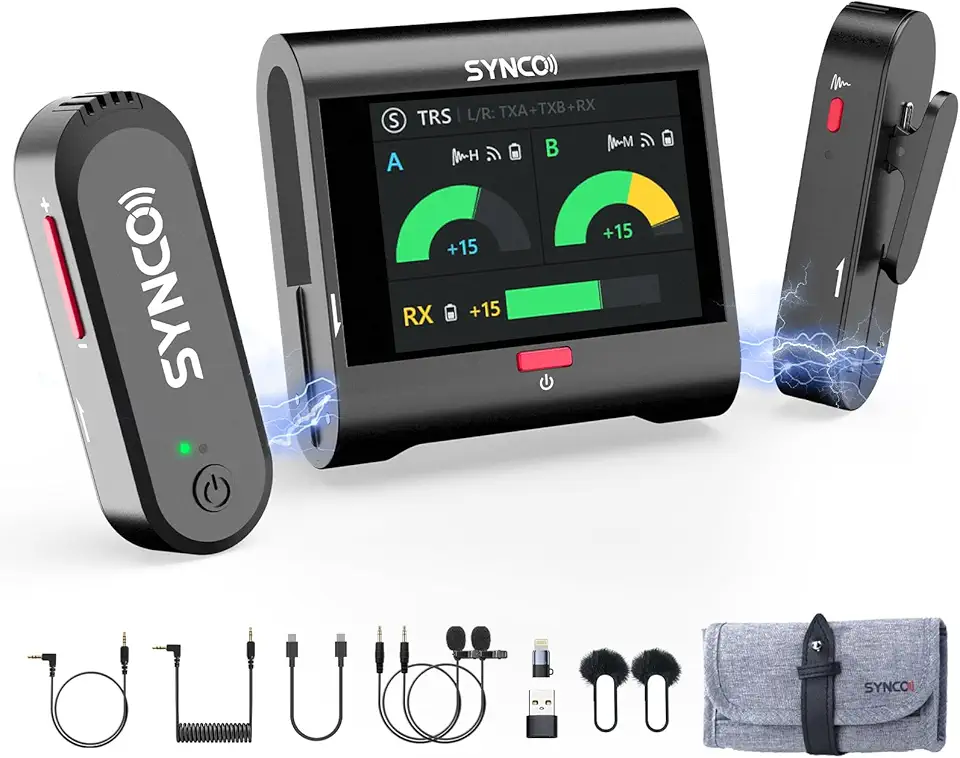
SYNCO G3 PRO 2.4G Dual Lavalier Wireless Microphone System
Reliable digital transmission, two clip-on transmitters, low-latency audio, simple pairing, ideal for interviews and content creators.
Check PriceThe SYNCO G3 Pro is the sort of wireless kit I reach for when signal stability matters more than shaving grams off my rig. With a 250 m wireless signal range it handles documentary runs, outdoor shoots and long‑distance setups with confidence.
In practice you get low latency and a consistent signal without dropouts, which means fewer retakes chasing lost audio. The on‑screen noise reduction helps a lot against wind and unpredictable environmental noise on location.
It packs smart, usable features a working filmmaker will appreciate: Syncoder™ 4.0 encryption for secure feeds, a 2‑inch full‑color touchscreen for quick adjustments, and swift Type‑C/TRS interface switching so you can hop between cameras and recorders. Multiple interface options broaden compatibility across multi‑camera productions.
Battery life is solid for a field rig — expect around 10‑hour battery life, which keeps you rolling through long shooting days without swapping cells. Real‑world feedback praises its robustness and reliable signal, so it’s a safe choice when you can’t afford interference or dropouts.
The tradeoffs are worth noting. The receiver can be relatively bulky on ultra‑light rigs, so if you shoot completely minimal handheld or gimbal setups it may feel cumbersome. Also, while it’s exceptionally stable for its class, it’s not the absolute best for pure sound quality compared to higher‑end mics — but for outdoor and multi‑camera work it’s mostly a win.
- 250 m wireless range
- Adjustable on‑screen noise reduction
- Quick Type‑C/TRS interface switching
- 10‑hour battery life
- Receiver relatively bulky for ultra‑light rigs
- Not best for pure sound quality vs higher‑end mics
3. Rode Wireless Pro at a Glance

Rode Wireless PRO Wireless Microphone System with Timecode, 2 Lavalier Mics and Charge Case
Professional time-synced recording, dual clip-on mics, portable charging case, studio-quality sound for filmmakers.
Check PriceThe Rode Wireless Pro is a premium wireless kit that ships with two Rode Lavalier II mics and offers recording at the mic/transmitter and at the receiver. It also supports 32‑bit float recording, which lets you capture very clean, low‑distortion files with a lot of headroom. As a photographer who often records interviews on set, that redundancy is a huge comfort — you can keep shooting even if something goes awry with one feed.
Sound quality is professional‑grade: the system delivers exceptionally clean audio and low distortion thanks to the 32‑bit float tech. Redundancy options protect against lost audio, so you’re not one small failure away from a ruined take. For dialogue-heavy shoots this reliability really matters.
In practice the Wireless Pro is excellent for interviews and multi‑person dialogue. Transmission is reported as reliable, and magnetic mounts make quick attachment simple during fast setups. The system is compatible with smartphones, computers, DSLRs and recorders, and it has sufficient wireless range for typical shoots — exactly the kind of flexibility small crews and on-the-go filmmakers need.
The main downsides are cost and complexity. Some users note it’s expensive compared to mid‑range options, and the feature set can feel more than a beginner needs. If you’re a professional or podcaster who prioritizes reliability and want dual‑channel backup, this is mostly worth the investment; if you’re just starting out, it may be overkill.
- Dual‑channel recording with redundant backup
- Exceptionally clean sound and low distortion with 32‑bit float tech
- Magnetic mounts for easy attachment; sufficient wireless range for typical shoots
- Compatible with smartphones, computers, DSLR, recorders
- High cost relative to mid‑range options
- Complexity may exceed beginner needs
4. Audio-Technica PRO70 Cardioid Lavalier Overview

Audio-Technica PRO70 Cardioid Condenser Lavalier/Instrument Microphone
High-sensitivity cardioid capsule delivering clear, focused instrument or lapel pickup with minimal background noise and rugged stage-ready build.
Check PriceAs a working photographer who often doubles as a sound wrangler on smaller film sets, the Audio‑Technica PRO70 stands out for clean, focused dialogue capture. It’s designed for stage, broadcasting and filmmaking, and its cardioid polar pattern is built to reduce ambient noise so you get the actor’s voice — not the room.
The PRO70’s low‑profile design makes it easy to hide on wardrobe while still maintaining a very natural, smooth vocal response. Sonically it delivers smooth, clear sound with excellent rejection of background noise thanks to that cardioid design — ideal when you can’t control every ambient sound on set.
Mechanically it’s a solid workhorse. The build quality is robust, and the mic terminates in a standard XLR output, which is great if your workflow uses wired feeds to mixers or high‑end wireless packs. That XLR termination does mean you’ll need a quality wireless transmitter or mixer to integrate it into a wireless setup.
Bottom line: if you’re part of a professional film team working in controlled environments and you prioritize isolation and sound quality over plug‑and‑play mobility, the PRO70 is a reliable choice. If you need maximum mobility or a built‑in wireless solution, expect to add hardware to make it work for run‑and‑gun shoots.
- Excellent background noise rejection via cardioid polar pattern
- Highly durable build quality
- Very natural, smooth vocal response
- Standardized XLR output for professional gear compatibility
- Requires separate transmitter or mixer, limiting standalone use
- Less convenient than wireless systems for mobility
5. Shure SM93 Subminiature Lavalier Overview
Shure WL93 Subminiature Condenser Lavalier Microphone with 4 ft (1.2 m) Cable
Ultra-compact condenser lapel mic with long cable for discreet, detailed vocal capture during presentations.
Check PriceThe Shure SM93 is a professional subminiature lavalier built with discretion in mind — it’s designed for Shure wireless packs and disappears easily on camera. Its omnidirectional pickup gives a natural, consistent capture that works well when the mic must be tucked close to the talent.
In practice you get clear, natural sound in close‑miking scenarios, which is exactly what you want for dialog-heavy scenes or theatrical work. There’s also a preamp‑powered XLR version that adds wired/wireless flexibility, so you can choose between a wireless pack or a direct multicore/XLR feed to your mixer or recorder.
Broadcasters and stage professionals favor the SM93 because of its subtle appearance and reliable tonal consistency under lights and movement. That makes it an excellent choice for productions where the mic must be unseen but still deliver broadcast‑quality voice reproduction.
Just be aware this is not a plug‑and‑play, all‑in‑one solution — it requires additional hardware. The preamp XLR option needs phantom power, and you’ll typically pair the capsule with a compatible wireless bodypack or an XLR preamp for location use.
- Exceptionally small and discreet on talent
- Smooth, natural sound reproduction suitable for film and broadcast
- Versatile mounting options
- Balanced XLR output with preamp for wired use
- Phantom power required for preamp version
- Needs external wireless pack, limiting standalone usability
Choosing the Right Lavalier Polar Pattern

Polar pattern is one of those small specs that makes a big difference on set. It dictates how the mic “hears” the world around it, and that affects not just noise rejection but the character of a voice. As a photographer who often directs sound-for-picture, I treat pattern choice like choosing a lens: match it to the scene and movement.
Omnidirectional lavs pick up evenly from all directions. They give a natural, consistent sound and are forgiving of placement and movement, which makes them my go-to for run‑and‑gun shoots, moving interviews, or scenes with two people close together. If the room’s ambience is pleasant or you want a bit of room tone, omni is a simple, reliable choice.
Cardioid lavs focus on what’s in front and reject sides and rear. They’re excellent for isolating dialogue in noisy environments — think street interviews or busy interiors. They do require careful placement and orientation, and you’ll notice proximity effect (bass boost) if the mic is too close, so keep the capsule steady and slightly off-center from the mouth.
Supercardioid and hypercardioid patterns tighten that front lobe even more, which helps in very noisy locations. The trade-off is a small rear sensitivity lobe, so you must be mindful of where noise sources sit. For boomy wind or plosives, add a foam or furry windscreen and test for off-axis coloration before rolling.
Shotgun-style lobar patterns are rare in lavaliers but useful if you must isolate a single speaker from a distance. They can sound less natural and are more sensitive to misalignment, so reserve them for specific problem solves rather than everyday use.
Practical rule: use omni in quiet, controlled, or highly mobile shoots; reach for cardioid/supercardioid when environmental noise threatens your take. Always do a quick walk-and-talk and monitor with headphones. That five-minute check will save you more time in post than any tech spec ever will.
Clean Lavalier Placement and Setup Tips
On set I treat lav placement like lighting: small changes make big differences. Aim for the capsule just above the sternum or on the collarbone, pinned to a shirt, blouse, tie or lapel—this keeps a natural tonal balance and avoids chest thumps when the actor breathes or moves.
Concealment is more than aesthetics; it’s noise control. Run the cable inside clothing where possible, clip it loosely to the inside seam or tape it to the fabric with gaffer or medical tape so it can’t rub against textured materials or jewelry. Never clamp the cable so tight that it pulls the mic out of position when the talent moves.
Fabric choices matter. Avoid denim, sequins, or coarse knits near the mic and steer clear of necklaces or microphones brushing against collars. If you must place the mic near abrasive fabric, sandwich a small piece of moleskin, foam, or soft cloth between the capsule and the garment to kill rustle without muffling the voice.
Microphone orientation depends on polar pattern. With unidirectional lavs point the capsule toward the mouth; with omnidirectional types you have more leeway but still try to keep the mic facing the speaker. For breath and plosive control place the lav slightly off‑center under the chin and use a tiny foam windscreen or a furry cover outdoors.
Cable management is simple but critical: secure the wire to the actor’s inside shirt, run it to the beltpack and anchor again near the waist. That short, stable run prevents swing and rubbing when the talent walks or gestures.
Finally, always monitor in real time. Plug headphones into your receiver or recorder and have the performer run through lines and movements while you listen. If your wireless pack supports backup recording, use it—few things beat a redundant track when a clip or rustle ruins a take.
What People Ask Most
What is the best lavalier microphone for filmmaking?
There is no single best lavalier for every situation; the right choice depends on your workflow, on‑set conditions, and whether you need wired or wireless operation. Prioritize clarity, reliability, and compatibility with your recording equipment.
How do I choose a lavalier mic for film production?
Consider the polar pattern, connection type, build quality, and how you plan to conceal or mount the mic on talent. Match the mic to your environment and signal chain to ensure consistent, clean dialogue capture.
Are lavalier microphones suitable for filmmaking compared to shotgun mics?
Lavaliers excel at close, consistent vocal capture and discreet placement on actors, while shotgun mics are better for isolating sound from a distance. Many productions use both to provide complementary audio and redundancy.
How do you hide or conceal a lavalier mic on actors during filming?
Run the cable inside clothing and pin the mic securely just above the sternum, using small clips or tape as needed to prevent movement noise. Test placement and perform wardrobe rehearsals to avoid rustling or visible bulges.
How should you position a lavalier mic to get the best sound on set?
Place the mic on the chest or collar area where it has a clear path to the mouth and avoid direct airflow from the mouth to reduce breath noises. For directional lavs, orient the capsule toward the speaker and monitor in real time to fine‑tune placement.
Can wireless lavalier systems be reliably used for filmmaking?
Yes, wireless lavaliers can be reliable when you choose a robust system and manage on‑set variables like placement, interference, and power. Always monitor the signal and consider a backup recording strategy to protect against dropouts.
What is the difference between omnidirectional and directional lavalier mics for film?
Omnidirectional lavs pick up sound evenly and are easier to place for a natural, consistent tone, while directional lavs focus on the speaker and reject off‑axis noise but require more careful positioning. Choose based on the acoustic environment and how much ambient rejection you need.
Conclusion for Best Lav Mics for Filmmaking
This roundup brought together the top lavalier options for 2026 alongside practical, real‑world guidance on polar patterns and placement to help you capture reliable dialogue and clean location audio.
Instead of a one‑size‑fits‑all answer, the recommendations are framed around common workflows—compact setups, long‑range outdoor shoots, multi‑speaker redundancy, wired broadcast needs, and ultra‑discreet placements—so you can match gear to your project.
Remember that choosing the right polar pattern, securing and concealing the mic properly, and monitoring in real time often matter more than any single spec when it comes to usable audio on set.
If you want to sharpen your on‑set audio skills or dive deeper into setup and troubleshooting, check out more of our gear guides and how‑to articles on the site to continue learning.
Have a question or need a tailored recommendation for your workflow? Leave a comment below and we’ll usually reply within a few hours.



0 Comments